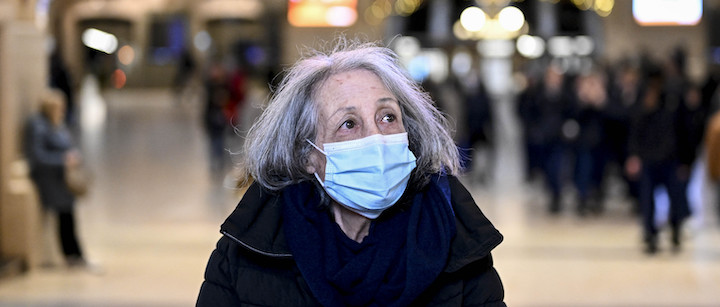
There's ample evidence that masks do a great deal.
https://pmc.ncbi.nlm.nih.gov/articles/PMC7301882/
You can even try a simple experiment to feel the difference a mask makes:
Put your hand about a foot in front of your mouth and exhale as if your doctor had just directed you to. You should feel appreciable airflow reaching your hand. Now put on a mask and do the same again. You'll notice that the airflow reaching your hand is significantly reduced, as it redirects the air out the sides of the mask. And if you move your hands around, you'll notice that the force of air from any direction is significantly reduced.
For airborne diseases, this translates to a significantly lower risk of transmission as the particulate matter that the disease is carried by doesn't have as much momentum and travels a much shorter distance before settling, roughly half the distance for the bulk of the droplets. This appreciably helps lower the rate of infection in the population.
This is not
remotely new information, nor is it controversial.
https://pubmed.ncbi.nlm.nih.gov/3470452/
You're confusing the fact that the issue was settled decades ago and therefore nobody was treating "masks work" as some novel revelation for the claim being untested.
Bluntly, that's rich from you, considering that you have consistently and almost constantly argued that your own unfamiliarity with information conflicting with your preconceptions means that the data does not exist and therefore any conflicting data that is shown to you in the course of conversation must necessarily be dismissible as 'bad data'. For Pete's sake, this isn't even a hard study to find!
https://pubmed.ncbi.nlm.nih.gov/36715243/
Shall I quote it for you?
Mind, the paper was also quick to point out (Author's Conclusions) that the results were necessarily hasty and predicated on studies that unfortunately had compromised results through:
1) Low adherence rates ("Adherence with interventions was low in many studies", compromising the ability to detect a measurable effect)
2) The studies largely being constructed in a way that subjected them to a high chance of bias (And I quote :
"Most included trials were open label, and there were concerns about bias due to non-compliance, loss to follow-up, and selective outcome reporting")
3) Inconsistent measurement and criteria between them. (Including heterogeneity in Outcome Definitions, Mask Types, Populations, and Settings)
Leading to them to directly state that they had - at best - low to moderate confidence in the very results you're quoting. Cochrane presented this as a preliminary result that did more to highlight the lack of robust recent studies than actually evidencing a given conclusion.
Interpreting this as saying 'Cochrane said there’s no evidence masks work' is like concluding 'condoms don’t work' based on a meta-analysis of pregnancy rates in populations where the studies openly admit people weren’t using them consistently or correctly. Much as that conclusion would not be an accurate representation of the condom data, neither is 'Cochrane said there’s no evidence masks work' an accurate representation of this data.
Hence Cochrane's own follow-up which cautioned against exactly the reading that you are making.
https://www.cochrane.org/about-us/n...t-or-reduce-spread-respiratory-viruses-review
To be a lot more direct, the conclusions were that the
quality (or lack thereof) and
capaciousness of the studies they were reviewing rendered their results unreilable and
unable to draw robust conclusions from. Never mind that the underlying studies tested the effectiveness of
interventions encouraging people to wear masks, rather than testing the effectiveness of masks themselves
For further reading see:
https://pmc.ncbi.nlm.nih.gov/articles/PMC10484132/
https://www.gavi.org/vaccineswork/y...reading-covid-despite-review-saying-they-dont
and
People online are touting the results of a Cochrane review to incorrectly claim that it shows masks “don’t work” against the coronavirus. But the primary conclusion of the review is that it’s uncertain from randomized controlled trials whether mask interventions in the community help slow the...

www.factcheck.org