
You just did anyway by rejecting the idea to argue.MASTACHIEFPWN said:You can't make me argue you.

You just did anyway by rejecting the idea to argue.MASTACHIEFPWN said:You can't make me argue you.

I don't think you read my post correctly and I stand by it. *All* situations are affected by chaos at some level (if you include the individual atoms) but that's not really the point. The key thing is that no two circumstances are ever identical and therefore your 'choice' (whatever that means) in one situation can be different from your choice in another seemingly identical situation *despite* being deterministic.Wyes said:I don't think you understand chaos theory...Flatfrog said:For me it amounts to a simple application of chaos theory: there are never two situations that are 'the same' so there is never a meaningful sense in which you 'could have done something different in the same situation'
I never said it was. Chaos is a *feature* of determinism. But the 'kind of free will worth wanting' as Dennett puts it is perfectly possible in a deterministic world.Chaos is not an argument against determinism.

Well, with that clarification I basically agree with you, besides two things; as I've stated, not all systems are chaotic (I think you're over-estimating the ubiquity of chaos to a minor extent), and even in chaotic systems you can have identical circumstances, although it is unlikely. This is why I was trying to clarify things about chaos.Flatfrog said:I don't think you read my post correctly and I stand by it. *All* situations are affected by chaos at some level (if you include the individual atoms) but that's not really the point. The key thing is that no two circumstances are ever identical and therefore your 'choice' (whatever that means) in one situation can be different from your choice in another seemingly identical situation *despite* being deterministic.Wyes said:I don't think you understand chaos theory...Flatfrog said:For me it amounts to a simple application of chaos theory: there are never two situations that are 'the same' so there is never a meaningful sense in which you 'could have done something different in the same situation'
I never said it was. Chaos is a *feature* of determinism. But the 'kind of free will worth wanting' as Dennett puts it is perfectly possible in a deterministic world.Chaos is not an argument against determinism.

Well, of course philosophy is important. I've said that I'm training to be a counselor. This means I've spent a lot of man hours studying psychology - and thus, by extension, philosophy because philosophy basically led to the formation of psychology. I've had to study philosophy much more than your average layman and even much more than your average college graduate, so I know quite a bit about it. The previous response doesn't mean I scoff at philosophy, just that I scoff at the philosophy of determinism. Notice the 'the' in my previous post so as to reference the specific philosophy that we have been discussing. Mind you, I'm referring to hard-line determinism.Wyes said:I have heard it in my physics classes, albeit in passing, because what a can of worms.GrinningCat said:I've only ever heard of it as a philosophical position and I've not heard any mention of it in any of my science classes. Whether it is or is not a property of the universe is still going to be a question heavily involved in philosophy, no matter how close you can get it to physics, which, unless it can be empirically proven, I'll always turn my nose upwards at the idea of it. If it can be empirically proven, however, and goes through peer review and meta-analysis, then I'd be forced to accept it.
Until then, I will always scoff at the philosophy.
And I cannot say whether or not it can or cannot be empirically 'proven' (established might be a better word). And, while to an extent I agree that without empirical evidence I'm not inclined to think something's true, philosophy still guides science (where do you think empiricism comes from?) and is a worthwhile field, particularly formal logic.
Regardless, I will not claim to know whether or not determinism is a property of the universe. I will however continue to point out bad arguments, one way or another.
Forgive me, I did miss the 'the'.GrinningCat said:Well, of course philosophy is important. I've said that I'm training to be a counselor. This means I've spent a lot of man hours studying psychology - and thus, by extension, philosophy because philosophy basically led to the formation of psychology. I've had to study philosophy much more than your average layman and even much more than your average college graduate, so I know quite a bit about it. The previous response doesn't mean I scoff at philosophy, just that I scoff at the philosophy of determinism. Notice the 'the' in my previous post so as to reference the specific philosophy that we have been discussing. Mind you, I'm referring to hard-line determinism.
I've already conceded the point of reality not being determined by our desires by admitting that if I saw scientific evidence that was empirically supported with peer review (and meta-analysis, if we wanted to go a step further), that I would accept it. However, the only reality that which is objective is that which science has been able to deem as fact through scientific study, support, review, and analysis. That is the only truth. That is the only reality. Everything else is subjective and so I've not committed any sin of desire which you need to keep pointing out.Wyes said:Forgive me, I did miss the 'the'.GrinningCat said:Well, of course philosophy is important. I've said that I'm training to be a counselor. This means I've spent a lot of man hours studying psychology - and thus, by extension, philosophy because philosophy basically led to the formation of psychology. I've had to study philosophy much more than your average layman and even much more than your average college graduate, so I know quite a bit about it. The previous response doesn't mean I scoff at philosophy, just that I scoff at the philosophy of determinism. Notice the 'the' in my previous post so as to reference the specific philosophy that we have been discussing. Mind you, I'm referring to hard-line determinism.
My point does stand about the nature of reality not being determined by our desires though. Also, even if I knew determinism were a property of the universe, I still wouldn't act like it was in my day-to-day life.
But, "hard-line determinism" (I tend to refer to it as classical determinism because of the link with classical physics) did kind of die with the maturing of quantum mechanics, when it became obvious that there were no 'hidden variables' and there are truly random processes.
Although this doesn't rule out 'probabilistic determinism' (which is basically that the Schrodinger equation is deterministic in time, so you can always give the likelihood of an event occurring which does have predictive power), although on the human scale we're more likely to see it behaving closer to classical determinism, due to decoherence.
Sorry, wasn't trying to harp on about the desire thing, was just reiterating my original point.GrinningCat said:I've already conceded the point of reality not being determined by our desires by admitting that if I saw scientific evidence that was empirically supported with peer review (and meta-analysis, if we wanted to go a step further), that I would accept it. However, the only reality that which is objective is that which science has been able to deem as fact through scientific study, support, review, and analysis. That is the only truth. That is the only reality. Everything else is subjective and so I've not committed any sin of desire which you need to keep pointing out.
Forgive me for ignoring the rest as it's 6 in the morning and that's not really the time to be getting into the nitty and gritty with philosophy.

True. Maybe I should have split this particular hair a bit more carefully. While we are part of the system and cannot get any outside perspective, the best (and only) real evidence we have would indicate that free will exists. Once you start down the path of "we are part of the system and cannot observe it," it quickly becomes impossible/incredibly difficult to make any observations about human cognition in an objective way.Wyes said:I agreed with most of your post, but I'd just like to point out that this is not evidence of free will. Part of the problem with arguing about free will is that we are part of the system. All of these actions can occur without free will.Naeo said:That being said, in the absence of any hard evidence either way, it seems most reasonable that free will exists in some form based on human experience. We can think and weigh options. We have indecisive moments, where we are unsure of things and must find our way to one option or another. We appear, empirically, to have free will. There is nothing to suggest, except in the realms of "maybe" and "what if" and fanciful interpretations, that free will is completely illusory. Ergo, on the basis of empirical/observational experience and the absence of any form of equivalently meaningful counterevidence, it's a safe assumption that we have free will.


That quote alone does not. His essay "On the Freedom of the Will" does.Realitycrash said:His 'will' is more about a reoccurring current of urges through a human being, it doesn't mean that he doesn't believe in Free Will.Hagi said:I like Schopenhauer on this topic:
Man can do what he wills but he cannot will what he wills.
Take from that what you will. As others have noted, free will doesn't really have any meaningful definition so it's kinda useless to argue about it.
OT: Asa I have said before, arguing for or against Free Will is pointless and Academic. Either we have Free Will, and everything is fine, or we do not, and then we will continue to act as we will. Even if we were to 'disprove' Free Will, then people won't accept it. People feel free. Our justice system and system of morality is dependent on Free Will, so any 'disproof' will just be ignored.
Yeah, but I wasn't saying that I wasn't going to argue that, I was just using that as a theoritical defense.MorphingDragon said:You just did anyway by rejecting the idea to argue.MASTACHIEFPWN said:You can't make me argue you.

You "can"? That also implies choice. You either do because you couldn't not have it, or you don't, because your own workings are predetermined that way.Dijkstra said:In a world without choice 'idiot' does not imply actual choice, it implies on who outputs bad information due to some property they have. You can still have scorn for a machine that produces bad results
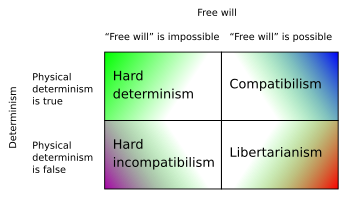
That's why I'm talking about "hard determinism" and "compatibilism"; since they both assume physical determinism.Dijkstra said:Cute but you're trying too hard tomake accusations of hypocrisy. It does not imply choice, it implies possibility. Furthermore you mistakenly assume a lack of free will requires predetermination. Even if we assume a lack of determinism we do not automatically claim rocks have free will. A lack of causal determinism is not thr same as free will.
With hard determinism in effect, that's not up to a conscious choice on my part, and if the particles in your brain are moving in a certain pattern you know that. And if they aren't, then you don't.Further don't try and play ignorant, even assuming determinism your interpretation is shitty. Not being omniscient I will of course not speak in absolutes. So I will say 'can'. Maybe instead of trying too hard for cheap shots you can consider the actual point
Naeo said:True. Maybe I should have split this particular hair a bit more carefully. While we are part of the system and cannot get any outside perspective, the best (and only) real evidence we have would indicate that free will exists. Once you start down the path of "we are part of the system and cannot observe it," it quickly becomes impossible/incredibly difficult to make any observations about human cognition in an objective way.

That Jack is a signature. I'm Jack. That quote is from John and Hank Green. But I love it.FalloutJack said:Could you tell me which Jack said this? It wasn't me, but it sounds like something I'd say. Who said it?AperioContra said:Don't Forget To Be Awesome (DFTBA) - Jack.

*Dofs helmet*AperioContra said:That Jack is a signature. I'm Jack. That quote is from John and Hank Green. But I love it.FalloutJack said:Could you tell me which Jack said this? It wasn't me, but it sounds like something I'd say. Who said it?AperioContra said:Don't Forget To Be Awesome (DFTBA) - Jack.
DFTBA
Jack