Das Paradox

Recommended Videos

Steve Butts

New member
Jun 1, 2010
1,003
0
0
MysteriousStranger said:
Paradox. par·a·dox/ˈparəˌdäks/: "A statement or proposition that, despite sound (or apparently sound) reasoning from acceptable premises, leads to a conclusion that seems senseless, logically unacceptable, or self-contradictory."
There's a lot of talk about Zeno's Paradoxes but many people miss the point of them.

They're meant to be taken as a group and show the errors of two competing views of reality. The point in question was whether or not magnitudes of space or time were infinitely divisible or not. In other words, could you get down to a distance or moment so small that there is no room to divide it further? It was, apparently, a hot topic in Ancient Greece. The Paradox is not any one of Zeno's individual arguments, but rather the collection of seemingly contradictory mathematical propositions.

Those who said magnitudes are infinitely divisible had to contend with Zeno's argument about Achilles and the Tortoise. If you keep dividing time and distance, Zeno claims, Achilles never catches up. Therefore, magnitudes can't be infinitely divisible. But if magnitudes are not infinitely divisible, how does the arrow move? If the arrow can't be between the two smallest increments of time or space, then it must be warping between them. But if it's not warping from A to B, then time and space must be infinitely divisible. Which brings you back to Achilles. Zeno's Paradoxes were an attempt to refute this either/or definition of reality.

The problem was that the ancients had no mathematical value for infinity, which is the key to reconciling the contradictions. Aristotle came close to figuring it all out, but we ultimately had to wait until the fairly recent discovery of calculus and the repeating decimal before we were able to crack this problem.

 

Ranorak

Tamer of the Coffee mug!
Feb 17, 2010
1,946
0
41
Lizardon said:
I'm not sure if this counts as a paradox or not, but it's an interesting thought

Lets say you have a boat. As parts of the boat wear out, you replace them with new parts. Eventually, you have replaced every part of the boat. Is it still the same boat?
Better yet.
your body now doesn't have any of the molecules left from when you were born.
Are you still you?
 

redisforever

New member
Oct 5, 2009
2,157
0
0
artanis_neravar said:
As for a paradox, you are standing ten feet away from your goal, with every step you take you cover half the remaining distance.
Yeah, you'll never get there, because the distance would never be 0.
 

universaltraveller

New member
Apr 28, 2011
98
0
0
I'm so GLaD i joined this site today, I didn't think there would be a paradox discussion here, and thanks to Portal 2 for starting all this.

As for my favorite paradox, it's Olbers Paradox, 'Why is the night sky dark, if the universe is infinite?' Even though this does have an answer, I love all the physics it took too get there.

Also has anyone read about how quantum computers work, and how, if you try to measure the workings of the computer it simply crashes?

*edit*

Oh and I forgot, I also love the Gandfather paradox, and all the time related ones. Has anyone ever seen the film Timecrimes? Also I'm gussing people have seen Twelve Monkeys.
 

ShakyFiend

New member
Jun 10, 2009
540
0
0
Ever[/b]]Blue Eyes:
The Hardest Logic Puzzle in the World

A group of people with assorted eye colors live on an island. They are all perfect logicians -- if a conclusion can be logically deduced, they will do it instantly. No one knows the color of their eyes. Every night at midnight, a ferry stops at the island. Any islanders who have figured out the color of their own eyes then leave the island, and the rest stay. Everyone can see everyone else at all times and keeps a count of the number of people they see with each eye color (excluding themselves), but they cannot otherwise communicate. Everyone on the island knows all the rules in this paragraph.

On this island there are 100 blue-eyed people, 100 brown-eyed people, and the Guru (she happens to have green eyes). So any given blue-eyed person can see 100 people with brown eyes and 99 people with blue eyes (and one with green), but that does not tell him his own eye color; as far as he knows the totals could be 101 brown and 99 blue. Or 100 brown, 99 blue, and he could have red eyes.

The Guru is allowed to speak once (let's say at noon), on one day in all their endless years on the island. Standing before the islanders, she says the following:

"I can see someone who has blue eyes."

Who leaves the island, and on what night?


There are no mirrors or reflecting surfaces, nothing dumb. It is not a trick question, and the answer is logical. It doesn't depend on tricky wording or anyone lying or guessing, and it doesn't involve people doing something silly like creating a sign language or doing genetics. The Guru is not making eye contact with anyone in particular; she's simply saying "I count at least one blue-eyed person on this island who isn't me."

And lastly, the answer is not "no one leaves."

I've done my best to make the wording as precise and unambiguious as possible (after working through the explanation with many people), but if you're confused about anything, please let me know. A word of warning: The answer is not simple. This is an exercise in serious logic, not a lateral thinking riddle. There is not a quick-and-easy answer, and really understanding it takes some effort.

Nicked this from my avatar, not strictly on topic I know but its on the general theme, if anyone can answer it without looking up the answer I will be incredibly impressed.

Also I've always loved the Euripides paradox, mainly cos I was thinking one day, came to the same conclusions myself, and only discovered it was actually a 'thing' many years later.
 

Shadow Geo

New member
Mar 24, 2011
63
0
0
This... statement... is... false!!!!
*don't think about it, don't think about it, don't think about it...*
 

ManOwaRrior

New member
Apr 12, 2011
58
0
0
SextusMaximus said:
georgesell123 said:
Can omni-potent god (an all powerful god) create a stone which he cannot lift.

If he can't create it then he isn't all powerful.

If he creates it but then is unable to lift it he still isn't all powerful.
Not a paradox, you just prooved the lack of existence of an Omni-potent God.
No, an omni-potent God could still exist, he would be able to defy logic.
So he could in fact create this stone. And he could still lift it. While this would be logically impossible, if he is omni-potent, he can do it regardless.
 

ipop@you

New member
Oct 3, 2008
189
0
0
The Unworthy Gentleman said:
ipop@you said:
Well I like the old going back in time with a purpose thing. If you go back in time to let's say kill Hitler then you go back and shoot him but then in your time he is already dead so there is no reason to come back and kill him so you don't go, but if you don't go then he is still alive so you have a reason to go and kill him and the cycle starts again.
Only if you go back with the intention of killing him. If you were travelling past Hitler in your car and your car spontaneously combusted killing Hitler then you would be caught in an endless loop of going back in time and accidentally killing Hitler, it would become History and nobody would know any different. Unless I've made a mistake in my thought over this.
Good point, hence why I said the travelling with a purpose thing.
 

SextusMaximus

Nightingale Assassin
May 20, 2009
3,506
0
0
ManOwaRrior said:
SextusMaximus said:
georgesell123 said:
Can omni-potent god (an all powerful god) create a stone which he cannot lift.

If he can't create it then he isn't all powerful.

If he creates it but then is unable to lift it he still isn't all powerful.
Not a paradox, you just prooved the lack of existence of an Omni-potent God.
No, an omni-potent God could still exist, he would be able to defy logic.
So he could in fact create this stone. And he could still lift it. While this would be logically impossible, if he is omni-potent, he can do it regardless.
No, it just means an Omni Potent God wouldn't exist because it would defy logic.
 

Hosker

New member
Aug 13, 2010
1,177
0
0
SextusMaximus said:
Hosker said:
Halceon said:
Hosker said:
I think this is called Curry's paradox:

If this statement is true, then Santa Claus exists.

It can be used to prove anything.
And what if it isn't true? Not much of a proof, is it?
It's irrelevant what the second phrase refers to. Wikipedia can explain it much better than I can: http://en.wikipedia.org/wiki/Curry's_paradox
I just exploded with laughter cause you linked to the Wiki article on curry.

OT: I always lie.
Damn links, not doing as they're told!
 

Judgement101

New member
Mar 29, 2010
4,156
0
0
Zeno's Paradox is a thing?! I always thought it was just a cheat code for Age of Mythology.....

OT:The sword that breaks all against the shield that cannot be peirced.
 

SextusMaximus

Nightingale Assassin
May 20, 2009
3,506
0
0
Hosker said:
SextusMaximus said:
Hosker said:
Halceon said:
Hosker said:
I think this is called Curry's paradox:

If this statement is true, then Santa Claus exists.

It can be used to prove anything.
And what if it isn't true? Not much of a proof, is it?
It's irrelevant what the second phrase refers to. Wikipedia can explain it much better than I can: http://en.wikipedia.org/wiki/Curry's_paradox
I just exploded with laughter cause you linked to the Wiki article on curry.

OT: I always lie.
Damn links, not doing as they're told!
Gave me a good giggle anyhow!
 
Mar 9, 2010
2,722
0
0
ipop@you said:
The Unworthy Gentleman said:
ipop@you said:
Well I like the old going back in time with a purpose thing. If you go back in time to let's say kill Hitler then you go back and shoot him but then in your time he is already dead so there is no reason to come back and kill him so you don't go, but if you don't go then he is still alive so you have a reason to go and kill him and the cycle starts again.
Only if you go back with the intention of killing him. If you were travelling past Hitler in your car and your car spontaneously combusted killing Hitler then you would be caught in an endless loop of going back in time and accidentally killing Hitler, it would become History and nobody would know any different. Unless I've made a mistake in my thought over this.
Good point, hence why I said the travelling with a purpose thing.
Shit, I missed that bit. And there I was, thinking I was all smart.
 

Death God

New member
Jul 6, 2010
1,751
0
0
HankMan said:
The following statement is true
The previous statement is false
PARADOX!
Dr Jones said:
Trippy Turtle said:
i like paradoxes that involve time.
WHAT HAVE YOU DONE SNAKE?! YOU'VE CAUSED A TIME PARADOX!

ps. i've got a time paradox. Say you travel back in time to before you were born and killed your grandfather. Logically he'd be dead and you would never have been born. But now, if you were never born, then how was the grandfather killed? He was killed by you, but since you were never born he should be perfectly fine...

TIME PARADOX
<youtube=rXU-ZdmzNmo>
You, sir, have raped my brain with that song!

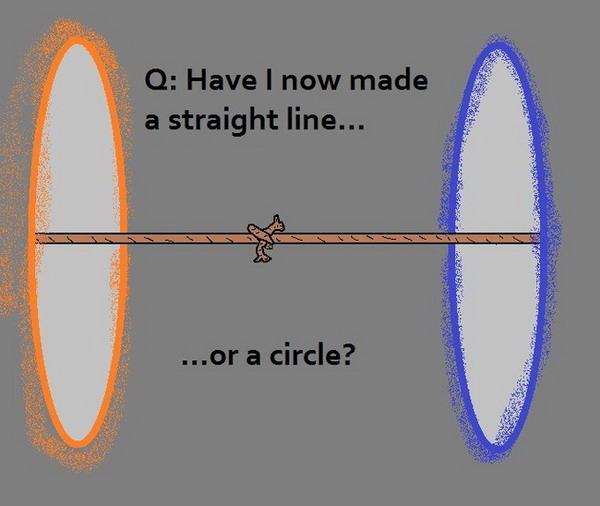
OT: Since we are talking about Portal, my favorite paradox is this:
 

Nieroshai

New member
Aug 20, 2009
2,940
0
0
The first paradox is only true in a digital world. In fact, the object can NEVER come to rest and will never BE at a state of rest because there is always a force acting upon it. "rest" to us is relative, the APPARENT lack of motion as observed to our eyes. Rest is the paradox, everything is in constant motion.
 

Lyx

New member
Sep 19, 2010
457
0
0
Solution: There is no such thing as "a point in time". It is simply a theoretical invention, that 1. is used to deny interaction, and 2. is a necessary evil of how our thought structures work: To define a range/area, we need to define where that range/area begins and ends... so, boundaries.... the problem is that those boundaries do not really exist, and are simply an arbitrary aspect of the process of "defining ranges/areas".

Yup, i have just proven the premises of the concept of the atom/particle false and untrue. Then again, did anyone really believe that a mathematical point is anything more than an idea? Yes? Oh dear.....

As for the "at rest"-thingie.... that concept is only true if it is treated as a comparison of interactions - so, an *active* relationship. When you think of something being at rest, you should compare movements... so, interactions - ranges, not "points in time".
 

Condor219

New member
Sep 14, 2010
491
0
0
ShakyFiend said:
Blue Eyes:
The Hardest Logic Puzzle in the World

A group of people with assorted eye colors live on an island. They are all perfect logicians -- if a conclusion can be logically deduced, they will do it instantly. No one knows the color of their eyes. Every night at midnight, a ferry stops at the island. Any islanders who have figured out the color of their own eyes then leave the island, and the rest stay. Everyone can see everyone else at all times and keeps a count of the number of people they see with each eye color (excluding themselves), but they cannot otherwise communicate. Everyone on the island knows all the rules in this paragraph.

On this island there are 100 blue-eyed people, 100 brown-eyed people, and the Guru (she happens to have green eyes). So any given blue-eyed person can see 100 people with brown eyes and 99 people with blue eyes (and one with green), but that does not tell him his own eye color; as far as he knows the totals could be 101 brown and 99 blue. Or 100 brown, 99 blue, and he could have red eyes.

The Guru is allowed to speak once (let's say at noon), on one day in all their endless years on the island. Standing before the islanders, she says the following:

"I can see someone who has blue eyes."

Who leaves the island, and on what night?


There are no mirrors or reflecting surfaces, nothing dumb. It is not a trick question, and the answer is logical. It doesn't depend on tricky wording or anyone lying or guessing, and it doesn't involve people doing something silly like creating a sign language or doing genetics. The Guru is not making eye contact with anyone in particular; she's simply saying "I count at least one blue-eyed person on this island who isn't me."

And lastly, the answer is not "no one leaves."

I've done my best to make the wording as precise and unambiguious as possible (after working through the explanation with many people), but if you're confused about anything, please let me know. A word of warning: The answer is not simple. This is an exercise in serious logic, not a lateral thinking riddle. There is not a quick-and-easy answer, and really understanding it takes some effort.
Nicked this from my avatar, not strictly on topic I know but its on the general theme, if anyone can answer it without looking up the answer I will be incredibly impressed.

Also I've always loved the Euripides paradox, mainly cos I was thinking one day, came to the same conclusions myself, and only discovered it was actually a 'thing' many years later.
I got real dang close. I didn't consider the logic of the browns would be applied in the same way, which would lead the browns to false information. But I figure it's a pretty good effort, considering basically the whole process was in line.
Spoilered so other people can give it a try.
All of the blues leave on that night. No other person leaves, they just know that their eyes aren't blue.
Alright, so nobody on the island can deduce their own eye color, but each blue (let's call this specific guy Bob) knows that there are 99 blues, and 100 browns, with his eye color being an unknown factor. Then, he knows that another blue can determine that there are 98 blues on the island, and 100 browns, with the unknown factors being Bob's eye color and this other blue's eye color (call him Terry). Bob figures that Terry will also make this deductive statement, coming to the conclusion that Terry's eyes are an unknown factor, some other blue knows his respective eyes are an unknown factor. Through that, Bob can determine that this blue knows for sure that there are at least 97 blues on the island, and 100 browns. From this, Bob can go through that same process all the way down to 0 (considering his knowledge started at 99 + unknown factor, then decreased to 98 + 2 unknown factors at the 99th blue, etc). Bob then knows, that the final person who's making this logical statement (knowing that everyone's sense of logic will go down this road) can in fact be Bob himself, considering his logical process is identical to all the other blues. So, Bob can deduce that there are at least 0 blues, and 100 browns. Considering there are 101 people left, 100 of them definitavely brown, Bob can figure out that his eyes are blue in order to satisfy the Guru's statement.

Bob also knows that every blue will also go through this process, and determine their true eye color, and they will all leave that night.