Education: No Zero Grading Policy Opinions

Recommended Videos

Ryotknife

New member
Oct 15, 2011
1,684
0
0
rasputin0009 said:
No Zero Grading Policy is essentially an education grading system that does not give zeroes for not handing in assignments. Instead, they are given multiple opportunities to hand in completed schoolwork, and are graded upon knowledge of the subject.

As I understand, Nordic European countries (like Norway) have been using this systems with great success. They are world leaders when it comes to teaching children.

On the opposite side, there's America's standard for giving zeroes and F's for unfinished work. They aren't even close to the top when it comes to education in First-World countries.
....are you sure that is the standard now?

I mean, sure it was like that when I went to school, but from what I hear from my sister who is a teacher they are not allowed to use red pens to mark up papers because "it is too traumatizing." If red pens are traumatizing, I can only imagine what a zero would be.

The education system in the US has changed drastically in the past 5-10 years, and not for the better. Not in the least.

As for the actual policy in question, it is really hard to recover from a zero. Sometimes there is a reason for being tardy or sometimes people make mistakes and forget. Adding a stiff penalty to a late assignment seems good enough. I know I personally suffered from an incident where I went from an A+ to C- because I was late (12 hours late to be exact, I had the time down wrong)

 

Ihateregistering1

New member
Mar 30, 2011
2,034
0
0
For starters, I wouldn't advise simply comparing two or more country's educational outcomes with something as simple as whether they have a "no zero grading policy" or not, because there are many, many factors that determine why some countries fall so far behind and others lead the pack. That being said:

"No Zero Grading Policy is essentially an education grading system that does not give zeroes for not handing in assignments. Instead, they are given multiple opportunities to hand in completed schoolwork, and are graded upon knowledge of the subject."

Sorry, but I think it's an awful idea. When you get into the real world, whether you work for a business, the Government, or even if you run your own company, deadlines are a fact of life. If your Boss tells you to get a budget report to them on Wednesday, you don't get to come in Thursday morning and say "well I know I didn't get it in to you like you asked, but I know the budget details really well!". An ability to follow simple instructions is necessary in many aspects of life, and very much so in the job world.

That being said, I think it should be the individual teacher's policy to determine how they want to handle late assignments. I had teachers who took off 10 points a day for every day it was late, and I had teachers who, if it wasn't in by the end of class, it was an automatic zero. But again, in the real world, you're going to have superiors with different expectations and standards, and preparing you for things like that is part of what school is all about.
 

lacktheknack

Je suis joined jewels.
Jan 19, 2009
19,305
0
0
Western Canada here.

All I know is that a local teacher was fired for giving a student a zero because the student handed in an assignment with literally no correct answers.

In my mind, this makes the system a horrible parody of itself.

Then the teacher was rehired at a different local school that does allow zeroes. Interestingly, not only was he hired with better pay, the school he was rehired at was ranked higher than the first one.

You also say that school isn't supposed to teach behavior... I call BS. School is supposed to help you succeed, and if you need to adjust your behavior to fit into the current system, so be it. A school that gives you a zero and fails you for not following instructions is a school that reflects reality.
 

Yopaz

Sarcastic overlord
Jun 3, 2009
6,087
0
0
CriticKitten said:
As someone who teaches in the United States, I will say that you're comparing two systems and countries that are not comparable. I allow students to make up work across the entire grading period, as well as retakes on quizzes and tests, and I *still* have a high rate of failure at my school because students simply can't be arsed to make up the work.

This is part of the problem with folks pointing to other countries and saying "it's their policies that make them learn". No, it's not. It's the culture.
Mind if I chime in here? No response? OK, I'll take that as a yes (I am joking here of course).

I agree completely with this. We treat education as it is a sound science, but it's not. You say we can't compare the US system to the Nordic system and I think you're right, but I would say the same apply to the system at different schools. I've been to several different schools and the way things are organized is very different from school to school. Even 2 classes can't be accurately compared. To be a good teacher you have to be flexible and prepared.


I also don't think using Norway as an example is good, we're not really great.

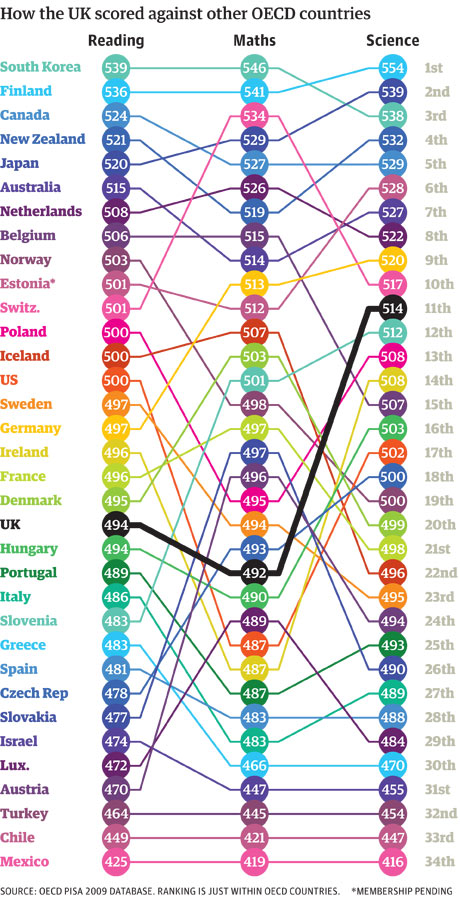
These results are a little outdated, but I don't think I can legally show the results that are being released this year, but bear with me.

We rank as #9 in reading, but as we can see, we're only ahead of USA by a hair in terms of points as for maths and science we're doing quite poorly while USA is actually handling science better than us.

From what we can see Finland is amazing at what they do ranking second in reading and maths and first in science. You'd think they are on top of the world and being quite proud of what they accomplish. They are not. They want to crack the code behind the Norwegian system because of the social structures.

We shouldn't make comparisons because each class is a new challenge. Great teachers with great policies can have failing students.

I do think we shouldn't give grades from the start though since that puts a lot of pressure on the kids at an early age. We should also be careful when it comes to segregating students based on performances. I managed to go from failing grades to top of the class in a year.
 

Zeldias

New member
Oct 5, 2011
282
0
0
Grading is pretty pointless, and I've found the skillset necessary to be an A student frequently has less to do with actual knowledge and more to do with time management and the ability to ferret out what will be acceptable and what isn't.

Schooling is important, but grading itself is just trying to quantify a process that is necessarily qualitative in nature. In addition to that, the grades override the actual information and learning process. Have y'all seen the way most student learn how to navigate and regurgitate with little to no understanding? I used to teach. It's nuts.

The only thing grading does is damage the learning process and inflict psychological harm. I skipped a grade as a kid, and wound up having trouble with math. Since I frequently got Fs, I decided I was bad at math, and that I hated it, which of course creates a self-fulfilling prophecy. Then I started playing DnD, and realized that algebra is actually incredibly simple. This little anecdote isn't to say that everyone can be good at everything, but I certainly think I would've been a better math student if the educational system I was in didn't use grades as a way to gauge and praise. If I was allowed to fail and go back over it and work it out and try again, it's a lot more likely that I would've done better. But don't we already know by now that regurgitation-based tests don't actually breed learning? I thought we figured this out at the same time everyone figured out that the IQ test is racist and limited in nature.

I don't really like the idea of students getting away with not turning in anything, because part of learning is trying and fucking it up, but I am against the idea of punishing that same process.
 

FalloutJack

Bah weep grah nah neep ninny bom
Nov 20, 2008
15,485
0
0
rasputin0009 said:
So I have a few questions for you:
1. What did you grow up with? (And where?)
2. What do you think of the no zero policy?
3. What do you think is wrong with the policy?
and 4. What do you think is right with the policy?
I feel that it's not as simple as pointing fingers at the grading system. Please, by all means, lay the blame in the other territories that are relevent: Bad teachers and knucklebrain students. They're there, and they need to be both prodded out of complacency and given proper attention. Now then...questions.

{1} I like in the U.S., thus they give zeroes for incomplete work here.

{2} Look, it's harsh, but I think you're also seeing it a bit black-and-white. I have had a few instances where the darn thing couldn't be completed as per deadline for various circumstances. In my case, it wasn't laziness because I have a decent work ethic. I was able to make the stuff up here. Some teachers understand, and some are assholes. HOWEVER, the people with oatmeal brains who can't complete their assignments and even balk at learning? Screw them. They deserve the shame. You have to embarass the lazy into doing what's expected of them because (suffice to say), we're not Norway. First World lifestyle makes people too comfee sometimes, and that means the brains aren't as stimulated as they should be.

{3} Probably the teachers who are assholes to their students. They don't do their job properly and at some point, you have to stop making excuses for them. If you let them put garbage in, you will only get garbage out, and their grading is shit. That's why colleges have little professor evaluations, to make sure the students don't think their instructor's an idiot.

{4} I think Answer #2 covers that point.
 

Trueflame

New member
Apr 16, 2013
111
0
0
The American education system is complete and utter shit, and that is no exaggeration. But I think giving zeroes for late assignments, dropping a letter grade for each day it is late, or other forms of incentivizing timely completion are important in preparing children for life after school, where they will face deadlines, schedules, and responsibilities that simply can't be put off. It's one of the few ways in which schools here in the US actually do prepare kids for their future.
 

Eddie the head

New member
Feb 22, 2012
2,324
0
0
krazykidd said:
What . The . Fuck . Seriously . If you don't do your work , or don't hand it in on time ( without a valid reason)you should get a 0. Why are we teaching kids it's okay to not so shit? What's going to happen when they at work and don't hand in their report on time? School is suppse to prepare you for real life.
Yeah because at my work if I had to do something and I didn't do it on time they just wouldn't accept it after that. No wait they would still expect me to do my my job, there might be a consequence for not doing it on time or doing it right, but they still want me to do it.
 

shootthebandit

New member
May 20, 2009
3,865
0
0
DANGER- MUST SILENCE said:
From my experience at school i can without a shadow of a doubt that the kids who "done well academically" at age 14 have now gone on to university whereas the others are now in some sort of unskilled employment or unemployed. There are only a few exceptions (such as myself) that were inbetween being academic and being vocational

My cast system is a reflection of the current system but the difference is EVERYONE gets a better education and NOONE leaves school empty handed. In supplement to my cast system adult learning needs to play a huge role. If someone went down the vocational route they can then go on to study academically once they are older and wiser (part time or full time) or if someone went down the academic route and at any point decided they didnt like it or couldnt handle the work then there should be a transition in place for people like this to enter the vocational path later on in life

You said that apprenticeships are awesome. Well this is simply an early entry apprenticship which gives children a practical real-world skillset meaning they can walk into a job in that field (or possibly multiple fields with little to no OJT (on job training) required. This means employers will benefit from the system too especially small local garages and builders (just a few of many examples) who otherwise wouldnt consider hiring and training a school leaver

You say cast system as if there is some sort of stigma behind the "working" class. This is not the case, both systems provide a different form of training that doesnt make one system "better" than the other. The reason i say "academically bright" is because i think it would be unfair putting someone through an academic system that inevitably they arent going to succeed in. This also means that both academic and vocational class sizes are halved meaning the teacher to student ration doubles (thus improving the quality of learning)

As i mentioned before there needs to be a bigger focus on adult learning (school isnt the be all and end all) and there also needs to be a bigger focus on vocational learning. The stigma behind both of these types of schooling needs to change. Someone who does a vocational course shouldnt be percieved as a "high school drop out" and adult learning shouldnt be perceived as "30 year old illiterate"
 

Seydaman

New member
Nov 21, 2008
2,493
0
0
1. What did you grow up with? (And where?)
I grew up with the zero grading, in New England, Massachusetts. I attended public school up until grade ten (I dropped after the first semester), before attending a therapeutic school for grades eleven and twelve.

2. What do you think of the no zero policy?
On one hand, I can see how it would reduce anxiety and focus more on the actual knowledge attained. However, part of education is learning to function with things like deadlines which are all too real everywhere else. You can't stall on a project because it needs to be done right now.

However, you said that Nordic countries have great success in their education, so, it would seem that the positive effects of the system outweigh the potential negatives, in so far as I can tell.

3. What do you think is wrong with the policy?
I feel that allowing someone to not do something isn't a great way to prepare them for life where they more or less will have to do shit that they hate or find extremely challenging.

4. What do you think is right with the policy?
I like how it focuses on the actual knowledge and not meeting deadlines.

I'd probably support a gradual introduction of this policy into the American education system, and observe how it affects us. If it shows positive results, make it a standard.
 

Seydaman

New member
Nov 21, 2008
2,493
0
0
amaranth_dru said:
Also teachers don't get paid enough to care and I feel strongly that the other side of that issue is the whole "tenure" thing where a teacher can work x-amount of years and basically become un-fireable because of "tenure" allowing the teacher to fuck-off and collect a paycheck. I still think teachers should be paid by both experience and merit, not just simply years in the trenches.
There's a lot more wrong with the education system, but a way to start off is by allowing teachers to explore different methods of getting students interested in their education rather than forcing them to work by "standards" that hold some students back thereby bringing the education system down.
State standards are often enforced due to an issue early on in the education system wherein a student would get an uneven education. Teachers would focus on varying areas so that two students in two different towns could have radically different educations.

For example, student A could do advanced calculus and program, but couldn't tell you anything about history. Student B was writing masterful essays and poetry, but couldn't solve an algebra problem to save their life. So we introduced standards (Things like state testing)

I agree about paying teachers more. Seriously, put them on the same pay level as lawyers and doctors, make the people who shape our future actually paid for that importance. Do you know how much college professors get in relation to grade school teachers?
 

krazykidd

New member
Mar 22, 2008
6,097
0
0
Eddie the head said:
krazykidd said:
What . The . Fuck . Seriously . If you don't do your work , or don't hand it in on time ( without a valid reason)you should get a 0. Why are we teaching kids it's okay to not so shit? What's going to happen when they at work and don't hand in their report on time? School is suppse to prepare you for real life.
Yeah because at my work if I had to do something and I didn't do it on time they just wouldn't accept it after that. No wait they would still expect me to do my my job, there might be a consequence for not doing it on time or doing it right, but they still want me to do it.
You'd get fired , and deserve it . If i'm paying you to do a job , and you don't do it , why would i keep you?
 

shootthebandit

New member
May 20, 2009
3,865
0
0
DANGER- MUST SILENCE said:
I agree with you but that last thing you want to do is put someone down track A when they are inevitably going to fail then end on track B anyway. I wouldnt recommend sending someone with basic literary and numerary skills to go to university

I think we should be able to choose within reason. Perhaps if students at this point were taken aside for a one to one interview in which recommends a path for them but doesnt choose a path for them

You said while a doctor earns more than a builder there will always be "stigma" sure we use money to value someones worth but a builder is still a respectable trade. There are professions such as corrupt bankers and "ambulance chasing" lawyers that are well paid but socially have little respect. What about policeman and fireman (who often have another job on the side) who earn little yet are still respected. Your average army private is probably the most underpaid job globally yet one of the most respected
 

Saltyk

Sane among the insane.
Sep 12, 2010
16,755
0
0
Okay, maybe it's because I'm an uncouth and ignorant American, but why wouldn't you give students a zero for not turning in an assignment? Now, I understand if you have too much work (I regularly went home in high school with 3 or four books easily making my backpack feel like lead weight) and something has to give. But you shouldn't be turning in every assignment late.

Anyway, I'll answer the questions.

1. What did you grow up with? (And where?)
As I said, I'm an American. I live in the Southeast US, actually. And In my experience, you could get zeroes on any assignment. Now, teachers usually allowed you to turn in late if you had a valid reason. Such as you were sick. And you could make up quizzes and tests after school. I've never felt my teachers were unreasonable.

2. What do you think of the no zero policy?
It sounds stupid. That should be up to the teacher and the student. You're basically saying that you can be lazy and not do you work and be rewarded, or at least not punished, for it. Try that at work.

I've also heard of another extreme. Teachers with a "No A" policy. A policy that no work was worthy of an A. And even teachers with policies of "only one A and two B's per assignment" for a class. Those policies sound horrible to me. Admittedly I heard about them as college courses from specific professors.

I see these policies as opposite extremes on the scale. And they are all equally bad policies.

3. What do you think is wrong with the policy?
As I said. It rewards, or refuses to punish, people for being lazy and not doing their work. Now, I am a lazy person, but I will always turn in my work or do my job. Not doing that will only result in utter failure (I'm actually pretty hard working at my job, just lazy at doing things I don't want to do).

Plus, I fear for a teacher getting a deluge of late assignments in at the last minute from students who did all that late work the night before.

But what's really annoying is that it undermines the students who actually did the assignment and turned it in on time. Like they were supposed to. Doing things the right way, offers no benefit. This isn't about grading ability. It's teaching students that not doing you work has consequences.

4. What do you think is right with the policy?
Nothing. It's all wrong. It's a bad policy. There shouldn't be a policy that forces teachers to accept an assignment no matter how late it is. It ties the teachers hands. I'd compare it to mandatory sentences for drug offenses.
 

Raikas

New member
Sep 4, 2012
640
0
0
DANGER- MUST SILENCE said:
Then why use grades as a barrier at all? It serves absolutely zero purpose. Let people enter the track they want to enter.
But if they end up dropping down to a lower track within 6 months (presumably because of performance, so it's still about test scores), where's the difference?

It must be voluntary. There is simply no advantage to imposing on students what future they are allowed to pursue. It doesn't benefit students, it doesn't benefit teachers, and it doesn't benefit society.
But how does it benefit teachers to have students failing their classes?

I live in Canada (Ontario), and secondary schools here have different tracks (academic and applied), because people have different levels of ability - in general you need academic credits to go to university (although some arts programs take people with mixed track credits), but you can certainly go to college (which I gather is like community college in the US or vocational college in the UK) with applied credits, so they're still not being forced into some dead-end future. It's just reality that some people don't have the math (or whatever) aptitude to make it in certain professions - so why would you want them to spend years struggling in a higher track courses when they could be succeeding in the lower one?
 

Amir Kondori

New member
Apr 11, 2013
932
0
0
American schools suck for so many reasons. Of course changes will be slow to come, if they come at all, no matter if they are even the right changes to make.
 

Amir Kondori

New member
Apr 11, 2013
932
0
0
DANGER- MUST SILENCE said:
Soundwave said:
1) It's not that we don't need more college-educated students so much as nobody actually needs frivolous degrees like art history majors. I'm all for vocational education.
Who are you to decide what degrees we need or don't need? Have you consumed the spice, looked down the God Emperor's Golden Path and mapped every possible future in the space-time continuum? How dare you presume to know which disciplines are necessary and which ones aren't? Literally speaking, no education of any kind is necessary- our species could just as easily have never become anymore than hunter-gatherers who die in their 30s from infections of the gums. But frankly, I appreciate an existence that's a little bit more ambitious.
Sounds like a typical working class attitude to me. Art History is important culturally, the jobs market already does a plenty good job putting selective pressure on which degree's people get.
 

Imperioratorex Caprae

Henchgoat Emperor
May 15, 2010
5,499
0
41
seydaman said:
amaranth_dru said:
Also teachers don't get paid enough to care and I feel strongly that the other side of that issue is the whole "tenure" thing where a teacher can work x-amount of years and basically become un-fireable because of "tenure" allowing the teacher to fuck-off and collect a paycheck. I still think teachers should be paid by both experience and merit, not just simply years in the trenches.
There's a lot more wrong with the education system, but a way to start off is by allowing teachers to explore different methods of getting students interested in their education rather than forcing them to work by "standards" that hold some students back thereby bringing the education system down.
State standards are often enforced due to an issue early on in the education system wherein a student would get an uneven education. Teachers would focus on varying areas so that two students in two different towns could have radically different educations.

For example, student A could do advanced calculus and program, but couldn't tell you anything about history. Student B was writing masterful essays and poetry, but couldn't solve an algebra problem to save their life. So we introduced standards (Things like state testing)

I agree about paying teachers more. Seriously, put them on the same pay level as lawyers and doctors, make the people who shape our future actually paid for that importance. Do you know how much college professors get in relation to grade school teachers?
Just a note: Now we've skewed the system to pass kids who can take standardized tests well and memorize things they'll forget by the end of summer. And there are still students who are getting jack shit out of their education because of the time spent in class preparing for those standardized tests (FCAT in Florida takes up a couple months of my own kid's school, and its not learning its cramming review).
 

Raikas

New member
Sep 4, 2012
640
0
0
DANGER- MUST SILENCE said:
The difference is if they drop down of their own accord versus being told they aren't allowed to even try.

That's a major difference. A critical difference. Anyone who has studied any published research on education knows that motivation is a factor. Being told which branch one is allowed to enter kills motivation. Being allowed to choose which branch is best for you (and then to change if it turns out your choice was wrong) can preserve motivation.
Sure, but there are still people who want to study at the academic level but can't handle it. In both cases they don't get to do what they want, they just have to take a few extra tests before they're bumped down.

It must be voluntary. There is simply no advantage to imposing on students what future they are allowed to pursue. It doesn't benefit students, it doesn't benefit teachers, and it doesn't benefit society.
But how does it benefit teachers to have students failing their classes?
I didn't say it benefits teachers to have students failing their classes- that's a straw man. However, it benefits teachers vastly to make sure that their students want to be in their classes- I know from experience there's little more lethal to student motivation than when the student is told they have to take a class because they aren't quite good enough to take the class they want to take.
But getting rid of tracks doesn't change required courses. Someone who isn't interested in a required course - where I am, students in their first year of high school need to take Math, Science, English, French, and Phys Ed (plus electives), and that's true whether they're at the academic track or the applied track.


If a few students fail the class, that doesn't hurt the teacher. Indeed, a savy teacher may even be able to find a way to make use of it. I once worked with an elementary school teacher who paired up the strongest student in her class with a boy with Down's Syndrome whose potential to ever speak his own language was limited at best, let alone his potential to learn the second language I was teaching.
I'm not at all anti-mainstreaming, but there's a huge difference in elementary school and high school classes, both in terms of goals and the way the kids are marked.


so why would you want them to spend years struggling in a higher track courses when they could be succeeding in the lower one?
You misunderstand the argument. I don't want anyone in any particular track. The only things I'm arguing against are A) assigning someone to a track against their will, B) the notion that classroom grades accurately predict professional competence, and C) the notion that a 14 year old test score has one iota of predictive ability towards someone's adult capabilities.
On A: I don't see how this doesn't happen eventually. For example, I had a friend in high school who wanted to be a botanist, but was terrible at math - since that's a career that requires university she repeatedly tried and failed to pass the higher level of math, but she just didn't have the talent for it (she seriously retook the grade 9 math course two semesters in a row and then again during the summer). She dropped down to the lower level course, got As and eventually ended up going to an agricultural college and is now in a landscaping career that she loves.

On B/C: I think a fair bit of that depends on the profession - careers in engineering and the hard sciences tend to require a certain educational background for success. I don't disagree that a lot of careers don't, but plenty of the people I see succeeding in business went to college rather than university, so I don't see how they were harmed by it (I have two friends who went into banking, one with a university degree and one with a college diploma, and ten+ years after graduation they pretty much do the same thing).
 

frizzlebyte

New member
Oct 20, 2008
641
0
0
SecretNegative said:
The thing is, we don't give grades at all until students are atleast 14/15 because honestly, grades don't matter before that. I think that's honestly the real big difference, I have no clue where you've got the "no 0's" things from. We simply don't grade people at an early age, other than "good job" or "work on your spelling/grammar/whatever".
I read about this in a Smithsonian Magazine (the official publication from our national museum) article a few years ago, and ever since I've wondered how this would do in America. I think it would be great, really, but I don't know if the culture would ever support it. Our school system and culture tends to foster an "achievement competition," at least from my perspective, where the parents push the kids to perform better and better at school.

Is that less of a problem in Sweden, because I can't see the "no grades until you're older" thing working out unless it is.

Here everyone would be concerned about not being able to measure their kid's "success."