Genetically modified food

Recommended Videos

Naeras

New member
Mar 1, 2011
989
0
0
There's no logical reason why changing the genetical expression in a plant should be dangerous to humans. Unless, of course, the protein in question is actually poisonous, but why would anyone manipulate food specifically to do be poisonous? The actual dangers with genetically modified food is an ecological one, as it might lead to monoculture or unforeseen consequences if crossed with non-modified food types. As someone who studies stuff like this, that's the only gripe I have with genetically modified food.
 

BiscuitTrouser

Elite Member
May 19, 2008
2,859
0
41
SmashLovesTitanQuest said:
The problem is that no one really knows exactly what effects it has on the human body.

Countless studies have been dedicated to the subject. The ones stating it is harmless are usually financed by companies selling genetically modified food, while the ones stating it is harmful are typically financed by BIO companies. Go figure.

The ones not financed by either havent really come up with an answer yet. At least, thats what was going on the last time I really had a look at the subject...
Ive visited a GM crops labs called syngenta and have work experience there.

The plants are given DNA splices from othre plants that share resistences, causing them to alter protien productionto be more similar to the plant that was spliced in, in a laymans terms. If you ate both the original plant before splicing and the plant you spliced in you get all the protiens present in the final plant in your body. Its not like they are poisonous. Theres no reason it would do any harm ever. I want one study its harmfull at all. To anyone. Ever.

I found a study so old saying GM crops were bad that the main reason they cited was "Scientists dont understand DNA well enough, we dont even know what human DNA all does" We mapped the human genome. So we do. Like 4 years ago? Thats how old this is.
 

Guffe

New member
Jul 12, 2009
5,103
0
0
Saladfork said:
Can anyone come up with legitimate arguements against it?
Nope...
Because before they start selling it they make sure you can't get anything from it.

Then again ever heard about a thing called wheat?
Yeah, that's genetically modified, the "original" wheat on earth was poisonus so they took away the poison = genetically modified and one of the most used ingredients on this planet.
 

Dejawesp

New member
May 5, 2008
431
0
0
To quote someone else.

If we only grew organic food we would only have enough food to feed 1.5 billion people. So which 4.5 billion are going to go away?

Genetically modified food has to go through very critical testing before it even ends up in the stores.

Meanwhile organic food is so weak against pests that they have to use more and stronger pesticides to grow them which ironically means that the organic food contains more harmful chemicals that goes into the bodies of people who eat it.
 

Ruwrak

New member
Sep 15, 2009
845
0
0
Actually, my honest view is that the world is to full and to crowded to support such a big stock of humans on this globe. I would think that since we already have food that is not 'natural' as some people claim it. Meaning we're sustaining our species with things we made up.

If the chemical / produced foodproducts would fall away from our world. How will most people come by then? I think the population will drop quite rapidly actually. But egh erm my views on genetically engineered food? Well if we need it to sustain our species #, then we're not doing right for the planet sake.

Guffe said:
Yeah, that's genetically modified, the "original" wheat on earth was poisonus so they took away the poison = genetically modified and one of the most used ingredients on this planet.
You mean they had means to cleanse the poison from wheat in the middle ages when they used it for making bread & beer? I'm not sure if you can call that genetically modified really..

What's the definition of the case anyway, before we all start talking about a different interpretation of the word |3
 

RhombusHatesYou

Surreal Estate Agent
Mar 21, 2010
7,594
1,916
118
Between There and There.
Country
The Wide, Brown One.
lunavixen said:
you're not seeing the whole picture, you can't just constantly plant crops in the same area
Sure you can, there's these places they have called 'farms' where they constantly plant crops in the same area.

it degrades the soil to the point that there are no nutrients, producing inferior crops and much lower yields
If you're stupid enough to constantly plant the same crop repeatedly in the same area, yes. However crop rotation has a very important place in modern industrial agricultural, and unlike oldey timey crop rotation now they do it backed up with Science. Some of the farmers I know have 8 year crop plans based on the soil composition of their fields and what nutrients various crop types take and return to the soil. Soil science is serious business with farmers.

(Don't get me started on rice, it doesn't end well)

GM foods (if properly tested and deemed okay) could be modified to take less out of the soil, or produce a double yeild on the plants, Genetically modifying foods doesn't change the chemistry of them, only minor changes in the biology of them.
Or we could genetically engineer people to have more efficient digestive systems! Or give people chlorophyl so they can photosynthesise! There's a real Green revolution for you.

Here's one thing people never seem to be able to answer me, though... Who grows the food when the abundance of food crops causes the arse to fall out of the markets and all the farmers go broke?

If this future point in time of miracle plants also has a global utopian society, that's cool but people need to mention this beforehand... and they should also state if there are flying cars or not because flying cars are cool.

The bolded statements are not quite true, if the researchers in the west get GM foods right, the seeds will likely be introduced into everyday crop farming, thus reducing the price over time, and as the seeds/plants become cheaper, because the more you make something, the more efficient you get at it, R&D costs would likely be subsidised for the first few years, or until GM crops move into large scale and wider introduction into the food chain, then a small percentage of the overall cost of the product would be sent back into R&D for future use.
Right... so even though we have food surpluses today that aren't given to the starving masses except as aid, GM crops are going to magically change the global economy so that transportation and distribution costs are negated?

I'm not against GM food but it's not a cure to world hunger because that isn't caused by a global shortage of food.
 

Zack Alklazaris

New member
Oct 6, 2011
1,935
0
0
Our water is purified. Our food has preservatives and otehr additives to make it more palatable, hell even coloring to make it look better.

I think if we are ever forced to eat true natural food again our stomachs wouldn't be able to digest it. Thats my only real issue, but it only becomes a true event if something horrific happens like nuclear fall out so eh.

Though I have heard rumors that Blue 1 causes cancer, but I never could find any proof online. So its probably not true.
 

omega 616

Elite Member
May 1, 2009
5,879
1
43
Saladfork said:
Well even if you go to a farmers market and buy the food he claims has never even been in 100 miles of another GM food, he would still be wrong, even though he honestly believes it.

Carrots used to be black for example, if you saw a black carrot you would probably think it was REALLY off. Weird, huh?


Basically everything we eat now has been genetically altered, sure we are doing it in a lab now rather than with selective breeding but we are just using a refined method.

Plus if you watch "Britain's really disgusting food" you will find out that the amount of chemicals and rubbish that we eat is mind boggling. Like the minimum amount of good meat that is allowed in a sausage is something like 13%, anything less and it has to be called a banger.


If we can stomach eating stuff like that, we wont be harmed from GM.

ps. Sorry ruining fast food for everybody!
 

Aurgelmir

WAAAAGH!
Nov 11, 2009
1,564
0
0
Saladfork said:
For something that has allowed so much more food availibility in the world, there sure is a lot of resistance to it.

Next time someone resist, ask them if they eat Bananas or Carrots. If the answer is yes, tell them they are hypocrites.

A lot of the plant foods humans eat has at one point or another been cross pollenated to make the crops better, this is gene modification. Anyone that disagree haven't got a clue what htye talk about.
 

Killertje

New member
Dec 12, 2010
137
0
0
The biggest problem with GM food is that the research done for a new "species" of crop isn't enough. The long term effects aren't studied at all because that would take 50 years or more. So if it seems safe after say 2 or 3 years and the new food is better (for whatever reason) than the old it will be mass produced. There is always a chance that a gene that makes the food grow faster or bigger or makes it resistant to poisons gets absorbed by insects or bacteria which would screw up the entire ecosystem. But hey, as long as we save more monies now, everything else is the problem of the next generation... right?
 

Viptorian

New member
Mar 29, 2010
95
0
0
It can be a dangerous thing in the long run.

Most veggies are produced sterile now so that you can't harvest seeds and plant them. For that matter, almost all commercial seeds available in the US are genetically modified so that the resulting plant does not produce seeds resulting in you having to go buy more).

All bananas are clones of the same banana and if there were to be some massive issue affecting bananas DNA (I'm no scientist so I can't say what that would be), it could be bad juju.

If I go buy a tomato, I can't grow more unless it is an heirloom tomato (more expensive and harder to find), because the regular ones don't contain viable seeds.

Locally grown food is the best way to go about things because it causes fewer problems, makes shipping easier, can be healthier to eat (honey, for example, is best when local because the bees uses locally grown pollens and those with allergies might be more used to those).

Splicing and enhancing traits, fine. I don't like synthetic modifications, though.
 

Sectan

Senior Member
Aug 7, 2011
591
0
21


Genetically modified crops don't bother me at all. I think Moviebob did a show on "Franken Food." Instead of years of pollinating plants, letting them grow and pollinating them again, scientists just go in and change the genes themselves instead of waiting for nature to do it. Or something along those lines.
 

Hazy992

Why does this place still exist
Aug 1, 2010
5,264
0
0
Sectan said:


Genetically modified crops don't bother me at all. I think Moviebob did a show on "Franken Food." Instead of years of pollinating plants, letting them grow and pollinating them again, scientists just go in and change the genes themselves instead of waiting for nature to do it. Or something along those lines.
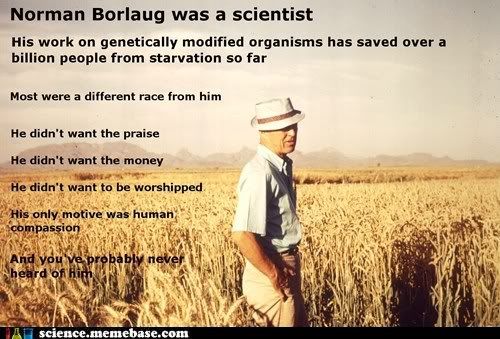
I was just about to write something about Norman Borlaug. Good to see someone's already beat me to it :)

OT: Yeah Norman Borlaug has saved over a billion (with a B) people from starvation. All thanks to GM crops. I think that is reason enough to use more GM crops.

And some people seem to forget what GM means. Bananas, carrots and cows (to name but a few) are all GM.
 

Rednog

New member
Nov 3, 2008
3,566
0
0
Killertje said:
There is always a chance that a gene that makes the food grow faster or bigger or makes it resistant to poisons gets absorbed by insects or bacteria which would screw up the entire ecosystem.\
But that's not how genes work....at all.
No, seriously. If you think that is any way viable I seriously urge you to stop studying whatever science field you're in.
DNA is actually very very fragile, and there really is no way any gene survives the digestive process, hell DNA can't exist alone inside a cell without being destroyed and you somehow think that not only will the DNA survive insanely harsh conditions in digestive systems but that gene will be somehow transported to the exact cells in which they could cause the feared effect. Once at the very specific site they would have to have some sort of mechanism to be uptaken into the cell. Once again the odds of the gene being digested in the cell is high. Then you would have to have some miracle where the DNA would be recognized and taken to the target's DNA...
You know what the process goes on, summary is...no.
 

Rednog

New member
Nov 3, 2008
3,566
0
0
Viptorian said:
It can be a dangerous thing in the long run.

Most veggies are produced sterile now so that you can't harvest seeds and plant them. For that matter, almost all commercial seeds available in the US are genetically modified so that the resulting plant does not produce seeds resulting in you having to go buy more).

All bananas are clones of the same banana and if there were to be some massive issue affecting bananas DNA (I'm no scientist so I can't say what that would be), it could be bad juju.

If I go buy a tomato, I can't grow more unless it is an heirloom tomato (more expensive and harder to find), because the regular ones don't contain viable seeds.

Locally grown food is the best way to go about things because it causes fewer problems, makes shipping easier, can be healthier to eat (honey, for example, is best when local because the bees uses locally grown pollens and those with allergies might be more used to those).

Splicing and enhancing traits, fine. I don't like synthetic modifications, though.
So seeds modified so you have to buy more, yea it is a business in the US. Making the seeds costs a lot of time and money, if you don't protect your investment you would only get a few rounds of seed sales before people would have to stop buying seed from you.

Fewer problems? How so? Local grown organic stuff can actually use more problems because they don't have the same protection as the GE crops and usually require more time/money to maintain.

Shipping? Things are going to be shipped long distances no matter what. I hope you realize climates in places all around the world vary by quite a big degree, and isn't viable for a good variety of crops to grow. If you limited growth/shipping to local areas only be prepared to never see something like an orange or a banana again.

Umm might want someone to fact check that bee pollen thing. Let's say in theory that the allergen from the pollen is somehow transferred in the honey making process to the honey. If people in the area are allergic to the local pollen then they in turn would be allergic to this honey containing the allergen of the pollen.
Constant exposure to something doesn't make you less allergic to it. Allergies don't work like that.
 

Wieke

Quite Dutch.
Mar 30, 2009
391
0
0
I love the concept of GM food. And if it is deemed safe for human concumption (following the standards for all the other stuff i've been eating so far) I will eat it. Granted some (maybe a lot, i don't know) of the politics/economics surrounding GM crops are downright despicable.

Also bring on the artificial meat! (Again once found safe for human consumption.)


RhombusHatesYou

Surreal Estate Agent
Mar 21, 2010
7,594
1,916
118
Between There and There.
Country
The Wide, Brown One.
Rednog said:
Then you would have to have some miracle where the DNA would be recognized and taken to the target's DNA...
There is one possible way GM DNA could end up transfering... but as long as you don't eat people who've had viral vectored gene therapy without first cooking them then there's nothing to worry about...

...and it only counts if you accept gene therapy as GM.
 

Denamic

New member
Aug 19, 2009
3,803
0
0
We've been 'genetically modifying' foods since pre-historic times.
Every single meat, every fruit, and every vegetable you buy in stores are GM.
The 'organic' alternatives are just 50% more expensive and were grown using inferior and often actually more toxic fertilizers and pesticides.
 

Tiger Sora

New member
Aug 23, 2008
2,219
0
0
Send all complaints to the Monsanto Company. They control 90% of the GM seeds in the US and most of the world. They've done alot of good feeding people with higher yield crops. But all the pesticides they make are poisoning the land and water. They have a terrible track record of environmental damage. They use child labor in India.

It's against company policy to keep GM seed you bought and didn't use over to next year. They send inspectors and if they find out they'll never sell to you again.

Than theres that the crops don't make seeds, and aren't diverse. So if something happened. The crops could collapse.

So they do some good and alot of bad. But were stuck with them. What can ya do. *Shrugs*.
 

SciMal

New member
Dec 10, 2011
302
0
0
Saladfork said:
What does the escapist think of genetically modified food? Can anyone come up with legitimate arguements against it?
I'm mostly fine with it. There are a few worrying findings I've read from various studies, but overall I'd say 90% of GM crops are safe.

Oh, and to be consistent here, officially "Genetically Modified" excludes purpose-bred variants that haven't had their DNA directly modified via some vector. This means that thing which took a few centuries to properly cultivate into the form we know today are excluded.

OriginalLadders said:
The thing is that none of the stuff that changes the DNA is present in the plant; one seed was changed and then cultivated. It can't pose any risk to your health that eating either of the two sources of DNA don't cause already.
This is pretty much it. Genetic modification is usually done via a viral vector that's endocytosed into the cells of the organism and comes pre-loaded with retroviral capabilities. Once the foreign code is inserted into the host DNA, only chance mutations are going to get it out.

While foreign DNA does enter human cells, proteosomes, mRNAs, APOBEC, and other mechanisms usually degrade it very, very quickly. The production of unpredicted proteins poses more of a threat (in my opinion, at least) than the incorporation of genetically modified DNA into human cells.

Typically they don't even use chemicals to create genetic diversity, they use radiation, which is arguably safer.
While the logic works for Mass Effect, biological diversity (again, at least in my experience) is never created via radiation.

It's done via viral vectors, host cells, and plating. Want something that's going to survive cold temperatures? Find something that already does, find what protein(s) causes the effect, manufacture the DNA to create that protein - complete with Primer, Enhancers, etc. - stick it in your viral vector, manipulate the cells of your seed to accept the vector, stick it in a very cold room, and see which ones grow best.

Radiation, while it would create diversity, is very unpredictable, and would result in impractical amounts of work. You're literally dealing with 1 in 1,000,000,000's worth of chances (if that high, depending on the organism).

Not worth it.

theartknife said:
The thing that annoys me is that being anti GM seems to be generally lumped in with other concerns that could be described as "green issues", things like climate change, recycling, renewable energy etc.
I think it was initially because the vast majority of fertilizers a while back were petroleum-based, essentially byproducts of gasoline and diesel production. I don't know the particulars of the process, but I do agree that the correlation is unwarranted.

Squirrel1328 said:
It just bothers me that people link organic food with being healthy, it's not, if anything it's more likely to be unhealthy as it has no protection against pests or diseases, yet people spend 50% extra to buy a product that's apparently healthy because it's not protected from pests. Also Organic food is not going to solve world hunger, there's too much waste when harvested. In my mind GM food, is the better option
No to your first bit, yes to your second.

Organic food is healthier. It cultivates a better soil environment, which translates into increased phytonutrient and vitamin content for most fruits and some vegetables. The rule of thumb I've been using is, "The more colorful it is, the more nutritious it is, and the more an organic version benefits over the standard." Blueberries, Strawberries, Tomatoes, etc. have all been studied and shown to provide better nutrition and higher soil sustainability than their conventional counterparts.

That said, Organic farming will not save the world or eliminate hunger. For most crops, it's simply more intensive to get to harvest, and when paired with non-GM strains, there simply isn't enough viable farmland in the world (even if you chop down all the trees) to feed everybody.

One good example is bananas. Organic bananas (the kind we eat, at least) have to be grown between certain altitudes and in a place with a certain amount of rainfall to be produced. They cost about $0.30/lb more because the areas where you can organically grow bananas are slim pickings compared to those where you can conventionally grow them.

So, yes, while it's healthier, it will never be able to feed seven billion people.

Then again, my personal view is that the human population has been too large for a while to be sustainable in any fashion (much less grow), and as Global Climate Change really starts to crank up over the next little while, we're going to see a massive clash over resources and subsequent drop in population.

Most species which suddenly outgrow their resources don't have a nice, soft bell-curve to sustainability. It's usually a pretty steep drop to populations well below sustainable, and then a slow curve back up again.

Asmosos said:
The real risk is in driving ecology toward homogeneity. Lets say you could make a "super rice" crop which had 3x yield and was resistant to all known rice diseases. The problem would be that one day, one disease would find a way to kill your crop. Then you have lost ALL of your rice. That would cause you issues.
and

Tanakh said:
Leaving aside the possible health issues. GM crops have very resitrictive legal terms.
...are the big reasons why I don't buy GM crops.

The first has (and is, if you've heard about the Roundup corn debacle going on) already happened. The big, big, big problem with GM crops is that they are the majority crops being produced on farms. Once the disease/pest has adapted (usually by an over-eager farmer planting too much of the crop, or over-eager company saying you can plant too much), not only are your old crops SOL, so's the GM one.

That, and the trademarking of GM crops - combined with the legal actions taken by corporations like Monsanto against something as completely uncontrollable as having a few rapeseeds get blown off a truck as it passes by another farm - is why I can't support GM crops.

As long as DNA sequences can become trademarked, I can't openly support it. It's ridiculous, and really opens up the doors to potential shitholes. Medicinal gene therapy is on the rise. Say some research lab creates a gene that maintains the poly-adenylation on our DNA better than our current version. Let's suppose (since there's correlation, but no proven causation) that this increases the lifespan of a healthy human by 30% and drastically improves collagen and skin maintenance, making you look 40 when you're 95.

It's a pharmaceutical company's wet dream as long as the US holds that DNA can be patented.

That's just a benign example. Say there's a chunk of DNA created which causes humans to pretty much never succumb to HIV or the flu... Something that actually saves lives.

Suddenly Gattaca seems pretty haunting and relevant.

Mimsofthedawg said:
3. Some plants have been modified to produce their own insecticide to repel predatory insects. However, there is a major concern that this insecticide isn't taken out of the food itself (and in actuality, it's not). The argument in favor of insecticide is based on two things: A. the insecticide is a protein which your body can break down, rendering it harmless. B. its found in such low quantities that you'd have to eat way more than you're able to be effected. However, some people have attributed an increase in birth defects and cancer to this practice.

4. Got Milk? If it's unorganic, what you're ACTUALLY drinking is a cocktail of pus, blood, antibiotics, hormones, bacteria, and milk. The hormones and unsanitary conditions most dairy cows are kept in make them prone to infectious diseases. To combat this, farmers pump cows full of antibiotics. However, it being an infection, the cows immune systems are still very active, and inflammation is a regularity. If you don't know, anything that goes into a mother finds its way to the mammary glands and thus the the milk. So all this lovely stuff is also in your drink. Proponents of the practice say that pasturization kills off/destroys all negative side effects. This is true. But it also destroy any of the original health from the milk. This is why Vitamin's A and D have to be ADDED to milk, even though they (and a host of other natural health supplements) are naturally found in milk (thus, again, you can see why the fact "it's not natural" is a valid argument).
The other numbers on your list I either agree with or don't know about. For these two, though...

#3 - Birth defects and cancers can be attributed to damn near everything under and including the sun.

I have yet to read a single, well-performed study that even correlates GM crops with either.

Most people who put up #3's argument usually don't have a thorough understanding of human Biology or BioChemistry.

Apple seeds have cyanide in them. Your body deals with it if you eat them. GM corn has a very specific insecticide in it, which is far less harmful than the cyanide due to the metabolic pathways involved.

#4 - Organic milk is still pasteurized, still contains trace amounts of other bodily fluids, and is still fortified with Vitmains A and D. "Organic" in this context refers to the minimal use of antibiotics (yes, they're still used, but in a different manner) and the lack of hormone therapies. The feed is also different, if I remember correctly.

There's actually very, very little benefit to organic milk over conventionally produced milk.

Also, I think you're confusing a lot of the Organic Milk arguments with Unpasteurized milk, which is illegal to sell in most states because it can easily harbor infections. Unpasteurized milk is more nutrient dense and not 'fortified' with A and D, but any infection that the cow gets which can enter the milk will be passed on to humans.


I'm a Science Major with degrees in Biology and Chemistry and an Emphasis in Organismal function. I've had hands on experience producing resistant strains of organisms, and my opinions are almost always based on well-performed studies. However, I'm not now, nor do I claim to be, omniscient. These are my opinions, and I don't being proven wrong.