So, yeah, another Watchmen topic. I've just been really into it as of late, thinking about all the psychological issues it brings up and the complexity of its narrative and, forgive my unbridled enthusiasm (especially as an over-thinking A-Level English student), but it's just my FAVOURITE BOOK EVERRRRRRRRRR!
Ah-hem.
But anyway, what I want to talk about is...well, I wouldn't call it a "theme", but it's something that seems to pop up every now and then in Watchmen. Homosexuality. Out of the eight Minutemen, there were three gay masked adventurers. I just find that surprising, considering the percentage of gay people outside of them in the real world being, what, 2%? Maybe Sally Jupiter or whoever it was were right when they said being a costumed crime-fighter attracts a certain type. And I don't mean in a sexually sadistic way, like Hooded Justice. I mean, something like, it's a way of expressing themselves in ways they cannot in their ordinary lives; understand, this was in the 30s and 40s, when homosexuality was still largely condemned or even illegal.
Fast-forward to the late 70s and 80s, "gay woman" has apparently replaced "lesbian" as the "PC" term for homosexual females in America, judging by Sally Jupiter's interview in 1976 (where, when describing the reasoning for the Silhouette's expulsion from the Minutemen after it was revealed she was dating another woman, she says something like that, "when the papers got a hold of her being--a gay woman they say nowadays".
Why this stark social change? Even early in the first volume, when Dan and Laurie are in Rafael's cafe talking over the latter's relationship with Jon, we see two old men (who are, according to one popular fan theory, Hooded Justice and Captain Metropolis, the two gay male superheroes who'd apparently faked their deaths - don't ask me how, that "occulted essay" never explained it - and are now celebrating the anniversary of HJ's public debut) openly showing affection for one another. As we know from Alan Moore's meticulous attention to detail and how it would've affected Dave Gibbons' art, this panel can't have been thrown in there for nothing, for not making some kind of social commentary on the vastly different world in 1985 (Moore/Gibbons even labours to point out that Heinz baked beans now has 58 varieties, instead of 57, possibly Dr. Manhattan's influence on the world and the food industry, as we also later see a four-legged turkey or whatever in Rafael's cafe).
So, unless this is simply an upper-class restaurant that's friendly to LGBT people, it seems social attitudes towards gay people has changed, and that they are more accepted by 1985.
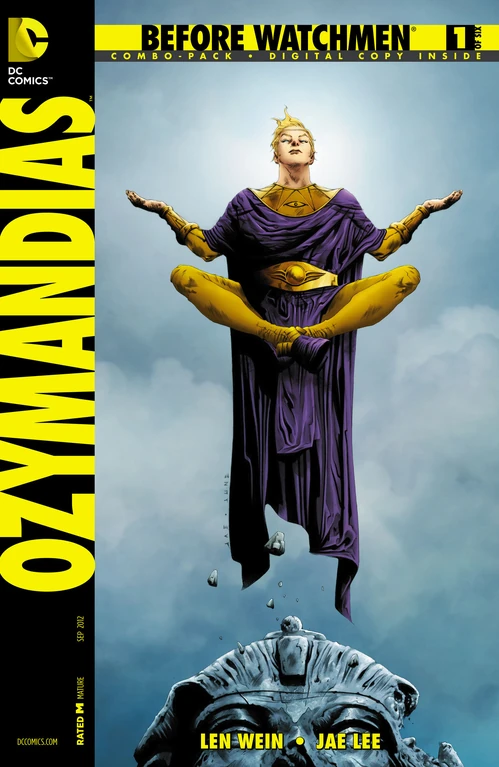
Well, since most of the major events in history were apparently affected by superheroes in this reality, my theory, which has never been contradicted (as far as I'm aware), has always been that it was Veidt's marketing of more social minority tolerance towards the population of America that has affected this. No, this isn't some kind of "gay agenda" bullshit I'm pushing; one of my fanon theories is that, judging by the purple triangles dotted around on Veidt Enterprises' products and just how much his business has infiltrated practically every facet of New York people's lives (e.g. the "Utopia" cinema subconsciously preparing people for an "alien invasion", by consistently airing sci-fi invasion films like The Day the Earth Stood Still[/i), Veidt was bisexual and, as part of his fledgling utopia, attempting to make people more tolerant and accepting of LGBT people. It's even said that Nostalgia was partially marketed towards gay people, by choosing somewhat androgynous female models (yeah, that sounds stupid, but still).
So, what are your thoughts?
Ah-hem.
But anyway, what I want to talk about is...well, I wouldn't call it a "theme", but it's something that seems to pop up every now and then in Watchmen. Homosexuality. Out of the eight Minutemen, there were three gay masked adventurers. I just find that surprising, considering the percentage of gay people outside of them in the real world being, what, 2%? Maybe Sally Jupiter or whoever it was were right when they said being a costumed crime-fighter attracts a certain type. And I don't mean in a sexually sadistic way, like Hooded Justice. I mean, something like, it's a way of expressing themselves in ways they cannot in their ordinary lives; understand, this was in the 30s and 40s, when homosexuality was still largely condemned or even illegal.
Fast-forward to the late 70s and 80s, "gay woman" has apparently replaced "lesbian" as the "PC" term for homosexual females in America, judging by Sally Jupiter's interview in 1976 (where, when describing the reasoning for the Silhouette's expulsion from the Minutemen after it was revealed she was dating another woman, she says something like that, "when the papers got a hold of her being--a gay woman they say nowadays".
Why this stark social change? Even early in the first volume, when Dan and Laurie are in Rafael's cafe talking over the latter's relationship with Jon, we see two old men (who are, according to one popular fan theory, Hooded Justice and Captain Metropolis, the two gay male superheroes who'd apparently faked their deaths - don't ask me how, that "occulted essay" never explained it - and are now celebrating the anniversary of HJ's public debut) openly showing affection for one another. As we know from Alan Moore's meticulous attention to detail and how it would've affected Dave Gibbons' art, this panel can't have been thrown in there for nothing, for not making some kind of social commentary on the vastly different world in 1985 (Moore/Gibbons even labours to point out that Heinz baked beans now has 58 varieties, instead of 57, possibly Dr. Manhattan's influence on the world and the food industry, as we also later see a four-legged turkey or whatever in Rafael's cafe).
So, unless this is simply an upper-class restaurant that's friendly to LGBT people, it seems social attitudes towards gay people has changed, and that they are more accepted by 1985.
Well, since most of the major events in history were apparently affected by superheroes in this reality, my theory, which has never been contradicted (as far as I'm aware), has always been that it was Veidt's marketing of more social minority tolerance towards the population of America that has affected this. No, this isn't some kind of "gay agenda" bullshit I'm pushing; one of my fanon theories is that, judging by the purple triangles dotted around on Veidt Enterprises' products and just how much his business has infiltrated practically every facet of New York people's lives (e.g. the "Utopia" cinema subconsciously preparing people for an "alien invasion", by consistently airing sci-fi invasion films like The Day the Earth Stood Still[/i), Veidt was bisexual and, as part of his fledgling utopia, attempting to make people more tolerant and accepting of LGBT people. It's even said that Nostalgia was partially marketed towards gay people, by choosing somewhat androgynous female models (yeah, that sounds stupid, but still).
So, what are your thoughts?