
How do animals?
- Thread starter CODE-D
- Start date
Recommended Videos

This can be answered with some basic web/ encylopedia research. Which I'm not going to do for you, lazy bum.

It's different for different animals, with many different classes of toxin. It's like asking "how do living creatures (as in, all five kingdoms) reproduce?" The question is way too broad.
Well, from my VERY basic understanding of animals and biology, venom is basically amino acids and other organic materials/chemicals constructed within the bodies of certain oganisms that, basically, tells other organic material to do things, such as causing flesh to destroy itself or getting blood to coagulate/implode, or sending electro chemicals into the receptors of neurons to block neurological activity (which can lead to numbness or a paralyzed effect).
Not all venom does the same thing, but venom pretty much has a primary objective, to kill, or at the very least disable to allow for killing. It comes about in animals through survival by means of evolution.
It's like how DNA commands the construction of things such as skin cells, blood cells, white blood cells, etc through the usage of RNA, bringing amino acids together to create proteins, just, in the case of certain animals, it constructs venom, often stored in a sac or a deposit with some form of tool to dispense it (the fangs of a snake, stinger of a bee, or the pores in the skin of a poison dart frog).
EDIT: this is as educated of a guess that I can give by the way, again I do not have a thorough understanding.
Not all venom does the same thing, but venom pretty much has a primary objective, to kill, or at the very least disable to allow for killing. It comes about in animals through survival by means of evolution.
It's like how DNA commands the construction of things such as skin cells, blood cells, white blood cells, etc through the usage of RNA, bringing amino acids together to create proteins, just, in the case of certain animals, it constructs venom, often stored in a sac or a deposit with some form of tool to dispense it (the fangs of a snake, stinger of a bee, or the pores in the skin of a poison dart frog).
EDIT: this is as educated of a guess that I can give by the way, again I do not have a thorough understanding.

You are full of poison. You have potent acid and deadly bacteria filling you from head to toe. You are covered in allergens. You carry some of the most deadly diseases known to nature. You are not harmed by these things but some animals can be, and if they could harm you then it would be because something very major messed up. Other animals are similar to this.

Eh, the stomach mostly just produces H-Cl. It's considered a strong acid, but it's far from some of the wacky stuff they can make in labs that's strong enough muck up the pH scale.aba1 said:You know our stomach is full of some of the strongest acids out there.... our body makes dangerous materials too.
I believe the father of toxicology is noted for saying something to the effect of 'The dose makes the poison'.

I didn't "strongest" I did say "some of the strongest" I mean it is stronger than most acids. Either way it is really interesting how our body handles it in the same way some species bodies handle poisons.Dags90 said:Eh, the stomach mostly just produces H-Cl. It's considered a strong acid, but it's far from some of the wacky stuff they can make in labs that's strong enough muck up the pH scale.aba1 said:You know our stomach is full of some of the strongest acids out there.... our body makes dangerous materials too.
I would imagine it is a similar process to how you make your poisons, dangerous materials, and damn near everything else. It a broad sense it is a sequence of controlled chemical reactions. I really can't say any more than that since the processes differ for the substance and animal. I imagine the stuff you are thinking of are just enzymes, enzyme inhibitors, or various other chemicals.
From what I understand, the H-Cl in your stomach is 2 molar. It is hardly the strongest stuff, but it can burn a hole in a sidewalk. If my math is right (it probably isn't) the pH is 3.Dags90 said:Eh, the stomach mostly just produces H-Cl. It's considered a strong acid, but it's far from some of the wacky stuff they can make in labs that's strong enough muck up the pH scale.
Stomach acid pH is about 2, which puts it at 0.01 M[sub]eq[/sub] H-Cl. It's close to that of lemon juice. Not exactly scary stuff unless you have some wacky phobia of lemons.crudus said:From what I understand, the H-Cl in your stomach is 2 molar. It is hardly the strongest stuff, but it can burn a hole in a sidewalk. If my math is right (it probably isn't) the pH is 3.
A fair amount of animals don't directly make poison, they simply sequester it from their food. Notable examples include the Monarch butterfly.

Generally it'll bind a protein that is in some way important in a metabolic pathway, stopping the body from completing that action.
For instance, Cyanide binds to a protein in your mitochondria that would normally produce Oxygen as a waste product of respiration. Because that protein can't do it's job properly, several other proteins upstream get backed up due to the amount of incomplete products, and your body dies as you can't produce enough energy in a usable form.
For stuff like snake venom, it'll typically bind to a protein in the brain & have a different effect. All poisons tend to bind very tightly & specifically to proteins, but I won't go into that unless you're interested.
For instance, Cyanide binds to a protein in your mitochondria that would normally produce Oxygen as a waste product of respiration. Because that protein can't do it's job properly, several other proteins upstream get backed up due to the amount of incomplete products, and your body dies as you can't produce enough energy in a usable form.
For stuff like snake venom, it'll typically bind to a protein in the brain & have a different effect. All poisons tend to bind very tightly & specifically to proteins, but I won't go into that unless you're interested.

All I can think of is you might be wondering how it doesn't kill them. The fact is a venom is different from a poison. You can drink a venom quite safely. It's only going directly into your bloodstream say, through a bite or scratch that it has any effect.CODE-D said:How do animals make poison/toxins?
Such as bees and snakes, how?
Edit: Just to clarify, I at least wanted to contribute. My knowledge of chemistry doesn't quite match up to most of these guys...

Dtox333 said:Well, from my VERY basic understanding of animals and biology, venom is basically amino acids and other organic materials/chemicals constructed within the bodies of certain oganisms that, basically, tells other organic material to do things, such as causing flesh to destroy itself or getting blood to coagulate/implode, or sending electro chemicals into the receptors of neurons to block neurological activity (which can lead to numbness or a paralyzed effect).
Not all venom does the same thing, but venom pretty much has a primary objective, to kill, or at the very least disable to allow for killing. It comes about in animals through survival by means of evolution.
It's like how DNA commands the construction of things such as skin cells, blood cells, white blood cells, etc through the usage of RNA, bringing amino acids together to create proteins, just, in the case of certain animals, it constructs venom, often stored in a sac or a deposit with some form of tool to dispense it (the fangs of a snake, stinger of a bee, or the pores in the skin of a poison dart frog).
EDIT: this is as educated of a guess that I can give by the way, again I do not have a thorough understanding.
So the animals body synthesizes amino acids that will bind to other things once injected. But thats all animal poison is, amino acids?Esotera said:Generally it'll bind a protein that is in some way important in a metabolic pathway, stopping the body from completing that action.
For instance, Cyanide binds to a protein in your mitochondria that would normally produce Oxygen as a waste product of respiration. Because that protein can't do it's job properly, several other proteins upstream get backed up due to the amount of incomplete products, and your body dies as you can't produce enough energy in a usable form.
For stuff like snake venom, it'll typically bind to a protein in the brain & have a different effect. All poisons tend to bind very tightly & specifically to proteins, but I won't go into that unless you're interested.

I don't know if you have noticed but the animals that produce poisons are very angry animals. As we know, rage often culminates in the face and in the anus. Hence, poison fangs and stings are merely manifestations of pure fury. Humans, being impure beings, can only produce bile and diarrhoea.
Doesn't have to be an amino acid sequence, but a poison could definitely be an amino acid. You can get heavy metal poisoning for instance, which is just one element, or you could synthesise a steroid compound like Taxol to poison stuff if you're a yew tree.CODE-D said:So the animals body synthesizes amino acids that will bind to other things once injected. But thats all animal poison is, amino acids?
The general aim is to bind really tightly to a target protein, so that the things it usually binds to never have a chance to connect. This is also how a lot of drugs work.


Google's your friend. They have specialized glands and chemical makeups and such. I'm not a Biology teacher! :O
...and here I thought the thread title accidentally. I was expecting something cheeky and random when I clicked this one.
As for their poison, it's a paralytic produced by a gland behind their ovipositor, and delivered by such. That's right, a wasp stings with the closest thing it has to a sexual organ. If they were self-aware, they would be raping you.
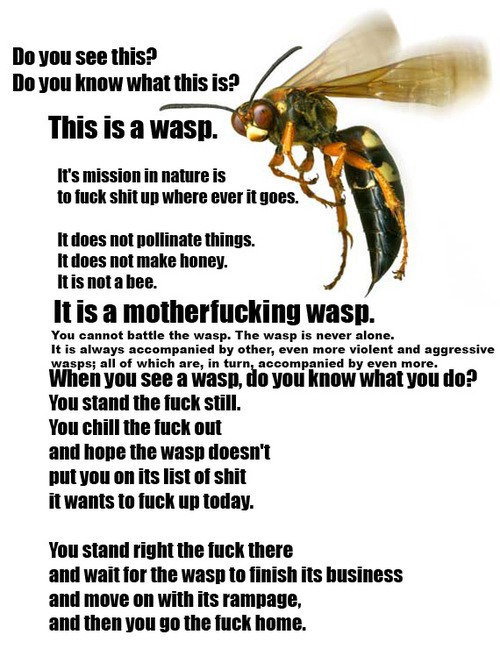
I hunt wasps with a pressure washer, and I seal up their nests with concrete. The little bastards give bees a bad name.lRookiel said:You don't need to know how the wasp makes it's devil sting. All you need to know, is this.
As for their poison, it's a paralytic produced by a gland behind their ovipositor, and delivered by such. That's right, a wasp stings with the closest thing it has to a sexual organ. If they were self-aware, they would be raping you.
According to wikipedia the pH is 2.5+/-1. Which puts the concentration around 5000 parts per million(.03 to .0003 molar. It has been too long since my last chem course).Dags90 said:Stomach acid pH is about 2, which puts it at 0.01 M[sub]eq[/sub] H-Cl. It's close to that of lemon juice. Not exactly scary stuff unless you have some wacky phobia of lemons.
A fair amount of animals don't directly make poison, they simply sequester it from their food. Notable examples include the Monarch butterfly.