"Epic" is a word that gets mis-used quite often nowadays, but with Too Human, we are brought crunching back to its original meaning - a lengthy poem of mythic and legendary deeds. Homer, Dante, Milton. And, of course, Norse sagas. Let's get something out of the way right now - I fucking love mythology in pretty much any form, and Norse mythology especially. Even if it wasn't promising some hardcore sci-fi action-rpg fun, I probably would have seriously considered getting it for the Norse mythos.
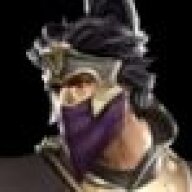
And true to Epic form, we start in medias res, with Baldur, the main character, leading a group of soldiers into the frost bitten "Hall of Heroes", a mausoleum for giants that has been populated by mechanical "goblins". Through flashbacks, we see why he is here - in pursuit of a mechanical monstrosity called Grendel, which looks like some sort of electric razor with legs. The whole game setting is a cyber-punk, dystopic re-imagining of the Ragnarok cycle, with "magic" being swapped with "nano-tech". The Aesir are cybernetically enhanced creatures who rule over the humans of Midgard. Elves and Frost Giants are mechanical soldiers left over from the war of an older civilisation, the Ymir. The NORNS are nano-bot AI's, who live in a virtual reality realm.
Now, something that comes with being closely linked to the Ragnarok cycle is that anyone who knows the story - even the bare bones of it - won't be surprised by the twists. Now, I accept I'm not normal in this area, but I really was left thinking "so what"? And I only really know the summary, it's not like I'm some sort of hardcore folklore expert. This isn't helped by a slightly hamhanded crowbaring of some plot elements, although things work quite nicely (Tyr, the one handed Aesir, in the mythology lost his hand while binding Fenris the wolf in magical chains. In the game, Fenrir is Baldurs sentient weapon, which cut off Tyrs hand while he was binding it) Dialogue is quite unconvincing and the story suffers from being the first of a trilogy - it's not self contained and the ending is not satisfying.
Okay, moving away from the story and onto the game itself. Like any decent RPG, Too Human tries to give you a variety of choices in working through the game. At the start, you are presented with five possible classes, four which are specialists in their areas and one which is a "jack of all trades". These classes each have a skill tree that take you down three potential routes, and on top of this there are two "alignment" trees (Cybernetic or Human, depending on whether you choose to dope yourself up on enhancements or instead rely on your own skill) This is alright in theory, but having played it with a couple of classes, I really didn't notice much difference between them, or at least not enough worth mentioning. It's not as well executed as, say, Mass Effects class systems.
Melee uses the right joystick, nudging it in the direction of the foe you want to hit. This system I first came across in Blade II, and to be frank Blade did it better. The melee is slow and finicky about what constitutes a hit, and considering you are frequently swarmed with enemies, this is a ltitle irritating. Shooting is a little better executed, but the fine aiming on the body parts of larger foes like Trolls needs work.
Now, you know how a lot of modern games try to be all cool and not have health bars? This can work but it seems Too Human took the most retarded part of it - the lack of health ups. You have a health bar but theres practically no such thing as a way to heal damage. There are status effects, but no such thing as an antidote. The absence of items such as potions - or any items you can cary and use other than equipment - is a little baffling in an RPG, but not unforgivable. You can remedy it by having health ups dropped by enemies fairly common, or having characters regenerate when not in battle. Too Human does have regeneration, but for only one class. It does have enemy dropped health ups, but they are much rarer than they should be. The dev teams answer to this is the most idiotic decision I've seen for a while - death means nothing in this game. You run out of health and a Valkyrie comes down, picks you up and carries you off.. and you turn up, fully healed, not far from where you fell, to continue the fight. Now matter how often you die. It's not like you have a limited number of lives, you can die and die and die and you aren't punished for it. The developers want you to beat the game, clearly, but combat loses its exhiliration and the game loses its challenge.
Now, its not all bad news of Too Human, because I do like it. It's very pretty, with decent replay value and it is undeniably epic - charging the hordes of the undead armies of Hel while massive seige engine blast the walls of her mausoleum-fortress to peices is one moment that really appeals to me and sticks in my memory well. The story suffers from being the first of three but hopefully at the same time, Silicon Knights will use the opportunity of a second game to brush up their mess and tighten up where Too Human gets sloppy. Worth at least a rental, but I don't rate it a full buy.
And true to Epic form, we start in medias res, with Baldur, the main character, leading a group of soldiers into the frost bitten "Hall of Heroes", a mausoleum for giants that has been populated by mechanical "goblins". Through flashbacks, we see why he is here - in pursuit of a mechanical monstrosity called Grendel, which looks like some sort of electric razor with legs. The whole game setting is a cyber-punk, dystopic re-imagining of the Ragnarok cycle, with "magic" being swapped with "nano-tech". The Aesir are cybernetically enhanced creatures who rule over the humans of Midgard. Elves and Frost Giants are mechanical soldiers left over from the war of an older civilisation, the Ymir. The NORNS are nano-bot AI's, who live in a virtual reality realm.
Now, something that comes with being closely linked to the Ragnarok cycle is that anyone who knows the story - even the bare bones of it - won't be surprised by the twists. Now, I accept I'm not normal in this area, but I really was left thinking "so what"? And I only really know the summary, it's not like I'm some sort of hardcore folklore expert. This isn't helped by a slightly hamhanded crowbaring of some plot elements, although things work quite nicely (Tyr, the one handed Aesir, in the mythology lost his hand while binding Fenris the wolf in magical chains. In the game, Fenrir is Baldurs sentient weapon, which cut off Tyrs hand while he was binding it) Dialogue is quite unconvincing and the story suffers from being the first of a trilogy - it's not self contained and the ending is not satisfying.
Okay, moving away from the story and onto the game itself. Like any decent RPG, Too Human tries to give you a variety of choices in working through the game. At the start, you are presented with five possible classes, four which are specialists in their areas and one which is a "jack of all trades". These classes each have a skill tree that take you down three potential routes, and on top of this there are two "alignment" trees (Cybernetic or Human, depending on whether you choose to dope yourself up on enhancements or instead rely on your own skill) This is alright in theory, but having played it with a couple of classes, I really didn't notice much difference between them, or at least not enough worth mentioning. It's not as well executed as, say, Mass Effects class systems.
Melee uses the right joystick, nudging it in the direction of the foe you want to hit. This system I first came across in Blade II, and to be frank Blade did it better. The melee is slow and finicky about what constitutes a hit, and considering you are frequently swarmed with enemies, this is a ltitle irritating. Shooting is a little better executed, but the fine aiming on the body parts of larger foes like Trolls needs work.
Now, you know how a lot of modern games try to be all cool and not have health bars? This can work but it seems Too Human took the most retarded part of it - the lack of health ups. You have a health bar but theres practically no such thing as a way to heal damage. There are status effects, but no such thing as an antidote. The absence of items such as potions - or any items you can cary and use other than equipment - is a little baffling in an RPG, but not unforgivable. You can remedy it by having health ups dropped by enemies fairly common, or having characters regenerate when not in battle. Too Human does have regeneration, but for only one class. It does have enemy dropped health ups, but they are much rarer than they should be. The dev teams answer to this is the most idiotic decision I've seen for a while - death means nothing in this game. You run out of health and a Valkyrie comes down, picks you up and carries you off.. and you turn up, fully healed, not far from where you fell, to continue the fight. Now matter how often you die. It's not like you have a limited number of lives, you can die and die and die and you aren't punished for it. The developers want you to beat the game, clearly, but combat loses its exhiliration and the game loses its challenge.
Now, its not all bad news of Too Human, because I do like it. It's very pretty, with decent replay value and it is undeniably epic - charging the hordes of the undead armies of Hel while massive seige engine blast the walls of her mausoleum-fortress to peices is one moment that really appeals to me and sticks in my memory well. The story suffers from being the first of three but hopefully at the same time, Silicon Knights will use the opportunity of a second game to brush up their mess and tighten up where Too Human gets sloppy. Worth at least a rental, but I don't rate it a full buy.