
I just uninstalled Skyrim
- Thread starter Duffeknol
- Start date
Recommended Videos


It's nice to see you're one of the first in the long line of people removing Skyrim's fishhooks from themselves. While I don't think Skyrim is a bad game (I haven't even played it), I know for a fact that it has fishhooks that make people play for hours whether they like it or not. That's how it is with every Elder Scrolls game.

Look. I don't like Skyrim either. Or the Elder Scrolls at all for that matter. But reading this thread title and OP, all I could think was... why are you sharing this, exactly? I just uninstalled Alpha Protocol. FUCK Alpha Protocol was horrible. I'm not making a goddamn thread about it.
Point is, you're fanbaiting. Very hard to provoke genuine debate and discussion when that's going on.
Point is, you're fanbaiting. Very hard to provoke genuine debate and discussion when that's going on.

WOW, thanks for the write up, I can see you are really into the TES unvierse! Ok, well I will admit that I don't care about most of these things so I have no insight to share but let's talk about some of it.SirBryghtside said:Haha, this'll take a while...Crono1973 said:Why can't you stand Oblivion but like Morrowind and Skyrim?SirBryghtside said:...apart from the fact that Oblivion is one of 4 Elder Scrolls games that came before Skyrim? It lived up to and blew apart my expectations, as a person who loved Morrowind, likes Daggerfall and can't stand Oblivion.Crono1973 said:Maybe you haven't noticed all the "Oblivion sucked, Skyrim is the best game ever!" posts?BloatedGuppy said:Buh?Crono1973 said:It seems to me that comments like yours (and there are many) are really saying that those who hate Oblivion will be the most likely to love Skyrim. To me, that is evidence enough of how far Skyrim has strayed from the expectations of TES fans. In short, Bethesda sold out TES fans.
They're extraordinarily similar, sharing almost all the same virtues and all the same flaws.
Hate Skyrim if that floats your boat. But sold out TES fans? Good grief, people.
OK. Let's start with why Morrowind is my favourite game of all time. First and most foremost, the setting. From the very first moment you're thrust into the alien port of Seyda Neen, you can tell that this is one of the weirdest, and somehow most realistic games you've ever played. The creature variety is insane, with bipedal crocodiles, freakish pterosaurs, steampunk armadillos, hunks of bone and flesh patched together Frankenstein-style, and humanoid Gligars. The aesthetic is wonderfully and consistently inconsistent, which gives you an awesome feeling of being thrown into another land.
Compare and contrast Oblivion. The creatures are pretty much all standard fantasy fare, with Goblins, lions and minotaurs so heavily featured that it ends up feeling hopelessly generic. The Daedra, often the most interesting part of TES games, look a lot less colourful - compare this Clannfear [http://media.giantbomb.com/uploads/1/17166/965689-mwcreature_clannfear_large.jpg] to Oblivion's [http://media.giantbomb.com/uploads/1/17166/965700-oblivionclannfear_1.jpg]. Add to that the Lord Of The Rings setting and copy/pasted dungeons everywhere you look, and the magic is gone - it just feels like your typical bland fantasy game 001.
Enter Skyrim. You're back to being thrown out in a harsh environment with little direction at all. It ends up reusing a lot of the creatures from Morrowind, and almost ditching the Daedra altogether - which I can't say I'm all too happy about - but the redesigns are so good that it almost doesn't matter. The aesthetic is back to being slightly bland, with animals ranging from Sabre Cats and Mammoths to Giants and Dragons - but the difference between this and Oblivion is that firstly, the original creatures, and there are a fair few, are amazing - Wispmothers, Ice Wraiths, Falmer to name a few - but also that they actually feel realistic and varied. In Morrowind, the animals had very different attack styles, from the aerial approach taken by the Racers to the charging in of the Alits, and this is mostly missing in Oblivion, with all creatures and NPCs just walking up to you and attacking, without variation. Skyrim returns to the Morrowind style - fighting, say, a Dragon cannot be more different from the flanking tactics taken by packs of Wolves, the brutish maneuvers of the Trolls, or the Headcrab-style pouncing of Spider Centurions. The actual world, as I said, feels harsh and unique, and this is supported by the consistent idea of a wintry area mixed with all the different and interesting things the devs managed to do with them. There's so much open space that it feels inviting to explore again, rather than the unspoken suggestion to stick to the roads.
Still not done! You asked for this, you know.
So, combat systems/general gameplay. In Morrowind, EVERYTHING, and I mean EVERYTHING, was decided by dice rolls D&D style. This led to a game where everything was the bare minimum it needed to be, which shifted the overall focus to the RPG mechanics. It's a rough tradeoff, and while it doesn't entirely work, it's solid. The actual combat system relies on hit/miss mechanics, which many people get turned off by - especially when they first play - but again, it's the bare minimum.
The problem with Oblivion is that while it tried to have a more involving battle system than Morrowind's, which I don't fault it for doing from a purely theoretical perspective, it ended up being mechanically the same thing as Morrowind - just with the added annoyance of it not actually feeling like you're doing anything. In Morrowind you hit them and they'll do a 'hit' animation. In Oblivion you hit them and they'll wobble a bit, with your weapon flying backwards as if they were made of rubber. It's horrifically immersion-breaking, and it's actually an incredible feat that they managed to make it more so than missing someone who's standing right next to you.
However, as I said, it's not the idea of an action-based combat system that I hate, it's the implementation. And that leads me to Skyrim. Every single part of this was designed to make it feel like you are actually wielding whichever weapon you've got equipped. Dual swords? The best tactic is to maximise your DPS by mashing both mouse keys/triggers, or holding them both down at the same time to do a move I like to all the Eviscerator. Giant warhammer? Running at them like a maniac before unleashing a power attack. Stamina affects the game in a significant way thanks to the sprinting and power attack mechanics rather than it being an annoying bar you don't pay much attention to in both Morrowind and Oblivion. And then the finishing moves come in, adding just enough cinematic brutality to make winning a fight feel like an achievement, but not so much that it becomes dull to watch every time.
Still not done...
Story. Now, I'll be the first to admit that TES hasn't exactly got the best plotlines in the universe - but I've always found it strange how people constantly fault this series for that while praising Half-Life 2 to the high heavens. Everyone's familiar with the idea in HL2 of there being a fairly generic story, but the presentation being amazing - and that is exactly what happens in Morrowind. The main plotline is standard 'you are the hero who must slay the demon', but the lore behind the Nerevarine, the justification and depth of Dagoth Ur and the Sixth House, and the little details and characters you come across along the way are what makes it interesting. Outside of the Main Quest, the guild quests are noticeably devoid of any form of overarching storyline - but the conflicts between the different factions and within them are well-defined. Outside of even this, and going into the world as a whole, there are a lot little stories and quests that all have interesting snippets of what could be considered 'story'. These make the word feel deep, grand and realistic. One more thing I want to say on this front is that in Morrowind, every bandit, Ashlander and farmer has a name. This tiny factor adds a huge amount to the depth of the world, making every character feel a bit more like an actual person. The game also has a great sense of lore about it which can take years to fully understand - but almost all of it is in plain view for the player to access, be it in the form of books, random NPC conversations, or parts of the world.
Oblivion, on the other hand... the main plot is 'fight demons in hell, save world'. It has hints of Morrowind's detail, for example in Mankar Camoran's speeches, but it doesn't really add anything to the lore that hasn't already been established about Mehrunes Dagon in previous games (AKA he's a bad Satan sorta guy). It also seems to have no real focus - you're going through random dungeons to get MacGuffins A, B and C before going and killing the biggest, baddest demon ever. It's about as deep as Doom, and at least that had some humour in it. Unlike Morrowind, the Guilds have their own self-contained overarching plotlines - but these boil down to Necromancers are bad, the Gray Fox is cool, and you... don't like the Blackwood Company? These aren't very deep at all, but I'd like to focus on the Mage's Guild plotline, because it highlights a major feature of the Lore's treatment in Oblivion. This [http://www.imperial-library.info/sites/default/files/gttpo_mannimarco_01.gif] is the King of Worms from waaay back in Daggerfall, who was an interesting, dark character, who acted with a keen sense of logic and had hands in the pockets of politicians all across the continent. And this [http://images.uesp.net/thumb/6/6e/OB-npc-Mannimarco.jpg/180px-OB-npc-Mannimarco.jpg] is him in Oblivion. You can immediately tell that he's gone from being a corrupted figure to... just some High Elf. In-game, he's gone from being a great character to some cartoonish supervillian with the depth of Team Rocket, head of some ragtag band of Necromancers that have formed to do eeeeeviiiil in the land of Cyrodiil. This is just one example of the total disrespect for the lore that features so heavily in the game - other 'great' examples include the transformation of the country from a jungle into the dull countryside I mentioned earlier, and having no references to previous Elder Scrolls games bar when they wanted to destroy something (see Mannimarco). And the detail, contained plotlines? All but gone.
And now, back to Skyrim. The story is, again, fairly generic - 'you are the chosen one who must rid the world of Dragons' - but the detail is back to Morrowind-style. Buzzwords like 'Thu'um' keep coming up, they invented an entire language just to complement it, and the civil war plotline is one of the most morally ambiguous and fleshed-out choices I've ever seen in a game. So it adds great lore to the series - but not just that, it isn't ashamed of its past. The Wolf Queen, the Red Year, a pub called 'New Gnisis Cornerclub' - these references, though small, really add a sense of connection to the old games - and admittedly, just make me happy every time I see them. And the detail that featured in Morrowind? Back to the power of ten. At least half of the dungeons I've entered have had secrets, little snippets of what happened, and just detail in general. Things like a tent with two beds, covered with flowers and a single Amulet of Mara, a madman who resurrects dead women for... pleasure, and a deserted mine bar one man crushed by rocks... these details make the game so rich and just plain cool that you can spend days just exploring every nook and cranny of Skyrim and never get bored or feel like you've completed it.
If there's one thing I feel defines the Elder Scrolls as a series, apart from the obvious exploration and worldbuilding, it's that it takes every fantasy trope out there and screws with it until it is almost completely indistinguishable from the original. Morrowind and Skyrim fit this to a T - Oblivion not so much, instead opting to play all of it completely straight. And that is not what the games should be.
And that is why I can't stand Oblivion, but like Morrowind and Skyrim. Thanks for your time, there will be no TL;DR.
I agree that the intro to Morrowind was alot more amazing and alien-like than either Oblivion or Skyrim. It also wasn't long and drawn out. No doubt, Morrowind is the easiest game to start over and in TES games, I do alot of starting over.
Oblivion started with you in jail and in the opening dungeon but there wasn't alot of down time (time when you had no control of your character). Oblivion also let you change everything and save just before you left the sewers. You could save there and never have to replay the intro dungeon. Yes, the world was generic but I liked the world. I like sunshine and green grass. It didn't feel as alien as Morrowind and the exploration wasn't as rewarding as Morrowind but it was fine.
Skyrim is the worst intro of them all, you have to sit through that long and boring intro and the most you can do is look around at the bad feet textures. It looks more generic than Oblivion in my opinion but that's just my opinion. I live in a place where we have snow 6 months out of the year, I am not impressed by dark skies and snow. Anyway, when you finally fuckin get control of your character you still can't do much because your hands are bound. So you follow the steps to finally get the freedom to play. Something you could do within 5 minutes with Morrowind and Oblivion took around 15-20 minutes in Skyrim. then you go through the opening dungeon. To make matters worse, there is no chance to save and change everything at the end of the dungeon like you could do in Oblivion so the next time you start a new character, you gotta sit through all the BS again.
The combat feels better in Skyrim (sometimes I realized I was gritting my teeth while fighting something), I'll give it that but what does it matter if I don't enjoy the perk system? The perk grid looks like they ripped it out of Final Fantasy XIII (the Crystarium) and then made it harder to navigate. How many times have you gone to the wrong place on the perk grid by tilting the stick a little too far? The layout is just a small thing though, the real problem is that the perks are more important than raising your skills. Sorry but that shit just makes the whole system seem artificial. It makes no sense why a high skill level is less important than a perk.
About the look of enemies, I am not that bothered one way or the other. I thought the Argonians looked weird in Oblivion when I first saw them. I was just used to them in Morrowind. Now though, the ones in Morrowind look weird. To me, I am not that picky but if you are, that's cool.
I am not so concerned about story and I don't expect a good main quest from Bethesda.

That's not true, every other game that has dragons are "take turns hitting each other" games. This is the first time you can actually use action controls to fight a dragon. You can track the dragons flight path with a bow, if it begins to hover - blast it with magic or a shout, when it lands wail on it. When it flies overhead spraying the ground with fire... run, duck and cover, avoid death.Crono1973 said:Dragons aren't even worth a single mention unless this is the first game you've played with dragons in it. It's like getting excited over zombies in a shooter.
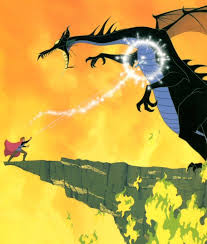
The dragons in Skyrim are different than dragons in other games. These aren't turn based dragons, these are real time dragons you fight from an action pespective. It's the first time it felt like this:

Yeah, I also would like to add to the odd drive to play games we don't like just because everyone else does. I've done it a lot and I really want to stop. I hated Arkham Asylum, but I still bought Arkham City hated that, too. I was reluctant to buy the Saints Row games because I didn't really like the idea of a jokey GTA, but lo and behold, I bought it and it turns out I don't like a jokey version of GTA. I just need to start buying games I absolutely 100% know I will like.
I haven't even started Skyrim (still waiting on patches, etc), but I didn't buy it because it was popular, I bought it because I liked Oblivion/Fallout/New Vegas. I've yet to see any Oblivion fans complain about it's inferiority to that game, just it's inferiority to a game that came out over ten years ago that I haven't played (and have no convenient way to play). If anything, I probably shouldn't give Morrowind a try because I enjoy the more recent games so much. I might not like it.
However, I didn't really like Mass Effect 1, but I really liked Mass Effect 2. And I loved Assassin's Creed 1, but hated 2. So I don't know. I just wish the quality level was more uniform and that reviews were better written than Excel spreadsheets and Nintendo Power back issues. It's why I like Yahtzee. I know his tastes and I know what he likes and dislikes. I can more accurately judge what a game will be like than a bunch of digits and decimal places.
I haven't even started Skyrim (still waiting on patches, etc), but I didn't buy it because it was popular, I bought it because I liked Oblivion/Fallout/New Vegas. I've yet to see any Oblivion fans complain about it's inferiority to that game, just it's inferiority to a game that came out over ten years ago that I haven't played (and have no convenient way to play). If anything, I probably shouldn't give Morrowind a try because I enjoy the more recent games so much. I might not like it.
However, I didn't really like Mass Effect 1, but I really liked Mass Effect 2. And I loved Assassin's Creed 1, but hated 2. So I don't know. I just wish the quality level was more uniform and that reviews were better written than Excel spreadsheets and Nintendo Power back issues. It's why I like Yahtzee. I know his tastes and I know what he likes and dislikes. I can more accurately judge what a game will be like than a bunch of digits and decimal places.
Everybody passes their opinion off as fact unless they state "just my opinion" every other sentence. You should be smart enough to know that everything people post is opinion unless otherwise stated. That would be too easy though, right?poiumty said:You're funny. Saying someone shouldn't have bought the game doesn't invalidate what they thought of it. I'm not a skyrim fanboi coming here to rage at people saying bad things about my game.Crono1973 said:Let's take a look:poiumty said:I think it's pretty sad too. I also think it's nothing that has to do with anything I said.Crono1973 said:I think it's pretty sad when an opinion is invalid because he BOUGHT the game.
Nope, it has nothing to do with what you said. Of course, if the OP hadn't bought the game and played through it, he would be told that his opinion is invalid because he didn't put enough time into it.He did the smart thing and didn't buy it. Can't say the same about you.
Oh, if I had to criticize his opinion, it would be the fact that he tries to pass it off as fact, as other people have pointed out before me.
Anyone who says that Oblivion is better than Skyrim would get shouted down. That's probably why no one bothers.zelda2fanboy said:Yeah, I also would like to add to the odd drive to play games we don't like just because everyone else does. I've done it a lot and I really want to stop. I hated Arkham Asylum, but I still bought Arkham City hated that, too. I was reluctant to buy the Saints Row games because I didn't really like the idea of a jokey GTA, but lo and behold, I bought it and it turns out I don't like a jokey version of GTA. I just need to start buying games I absolutely 100% know I will like.
I haven't even started Skyrim (still waiting on patches, etc), but I didn't buy it because it was popular, I bought it because I liked Oblivion/Fallout/New Vegas. I've yet to see any Oblivion fans complain about it's inferiority to that game, just it's inferiority to a game that came out over ten years ago that I haven't played (and have no convenient way to play). If anything, I probably shouldn't give Morrowind a try because I enjoy the more recent games so much. I might not like it.
However, I didn't really like Mass Effect 1, but I really liked Mass Effect 2. And I loved Assassin's Creed 1, but hated 2. So I don't know. I just wish the quality level was more uniform and that reviews were better written than Excel spreadsheets and Nintendo Power back issues. It's why I like Yahtzee. I know his tastes and I know what he likes and dislikes. I can more accurately judge what a game will be like than a bunch of digits and decimal places.
Secret of Mana comes to mind. Sure, it's a 2D game but it's not turn based. You can say that fighting dragons is unique in Skyrim but can't you say that about any enemy?Savagezion said:That's not true, every other game that has dragons are "take turns hitting each other" games. This is the first time you can actually use action controls to fight a dragon. You can track the dragons flight path with a bow, if it begins to hover - blast it with magic or a shout, when it lands wail on it. When it flies overhead spraying the ground with fire... run, duck and cover, avoid death.Crono1973 said:Dragons aren't even worth a single mention unless this is the first game you've played with dragons in it. It's like getting excited over zombies in a shooter.
The dragons in Skyrim are different than dragons in other games. These aren't turn based dragons, these are real time dragons you fight from an action pespective. It's the first time it felt like this:
Did Alpha Protocol have hundreds of threads talking about how awesome it is? No, then it's not really comparable.Andy of Comix Inc said:Look. I don't like Skyrim either. Or the Elder Scrolls at all for that matter. But reading this thread title and OP, all I could think was... why are you sharing this, exactly? I just uninstalled Alpha Protocol. FUCK Alpha Protocol was horrible. I'm not making a goddamn thread about it.
Point is, you're fanbaiting. Very hard to provoke genuine debate and discussion when that's going on.

Those are the complaints of people who mistake immersion frem realism. Immersion isn't overrated, but some things that people THINK are immersion actually aren't immersion at all. It's simply Yahtzee-fanboys who tries to act cool, but doesn't get what Yatzhee actually meant, and now they think they're experts.erttheking said:Meh, immersion is overrated. I can't tell you how many lame complaints I've heard about regenerating health, or cutscenes breaking immersion and saying that the game was bad because of it. What, the main character touching a med kit and having all of his wounds magically disappear is fine, but standing behind a rock and healing is just too much? I think you're overreacting because you can't...slaughter everyone though...really? We have GTA for that.
Regenerating health has little to do with immersion and cutscenes MIGHT break immersion if implemented poorly (Bad Company 2, I'm looking at ya!). But again: Realism and immersion is not the same thing.
So i guess MMO's doesn't count, or that you just never played World of Warcraft?Savagezion said:That's not true, every other game that has dragons are "take turns hitting each other" games. This is the first time you can actually use action controls to fight a dragon. You can track the dragons flight path with a bow, if it begins to hover - blast it with magic or a shout, when it lands wail on it. When it flies overhead spraying the ground with fire... run, duck and cover, avoid death.
 )
)
Well, if you didn't like the leveling system of Morrowind then I can't really relate to your opinion at all. In Morrowind and Oblivion leveling up meant something more than "here, have a brightly colored cookie", it meant you were taking control of the development of your character. You always were, with every move you made but the level up was the point where it paid off.Hal10k said:I wasn't much of a fan of Morrowind's leveling system either- It was essentially the same as Oblivion's, except it made everything take longer. What I loved about Morrowind was the setting. You had cities constructed underneath the shells of ancient insects, Daedric temples with twisted architecture, steampunk Dwemer ruins, Lovecraftian cattle, and plains choked with volcanic ash, and much more. And more importantly, it all seemed to fit together. Everything from the architecture to the environment design to the costume design went together to create a sense of place that Oblivion just lacked for me. Oblivion just felt artificial to me. It felt like somebody had taken figures from a D&D board game and shaken them loose upon the table. The only locations that felt interesting were the Deadlands, and we all know the problems that the Oblivion Gates had. Skyrim goes a long way towards recapturing the feeling of uniqueness and realism that Morrowind had for me- it may not be as utterly alien as Morrowind, but it's unique enough to make me want to explore in a way Oblivion didn't.Crono1973 said:So you like the perks better, what did you think of Morrowinds leveling system? Better yet, what did you like about Morrowind that Oblivion didn't have but Skyrim did?Hal10k said:Don't take my words the wrong way: I liked Oblivion. Not as much as I liked Morrowind, and I'm still reserving judgement on Skyrim until I can reflect upon it more in hindsight, but I still thought Oblivion was really good, especially when you take Shivering Isles into account. It still had flaws, though, and the reason Skyrim has garnered so much praise is that many people feel it addresses those flaws. This may not ring true to you, but it does for many people. And if somebody says "I enjoyed Skyrim's locations more than Oblivion's" or "I liked the voice acting in Skyrim more than Oblivion", you can't really tell them that they're wrong.Crono1973 said:You didn't answer my a question then. I ask why YOU like Morrowind and Skyrim and not Oblivion. I know what every one else is saying and I think none of it rings true (as I pointed out with bullet points).Hal10k said:Like I said, people felt that Skyrim addressed these concerns. Something that feels unique or interesting to one person will feel generic or boring to another. Different people take up different cues from their surroundings. The people who are complimenting Skyrim over Oblivion are the ones who saw positive differences in the game.Crono1973 said:It didn't though.Hal10k said:The common sentiments that I have seen point out the somewhat generic environment design, copy-and-paste locations, comically bad voice acting, the flawed leveling system, and the fact that all of the NPCs looked like potatoes. Many people who disliked Oblivion for these reasons felt that Skyrim addressed these concerns well.Crono1973 said:Why can't you stand Oblivion but like Morrowind and Skyrim?SirBryghtside said:...apart from the fact that Oblivion is one of 4 Elder Scrolls games that came before Skyrim? It lived up to and blew apart my expectations, as a person who loved Morrowind, likes Daggerfall and can't stand Oblivion.Crono1973 said:Maybe you haven't noticed all the "Oblivion sucked, Skyrim is the best game ever!" posts?BloatedGuppy said:Buh?Crono1973 said:It seems to me that comments like yours (and there are many) are really saying that those who hate Oblivion will be the most likely to love Skyrim. To me, that is evidence enough of how far Skyrim has strayed from the expectations of TES fans. In short, Bethesda sold out TES fans.
They're extraordinarily similar, sharing almost all the same virtues and all the same flaws.
Hate Skyrim if that floats your boat. But sold out TES fans? Good grief, people.
Skyrim has:
- generic environment design (ie, mountains and snow vs forests)
- copy and paste locations
- bad voice acting and comic dialog (ie, the arrow to the knee and the horrific german accent)
- the level scaling system is better but not by much
- The NPC's do look better but that hardly helps gameplay
I think Skyrim is worse because the leveling system has been reduced to three attributes and perks. The perks being far more important than your skills (you can have a high skill level in something but it not be as good as having a low skill level plus a perk).
I'm not entirely sure how we segued into a discussion of the leveling system, but I prefer the perk system to the previous game's linear stat progressions. It allows for greater specialization, even if you've managed to max out your stats, and makes for immediate, noticeable benefits to leveling, as opposed to "You can swing your sword incrementally faster". It seems like a natural extension of Oblivion's "You can cast Expert Level Destruction magic now" stuff, at least in that regard.
So you understand where these questions are coming from, let me explain my POV. Oblivion had the same skill level system as Morrowind, just fewer skills but still plenty. Oblivion had the attributes that could be directly altered just like Morrowind. Oblivion had the same means of leveling your skills (ie, use them to level them). So under the hood, Oblivion and Morrowind are more similar to each they other than either is to Skyrim. In fact, on the Bethesda forums, one guy told me that Skyrim is not an RPG at all. I have to to agree that it is less RPG than previous TES games.
Now, "RPG" is, by necessity, a rather vague genre. I seem to recall seeing many threads recently on the definition of the term where everybody walks in with a different definition and subsequently walks out angry. To me, thinking in terms of stats, an RPG has to force the player to specialize. Something that will give the player all available benefits given enough time, such as Call of Duty's multiplayer, is not an RPG. But something that forces the player to adopt a particular playstyle as they level up, and will actually play differently if they pick another playstyle, is an RPG. In this way, I think Skyrim is even more of an RPG than any of the previous games. In Arena, Daggerfall, Morrowind, or Oblivion, you can become the undisputed master of all available skills given enough time. There isn't always a cap, but there's always a point where leveling up any further just becomes redundant. At that point, you can adopt pretty much any playstyle and expect the same amount of success. But in Skyrim, the limited number of perks forces the player to choose a particular playstyle. Even if you level up all of your skills to 100, you're going to be most effective with your preferred playstyle- the one you've put the most perks into.
In case anyone doesn't understand. Brightly colored cookies = perks.
Those aren't action based controls though, they are turn based that mimic them. There is a "Select target" "auto attack" where damage is done. If you plan to shoot a dragon with an arrow in Skyrim, aim your shit and don't miss. You knock the arrow, you track the target, you time the shot, and you choose when to release, every shot. IN melee, you decide how many times you need to power attack, shout, bash, etc. based on your stamina bar, not a "cool down" timer. Under its surface WoW is still the same turn based combat model as MMOs from 1998 used.Athinira said:So i guess MMO's doesn't count, or that you just never played World of Warcraft?Savagezion said:That's not true, every other game that has dragons are "take turns hitting each other" games. This is the first time you can actually use action controls to fight a dragon. You can track the dragons flight path with a bow, if it begins to hover - blast it with magic or a shout, when it lands wail on it. When it flies overhead spraying the ground with fire... run, duck and cover, avoid death.
Did you actually play the game on PC? You mention the child killing mod, but I didn't see anywhere you mentioned having the pc version.Duffeknol said:snippety snip
If you did have the pc version at some point, then I'm sorry you feel that way and I understand.
If you didn't have the pc version, then please, please for the love of god listen to me, on PC it is the single greatest game I have played since oblivion, if not much better than oblivion. The ps3 version is a shitty piece of garbage-y shit. I returned it for the pc version because I could not stand the ps3 version any longer, because it crashed every hour and had bugs up the wazoo. I have played it for over 27 hours on the pc (I'm a student and was only able to play for about a week) and I have had no crashes and no real bug issues or slowdowns.
But if you still hate it then still, I understand why, it makes sense.
I love it though.
Annoyingly pointless tedium = Attributes.Crono1973 said:Well, if you didn't like the leveling system of Morrowind then I can't really relate to your opinion at all. In Morrowind and Oblivion leveling up meant something more than "here, have a brightly colored cookie", it meant you were taking control of the development of your character. You always were, with every move you made but the level up was the point where it paid off.
In case anyone doesn't understand. Brightly colored cookies = perks.
Gimme mah cookies.
I prefer the perk system. Not that it couldn't be improved but it doesn't hamper gameplay.

Who says perks don't give you control over your character? Why is "You hit 2% harder with axes now" inherently superior to "You hit 2% harder with one-handed weapons now, plus you can choose from a range of permanent bonuses to one-handed weapons if you so wish"?Crono1973 said:Well, if you didn't like the leveling system of Morrowind then I can't really relate to your opinion at all. In Morrowind and Oblivion leveling up meant something more than "here, have a brightly colored cookie", it meant you were taking control of the development of your character. You always were, with every move you made but the level up was the point where it paid off.Hal10k said:I wasn't much of a fan of Morrowind's leveling system either- It was essentially the same as Oblivion's, except it made everything take longer. What I loved about Morrowind was the setting. You had cities constructed underneath the shells of ancient insects, Daedric temples with twisted architecture, steampunk Dwemer ruins, Lovecraftian cattle, and plains choked with volcanic ash, and much more. And more importantly, it all seemed to fit together. Everything from the architecture to the environment design to the costume design went together to create a sense of place that Oblivion just lacked for me. Oblivion just felt artificial to me. It felt like somebody had taken figures from a D&D board game and shaken them loose upon the table. The only locations that felt interesting were the Deadlands, and we all know the problems that the Oblivion Gates had. Skyrim goes a long way towards recapturing the feeling of uniqueness and realism that Morrowind had for me- it may not be as utterly alien as Morrowind, but it's unique enough to make me want to explore in a way Oblivion didn't.Crono1973 said:So you like the perks better, what did you think of Morrowinds leveling system? Better yet, what did you like about Morrowind that Oblivion didn't have but Skyrim did?Hal10k said:Don't take my words the wrong way: I liked Oblivion. Not as much as I liked Morrowind, and I'm still reserving judgement on Skyrim until I can reflect upon it more in hindsight, but I still thought Oblivion was really good, especially when you take Shivering Isles into account. It still had flaws, though, and the reason Skyrim has garnered so much praise is that many people feel it addresses those flaws. This may not ring true to you, but it does for many people. And if somebody says "I enjoyed Skyrim's locations more than Oblivion's" or "I liked the voice acting in Skyrim more than Oblivion", you can't really tell them that they're wrong.Crono1973 said:You didn't answer my a question then. I ask why YOU like Morrowind and Skyrim and not Oblivion. I know what every one else is saying and I think none of it rings true (as I pointed out with bullet points).Hal10k said:Like I said, people felt that Skyrim addressed these concerns. Something that feels unique or interesting to one person will feel generic or boring to another. Different people take up different cues from their surroundings. The people who are complimenting Skyrim over Oblivion are the ones who saw positive differences in the game.Crono1973 said:It didn't though.Hal10k said:The common sentiments that I have seen point out the somewhat generic environment design, copy-and-paste locations, comically bad voice acting, the flawed leveling system, and the fact that all of the NPCs looked like potatoes. Many people who disliked Oblivion for these reasons felt that Skyrim addressed these concerns well.Crono1973 said:Why can't you stand Oblivion but like Morrowind and Skyrim?SirBryghtside said:...apart from the fact that Oblivion is one of 4 Elder Scrolls games that came before Skyrim? It lived up to and blew apart my expectations, as a person who loved Morrowind, likes Daggerfall and can't stand Oblivion.Crono1973 said:Maybe you haven't noticed all the "Oblivion sucked, Skyrim is the best game ever!" posts?BloatedGuppy said:Buh?Crono1973 said:It seems to me that comments like yours (and there are many) are really saying that those who hate Oblivion will be the most likely to love Skyrim. To me, that is evidence enough of how far Skyrim has strayed from the expectations of TES fans. In short, Bethesda sold out TES fans.
They're extraordinarily similar, sharing almost all the same virtues and all the same flaws.
Hate Skyrim if that floats your boat. But sold out TES fans? Good grief, people.
Skyrim has:
- generic environment design (ie, mountains and snow vs forests)
- copy and paste locations
- bad voice acting and comic dialog (ie, the arrow to the knee and the horrific german accent)
- the level scaling system is better but not by much
- The NPC's do look better but that hardly helps gameplay
I think Skyrim is worse because the leveling system has been reduced to three attributes and perks. The perks being far more important than your skills (you can have a high skill level in something but it not be as good as having a low skill level plus a perk).
I'm not entirely sure how we segued into a discussion of the leveling system, but I prefer the perk system to the previous game's linear stat progressions. It allows for greater specialization, even if you've managed to max out your stats, and makes for immediate, noticeable benefits to leveling, as opposed to "You can swing your sword incrementally faster". It seems like a natural extension of Oblivion's "You can cast Expert Level Destruction magic now" stuff, at least in that regard.
So you understand where these questions are coming from, let me explain my POV. Oblivion had the same skill level system as Morrowind, just fewer skills but still plenty. Oblivion had the attributes that could be directly altered just like Morrowind. Oblivion had the same means of leveling your skills (ie, use them to level them). So under the hood, Oblivion and Morrowind are more similar to each they other than either is to Skyrim. In fact, on the Bethesda forums, one guy told me that Skyrim is not an RPG at all. I have to to agree that it is less RPG than previous TES games.
Now, "RPG" is, by necessity, a rather vague genre. I seem to recall seeing many threads recently on the definition of the term where everybody walks in with a different definition and subsequently walks out angry. To me, thinking in terms of stats, an RPG has to force the player to specialize. Something that will give the player all available benefits given enough time, such as Call of Duty's multiplayer, is not an RPG. But something that forces the player to adopt a particular playstyle as they level up, and will actually play differently if they pick another playstyle, is an RPG. In this way, I think Skyrim is even more of an RPG than any of the previous games. In Arena, Daggerfall, Morrowind, or Oblivion, you can become the undisputed master of all available skills given enough time. There isn't always a cap, but there's always a point where leveling up any further just becomes redundant. At that point, you can adopt pretty much any playstyle and expect the same amount of success. But in Skyrim, the limited number of perks forces the player to choose a particular playstyle. Even if you level up all of your skills to 100, you're going to be most effective with your preferred playstyle- the one you've put the most perks into.
In case anyone doesn't understand. Brightly colored cookies = perks.
Yes, those are valid opinions, well accept maybe the last one.karoliso said:I found combat to be the weakest part of the game. It usually boils down to mashing m1/m2 while frantically consuming potions and whatnot.Sonic Doctor said:snip
Crafting is completely messed up. All I did was spam iron daggers until I got a high smithing rating and got myself the Daedric set which turned the game into a joke at that point (combat-wise).Sonic Doctor said:snip
Oh how I truly hate when people just say DRAGONS and think it's a point in the games favour. Skyrim turns dragons into another random mob that you need to kill over and over again. In fact bears pose a bigger threat than dragons do.Sonic Doctor said:8.) DRAGONS!!! Woooot!!
Really so, you just want another game that dragons are a major part of, but then you only have maybe 3 or so epic battles with them at most.
I much rather have a game where I could have an epic battle with a dragon at any time, rather that scripted dragon battle after scripted dragon battle.
The unscripted-ness of the game is main reason I find it so awesome. I like having a few games where I'm not lead on through the dance, but instead I can make my own dance and random dancers barge in on occasion where I have to change the steps in my dance.
Really, other than Skyrim, I can name around 3 three games that have reasonably epic battles with dragons, both Dragon Age games, and somewhat WoW.Crono1973 said:Dragons aren't even worth a single mention unless this is the first game you've played with dragons in it. It's like getting excited over zombies in a shooter.
If there are any more, than I've never heard of them, or I have but they didn't hold my attention enough to remember them.
Zombies are a horrible comparison, because these days in gaming, nothing has been done more to death than zombies. It seems every game these days, developers or publishers think they need some form of a zombie in them or a zombie mode to be played later. I remember seeing at list of at least 20 zombie games and/or add-ons, and that is just the mainstream triple A titles. At least the undead/zombies in the Elder Scrolls games make sense and weren't added on because of the craze. Dragons weren't even added on as part of the dragon craze(which is really just starting sort of), because dragons were a part of the Elder Scrolls lore before the dragon craze.
Dragons come nowhere close to the zombie craze in games.
Yeah, we aren't going to agree because I loved the attributes. It cool though, different strokes and all that.Savagezion said:Annoyingly pointless tedium = Attributes.Crono1973 said:Well, if you didn't like the leveling system of Morrowind then I can't really relate to your opinion at all. In Morrowind and Oblivion leveling up meant something more than "here, have a brightly colored cookie", it meant you were taking control of the development of your character. You always were, with every move you made but the level up was the point where it paid off.
In case anyone doesn't understand. Brightly colored cookies = perks.
Gimme mah cookies.
I prefer the perk system. Not that it couldn't be improved but it doesn't hamper gameplay.
Thing is though, I did like the perks in Fallout: New Vegas and Fallout 3. They were there and they were like little bonuses. In Skyrim they are far too important.