Is progress the cause for social differences?

Recommended Videos

kommunizt kat

New member
Jul 8, 2009
351
0
0
I noticed that most people from the provinces here or the indigenous tribes do not have any social difference problems. I am talking about homosexuality, birth disorders, and other "un-natural problems". Im not saying that homosexuality is bad but I just noticed it is less common in rural places, and we all know that drugs and alcohol (among other things) are the causes of some other problems in society. So is raising our children the "old fashioned way" (foraging, hunting, fishing, etc...) the best way to raise them? I also noticed that their personalities are less... unstable than kids born in urban areas. Well I guess that everything must have a bad side.

note: These are my opinions and observations... if you want to correct me, please do it with decency.
 

Skeleon

New member
Nov 2, 2007
5,409
0
0
Nah. The reason why you don't see much homosexuality in rural regions is because they fear persecution there more than in the cities. If your village knows you're gay, you can basically start packing and move elsewhere.

The cause of social differences isn't progress itself but the different speeds of progress and people with these varying backgrounds clashing, I'd say. A person from a very traditional Muslim background, for example, will have a harder time integrating into a Western society than a liberally raised Muslim, who can be perfectly adapted.

The "old ways" only result in less social differences because they tend not to interact very much with other people's "old ways".
 

Silver

New member
Jun 17, 2008
1,142
0
0
There is no best way to raise someone, it depends on the desired results. Someone raised harshly, without enough food, money, resources, who'll have to struggle will be stronger, more adaptive, more resourceful, and will remain stable as long as the struggle remains. Someone raised in an indigenous tribe will be in much the same situation, but without the struggle, and pain, and therefore less strength. Someone raised in our cities, our urban areas will be more troubled because they have more time for it, and because most people aren't well adapted to deal with the sickening amount of problems present. We have the luxury to worry, to grow insane, to think too much, and not all of us can handle that, especially not surrounded by the things we are. With criminality rampant, with death, disease and murder all around us, every day, with the hero tales of our time depicting violence, disobediance, authority and theft as solutions for everything, we're bound to get confused. While we're being taught stealing is wrong, we cheer for the criminals of Ocean's 13. While murder is wrong, in every action movie the hero kills the villain, and the world rejoices. While we're told to respect the government, the laws, they're almost always the villain, and if not, they're greedy, ineffectual and stupid in movies, books, and games.

Sure, it's just fiction, but that fiction is what we grow up around, what shapes us, just like the rest of society does. We're bombarded with so much information, about everything, from conflicting sources, every day, that's it's no wonder some of us can't handle it, and most of us grow unstable, or confused.

The sheer size of society has also made it less of a society. In a tribe, in a small village, when you walk down the figurative street you see family, friends, neighbours. You see people you know. In a city, you hardly even see individuals. You see a huge mass of people, that you know nothing about, that know nothing about you. You see thousands of people every day, and you wouldn't even notice if all of them were dead the next day. And not a single one knows you even exist. That dehumanization of ourselves is the cause of a lot confusion, and depression, and problems. It's hard to deal with, both as an individual, and for the authority. They get figures about unemployement, about criminal activity, and they're supposed to do something about it, but people aren't just numbers, and just increasing the number of police on the street, or the amount of money diverted into schools isn't going to make the problems underlying it all go away.

The reason there are seemingly less homosexuals in a group such as an indiggenous tribe is that it's not a luxury that can be affored, and because of the more limited gene pool. Birth disorders are at least just as common, probably more so, BUT they're not as well known. And in a city you have far more people. If it only happens to every 1 in say 10000 people, not an unreasonable assumption, then it'll happen to a large number of people in a city of several million, but only once every few generations in a tribe of 500. And when it does, only that single tribe would know about it, whereas in a city, news travel around the entire world, can reach millions of people, in seconds. I don't know what other unnatural problems you refer to, since neither of those are in any way unnatural.

And even if homosexuality exists such groups, which (believe me) it does, it doesn't exist in the same way as in an urban center. Some groups would hide it, some groups wouldn't even notice it, and wouldn't care. It's not the subject of the same sort of scrutiny or controversy as it is in western society today. It's a hot subject at the moment, but that doesn't mean everyone think it's that important, or care about it in the same way.

 

Carbonic Penguin

New member
Jul 7, 2009
466
0
0
People weren't as angry or violent back then because they didn't have those darned video games! Joking, but seriously, I think it's because they had MUCH harsher discipline back then. For example, for the Aborigines, if I guy did something particulary bad (can't remember), he got walked about 1 kilometer from the camp, and his leg gets impaled by a hard to remove spear. And then left all alone. With that kind of threat, who'd want to be a jerk?
 

Agema

Overhead a rainbow appears... in black and white
Legacy
Mar 3, 2009
10,971
7,931
118
Silver said:
That's a pretty good answer.

However, actually I would like to add a caveat about what you say about depression stemming from dehumanisation in a large and relatively anonymous culture.

Small groups have their own problems. Closely-knit, often insular communities have often had strict rules about behaviour that is and is not acceptable within the community. Those people who don't fit within the community experience a lot of unhappiness, because they are forced to deny their natures and preferences or risk alienation if they did. In this sense, maybe we have merely exchanged one depressing thing for another. Obviously, this also means that the cracks of several "un-natural problems" (as the OP puts it) are papered over, it's not they aren't there.

There will likely be a lower prevalence of minorities in small communities. If a certain minority interest or preference is sufficiently uncommon, people will tend to leave small communities because it is too hard to find like-minded people, even if there is no hostility towards their inclinations.
 

Datalord

New member
Oct 9, 2008
802
0
0
No, in the past, most diseases we have now either were unnamed and associated with some more common disease or the people died from a combination of alcohol and unsanitary conditions before they could die of something else
 

000Ronald

New member
Mar 7, 2008
2,167
0
0
In the short run, yes. People tend to grasp for any reason they can to cause conflict, if only so they can have their precious soapbox moment.

In the long run, though, I'd like to say no. Why? For me, at least, overcoming differences between people is a large part of progress. People have come a long way in the time we've been here, and we've both created and overcome a massive amount of nonsensical ideologies that were doing nothing but holding us back. We're always going to have problems; no one is perfect, and no society (therefore) can be perfect, but we'll solve our problem over time.

Apologies for prattling.
 

Nomad

Dire Penguin
Aug 3, 2008
616
0
21
kommunizt kat said:
I noticed that most people from the provinces here or the indigenous tribes do not have any social difference problems. I am talking about homosexuality, birth disorders, and other "un-natural problems". Im not saying that homosexuality is bad but I just noticed it is less common in rural places, and we all know that drugs and alcohol (among other things) are the causes of some other problems in society. So is raising our children the "old fashioned way" (foraging, hunting, fishing, etc...) the best way to raise them? I also noticed that their personalities are less... unstable than kids born in urban areas. Well I guess that everything must have a bad side.

note: These are my opinions and observations... if you want to correct me, please do it with decency.
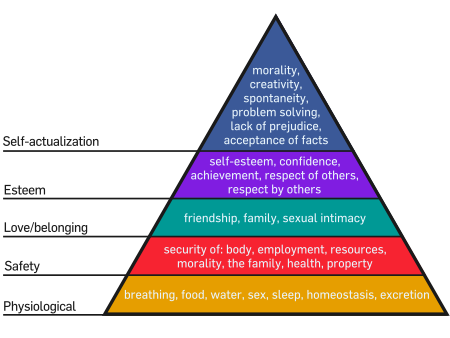
Your question can be answered with a simple visit to good old Maslow's hierarchy of needs.


Homosexuality and other social issues are so-called "luxury-problems". If you're on the verge of starving to death, then you don't have time to complain about not being socially accepted. The better our lives get, the more numerous and more insignificant problems will arise.
Food -> Shelter -> Consistency/group membership -> Self-esteem/acceptance -> entertainment.

If you worry about finding food or shelter, then you won't worry about fulfilling yourself.
So yeah, sure. Solving gigantic problems is the cause of the emergence of small problems.
 

Silver

New member
Jun 17, 2008
1,142
0
0
Agema said:
Silver said:
That's a pretty good answer.

However, actually I would like to add a caveat about what you say about depression stemming from dehumanisation in a large and relatively anonymous culture.

Small groups have their own problems. Closely-knit, often insular communities have often had strict rules about behaviour that is and is not acceptable within the community. Those people who don't fit within the community experience a lot of unhappiness, because they are forced to deny their natures and preferences or risk alienation if they did. In this sense, maybe we have merely exchanged one depressing thing for another. Obviously, this also means that the cracks of several "un-natural problems" (as the OP puts it) are papered over, it's not they aren't there.

There will likely be a lower prevalence of minorities in small communities. If a certain minority interest or preference is sufficiently uncommon, people will tend to leave small communities because it is too hard to find like-minded people, even if there is no hostility towards their inclinations.
You will notice I never claimed one was better than the other, or that a smaller, insular community was the solution. Far from it, in fact.

I should point out, that everything after this point is purely my own subjective opinion, and my own conclusions.

The solution isn't to divide ourselves into smaller, isolated groups. That won't work, and will impede progress towards something better (progress in itself is not a good thing, and can be defined any number of ways, progress towards something better however, is by definition, good) for all of us, no matter what we identify ourselves as. The solution is to find a way to rehumanize the population, to turn ourselves from being just numbers and statistics, to actual individuals. I believe a smaller population, or a new start would be almost pivotal to accomplish this, but it might be possible to do in some other way. By being a smaller group, every one of us could understand everyone else in the group, and if a group wasn't limited by where or how you were born, as it currently is, but by what you believed, or felt, the sense of community within the group would increase.

I believe groups such as this should replace our normal families, it's an outdated concept not in line with how we work. Biologicaly we're not supposed to live in nuclear families, we're pack animals. Socially, being raised by a wider group of people would give us a broader, more open view of things. If raised by just two parents, any flaws they pass on will be present in us, if raised by a bigger group, we're allowed a greater store of knowledge.

These groups could interact with each other, in much the same way as individuals toward each other. Much like how in a school you might recognize everyone as belonging to certain majors, or classes, or clubs (if they exist), you would see people as more than just a grey mass. There is of course the risk that this would cause strained relations between groups, just like between the stereotypical jock and nerd antagonism in the school example, but hopefully we could avoid that. We'd be smaller societies within a greater one, in essence. It's slower than our current political system, but if each of these groups had a representative in a government, we'd know our voices were heard, since we'd all have someone we knew there. It'd be a few more steps to clear everything, but with the ease of communication we have nowadays, it should be possible to make it much faster than it is currently (but not faster than it SHOULD currently be, if proceedings were just made simpler, and more efficient). Basically each of these family units would have a let's call it district representative. Each district would have a city representative, each city a nation (or state, in the case of too big to function efficiently countries), and then an international group on top of that.

With this as a start, we could raise our children more tolerant, and with a greater freedom. We'd be able to find people with similar interests, and beliefs to ourselves, and have that provide comfort. If you didn't agree or fit in with your own group, you could pick another. There's still problems of course, some people of shared belief systems are automatically antagonistic towards others, especially religious people. Hopefully a part in gradually implementing this would be to make people of faith wake up a bit, and closer examine their beliefs, and how they have to impact others. I won't go into any further detail, hoping not to cause offence or derail the thread into yet another religious debate.

Yes, I know I'm a naïve, idealistic utopian, thanks for asking.
 

Eclectic Dreck

New member
Sep 3, 2008
6,660
0
0
Silver said:
There is no best way to raise someone, it depends on the desired results. Someone raised harshly, without enough food, money, resources, who'll have to struggle will be stronger, more adaptive, more resourceful, and will remain stable as long as the struggle remains. Someone raised in an indigenous tribe will be in much the same situation, but without the struggle, and pain, and therefore less strength. Someone raised in our cities, our urban areas will be more troubled because they have more time for it, and because most people aren't well adapted to deal with the sickening amount of problems present. We have the luxury to worry, to grow insane, to think too much, and not all of us can handle that, especially not surrounded by the things we are. With criminality rampant, with death, disease and murder all around us, every day, with the hero tales of our time depicting violence, disobediance, authority and theft as solutions for everything, we're bound to get confused. While we're being taught stealing is wrong, we cheer for the criminals of Ocean's 13. While murder is wrong, in every action movie the hero kills the villain, and the world rejoices. While we're told to respect the government, the laws, they're almost always the villain, and if not, they're greedy, ineffectual and stupid in movies, books, and games.
This is a seemingly reasonable explanation, but I do not know if it universally holds true. I do my best work (of any sort) when I am in a situation I am unfamiliar with and yet I was raised in a city in a stable environment. It is often stability, or to put it better, stagnation, that leads me down the road of depression and apathy.

Silver said:
Sure, it's just fiction, but that fiction is what we grow up around, what shapes us, just like the rest of society does. We're bombarded with so much information, about everything, from conflicting sources, every day, that's it's no wonder some of us can't handle it, and most of us grow unstable, or confused.
This is an interesting line of thought. Extended the question really is can one call any decsion their own? We are all influenced in some capacity by where we come from. Even recognizing the subtle tug at our minds that our upbringing constantly plays is difficult and resisting such things almost always leads to discomfort. This can obviously be overcome to an extent but doing so essentially means rejecting the notion of absolute morality. The first time a person truly starts weighing the universe in terms of nebulous relativity, the result is, perhaps at best, depression. Once you discard absolute morality as a basis for decision making you are left with few truths to cling to when facing a difficult moment in life. The prospect is certainly scary, and it's bad enough that most are content to follow the familiar and the known. There doesn't appear to be a way to completely free one's thoughts from their culture and upbringing because its often impossible to determine when such things are an influence. In some cases, there is a concious choice made to follow such traditions and I can hardly say that such a course is inherently worse than another.

Silver said:
The sheer size of society has also made it less of a society. In a tribe, in a small village, when you walk down the figurative street you see family, friends, neighbours. You see people you know. In a city, you hardly even see individuals. You see a huge mass of people, that you know nothing about, that know nothing about you. You see thousands of people every day, and you wouldn't even notice if all of them were dead the next day. And not a single one knows you even exist. That dehumanization of ourselves is the cause of a lot confusion, and depression, and problems. It's hard to deal with, both as an individual, and for the authority. They get figures about unemployement, about criminal activity, and they're supposed to do something about it, but people aren't just numbers, and just increasing the number of police on the street, or the amount of money diverted into schools isn't going to make the problems underlying it all go away.
There is a certain line of thinking that states living in an urban center today means you are alone in a crowd. I tend to agree in general. In my k-12 education, I spent twelve years with many of the same people and, as a result, came to know the bulk of my classmates in some capacity or another. In college however, since the class sizes have grown well beyond the 400 people in my high school class, I can't say that I really know anybody. There are people that I recognize certainly but there are only a handful that I truly know anything about. This does breed a certain feeling of isolation from my peers but I generally rationalize that I'm not there to make friends and attend parties.

Speaking of parties, as a general rule it would seem that, if invited to a small gathering of people that you generally don't know, a person can make an effort to actually become a part of the group. If the collection of people raises too high, this becomes nearly impossible. I suspect the reason is because once a group exceeds a certain threshold, it actually is a mass of people that is sub-divided into other groups. The dyanmics are not often clear and as a result, you will likely end up only socializing with a single sub group in this mass, generally the one that the person who invited you ends up with.

Silver said:
The reason there are seemingly less homosexuals in a group such as an indiggenous tribe is that it's not a luxury that can be affored, and because of the more limited gene pool. Birth disorders are at least just as common, probably more so, BUT they're not as well known. And in a city you have far more people. If it only happens to every 1 in say 10000 people, not an unreasonable assumption, then it'll happen to a large number of people in a city of several million, but only once every few generations in a tribe of 500. And when it does, only that single tribe would know about it, whereas in a city, news travel around the entire world, can reach millions of people, in seconds. I don't know what other unnatural problems you refer to, since neither of those are in any way unnatural.
I'll agree with this in a general way. I would point out that in a tribal setting, tradition and inherited ethics and morality are stronger because you have a generally homogonous group. A city can be thought of as a collection of homogenous groups. Distancing yourself from one group (say a traditional "American Values by Republican definition") to another (a more progressive one that accepts homosexuality as a valid option) is an option in such a setting. As a social creature, people generally want to find acceptance in a group; those that don't are generally classified as being insane. It would appear that this is a reasonble classification because without the drive to be a part of a group of some kind (regardless of postion, leading or following or somewhere in between) there is little motivation to interact with people on a social level. Such a person is generally classified as a sociopath.

Silver said:
And even if homosexuality exists such groups, which (believe me) it does, it doesn't exist in the same way as in an urban center. Some groups would hide it, some groups wouldn't even notice it, and wouldn't care. It's not the subject of the same sort of scrutiny or controversy as it is in western society today. It's a hot subject at the moment, but that doesn't mean everyone think it's that important, or care about it in the same way.

It seems to be the case, at least in western society, that homosexuality has always been present. In some cultures (Greek, Roman) it was accepted as being such a perfectly normal thing that it may be considered strange if one never engaged in it. At times throughout history, this has been repressed by governing organizations but the fact that it persists throughout history makes me believe that it is, at the very least, a common factor in human relations. If one moves beyond the notion that such things are an affront to god the argument against homosexuality becomes "but what about the children". In this case, there is an assertion that something that has seemingly always existed to an extent in western society is somehow harmful to a child. I suspect what the argument really boils down to is simply this: if one doesn't approve of homosexuality, then it stands to reason they would take a stand against the potential creation of another homosexual. This really seems to be the crux of the argument when one discards god from the discussion (which itself is a reasonable move as there can be no discourse when divine intervention is injected into an argument - a postion on the moral highground is inassailable and thus harmful for any reasoned debate), the argument becomes "it shouldn't be allowed because such a course would surely lead to more homosexuals, which I don't approve of". The welfare of the child has nothing to do with it in general.

All that said, an excellent post.
 

Silver

New member
Jun 17, 2008
1,142
0
0
Eclectic Dreck said:
This is a seemingly reasonable explanation, but I do not know if it universally holds true. I do my best work (of any sort) when I am in a situation I am unfamiliar with and yet I was raised in a city in a stable environment. It is often stability, or to put it better, stagnation, that leads me down the road of depression and apathy.

*Snip*

There is a certain line of thinking that states living in an urban center today means you are alone in a crowd. I tend to agree in general. In my k-12 education, I spent twelve years with many of the same people and, as a result, came to know the bulk of my classmates in some capacity or another. In college however, since the class sizes have grown well beyond the 400 people in my high school class, I can't say that I really know anybody. There are people that I recognize certainly but there are only a handful that I truly know anything about. This does breed a certain feeling of isolation from my peers but I generally rationalize that I'm not there to make friends and attend parties.

Speaking of parties, as a general rule it would seem that, if invited to a small gathering of people that you generally don't know, a person can make an effort to actually become a part of the group. If the collection of people raises too high, this becomes nearly impossible. I suspect the reason is because once a group exceeds a certain threshold, it actually is a mass of people that is sub-divided into other groups. The dyanmics are not often clear and as a result, you will likely end up only socializing with a single sub group in this mass, generally the one that the person who invited you ends up with.

*Snip*
Emotional and psychological stability or instability have little or nothing in common with unfamiliar enviroments, or a stable upbringing. While a stagnant and dull lifestyle can easily lead one to a depressive state, an unstable mental state is far more likely to cause actual clinical depression in someone. It's important to keep the two separate, as, while in both cases (depression and stability) the words are the same, the meaning is very different. It can lead to misunderstandings, and a lot of unecessary grief (when it comes to depression, and the inability to distinguish momentary depression with the psychological condition). What I referred to was the mental state of people, not necessarily the situation around them. I believe that a stable environment is important, when growing up, and to have the ability to retreat to one though, despite, as you say, being very fond of the unfamiliar and unknown. I don't think I'd be so keen on it if I didn't have somewhere mostly stable to retreat to, however, or if I was more unstable myself, emotionally.

Being alone in a crowd stands at the basis of my argument, yes. It's an interesting observation with parties, while I don't have enough experience to draw the conclusions on my own, when you point it out I can draw parallels from my own experiences.

On the subject of free will and our upbringing, I won't get into it. It's certainly an intriguing philosophical discussion on it's own, but it's not for now. I choose to believe we are capable of making our own way, and our own choices though, no matter what we've experienced before. (At the same time, I can't keep myself from blaming myself when I assume that of those I know, instead of assuming they'll act according to their nature, but that too, is a discussion for another time.)


What you bring up about homosexuality is interesting. While it has existed in some form or another for a very long time, it's rarely been as complete, and open, as the issue is nowadays. In ancient Greece it was men who engaged in homosexual practices, but never exclusively (at least not without suffering even more scorn than today). A man might take younger male lovers, but he also married. And female homosexuality has been far less prevalent. There was the unconfirmed practices of Sappho, on Lesbos and her school, but she too was married, and had a daughter. Still, this too is a discussion for another time.

Finally, I'd like so say thank you for praise. I think I've said what I need to on the subject, for the moment.
 

Parallel Streaks

New member
Jan 16, 2008
784
0
0
I lived in a rural town. It was full of loud-mouthed chavs, drug-abuse, violence and intolerance. They were NOT stable. Now I'm in the city I feel a lot safer and more at home, then again it could be the anonymity that the City gives you, if you do something embarrassing in public in a small town you are going to hear about it for a while, if you do it in a city chances are people probs won't think twice about it.