
Is psychology a science?
- Thread starter HeyListen
- Start date
Recommended Videos


That's actually somewhat true. The standard model was put together ala Frankenstein by physicists using sheer experimental data and lots of smarts, but it was deduced by some mathematician dude using mathematical theory (kaluza-Klein) waaaaay before that, yet people never knew about it because a) he wasn't famous and b) the World War fucked Europe up.The Shade said:Psychology is a derivative of mathematics. Just like everything else.
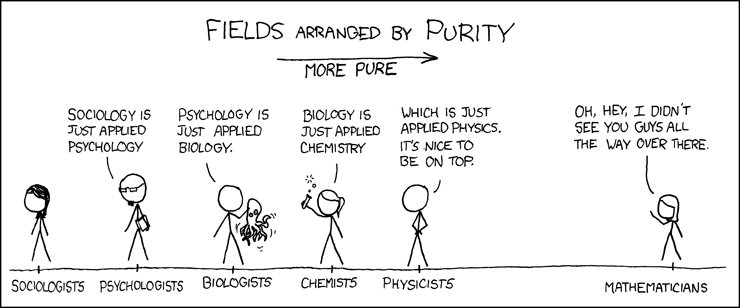
Also, a mathematician whose last name was Ramanujan found some modular functions that turns out also turn up in superstring theory. Magic numbers and all.
But it is too bad that pure math amounts to shit just by itself, otherwise we would be close to singing "FUCK YEAH" as we close in to the appropriate solutions for superstring theory. The hardcore experimentation of physicists is what makes stuff really, really matter in the natural world.

It's a human science. And with humans, we change constantly and come in so many variations. So it's an unstable science, that won't stabilize till it's out of its infancy stage.

Do I really have to do this?
Now tell me that isn't a science. Anything that claims to be Psychology but is not scientific is not Modern Psychology.British Psychological Society said:If you tell your friends you are interested in psychology, common reactions might be 'well can you tell what I'm thinking then?' or 'Psychology? That's all just common sense isn't it?'
But psychology is actually based in science and psychologists learn the scientific basis of human behaviour by observing, measuring, testing, and using statistics to show that what they find is reliable evidence and not just down to chance.

dear god i hate this question... we dedicated two courses to discussing that topic at my uni, and the only thing we came up with was "it's both an art and a science"...
YAY!
my point was... what the hell does it matter? determining whether it's a science or an art is irrelevant to any actual function, beyond "if we say it's a science, the chemisty nerds will stop picking on us"
YAY!
my point was... what the hell does it matter? determining whether it's a science or an art is irrelevant to any actual function, beyond "if we say it's a science, the chemisty nerds will stop picking on us"

I agree completely. In my mind, Anthropology is a softer science than Psych. With many anthropology courses you learn about how experts study artifacts and then deduce what they were used for. This is softer science than trying to test spatial awareness in a maze, or seeing what happens when you alternate color patterns on a wall in front of a child while monitoring their eye movements to determine what patterns and colors are most visible.FightThePower said:Thank you. Actually, I'll write that again in big letters:high_castle said:This isn't even debatable, and I'd be surprised if any of the kids debating this in your school have ever actually taken psychology (few schools offer a comprehensive course in it, just overviews that gloss over the hard facts). If you study it in college or post-graduate, you'll find it's a much "harder" science than most people assume. It's very much concerned with the flow of information along the nervous system in addition to the fields of behavior.
I hate when people debate the validity of something they don't understand. Study it for four years and get back to me.
[HEADING=3]THANK YOU[/HEADING]
Like I said, as someone who does Psychology as a degree, there is nothing more frustrating to see people say "it's not a science" when I've taken my time to study it properly and know that they are compeltely wrong.
It's like when people say "you know we only use 10% of a our brains". Most irritating myth ever.
People of science had this same debate 50 years ago and they came to the conclusion that it is, in fact, an own branch in science. Also you can do tests with the same "rules" as any other science and get answers in the same way as e.g. physics and chemistry. So yes, it is a science.
I've taken many courses in psychology and wrote it in a matriculation examination, this means I had 7 books to read + everything I had noted in class over a period of 3 years (all in all maybe 1 school year worth of work) learn that all over and write a test about it all. One of these courses was about psychology as a part of science and how it already has evolved into science and how psychologists use the same measurements as physicists or chemists to learn new things and achieve data, So basically not calling psychology a science then you are not calling physics or chemistry science either, since those have approved psychology as a part of the scientific circle, this happened about 50 years ago.
I've taken many courses in psychology and wrote it in a matriculation examination, this means I had 7 books to read + everything I had noted in class over a period of 3 years (all in all maybe 1 school year worth of work) learn that all over and write a test about it all. One of these courses was about psychology as a part of science and how it already has evolved into science and how psychologists use the same measurements as physicists or chemists to learn new things and achieve data, So basically not calling psychology a science then you are not calling physics or chemistry science either, since those have approved psychology as a part of the scientific circle, this happened about 50 years ago.

Name a Psychological construct that has proven validity in a non-laboratory test. It's still all theory that works "some" of the time. A Hard Science would need it to work all of the time.Phyroxis said:Untrue. Look at the application facets of Social or Industrial/Organizational psychology. They apply psychological theory and scientific findings to the "real world" and get pretty good results.The_root_of_all_evil said:It's a soft science. It deals with theory rather than practical implications.
Science in general is the ordered process of deciphering the laws of the Universe, as they pertain to us.crudus said:What is the rest of science?The_root_of_all_evil said:It's a soft science. It deals with theory rather than practical implications.
Hard Science like Mathematics deal with the laws themselves.
Medium Science like Chemistry deal with the laws as they pertain to us. (As they can only be proved by observation rather than logic)
Soft Science deals with pertaining to us. (As their proof can only be obtained through dividing us into those that can experience certain laws (Defined by Hard, Designated by Medium) and those that can't/won't/don't)
And if the soft sciences get upset by this, they earn a hell of a lot more.

if there are still relevant questions unanswered, then I would gladly call the people studying psychology scientists.
The problem is that psychology deals with living beings and not objects or mathematic theories and therefore there will probably never be a 100% complete thing, ever in psychology. (It still is a part of science), did you come up with "soft science" or is it something they actually use to tell how well a theory works in a natural environment or have I completely misunderstood you?The_root_of_all_evil said:Name a Psychological construct that has proven validity in a non-laboratory test. It's still all theory that works "some" of the time. A Hard Science would need it to work all of the time.Phyroxis said:Untrue. Look at the application facets of Social or Industrial/Organizational psychology. They apply psychological theory and scientific findings to the "real world" and get pretty good results.The_root_of_all_evil said:It's a soft science. It deals with theory rather than practical implications.
That's why it'd defined as soft as things can't be 100% proven. It's not an insult, just an expression.Guffe said:The problem is that psychology deals with living beings and not objects or mathematic theories and therefore there will probably never be a 100% complete thing, ever in psychology. (It still is a part of science),
Nope, been around long before me: http://en.wikipedia.org/wiki/Hard_and_soft_sciencedid you come up with "soft science" or is it something they actually use to tell how well a theory works in a natural environment or have I completely misunderstood you?
Soft Computing may provide the answers you seek as that's basically fuzzy logic.
I remembered a psychological test that works all the time!!!The_root_of_all_evil said:That's why it'd defined as soft as things can't be 100% proven. It's not an insult, just an expression.Guffe said:The problem is that psychology deals with living beings and not objects or mathematic theories and therefore there will probably never be a 100% complete thing, ever in psychology. (It still is a part of science),
Nope, been around long before me: http://en.wikipedia.org/wiki/Hard_and_soft_sciencedid you come up with "soft science" or is it something they actually use to tell how well a theory works in a natural environment or have I completely misunderstood you?
Soft Computing may provide the answers you seek as that's basically fuzzy logic.
If you have been drinking alcohol it slows your impulses in your nervous system making you react slower to things happening around you ^^. We did this test once and it's scary how much two pints already affects you when driving a car.

The_root_of_all_evil said:Name a Psychological construct that has proven validity in a non-laboratory test. It's still all theory that works "some" of the time. A Hard Science would need it to work all of the time.Phyroxis said:Untrue. Look at the application facets of Social or Industrial/Organizational psychology. They apply psychological theory and scientific findings to the "real world" and get pretty good results.The_root_of_all_evil said:It's a soft science. It deals with theory rather than practical implications.
Science in general is the ordered process of deciphering the laws of the Universe, as they pertain to us.crudus said:What is the rest of science?The_root_of_all_evil said:It's a soft science. It deals with theory rather than practical implications.
Hard Science like Mathematics deal with the laws themselves.
Medium Science like Chemistry deal with the laws as they pertain to us. (As they can only be proved by observation rather than logic)
Soft Science deals with pertaining to us. (As their proof can only be obtained through dividing us into those that can experience certain laws (Defined by Hard, Designated by Medium) and those that can't/won't/don't)
And if the soft sciences get upset by this, they earn a hell of a lot more.
Irrelevant.. The soft vs hard science dichotomy is a fallacy that is simply a social dick-waving concept used, usually, by members outside of the associated sciences (or students trying to prove their major is better than that of someone else) trying to establish a "dominant" science (or sciences).
Secondly, applicability of a discipline doesn't determine its validity as a science. What makes a science, simply put, is the degree to which it applies the scientific method. For the purposes of this discussion, Psychology is a science as a majority of (because there are outlier nuts in every population) the prominent, active, researchers within the discipline use the scientific method and all it entails (ie, internal/external control, reproducibility, disprovable hypotheses).
And dick-waving falls directly under the purveyance of ...psychology. Maths doesn't have directly conflicting ego-races.Phyroxis said:The soft vs hard science dichotomy is a fallacy that is simply a social dick-waving concept used, usually, by members outside of the associated sciences (or students trying to prove their major is better than that of someone else) trying to establish a "dominant" science.
Psychology have to engage a tolerance on all their results from the start due to observer bias. Hardly the scientific method.What makes a science, simply put, is the degree to which it applies the scientific method.
Purview of study. Study and participation are two different things. I don't know of any discipline that is immune to dick-wavers. Doesn't change the status of a science.The_root_of_all_evil said:And dick-waving falls directly under the purveyance of ...psychology. Maths doesn't have directly conflicting ego-races.Phyroxis said:The soft vs hard science dichotomy is a fallacy that is simply a social dick-waving concept used, usually, by members outside of the associated sciences (or students trying to prove their major is better than that of someone else) trying to establish a "dominant" science.
Not true..? Well designed Psychological experiments not only marginalize but can even eliminate observer bias. Statistics is an accepted methodology and creates solid theories. No, Psychological theories can't be 100% certain every time, but that doesn't invalidate a discipline as a science. Physics can't predict the movement of quarks (it can make strong guesses), but its not disqualified as a science.Psychology have to engage a tolerance on all their results from the start due to observer bias. Hardly the scientific method.What makes a science, simply put, is the degree to which it applies the scientific method.
Psychology can make consistent predictions for trends and tendencies. Its not 100% accurate, but when dealing with the most complex subjects known to man (himself), you can't expect that sort of result with the methodologies currently in existence. Furthermore, dealing with humans as subjects leads me to argue that Psychology is the (if we resort to the dichotomy that you seem to be wed to) hardest of sciences.

Not if you compare it to the exact (or 'natural') sciences. But it is a social science, and still follows the scientific method.
Like the other social sciences (cultural anthropology, history, sociology, and so on) you can't truly arrive at universal theories because empirical observation is impossible, and abstracted generalisation is never truly representative.
However, I'd say that they are sciences on their own terms. As they should be observed. The social sciences have given us insights into human interaction and culture that higher mathematics would never have given us, if only because mathematics do not ask such questions.
And, to conclude, I'd say you can't compare the two branches of science. Nor can you reduce the one solely to the other. You can't solely reduce sociology back to psychology. You can't solely reduce psychology to biology and so on.
Like the other social sciences (cultural anthropology, history, sociology, and so on) you can't truly arrive at universal theories because empirical observation is impossible, and abstracted generalisation is never truly representative.
However, I'd say that they are sciences on their own terms. As they should be observed. The social sciences have given us insights into human interaction and culture that higher mathematics would never have given us, if only because mathematics do not ask such questions.
And, to conclude, I'd say you can't compare the two branches of science. Nor can you reduce the one solely to the other. You can't solely reduce sociology back to psychology. You can't solely reduce psychology to biology and so on.
Zaverexus is right. It is a social science. But, I think it is, yeah.Zaverexus said:I'm taking a psychology class right now and at least according to that class, psychology is a SOCIAL science, so in the sense of rigidly defined exact science, no it is not, but I believe it still counts
tbf, that's more biochemistry because of the suppression of excitatory nerve pathway activity and increase of inhibitory nerve pathway activity due to ethanol. And even biochem. would flinch at the idea of "pints".Guffe said:I remembered a psychological test that works all the time!!!
If you have been drinking alcohol it slows your impulses in your nervous system making you react slower to things happening around you ^^. We did this test once and it's scary how much two pints already affects you when driving a car.