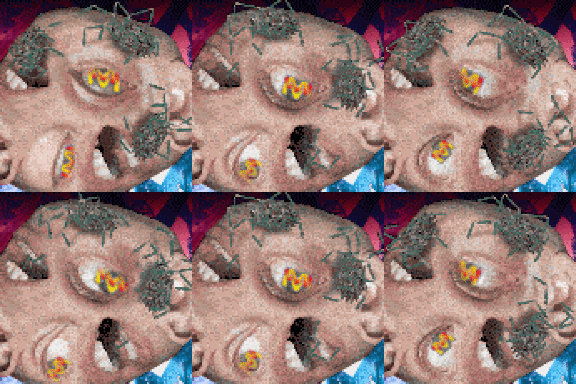
Lovecraft is an acquired taste, I think. Nowadays, Horror is more about well-known facets of our world peeling their masks back to reveal something wretched underneath; an action that either warrants sympathy or revulsion. It's gone to the point where the horrific and the commonplace are merging, and you end up with stuff that's not that far from Wondrous Realism.
Read stuff by Gabriel Garcia Marquez, as an example, and you'll see characters react to angels falling out of the sky and into chicken coops with an utter lack of surprise. We're pretty much smack-dab in this particular phase, where everything is so known and has been revisited so many times we're down to having vampire coworkers during night shifts who barely even have to hide. Or, you know, stuff like the Southern Vampire Mysteries. Blech.
Lovecraft really speaks to how things were before. Lovecraft was really active between the years 1910 and 1930 or thereabouts, and he's got old aristocratic roots. Considering this, there's still a very English bend to what he does, a bit of a Colonialist spirit; just twisted and turned really fucking negative. Between reading him and reading Poe, there's not really a whole lot of differences. The scope is simply bigger, more or less swapping traditional Gothic Horror for Pulp Horror, which means that the notion of travel, or of something coming from a far-off exotic place comes into play often enough.
To appreciate Lovecraft and the Mythos in general, you need to remember that a lot of things we take for granted in today's science were just on the cusp of being tested or discovered, in his time. Remember how the Large Hadron Collider made people freak out before it was turned on? If Lovecraft were alive today, he'd have written something about the LHC tearing the fabric of reality apart and letting unspeakable horrors in, much to everyone's doom and assured eternal suffering.
That's Lovecraft's deal, essentially. Whatever's left that qualifies as an Unknown, no matter if you're talking about a geographic location, a scientific principle or, well, whatever lies outside of the human eye's ability to perceive the color spectrum. What really drives this point home is how bigoted, conservative and in general just plain fucking racist he was. Not because he's an asshole on paper, far from it - but because these were the societal norms, back in his day.
In a sense, and I'm really simplifying things here, Lovecraft can and will appeal to you if you can imagine that a black pharaoh (not "African" black or "African-American" black; really "pitch-black" black) ruled over Egypt at some point in time and actually was the human guise worn by one of the Great Old Ones. You have to accept the idea that there's things Man Was Not Meant to Know - and you need to have some level of tolerance for plot devices which are pretty commonplace, today. "The Whisperer in Darkness" loses a lot of its impact if you just stick to the fact that it's another rendition of "OMG, THIS WAS SOME MONSTER WEARING MY FRIEND'S SKIN THE ENTIRE TIME!!"
The short and sweet of it is Lovecraft can't just be gobbled up wholesale like Stephen King. Not in 2012, at least. If you're into moldy aristocracy and forgotten civilizations, though, this just might fit the bill, along with anything by H. Rider Haggard, Arthur Machen, Robert Bloch, Lord Dunsany; so on and so forth.





 That doesn't change the fact that when it was first published it was considered the most terrifying story of it's time.