Oh, LGBT in manga, anime and cartoons! I wanna join the discussion!
What I noticed in western media, is that gay relationships are often used as a statement or message. These characters don't just get together because they love eachother, they get together because the writer has something to say. It makes sense, sure. American LGBT people wouldn't be where they are now without decades of activism and there's still so much they have to fight for. Using fiction to send a message feels natural. And couples like Korrasami aren't just a message, they show and conform a level of power and freedom gained through activism.
Looking at it like that, it's hard to hate media that sends a positive message. However, the actual writing is often a little awkward, as the means to actually show the developing relationships are often limited. Korrasami was pretty much all subtext until the finale confirmed it. And actually, the finale didn't even confirm is enough, because there were so many people who kept saying 'they're just friends!' the creators had to step in. As much as I like the idea of Korrasami, its execution was an awkward mess.
And using that awkwardness, we elegantly jump to Japan, were things are weird in a different way, the big elephant in the room being, of course, the boys love genre. Male-male romances primarily created and consumed by heterosexual women. While there are rare titles that could be seen as representative, these works mostly serve as a way for women to play with gender. With no female characters around, readers and creators are free to shed the confines of their gender role, and attribute male and female gender aspects as they see fit, creating their own perfect fantasy couples. They can identify with either one of the male characters, or enjoy the relationship as an onlooker. Freedom in fiction. This is entirely different from actual gay fiction produced and consumed by gay men.
Female-female romances (yuri) have similar but different origins, dating back to fiction idealising pure relationships between girls, Takarazuka theatre and so on. Though here's it's harder to tell how much is made for and by gay women.
BL, gay fiction and yuri are seen as genres that exist outside of the mainstream manga market, but that doesn't mean you don't see gay relationships in more mainstream works. For instance, Fumi Yoshinaga's What Did You Eat Yesterday, a cooking manga about a middle aged gay couple, runs in a magazine aimed at young men. And wow, Yuri!!! on Ice is looking really promising. So, yay, representation! ... Maybe? Though it's not too difficult to find relatively realistic gay people in manga and anime, they're not the only ones bring the gay to anime.
Subtext is a thing. Many popular series leave some room for the imagination of the reader/viewer, so they can pair of characters to their liking. It's pretty obvious in series like Black Butler and Seraph of the End. And even if there's no subtext, many fans will gladly fantasise about the possibilities anyway. Put on your yaoi goggles and imagine a world where Aldnoah.Zero's Inaho and Slaine are just the cutest couple... despite the two trying to kill eachother on multiple occassions in canon.
Meanwhile, on television, crossdressing and homosexuality play yet another role. Charicatures and stereotypes meant to be entertaining are still common, and even the people who do identify as LGBT tend to be over the top. There is, again, a disconnect between real-life and entertainment. No wonder Persona 4's Kanji was struggling with his sexual identity...
And on top of that is the situation of actual gay people. While polls show younger generations are accepting of LGBT people, many older generations still frown upon them. However, unlike in the US (and Europe) this has nothing to do with religion. They don't feel homosexuality as a sin, but as an irresponsible lifestyle. To them, LGBT people are refusing to play the role society needs them to play: settle down and have children. Hate crimes are practically unheard of. And while LGBT people are working to gain more right, this doesn't involve protests or parades. Most progress is made through regular political routes.
...
Yay, episode 7 was really cute?
NPC009 said:
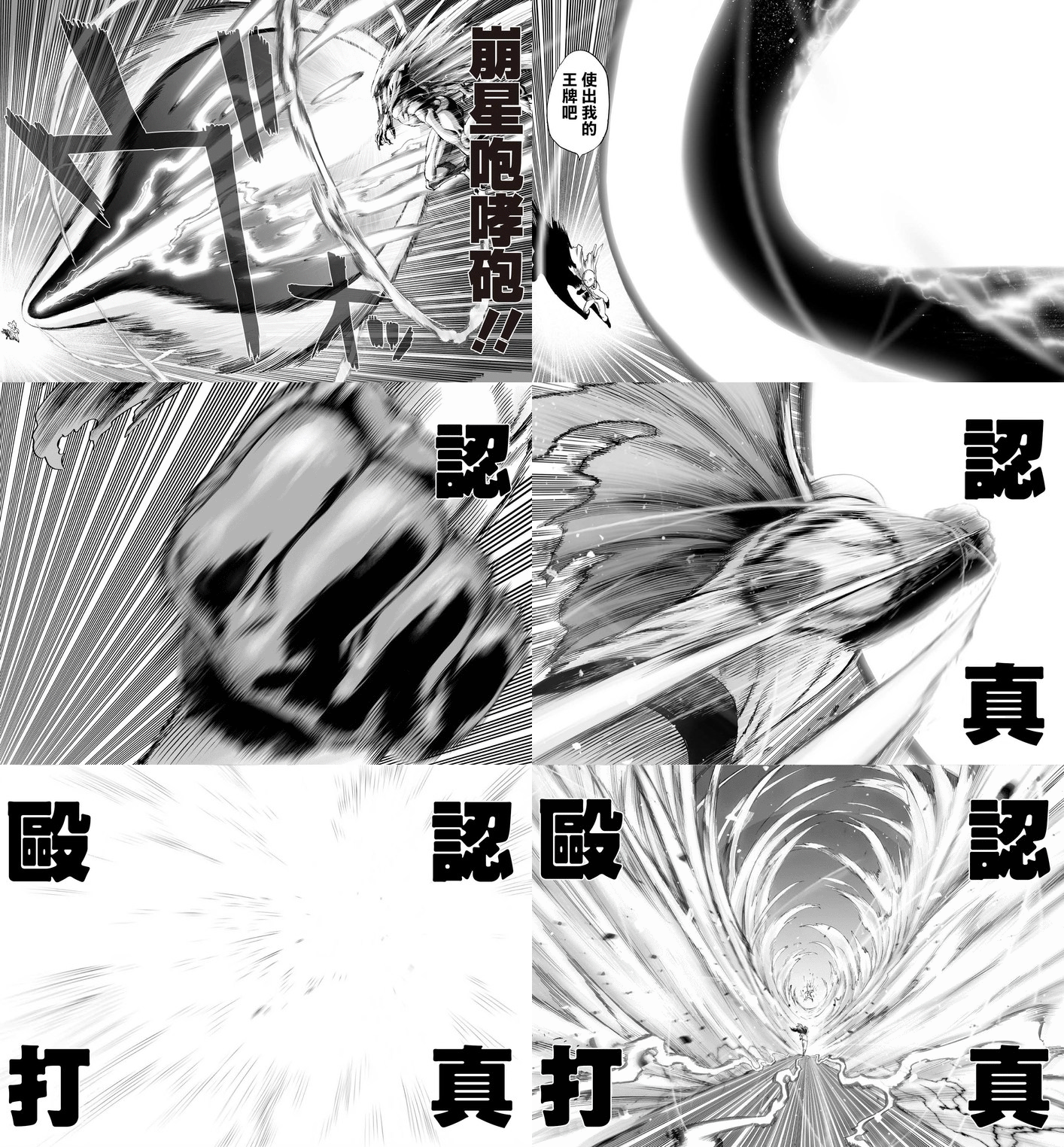
In most cases, genre deconstructions end up in depressing bloodbaths, and yes, that doesn't really go for One-Punch Man and Mob Psycho 100, but One does do what a deconstruction is supposed to do: he takes the common tropes, plays them straight and sees where is goes from there. The biggest difference with most deconstructive titles is that he makes comedies out of it.
Look at Saitama. He's like early Superman: so strong, saving the day is matter of just showing up. Unlike early Superman, this actually affects him emotionally. His life feels empty and his emotions are blunted.
Yeah, deconstruction doesn't need to be bloody but it needs to be critical of the genre and I can't really see it in OPM and MOB, Saitama feels empty and the first episodes do follow on that but he seems to get much better afterwards after spending some time with the rest of the cast. If anything it sometimes reconstructs the genre as the case with Kamen Biker (at least I think it was his name) and the green haired girl's sister that pretty much glorifies the rank system as even the weak heroes can help.[/quote]
Good points. Looking at it that way, I think One does bits of both: deconstructing in order to reconstruct. Whereas many other titles see deconstruction more as a method of destruction. And while destruction can be interesting in its own right, there have been to many titles lately that deconstruct for the sake of being grim and gritty.