
Proven in 1995 by Sir Andrew Wiles. Yes, he was actually knighted for solving it.ViciousTide said:Prove that a^n = b^n + c^n has no nonzero integer solutions for n>2.
http://en.wikipedia.org/wiki/Wiles%27s_proof_of_Fermat%27s_Last_Theorem

Proven in 1995 by Sir Andrew Wiles. Yes, he was actually knighted for solving it.ViciousTide said:Prove that a^n = b^n + c^n has no nonzero integer solutions for n>2.

I know I had a thread about it, might not have been the thread Lionsfan was talking about.DoPo said:That was funny, lol! While I haven't seen the thread, I can just imagine how it went...mmm, that would have been...interestingLionsfan said:The Cracked Article [http://www.cracked.com/blog/6-innocent-sounding-topics-that-are-guaranteed-flame-wars/], unfortunately (fortunately?), the actual topic on here got locked. But yeah......that was a nasty discussion, worse than some of the feminism threads

Again, that proof is about positive numbers, not integers as a whole. It's the same thing I said immediately before your comment - we have no solution for negative numbers.Bad Jim said:Proven in 1995 by Sir Andrew Wiles. Yes, he was actually knighted for solving it.ViciousTide said:Prove that a^n = b^n + c^n has no nonzero integer solutions for n>2.
http://en.wikipedia.org/wiki/Wiles%27s_proof_of_Fermat%27s_Last_Theorem

Dang, you got it with out even looking at it, you musta seen alto more of these then I have.DoPo said:snip

Not about mnemonics, just questioning the left to right orderexcalipoor said:The alternative solution is wrong, despite what your mnemonics tell you. Multiplication isn't a higher priority than division, neither is addition higher than subtraction.platinawolf said:8/2*(5-1)+1 = ?
*Snip*
 Mind you, the teacher was talking about logical operators but still ^^* If a thing possibly could be interpreted in two ways then whoever wrote the thing didn't do their job properly and you should slap them with both possible solutions.

What is this witchcraft?Dirty Hipsters said:Now here's a real math trick, and one that's practical, because it gives you INFINITE CHOCOLATE:


Oh that seems fun:madwarper said:If you really wanted to use a mathematical sleight of hand to confuse someone, I prefer using the "30th Dollar" story.
There are 3 businessmen on a trip. They decide to stay over night in a hotel, fortunately the only room open is a triple. The men agree to share it and split the cost evenly, which costs $30.
So, how much does each man pay to split the cost evenly? ___
Ok, the men check into the room and get settled. Later on, when the night clerk comes on, he goes over the books and sees that there's currently a discount on triple rooms and the 3 men had been overcharged. The room actually costs $25. He calls over Johnny the Bellhop, gives him 5 $1 bills and tells him to give the men the refund. Now, Johnny the Bellhop is a bit dishonest and knows that 5 doesn't divide into 3 evenly. He takes 2 $1 bills and puts them into his pocket.
So, how much is in Johnny's pocket? ___ How much is in his hand? ___ How much is in the cash register? ___ And that total is? ___
Ok, Johnny arrives at the triple room, knocks at the door, tells them they had been overcharged and gives them the 3 $1 bills as a refund.
So, how much did each man pay originally? ___ How much did each man get back? ___ So, the each men ended up spending? ___ How much did the 3 men end up paying? ___ And, add the $2 in Johnny's pocket, how much is that? ___ Where's the 30th Dollar?
So, how much does each man pay to split the cost evenly? $10
[...]
So, how much is in Johnny's pocket? 2 $1 bills How much is in his hand? 3 $1 bills How much is in the cash register? $25 And that total is? $30
[...]
So, how much did each man pay originally? $10 How much did each man get back? $1 So, the each men ended up spending? $9 How much did the 3 men end up paying? $27 And, add the $2 in Johnny's pocket, how much is that? $29 Where's the 30th Dollar?
Its just a trick. As it moves the blocks extend downwards a bit, making them bigger than when they started.Evil Smurf said:What is this witchcraft?Dirty Hipsters said:Now here's a real math trick, and one that's practical, because it gives you INFINITE CHOCOLATE:
https://encrypted-tbn1.gstatic.com/images?q=tbn:ANd9GcQ--90UkVVWF0U0Jv9JvrORSCR77MQbpetjic_XhujtYls_0tiw9w
Seriously how the shit does that work?


Hmm, actually good thinking. It does boil down to Fermat's Last Theorem again. See, I said I'm not into maths that much - it didn't even cross my mind.Dijkstra said:Well assuming n is an integer, if it's even then negative or positive is irrelevant. If it's odd then if all 3 are negative, that cancels out. If one is negative, move it to the other side and we get the exact same problem. If two are negative... well it can't be both b and c since they couldn't add to a positive. If it's a and another then you just move the other to the same side as a and you get the same problem again. So... if n is an integer then the problem for a, b, and c is an integer reduces to the problem that a, b, and c are positive integers.DoPo said:No, Fermat's work is about positive numbers, while this asks about integers, hence it's possible to have negative solutions. Or maybe not. I'm not that into maths to even attempt solving it.Dijkstra said:Fermat's Last Theorem, eh? Didn't it get proven at some point? Though IIRC it would not be something I'd understand or expect anyone here to be able to...ViciousTide said:Prove that a^n = b^n + c^n has no nonzero integer solutions for n>2.

There's also thisEvil Smurf said:Seriously how the shit does that work?
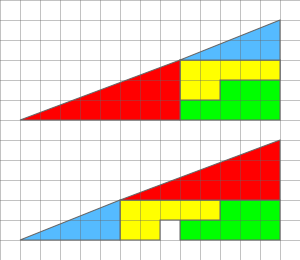
BrotherRool said:There's also thisEvil Smurf said:Seriously how the shit does that work?
Although I don't know if I was a fan of it. A teacher asked us to 'solve' it, so before doing anything we all said the obvious solution but he actually made us work it out to prove it (and the solution we'd guessed was correct) and it soured me to the puzzle