Goes to show you how little I care that I haven't researched this as much as you have. I'd much rather play and enjoy a game then worry about such things.Strazdas said:This is incorrect. Too often I hear people praise the Wii U by saying that it runs games at "1080p" while the other two consoles can't. This is NOT true. Nearly all games on the Wii U run at UPSCALED 1080p (fake 1080p). Do some research you'll see that only two AAA titles run at native 1080p (real 1080p). Those being WW HD and Rayman.WildFire15 said:I see no real excuse for Next-Gen systems not doing 1080p. The Wii U does it happily, so why shouldn't XB1 and PS4?
What resolutions are the games upscaled from? It's usually 720p, but can be as low as 600p. Fucking 600p!
You know what this means? There's more native 1080p games on the PS4 and Xbox One than there are on the Wii U. Much more, in fact.
Nintendo often distorting the truth about the technical aspects of their games. They like to lie about upscaled 1080p being the same as native 1080p.

No One Really Cares About 1080p, Says Far Cry 4 Dev
- Thread starter Steven Bogos
- Start date
Recommended Videos
I think I can understand his frustration, but both my tv and monitor are 1080p, so it matters to me!

He is right you know. The IGC makes a big deal out of a lot of things, and will twist what is happening if it doesn't fit their narrative if needed.
Ultimately Ubisoft is a hated performer by the IGC, but that means exactly nothing. Look at all the hated performers of the past who have been hated while drawing big no problem. Whats that? They can't do good stories? Can't do good graphics? Gameplay? They draw regardless which shows how much that matters.
Ultimately Ubisoft is a hated performer by the IGC, but that means exactly nothing. Look at all the hated performers of the past who have been hated while drawing big no problem. Whats that? They can't do good stories? Can't do good graphics? Gameplay? They draw regardless which shows how much that matters.

Shadow Fall and Second Son have an unlocked frame rate; and I get the feeling that Order 1886 will have one two; but all of them are reduced to 900p for some reason. If Uncharted 4 makes 1080p60, then there won't be any excuse for publishers.devotedsniper said:At least someone gets it!Darkbladex96 said:Exactly. It's not the consoles, it's the devs being inefficent as hell with their resources.
No the consoles aren't groundbreaking technologically speaking but they do have tremendous amounts of power compared to the old consoles, it's just right now we're stuck in the usual phase of I'm going to chuck everything at this new beast and pray it copes when a new generation appears.
I'm just disappointed they can't even achieve 1080p at a playable 30+fps when me and other pc gamers are starting to consider 4k and 1440p resolutions as viable options.
And it's not like the other platforms are doing any better; Digital Foundry had a hard time on Ultra1080p60 with a GTX 780 for Lords of the Fallen; and let's not get started with Evil Within.
Seriously now? What a crappy argument. It's not because there might indeed be few gamers (compared to the total) out there who actively debate about gaming online, that no one really cares about 720p vs 1080p anymore.
I'll say this: I'm not a graphics whore, I often play older games with crappy graphics and things like the general style and feel of a game are much more important for me than the graphical quality.
But when I play a game in 1080 versus 720p I definitely feel and see the difference, and if I CAN play it in a higher resolution I obviously will.
It's hugely ironic that after this new generation of consoles the same devs who were whoring all over graphics at the cost of gameplay suddenly start downgrading to make their unoptimized products run on the consoles they're releasing on, while claiming no one cares about such things anymore.
I'll say this: I'm not a graphics whore, I often play older games with crappy graphics and things like the general style and feel of a game are much more important for me than the graphical quality.
But when I play a game in 1080 versus 720p I definitely feel and see the difference, and if I CAN play it in a higher resolution I obviously will.
It's hugely ironic that after this new generation of consoles the same devs who were whoring all over graphics at the cost of gameplay suddenly start downgrading to make their unoptimized products run on the consoles they're releasing on, while claiming no one cares about such things anymore.

The irony when the developers of a series that gave us FarCry 1 talking about visuals not mattering.
I don't care if it is 1080p or not, they tried forcing it on us for years and now so many of our games on the 360/PS3 are 30fps which is sad given that they are capable of higher.
I don't care if it is 1080p or not, they tried forcing it on us for years and now so many of our games on the 360/PS3 are 30fps which is sad given that they are capable of higher.

To be honest, I think they have a bit of a point. I think maybe around 10%-20% of the buying public care about this sort of thing. What you see everywhere on Reddit, The Escapist, etc. is called the vocal minority. The people who speak up about their issues are not a majority of gamers. It's the same thing with the people who insult EA, and why EA still make a lot of money. Because most people don't give a shit about the politics, they just want to play games (Yes this includes casual gamers).
I'm of the opinion that as long as I can see what I'm doing, and the game play works, it's fine. I don't care if Call of duty is in 240p as long as I can see what is important, not the blades of grass and their shadows. 720p is fantastic to me because my sight is bad enough that I can't detect any better. If it lets them focus more on the game play and the actual fun in a game, then I say graphics are an acceptable sacrifice.
You may now tell me why my opinion is wrong. If you like better graphics that's fine, but you are not part of a majority, just a vocal minority.
EDIT: One other thing I'd like to mention, most people probably wouldn't be able to tell you the difference unless it was side by side as well. Someone ought to do a study about that...
I'm of the opinion that as long as I can see what I'm doing, and the game play works, it's fine. I don't care if Call of duty is in 240p as long as I can see what is important, not the blades of grass and their shadows. 720p is fantastic to me because my sight is bad enough that I can't detect any better. If it lets them focus more on the game play and the actual fun in a game, then I say graphics are an acceptable sacrifice.
You may now tell me why my opinion is wrong. If you like better graphics that's fine, but you are not part of a majority, just a vocal minority.
EDIT: One other thing I'd like to mention, most people probably wouldn't be able to tell you the difference unless it was side by side as well. Someone ought to do a study about that...

I think it's weird that someone who works in an industry that has always been an arms race to better and shinier graphics would say such a thing. You don't spend decades training your consumers to buy a game or system because it offers better graphics and then suddenly expect them to stop when your budgets get out of control by bringing up works from studios who literally identify as independent.

Well I suppose I'll be one of the few people who agrees with this statement. If there's any area whatsoever that I'd want a game to make cuts, it would be in the resolution. I mean, it's not like these games are running at 720p because they decided that's the better way to go, it's because they had to make some cuts due to the power of the device, budget, whatever. It's a different case when they lock it at 30fps and 720p of course, but I think it's kind of ridiculous to complain about it only running at 720p on a console that can only run it at 720p.
Then again most of my time I spend playing games on consoles 2 or more generations ago, and I still think games like Metroid Prime look far better than the vast majority of titles that come out nowadays, even at an "atrocious" 480p
Then again most of my time I spend playing games on consoles 2 or more generations ago, and I still think games like Metroid Prime look far better than the vast majority of titles that come out nowadays, even at an "atrocious" 480p

Vocal minorities don't cause companies to lose more money than they've ever lost in living memory (such as Microsoft, reporting such), ergo that statement is false. They (various companies who act this way) have lost money on some of the worst decisions, marketing, and products in their area. Even if they retain stability, it has been noted that they did suffer for it, and probably will again. Really, the asinine PR comments, the inability to back them up, the back-peddling... It's kind of inevitable.Patathatapon said:Poit
Sigh. I think you are misunderstanding me. Ill try to use paint, maybe that will be more clear.Lightknight said:No, it doesn't. The areas outside of your focal point are blurry in real life too. The reason why there's a blur outside of the focal point is because we lose focus the further away we go from the focal point. That's literally why it's called the focal point. Because that's where you're focusing your sight and everything else is out of focus (aka, blurry).
The focal point is the point that can resolve images the best. So... who gives a shit about everything outside of the focal point since if you succeed at catering to the focal point, everything else is as accommodated as it's going to get.
Again, here is how it goes:
1. If you can't resolve pixels with your focal point, you can't resolve pixels with non-focal vision.
2. If you can't resolve pixels with your non-focal vision, you may STILL be able to resolve pixels with your focal point.
So again, why do you think non-focal vision is relevant to this discussion? It's the only thing that matters when discussing the resolution of the screen. In what way do you think people would do anything differently to account for the parts of your vision that you're not focusing on?

Do you see why this graph is unrealistic information now? Do you see why i mentioned peripheral vision where majority of the screen remains at?
Newest titles do look next gen. they did for years. On PC that is. New consoles are weak and weaker than most of PCs so obviuosly they cant show off for much. Compare games from 2 years ago on PC and on consoles - massive difference in graphics. PC was "next gen" before consoles were.pilar said:When I say optimization and hardware, I mean the software by which the developers use to create their vision; if hardware was all that mattered, then these newest titles would be absolutely next gen looking on the PC instead just a little better looking and with a SOLID double frame rate -- and that's with a GTX 780!
But developers don't put any priority on those high-end GPU, which is why there are so few settings that make a noticeable difference between the platforms. Draw distance may be better among other things, but all of these settings can be made better or worse by the lack of software optimization.
The 750TI is much more powerful than a Playstation, but there's no game that's actually shown this; like Communism, there's what you see on paper, and there's what you actually get. You end up lowering the resolution, textures and other visual settings to sub Playstation just to lock a higher frame rate.
Tomb Raider was upgraded to Ultra PC settings on the Playstation 4 w/ several extra visual additions over the PC as well, because it was much, much more powerful than the Playstation 3 and with software that was better optimized for the new platform.
You can have any game in 1080p resolution, but if the textures are badly designed and the mechanics are jittery, then resolution doesn't really matter (if only to justify an overpriced GPU).
That's why SONY's exclusives are constantly in the mix for, or are usually the recipients of GOTY on several online magazines, like this one.
No matter how powerful a GPU is, you still can't beat optimized software.
Sure, anything can be made better with software optimization. you could make Commodore 64 run Crysis. though not in a playable state. It would likely cost billions though. Its much easier to just use a more powerful GPU for better tecxtures and the like... oh.... wait... consoles dont have that.
And once again you start your smear campaign when 750 has proven to play the same games at better settings and identical resolution/framerate to that of PS4. Once again please stop spreading falsehoods.
Here is your bellowed Digital Foundry proving you wrong on Tomb Rider falsehood: http://www.eurogamer.net/articles/digitalfoundry-2014-tomb-raider-definitive-edition-next-gen-face-off
i dont know, i care about my hobby and i care that i see unblurred visuals. maybe you dont.WildFire15 said:Goes to show you how little I care that I haven't researched this as much as you have. I'd much rather play and enjoy a game then worry about such things.

Are you commenting on the fact that the chart changes as the TV size changes? If so, I think I understand what you're getting hung up on.Strazdas said:Sigh. I think you are misunderstanding me. Ill try to use paint, maybe that will be more clear.Lightknight said:No, it doesn't. The areas outside of your focal point are blurry in real life too. The reason why there's a blur outside of the focal point is because we lose focus the further away we go from the focal point. That's literally why it's called the focal point. Because that's where you're focusing your sight and everything else is out of focus (aka, blurry).
The focal point is the point that can resolve images the best. So... who gives a shit about everything outside of the focal point since if you succeed at catering to the focal point, everything else is as accommodated as it's going to get.
Again, here is how it goes:
1. If you can't resolve pixels with your focal point, you can't resolve pixels with non-focal vision.
2. If you can't resolve pixels with your non-focal vision, you may STILL be able to resolve pixels with your focal point.
So again, why do you think non-focal vision is relevant to this discussion? It's the only thing that matters when discussing the resolution of the screen. In what way do you think people would do anything differently to account for the parts of your vision that you're not focusing on?
Do you see why this graph is unrealistic information now? Do you see why i mentioned peripheral vision where majority of the screen remains at?
The chart isn't making some sort of claim that you actually look at the entire screen as focus. As the size of the TV changes the pixel density changes. So if you had a 1080p 100" TV then it wouldn't look as crisp if you sat the same distance away from it as a 1080p 55" TV. This is because the larger the TV, the loosely packed those 1920 pixels by 1080 pixels are arranged and so are easier to resolve by the human eye.
http://teknosrc.com/resolution-vs-pixel-density-in-displays-all-you-need-to-know/
Pixel Density= Root((Horizontal Number of Pixel^2) + (Vertical Number of Pixel^2))/Screen Size
Basically, as the screen increases while the resolution remains the same, the Pixel density decreases. So it will make a difference and that's why there is a sliding scale as the TV gets larger rather than a straight line like you may have suspected. Smaller TVs with higher resolutions have SOOOO many pixels crammed in there that you have to get a LOT closer to be able to tell them apart.
PPI (pixel density or pixels per inch as the acronym means) changes directly with resolution and TV size because of what resolution is. Number of pixels high and number of pixels across.
So a typical 1920 by 1080 resolution will have 1920 by 1080 regardless of the inches of the TV. So imagine the difference in PPI on a 55" TV with that many pixels across and high compared to a 32" TV with that many pixels across and high. The 32" TV has them packed tighter together and they may even be smaller.
Does that, perhaps, clear up our disagreement? The chart uses resolutions and TV size instead of PPI because those qualifiers are more meaningful to us as consumers. Calculating the PPI isn't something everyone knows how to do and PPI isn't listed on TVs being sold as far as I've seen. So resolution and screen size is good enough even though what we're secretly discussing is PPI.

Sigh. you still dont seem to understand it. No, im not commenting on the fact that the chart changes as TV size changes. im commenting on the fact that the char is based on a study with wrong assumption that your whole screen is in focus when in reality only small part of the screen is in focus. thus the part that is in focus is only small part of the screen and as such that parts resolution is much smaller than that of whole screens. thus our focus resolution > that part of screen resolution.Lightknight said:Are you commenting on the fact that the chart changes as the TV size changes? If so, I think I understand what you're getting hung up on.
The chart isn't making some sort of claim that you actually look at the entire screen as focus. As the size of the TV changes the pixel density changes. So if you had a 1080p 100" TV then it wouldn't look as crisp if you sat the same distance away from it as a 1080p 55" TV. This is because the larger the TV, the loosely packed those 1920 pixels by 1080 pixels are arranged and so are easier to resolve by the human eye.
http://teknosrc.com/resolution-vs-pixel-density-in-displays-all-you-need-to-know/
Pixel Density= Root((Horizontal Number of Pixel^2) + (Vertical Number of Pixel^2))/Screen Size
Basically, as the screen increases while the resolution remains the same, the Pixel density decreases. So it will make a difference and that's why there is a sliding scale as the TV gets larger rather than a straight line like you may have suspected. Smaller TVs with higher resolutions have SOOOO many pixels crammed in there that you have to get a LOT closer to be able to tell them apart.
PPI (pixel density or pixels per inch as the acronym means) changes directly with resolution and TV size because of what resolution is. Number of pixels high and number of pixels across.
So a typical 1920 by 1080 resolution will have 1920 by 1080 regardless of the inches of the TV. So imagine the difference in PPI on a 55" TV with that many pixels across and high compared to a 32" TV with that many pixels across and high. The 32" TV has them packed tighter together and they may even be smaller.
Does that, perhaps, clear up our disagreement? The chart uses resolutions and TV size instead of PPI because those qualifiers are more meaningful to us as consumers. Calculating the PPI isn't something everyone knows how to do and PPI isn't listed on TVs being sold as far as I've seen. So resolution and screen size is good enough even though what we're secretly discussing is PPI.
PPI is all good and all, but its been heavily abused. for examples the "Retina screens" does not even come close to PPI that humans can see, yet Apple falsely claim it does. humans can easily see much higher PPI differences, unless their vision is subpar (hey blind people happen).
I guess Westerners are also elitists because they want to drink clean water even though somone in africa can only drink dirty one. because you know basic minimum standards are such elitism.Thurston said:(swirls brandy in a crystal goblet, while reclining on a silken throne)
...hmph, console peasants....
The Glorious PC Master Race STARTS at 1080p!
The PPI is uniform regardless of how much you view of the screen. Basically, the PPI is all this chart is about since it's about the resolution in relation to TV size. It's the only reason why the distance where things matters changes.Strazdas said:Sigh. you still dont seem to understand it. No, im not commenting on the fact that the chart changes as TV size changes. im commenting on the fact that the char is based on a study with wrong assumption that your whole screen is in focus when in reality only small part of the screen is in focus. thus the part that is in focus is only small part of the screen and as such that parts resolution is much smaller than that of whole screens. thus our focus resolution > that part of screen resolution.
Even if you were somehow focusing on the entire screen at once, the PPI would be the same as it would be if you were focusing on one square inch of the screen. That's because it's pixels per inch and as such remains the same as an average too.
So it doesn't matter that you focus on one point. Your ability to resolve points is mathematically determined once you know your vision type. If you're average, then that 300 PPI really does matter on the iPhone 4+ if you're looking at it from 12 inches away. If you're average, then higher PPI won't matter. If your vision is perfect then up to 477 PPI will make a difference and then anything higher won't.
But only about 1% of the population have 20/10 vision. So... are you advocating that we should base all of our products off of an extreme few? That the average consumer should pay hundreds of dollars more for a resolution that wouldn't necessarily benefit them? Far more people have 20/20 or less than those that have more.
Soneira's claims that the human eyes can see much higher PPI ( 477 ppi at 12 inches) relied on someone with above average eyesight.PPI is all good and all, but its been heavily abused. for examples the "Retina screens" does not even come close to PPI that humans can see, yet Apple falsely claim it does. humans can easily see much higher PPI differences, unless their vision is subpar (hey blind people happen).
http://blogs.discovermagazine.com/badastronomy/2010/06/10/resolving-the-iphone-resolution/#.VFkOfhZVW_I
So it depends. The Average eyesight has been accommodated for from 12 inches away the moment the PPI exceeded 300 but the above average group has yet to be fully catered to yet since I'm not seeing anything close to 477 PPI yet.
So you see, the topic can be mathematically discussed. It isn't a wishy washy subject that we can't get a grasp on. We know what the average acumen is and how that relates to image resolution.
PPI is uniform, but thats it seems that you are STILL not understanding. the chart is wrong because it assumes different PPI during viewing than it is in reality relative to your vision. it assumes that your focus point covers whole screen at said distance, whereas in reality it only covers part of it, and thus pixel density of focus point needs to be higher than the chart assumes to become unnoticable.Lightknight said:The PPI is uniform regardless of how much you view of the screen. Basically, the PPI is all this chart is about since it's about the resolution in relation to TV size. It's the only reason why the distance where things matters changes.
Even if you were somehow focusing on the entire screen at once, the PPI would be the same as it would be if you were focusing on one square inch of the screen. That's because it's pixels per inch and as such remains the same as an average too.
And thats only plainly seeing the pixels ignoring all other benefits of higher-than-visible resolution.
the 300PPI average is false too. Average human can see up to 700PPI at those distances. what your doing here is just repeating some bollocks Apple was pushing to excuse its display resolution. or are you implying that PCMR is an actual physical master race superior to everyone else?So it doesn't matter that you focus on one point. Your ability to resolve points is mathematically determined once you know your vision type. If you're average, then that 300 PPI really does matter on the iPhone 4+ if you're looking at it from 12 inches away. If you're average, then higher PPI won't matter. If your vision is perfect then up to 477 PPI will make a difference and then anything higher won't.
It could if the math wasnt intentionally tampered to pretend that we have reached the perfect number already.So you see, the topic can be mathematically discussed. It isn't a wishy washy subject that we can't get a grasp on. We know what the average acumen is and how that relates to image resolution.
[HEADING=1]Going in Circles[/HEADING]Strazdas said:Newest titles do look next gen. they did for years. On PC that is. New consoles are weak and weaker than most of PCs so obviuosly they cant show off for much. Compare games from 2 years ago on PC and on consoles - massive difference in graphics. PC was "next gen" before consoles were.pilar said:When I say optimization and hardware, I mean the software by which the developers use to create their vision; if hardware was all that mattered, then these newest titles would be absolutely next gen looking on the PC instead just a little better looking and with a SOLID double frame rate -- and that's with a GTX 780!
But developers don't put any priority on those high-end GPU, which is why there are so few settings that make a noticeable difference between the platforms. Draw distance may be better among other things, but all of these settings can be made better or worse by the lack of software optimization.
The 750TI is much more powerful than a Playstation, but there's no game that's actually shown this; like Communism, there's what you see on paper, and there's what you actually get. You end up lowering the resolution, textures and other visual settings to sub Playstation just to lock a higher frame rate.
Tomb Raider was upgraded to Ultra PC settings on the Playstation 4 w/ several extra visual additions over the PC as well, because it was much, much more powerful than the Playstation 3 and with software that was better optimized for the new platform.
You can have any game in 1080p resolution, but if the textures are badly designed and the mechanics are jittery, then resolution doesn't really matter (if only to justify an overpriced GPU).
That's why SONY's exclusives are constantly in the mix for, or are usually the recipients of GOTY on several online magazines, like this one.
No matter how powerful a GPU is, you still can't beat optimized software.
Sure, anything can be made better with software optimization. you could make Commodore 64 run Crysis. though not in a playable state. It would likely cost billions though. Its much easier to just use a more powerful GPU for better tecxtures and the like... oh.... wait... consoles dont have that.
And once again you start your smear campaign when 750 has proven to play the same games at better settings and identical resolution/framerate to that of PS4. Once again please stop spreading falsehoods.
Here is your bellowed Digital Foundry proving you wrong on Tomb Rider falsehood: http://www.eurogamer.net/articles/digitalfoundry-2014-tomb-raider-definitive-edition-next-gen-face-off
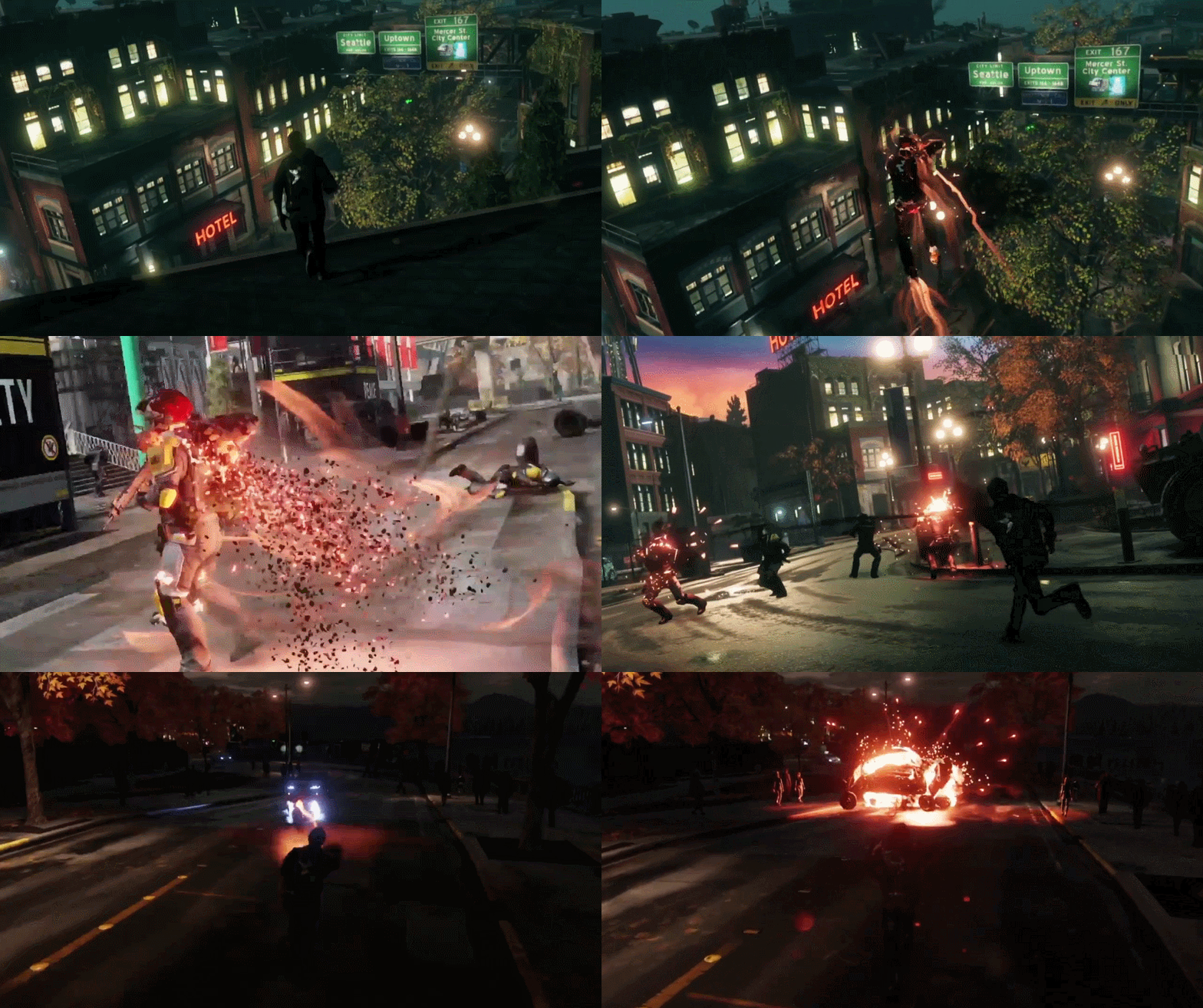
Crysis 3 might look as good, but that's where the comparisons end.
#WelcometoNextGen
Tomb Raider DE added character physics, a deeper environment, and they rebuilt Lara Croft entirely--among the dozen other things they added. You might have caught this if you didn't skim through it.
Last gen titles looked great on PC if you had the hardware; and Crysis is the worst example to give because of how demanding that trilogy is on high-end GPU. And now you're implying that all AAA looked as good as them, too.
SONY's AAA developers come up with creative games. This is why you won't dare compare the game as whole, because SONY's exclusives destroy anything resembling them on multi-platform.
And the most popular PC games are mostly being played on low-end laptops and old desktops. Even I plan to build a PC later on, but not until I've bought another laptop. No one wants to sit at a desk all day to write up reports. That's why consoles are so popular. For being all about Next Gen, you sure are behind on a lot of tech trends.
No, it doesn't. It assumes that regardless of your scope of viewing that you're still going to be looking at the same ratio of PPI. This is true regardless of if you are looking at 1 inch of the screen or the entire screen. If someone could magically focus on the whole screen all at once then they would still see the same distribution as if someone was focusing on only one part.Strazdas said:PPI is uniform, but thats it seems that you are STILL not understanding. the chart is wrong because it assumes different PPI during viewing than it is in reality relative to your vision. it assumes that your focus point covers whole screen at said distance, whereas in reality it only covers part of it, and thus pixel density of focus point needs to be higher than the chart assumes to become unnoticable.Lightknight said:The PPI is uniform regardless of how much you view of the screen. Basically, the PPI is all this chart is about since it's about the resolution in relation to TV size. It's the only reason why the distance where things matters changes.
Even if you were somehow focusing on the entire screen at once, the PPI would be the same as it would be if you were focusing on one square inch of the screen. That's because it's pixels per inch and as such remains the same as an average too.
And thats only plainly seeing the pixels ignoring all other benefits of higher-than-visible resolution.
Because of this scalable factor (something you just conceded in acknowledging that PPI is uniform), none of the numbers would change if you changed the area of focus because that's not even part of the equation. If you're focusing at all 55" of screen you're still going to be able or not able to resolve the pixels at a given distance as you would if you're focusing on 1" of the screen from the same distance. Field of vision is simply irrelevant to the equation.
This is because, what you are resolving are the pixels. Not images on the screen.
That is mathematically disproved in the source I linked. Perhaps you could do me the same courtesy and link sources if you're going to make a claim to the contrary?the 300PPI average is false too. Average human can see up to 700PPI at those distances. what your doing here is just repeating some bollocks Apple was pushing to excuse its display resolution. or are you implying that PCMR is an actual physical master race superior to everyone else?
I'll link it again below and now I'll even include commentary on the link to make it more convenient for your use. The author of this article is an expert in resolution who spent years calibrating the camera in the Hubble Telescope as part of his resume:
http://blogs.discovermagazine.com/badastronomy/2010/06/10/resolving-the-iphone-resolution/#.VFkOfhZVW_I
The following is a summary of the author's work I cited above:
Resolution is actually the ability to see two objects very close together. Resolution as we see it is actually measured as an angle. Because it is viewed as an angle, we can measure it in terms of distance. Think of the angle of the inside of one corner of a triangle that is opposite the two corners representing one object each, the narrower the angle in which those two objects can still be distinguished, the higher the resolution.
http://blogs.discovermagazine.com/badastronomy/files/2010/06/resolution_angles.jpg
So a 1 foot ruler that is 57 feet away would appear to be 1 degree across. If your eye had a 1 degree resolution then the ruler would appear exactly as 1 dot. Your resolution limit is when two objects appear to be one object.
Now, perfect vision is .6 Arcmin resolution. That's the number Soneira used to criticize Apple's comments. But the average vision is 1.0 Arcmin Resolution.
With 1.0 as the arcmin, any object that is 3438 times its own length away from you will look like a dot (so a quarter that is 1 inch across would appear as only a single point at 3438 inches away or a 1 foot ruler that is 3438 feet away would also look like a single dot. Closer and it looks wider, further away and it's still a dot. So you can use this math pretty darn easily to figure out how big an object must be before you can no longer resolve it. At 12 inches away, an object must be larger than .0035 inches before you can start to resolve it if you have average eye sight (12 inches/3438= .0035 inches). Ok, so how can we use this? Well, the iPhone 4 had a PPI of 326 pixels per inch. Well... 1/326 in is .0031 inches, which you'll note is smaller than the threshold of .0035 inches and so is unresolvable by average eyesight from 12 inches away.
Now, for perfect vision the resolution is .6 Arcmin. That means any object that is 5730 times it's own length would appear as a dot. 12 inches/5730 = .0021 inches. That is, of course, smaller than the .0031 inches size of the pixels in the iPhone4.
So while Soneira's claim holds water for people with PERFECT vision. That's really only relevant to 1% of the population. They can resolve up to 477 PPI, by the way, not 700PPI that someone pulled out of nowhere. Closer than 12 inches and those numbers go up, but not at 1 foot away.
So you are mathematically wrong here. No subjectivity in the house. I agree with a lot of technical things I see you say but this is just math and your numbers are wrong.
Yes, and if you had actually finished reading that article even after that it was still quite inferior to the PC version.pilar said:Tomb Raider DE added character physics, a deeper environment, and they rebuilt Lara Croft entirely--among the dozen other things they added. You might have caught this if you didn't skim through it.
Last gen titles looked great on PC if you had the hardware; and Crysis is the worst example to give because of how demanding that trilogy is on high-end GPU. And now you're implying that all AAA looked as good as them, too.
SONY's AAA developers come up with creative games. This is why you won't dare compare the game as whole, because SONY's exclusives destroy anything resembling them on multi-platform.
And the most popular PC games are mostly being played on low-end laptops and old desktops. Even I plan to build a PC later on, but not until I've bought another laptop. No one wants to sit at a desk all day to write up reports. That's why consoles are so popular. For being all about Next Gen, you sure are behind on a lot of tech trends.
Sure, in 2008 hardware like in consoles were rare. we dont live in 2008 anymore though and according to steam surveys over half of gaming population has better hardware than that.
Cryengine is demanding, yes, but it also provides a lot for that demand and can be scaled down well for low end GPUs. Cryengine is a great comparison actually, because its one of the best engines we have.
And you try to disprove that with a gif of horrible seconds son game? that game had so many graphics problems youd think it was made to run on last gen consoles. but then i already showed them to you and you blatantly ignored them so you can keep being ignorant about it.
Hah, wait give me a breather here. Sonys AAA being creative. thats a good joke. If you argued Nintendo then perhaps we could discuss it, but Sonys exclusives are quite unimpressive. you also live under false assumption that PCs dont have creative games, whereas PCs has more games in every single genre than all your sony exclusives put together. so your going to loose exclusives argument every single time.
and seriuosly buying a laptop. and you claim i am behind trends? laptops are dieing. they are being replaced by tablets. nowadays its tablets for portability desktops for power. and no, most popular games are not being played on laptops. a 5 year old PC cant even run the 3rd most popular game - WoT (i actually tried).
The focus area matter because of focus area resolution. our focus area has limited resolution it can resolve. however, if that focus area is smaller than the screen, the area you are seeing has lower resolution than whole screen and this comparing resolution of your focus area to whole screen resolution is incorrect, which this chart did.Lightknight said:No, it doesn't. It assumes that regardless of your scope of viewing that you're still going to be looking at the same ratio of PPI. This is true regardless of if you are looking at 1 inch of the screen or the entire screen. If someone could magically focus on the whole screen all at once then they would still see the same distribution as if someone was focusing on only one part.
Because of this scalable factor (something you just conceded in acknowledging that PPI is uniform), none of the numbers would change if you changed the area of focus because that's not even part of the equation. If you're focusing at all 55" of screen you're still going to be able or not able to resolve the pixels at a given distance as you would if you're focusing on 1" of the screen from the same distance. Field of vision is simply irrelevant to the equation.
This is because, what you are resolving are the pixels. Not images on the screen.
Now this chart used PPI to interpolate the distance changes which is fine, its the first presumption in there that led it astray.
I admit i was wrong about the 700 PPI though.
[HEADING=3]Next Gen IS Cryengine[/HEADING]Strazdas said:Yes, and if you had actually finished reading that article even after that it was still quite inferior to the PC version.pilar said:Tomb Raider DE added character physics, a deeper environment, and they rebuilt Lara Croft entirely--among the dozen other things they added. You might have caught this if you didn't skim through it.
Last gen titles looked great on PC if you had the hardware; and Crysis is the worst example to give because of how demanding that trilogy is on high-end GPU. And now you're implying that all AAA looked as good as them, too.
SONY's AAA developers come up with creative games. This is why you won't dare compare the game as whole, because SONY's exclusives destroy anything resembling them on multi-platform.
And the most popular PC games are mostly being played on low-end laptops and old desktops. Even I plan to build a PC later on, but not until I've bought another laptop. No one wants to sit at a desk all day to write up reports. That's why consoles are so popular. For being all about Next Gen, you sure are behind on a lot of tech trends.
Sure, in 2008 hardware like in consoles were rare. we dont live in 2008 anymore though and according to steam surveys over half of gaming population has better hardware than that.
Cryengine is demanding, yes, but it also provides a lot for that demand and can be scaled down well for low end GPUs. Cryengine is a great comparison actually, because its one of the best engines we have.
And you try to disprove that with a gif of horrible seconds son game? that game had so many graphics problems youd think it was made to run on last gen consoles. but then i already showed them to you and you blatantly ignored them so you can keep being ignorant about it.
Hah, wait give me a breather here. Sonys AAA being creative. thats a good joke. If you argued Nintendo then perhaps we could discuss it, but Sonys exclusives are quite unimpressive. you also live under false assumption that PCs dont have creative games, whereas PCs has more games in every single genre than all your sony exclusives put together. so your going to loose exclusives argument every single time.
and seriuosly buying a laptop. and you claim i am behind trends? laptops are dieing. they are being replaced by tablets. nowadays its tablets for portability desktops for power. and no, most popular games are not being played on laptops. a 5 year old PC cant even run the 3rd most popular game - WoT (i actually tried).

Most likely 1080p uncapped;
and which is amazing given the hardware.
You're nitpicking Second Son; and which is fine since you never sound objective anyways. It's a visual and mechanical art, but you can't get past the occasional pop-in. You must own a 980 to keep away from those peasant mid-range GPU that suffer the same problems.
Witcher, Arkham Knight, Dragon Age etc... are all day-1 purchases for PC and console users (although SONY has launch discounts) and will easily take 1+ month of gaming to complete. And then there's the console AAA, which aren't worth talking about since the closest you'll ever get is skimming articles about them.
Star Citizen won't be out of Alpha/Beta state until 2016. And you need to be a contributor for Early Access. I've looked into this. That's why I'm waiting on a PC build. That, and the fact that developers are getting lazy with optimizing for AMD's and Nvidia's GPU architecture, which means I'll need an i7-k & $450+ 780TI just max future games @ 1080p60.
Nintendo hasn't tried "original" since the Wii. List their latest new IP this moment--you can't w/out a Google Search. Sadder too that all anyone wants is a new Zelda.
Good to know that you skipped the Tomb Raider: DE article and went straight down to the conclusion.