Planetary Orbit

Recommended Videos

Dorian

New member
Jan 16, 2009
5,712
0
0
During one of my usual rounds of physical thinking, I've come across this one thing that I know not the answer to, nor does Wikipedia help any.

The planets of the Solar System orbit around the Sun, that is a given. We simply canNOT deny that piece of information, as it's too concrete. Now, HOW do these vast bodies of matter orbit that humongous radioactive ball of fire and light? I have never seen a model of our system anything other than the planets being level and lined up with each other. This may be nothing, I know, but I'm going to continue, for discussion's sake (if for nothing else). Would the planets not revolve around the Sun randomly and irrelevantly, much like John Dalton's idea of the atom?


Now, we have that in our heads. Do the planets really revolve in an ordered manner, or do they do it arbitrarily? And why do they do that?

If the planets really DO revolve horizontally, then there must be some outside force acting on them causing them do to so, much like a magnet keeping crushed lodestones flat on a table when held underneath. So, perhaps we're in some 2.5 dimension, or there's some other work of nature that we/I are unawares of.

 

Trivun

Stabat mater dolorosa
Dec 13, 2008
9,830
0
0
No idea, though as to the planets orbiting the Sun, that's all down to Kepler's Laws of Planetary Motion, and also the laws of physics regarding circular motion...
 

Souplex

Souplex Killsplosion Awesomegasm
Jul 29, 2008
10,308
0
0
Orbit is when your fall trajectory matches the curvature of the planet/moon/star you are falling towards. Orbit is literally falling and missing the ground.
 

Dorian

New member
Jan 16, 2009
5,712
0
0
Souplex said:
Orbit is when your fall trajectory matches the curvature of the planet/moon/star you are falling towards. Orbit is literally falling and missing the ground.
What word would you have used then to describe the act of an object going in constant revolutions around a larger object?
 

Kuchinawa212

New member
Apr 23, 2009
5,407
0
0
Hmmmm this is tricky. All that I can say is that I know at one point in history, Pluto took a bit of a short cut and got closer to the sun the Neptune. But if I had to pick, I say the planets go around in certain manner around the sun, kinda like how the moon goes around us.
 

RetiarySword

New member
Apr 27, 2008
1,377
0
0
It's gravity. The gravitational force and the centripetal forces the sun and the planets experience. Look up Kepler's laws of planatary motion.
 

grimsprice

New member
Jun 28, 2009
3,090
0
0
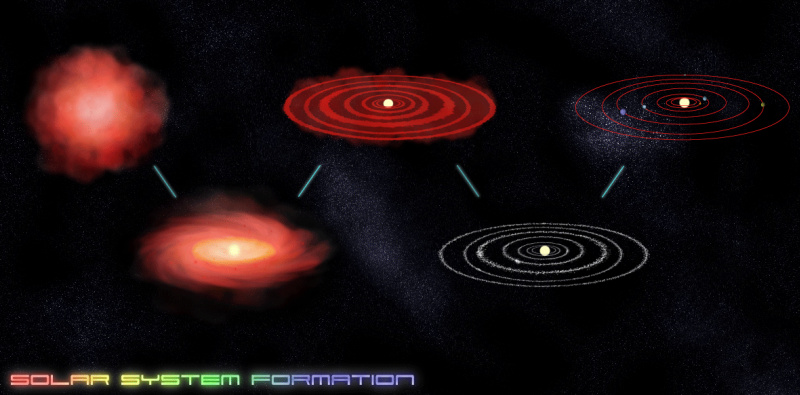
Does no one here know about the gaseous proto-disc that formed the solar system?
Look, i'll try and edit it how it happened, but it'll take a while.... its long...

Ok, so first you need to understand an interesting principle of wave physics.


Anyone who knows some fun facts about Saturn and the gas giants after it (specifically not including Jupiter), will know that saturns winds move only in one direction, with little or no turbulence. This happens because of that intersting principle of wave physics. A number of waves on a spherical surface will all end up going in the same direction.

However, this only happens in the presence of little to no energy. Get close enough to the sun and the amount of atmospheric energy causes turbulence like you see on Jupiter.

OK, second you need to understand why a ballerina accelerates when she contracts her legs in a spin. (conservation of angular momentum).

OK, third, you need to understand that the gas cloud that formed the solar system did not all end up in the sun. In fact, when the suns fusion started, most of the solar system was still a dense cloud of gas.


As the cloud began to contract under gravity, it began to spin, due to the above mentioned scientific principles. It could have spun the other way, but because a majority of its motion was in one direction, that is the direction it started to spin.

Now, if you spin a sphere, you'll notice that the equator spins faster than the polar regions. The gas at the "equator" was spining fast enough to fight gravity and establish a sort of orbit around the forming star, the gas above and below this plane wasn't; it fell into the star and became part of its mass.

Now that the gas above and below the star is gone, gas and dust only exists in a plane around the sun, and because of the wave properties listed above, its now moving in one direction. Thats why the planets all orbit the same direction.


Now that the star has begun its fusion, the remaining stabalized disc of gas gets blown away by stellar winds, revealing the largest of the gas and rocky clumps, asteroids, comets and other planetary objects.

Hurray for Science! Bringing real answers to real questions!
 

the1ultimate

New member
Apr 7, 2009
768
0
0
The planets are more or less all on the same plane, which is pretty amazing.

But I assume it has to do with the dynamics of how orbits form in the universe.

To me it makes sense that galaxies form mostly on the same plane, because their gravity is more focused than if they were randomly scattered.

The solar system is on a much smaller scale however, so I can only assume that it is fairly flat because (a) It aligns roughly with the plane the galaxy is on or (b) The solar system is still more or less affected by the forces that shape the milky way.
 

Souplex

Souplex Killsplosion Awesomegasm
Jul 29, 2008
10,308
0
0
Portal Maniac said:
Souplex said:
Orbit is when your fall trajectory matches the curvature of the planet/moon/star you are falling towards. Orbit is literally falling and missing the ground.
What word would you have used then to describe the act of an object going in constant revolutions around a larger object?
I never said I would call it something different, I was just explaining it's principles in a humorous manner.
 

LavosPrime

New member
Jan 9, 2009
38
0
0
When the sun formed, it blew off a large cloud of excess materials, which rotated with it. Centrifugal force pulls rotating spheres into discs, and that's what it did here. The debris spread out perpendicular to the axis of the Sun's rotation and kept orbiting. The whole thing would have been like Saturn's rings, but with everything scaled up, especially the rings. Eventually, these "rings" condensed into the planets due to their gravity. That is why the planets orbit in roughly the same plane. However, they are not "lined up" like in the given picture, which also isn't to scale. The planets could theoretically align, but that would be an extremely rare occurrence.

Incidentally, the OP means Rutherford's atomic theory. Dalton didn't know electrons existed, as they were discovered after he proposed his model.

EDIT:
grimsprice said:
Does know one here know about the gaseous proto-disc that formed the solar system?

Look, i'll try and edit it how it happened, but it'll take a while.... its long...
Here you go. Who ninja'd whom here?
 

FalloutJack

Bah weep grah nah neep ninny bom
Nov 20, 2008
15,485
0
0
Gravity is part of the answer, but there's a little more to it than that. In our universe, there exists dark matter. And one of the things dark matter is known for is being a rather dense substance, so anywhere that's got it have gravitational force involved because of its apparent weight and such. Our solar system is, to put it basically, surrounded by a dense halo of dark matter, and it is theorized that the orbits of the planets would have thrown themselves farther and farther away from our sun without it. There's also fields of dark energy out there, but I've yet to be explained to in a satisfactory way what they're suppose to DO.
 

Actual

New member
Jun 24, 2008
1,220
0
0
Gosh,it's been awhile since I did planetary formation. I'll see how much I can remember for you.

The planets all do revolve around the sun in a roughly flat disk arrangement, despite space being fully 3D the planets stick to a single plane of rotation.More or less, there is some wobbling but not much in the scale of a solar system.

Now I seem to remember this is because of how the planets were formed. When the Sun was young, it had not planets orbiting it. But it did have loads of particles of space dust left over when the local stars were created. This dust started rotating round the sun in a pretty random sphere at first but as the dust got closer together it started making it's own gravitational fields. And collected together in a massive disk swirling around the Sun. And as it compressed further the planets were formed. Still orbiting in the direction that the disk did before it.

This is based on vague memories of the one module I took at University on this topic. I'm sure someone more knowledgeable will be along to give a better account and correct my mistakes before long.

EDIT:
grimsprice said:
Grimsprice done it, read his.
 

grimsprice

New member
Jun 28, 2009
3,090
0
0
Wii Owner 3.14 said:
When the sun formed, it blew off a large cloud of excess materials, which rotated with it. Centrifugal force pulls rotating spheres into discs, and that's what it did here. The debris spread out perpendicular to the axis of the Sun's rotation and kept orbiting. The whole thing would have been like Saturn's rings, but with everything scaled up, especially the rings. Eventually, these "rings" condensed into the planets due to their gravity. That is why the planets orbit in roughly the same plane. However, they are not "lined up" like in the given picture, which also isn't to scale. The planets could theoretically align, but that would be an extremely rare occurrence.

Incidentally, the OP means Rutherford's atomic theory. Dalton didn't know electrons existed, as they were discovered after he proposed his model.

EDIT:
grimsprice said:
Does know one here know about the gaseous proto-disc that formed the solar system?

Look, i'll try and edit it how it happened, but it'll take a while.... its long...
Here you go. Who ninja'd whom here?
I have the pictures. I could be a month behind you and i'd still win. ;)
 

Ph33nix

New member
Jul 13, 2009
1,243
0
0
No the planets do not orbit in a level plane, pluto is 17 degrees off. The reason they orbit is because the are being pulled into towards the sun. The best description of why it works is because the huge mass of the sun warps space-time and the planets move in the warped area. Try to imagine if you had a large stretchable membrane with a grid painted on it that represented space-time in our localized area. Suppose the sun is represented by a large mass set upon this membrane so that it visually stretches. now suppose the planets are represented by smaller masses if you were to roll on of these towards the sun (say all masses are spherical) it would orbit for a while. the planets did this until they reached a speed and a distance that kept them at a specific distance (we are saying this for the sake of argument even though we know earth is still settling into its orbit and is not quite right.)
 

crudus

New member
Oct 20, 2008
4,410
0
0
Portal Maniac said:
Souplex said:
Orbit is when your fall trajectory matches the curvature of the planet/moon/star you are falling towards. Orbit is literally falling and missing the ground.
What word would you have used then to describe the act of an object going in constant revolutions around a larger object?
The angular momentum would keep it fairly level. Plus that model for the atom is wrong (in the way that it is too simplistic).