
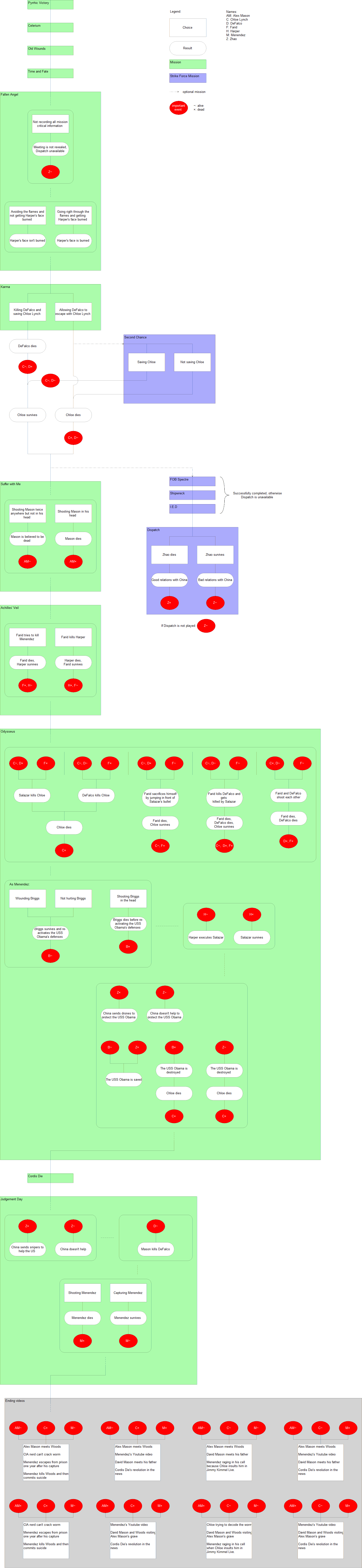
Call of Duty: Black Ops II is an example of a scripted story that is expertly written (if you don't hate David Goyer's schtick), filled with twists and turns, while also featuring obvious and non-obvious choices that have consequences both obvious and non-obvious throughout the game culminating in several endings. Making the player do stupid things that they know are stupid while expecting some sort of emotional resonance afterwards is bad design. (Spec Ops: The Line is flagrantly guilty of this.) Deus Ex: Human Revolution had a nasty case of "now the player must do this to proceed", which was a horrific violation of Warren Spector's core Deus Ex game design principles. The final boss where you shoot a defenseless, unarmed woman because reasons is an excellent example of "branching" storylines completely falling apart.sgy0003 said:These two seemed to be the biggest form of story telling in games.
Games such as To the moon, Valiant Heart, TLOU, Spec Ops: The Line (The only decision you make is the last one), Borderlands series, and FFVI are examples of scripted stories that are expertly written and filled with twists and turns.
Orson Scott Card wrote that "To the degree that the game is fixed ? the outcome predetermined ? the game is a story. But to the degree that you SEE that the game is fixed, it becomes less fun to play!" Practically speaking, a linear narrative is perfectly fine so long as you can never see the rails. But when the player wants to go in a completely different direction or even a slightly different direction to the game's narrative, things begin to fall apart. And the problem with branching narrative is that you're adding layers of complexity that alleviate player discontent, but can never fully absolve it.
Card stated that "When a movie is made from a book and the script changes key events, the readers are usually furious. Why? Since the original events weren't real, why not change them? The answer is simple: Even in fiction, what the author put down on paper is "the truth" and anyone who fiddles with it is "lying" or "wrecking it.""
There lies the rub. Branching narratives weaken the "truth" of a story. Real people make stupid mistakes. Players of a videogame do not want to make stupid mistakes. "There is no question about character motivation. The lead character is you, and your motivation is to beat the enemy and win," as Card put it. Gamers resent losing through no fault of their own, per se. That's why character incompetence in Ubisoft games "I'm gonna trip around instead of shooting you" is so jarring. Videogames have always struggled with how to make the player fail without descending into very blatant railroading. For example, a careful player will be pissed when the game decides to trigger a cutscene where the lead character walks into an area without checking that SUPER OBVIOUS blind spot where some guy with a blunt object is waiting to whack them. (Monolith did this twice in the SAME YEAR, with FEAR and Condemned: Criminal Origins.)