

Poll: Does 0.999.. equal 1 ?
- Thread starter mattsipple4000
- Start date
Recommended Videos
What makes me laugh is people stating "durr don't be stoopid, it equals one"
0.999r or 0.999 isn't one. It just isn't. To think it is is like being an atom away from being within an area; you're still not actually there, regardless of how infinitely small the distance.
The moment algebra, sums or rounding become involved you've changed the fundamental properties of the number and it's no longer 0.999; end of story. You've changed it, and therefore construed it.
The number 0.999 is not one.
Equal is not the definition of a rounded number.
0.999r or 0.999 isn't one. It just isn't. To think it is is like being an atom away from being within an area; you're still not actually there, regardless of how infinitely small the distance.
The moment algebra, sums or rounding become involved you've changed the fundamental properties of the number and it's no longer 0.999; end of story. You've changed it, and therefore construed it.
The number 0.999 is not one.
Equal is not the definition of a rounded number.

I like this description of it, easy to understand.Rough Sausage said:University student here, studying maths. 0.(9) is exactly equal to one. Look at this way: If you were to take 2 distinct numbers, you could also find a number in between them. Take 0.(9) and 1. Is there a number between them? No. Therefore, the are equal.
OT: Yes, for a multitude of logical and mathematically provable reasons stated in this thred already. I am surprised so many said no.

If I could rationally express 1/3rd as non-repeating decimal (in Base10), this question wouldn't even exist.
Any repeating decimal is representative of decimal's inability to rationally express an infinite repeating division operation in Base10 (we keep dividing to attain a precise answer, but the logic loops infinitely).
As soon as you stop thinking purely in Base10, the logic works just fine. .99 (repeating) is simply the addition of 3 units of (precisely) 1/3rd.
Any repeating decimal is representative of decimal's inability to rationally express an infinite repeating division operation in Base10 (we keep dividing to attain a precise answer, but the logic loops infinitely).
As soon as you stop thinking purely in Base10, the logic works just fine. .99 (repeating) is simply the addition of 3 units of (precisely) 1/3rd.
1 Isn't 2 you say? Challenge acceptedAlfador_VII said:HOWEVER, mathematically, definitely not, they're extremely close together but not identical. It comes down to proofs, and definitions. The two numbers are not the same. Saying that they are would be logically the same as stating that 1=2.
[sub]Yeah, I know why this isn't true, but I still like the idea [/sub]a = b (initial supposition)
ab = b^2 (multiply both sides by b)
ab-a^2 = b^2-a^2 (subtract a^2 from both sides)
a(b-a) = b^2-a^2 (factor out a from the left side using distributive property)
a(b-a) = (b-a)(b+a) (factor the right side using difference of squares)
a = b+a (cancel both b-a terms )
a = a+a (substitute a for b, legal since a=b)
a = 2a (simplify)
1 = 2 (divide both sides by a)

A swing and a miss. (Or have I misunderstood your statement?)Atmos Duality said:If I could rationally express 1/3rd as non-repeating decimal (in Base10), this question wouldn't even exist.
Any repeating decimal is representative of decimal's inability to rationally express an infinite repeating division operation in Base10 (we keep dividing to attain a precise answer, but the logic loops infinitely).
As soon as you stop thinking purely in Base10, the logic works just fine. .99 (repeating) is simply the addition of 3 units of (precisely) 1/3rd.
Try expressing 1/3, 2/3 and 3/3 in base3 (it consists of 0, 1 and 2).
Hint: it is 0,1 0,2 and 1, respectively.
 (Thank you wiki for making my day)
Actually i blame school for not explaining what math represents better.Generic Gamer said:The problem is that it's one of those things that seems really obvious whilst you're constantly being reminded of it at school, but is easily forgotten after a decade in the real world.1000000 said:I'm actually really surprised that the majority of people are wrong here. I guess I gave the population of this forum too much credit.
Yes, 0.999... = 1
In the real world it's useless knowledge, easily forgotten, because you'll never encounter an infinitely repeating number.
Think of it this way, you have 1 apple and 0.99999... apple... if you put them together you have 1.99999.... apples.
Now if you eat the apples and someone else eats 2 apples you will never actually get to the point where you have eaten less apple because it will take an infinite amount of time to get to it... thus there's no real world difference between the apples you and the other person ate.
And this actually works better with you having 0.9999... and the other guy 1 apple... or you eating 1 apple vs 0.9999... apples. You would never be able to get to the difference in time that should exist {assuming the apples are exactly the same besides the 0.(0)1 difference which never comes into play}.
Don't ask me how you'd finish eating the 0.(9) apple.
This is why i distrust math actually... it makes perfect sense... but not really... it's like fucking magic.

Of course not. There's a difference of more than 0,1 between 0,(8) and 0,(9).mattsipple4000 said:if 0.999(r) = 1
then is 0.888(r) = 0.999(r) ??
Yes. As some other people have already stated. If two numbers are different from each other, then you can find a number in between those two. There is no number between 0.(9) and 1.mattsipple4000 said:does 1.999(r) = 2
Extremely simplified and doesn't grasp the mathematical problem. You're basically saying "by the rules I KNOW, you're wrong, therefore I'm right". Which is bullcrap. It wouldn't be that bad and COULD be counted as a valid argument if you weren't so smug.Jack Skelhon said:snip

Sad that, despite several proofs posted and a link to the wiki, which contains several more proofs, still more than half of the 300+ voters have said that 0.(9) is NOT equal to 1.0
1/9 = 0.111111...
9 * 1/9 = 9 * 0.111111... = 0.999999...
1 = 0.999999...
1/9 = 0.111111...
9 * 1/9 = 9 * 0.111111... = 0.999999...
1 = 0.999999...

Sadly, maths is so far away from being my strong point that I'd need a team of Nasa trained mathematicians if I ever needed to calculate the distance. So a lot of the 0.333 0.999 stuff is going right through one side of my head and out the other and some crazy scamp even put the words "Simple" in front of it... Ga'h headache. Anyway the answer is yes, well at leasts thats the answer my Maths teacher gave to me when I asked and its also the same answer I get from all mathematicians I've bothered to ask. They tried explaining it but well, my brain ceased up and all I heard was buzzing sounds.
I've never been able to figure it out myself, though as said maths and I aren't friends. I can do basic calculations and thats it. Though it seems the people here have given it a go at explaining it... Still don't help me out... I feel real stupid now... I'm going to go in the corner and think about what I've done.
I've never been able to figure it out myself, though as said maths and I aren't friends. I can do basic calculations and thats it. Though it seems the people here have given it a go at explaining it... Still don't help me out... I feel real stupid now... I'm going to go in the corner and think about what I've done.
Gladion said:Yes. As some other people have already stated. If two numbers are different from each other, then you can find a number in between those two. There is no number between 0.(9) and 1.
There is, but you can never reach it because it would take you infinity... and you can never get to infinity. So reality just skips over the whole thing or something. Maybe Charlie Sheen murders it for the Vatican with his Warlock powers.

The gap is infinitely small, but there is a gap.
Plus anyone who says they are the same is clearly a pretentious retard desperately trying to look clever to cover the fact that he has below average IQ and has a small penis.
So yeah >.>
Plus anyone who says they are the same is clearly a pretentious retard desperately trying to look clever to cover the fact that he has below average IQ and has a small penis.
So yeah >.>
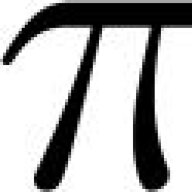
I think you'll find 0.(9) is a real number.bob1052 said:All Real Numbers have a value you between them (1.5 is between 1 and 2, 1.05 is between 1 and 1.1 1.005.....)
There is no value between 0.999... and 1, therefore 0.999... is not a real number and therefore it is not impossible to have multiple values.
What you meant (I believe) was that any two distinct(!) real numbers have a real number in between them, however we cannot find one, therefore they are not distinct.
Or there's nothing in the real world that's actually infinite so the difference doesn't exist in any material world sense so anything that might potentially be 0.(9) in the real world just defaults to 1 or 0.9999999999999999999....999998 at some point.Puzzlenaut said:The gap is infinitely small, but there is a gap.

What if you're a Wizard? (Harry?)Tetranitrophenol said:yes, if you are an Engineer.
no, if you are a Mathematician


Actually no, I just made one and the result is that basically it goes as far as it's precision can go (mine went to 1.74761864351931 * 10^-307) and after that it went to INF, infinity.In reality, yes the man would obviously catch the turtle really quickly, nobody disputes that.Serris said:so we could say the man moves 10 times as fast as the tortoise, who moves at 1 meter in the same time. if you would plot that into a function, it'd be pretty easy to see the man will overtake the tortoise.