
First things first, this is my first review. I do not fancy myself a good writer or even a decent one. I do feel, however, that my writing skills are sufficient enough to clearly get my point across. Hopefully for the readers, that will prove to be true.

Alpha Protocol let's you play as Michael Thorton. You are the newest member of Alpha Protocol, a secret government organization that carries out covert operations while protecting the US from accountability. After a rough orientation you are given your first mission: to assassinate the leader of Al-Samaad, the terrorist group that attacked the passenger aircraft in the opening cutscene. Things quickly become more complicated and you'll find yourself having to stop and impending international crisis, as a rouge Agent.
It is important to keep in mind that I say "let's you play as Micheal Thorton". Mike is a guy you cannot choose a female character and you cannot custom build your face. Mike's behavior, for the most part, is decided by the player, however it seems his personality is always bent towards dry sarcasm. You can't change your first name. Now a default does have its benefits as your friends won't constantly be referring to you as "Agent", or calling you by your last name. The game does let you customize some things about Micheal Thorton. You can pick your background history, which changes some dialog and initial stats, and you can modify your hair, facial hair, and choose to wear hats or glasses.

The strongest aspect of the game is the dialog system and the choices you make. You have a limited time to choose a response; once the NPC stops talking whatever option you're currently highlighting is the one you'll choose. This makes conversations more exciting and flow better. You can't go back and say, "Let me get back to my other questions". The downside to this is you might not have adequate time to look at your choices and fully understand them. The game tries to lessen the problem by assigning attitudes/stances (suave, professional, aggressive) to left, right, and up, however, some dialog trees don't quite turn out that way and the choice you make might end up being different that what you expected. Responses aren't just picking your stances. There are plenty of situations where the dialog options are clear choices and don't have anything to do with the three stances.
Tying into the dialog system, there's the reputation system. It gives interacting with the strong, well-acted, memorable cast of characters more depth. Alpha Protocol thankfully gets rid of the overused good/evil meter. Sadly, this means no devil horns, or glowing red eyes. Every major NPC has an opinion of you. Depending on the dialog choices you make you'll get positive or negative rep points. What's interesting about the rep system is getting negative rep is not necessarily bad and can actually have some benefits.
The consequences in Alpha Protocol aren't always immediate, and don't always come down to a dialog option you pick. At times it is a culmination of the things you do or say. The order you complete missions and the style in which you complete them are also factors that effect the game world. The choices you make can have a big effect on the story, but the game itself never really changes. For the most part you'll find yourself doing the same missions no matter what choices you make. The decisions you make don't always have a big effect, but they are at least mentioned in emails, news reports, and dialog with NPCs. Little touches like these make the game more personal to the player. This is something I find ME lacks; there are choices but rarely are there consequences, big or small. When there is a consequence there is usually an optimal outcome.
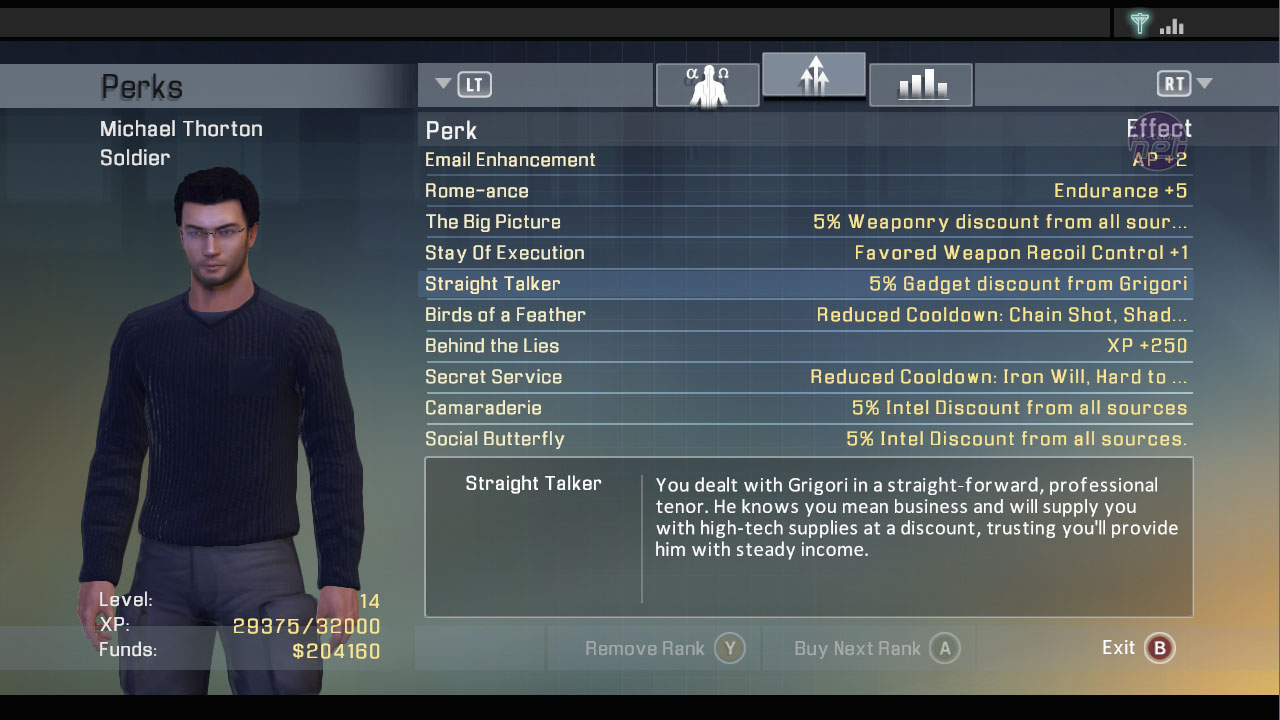
There are basically two different styles to play the game; three depending on how you look at it. You can play it like a stealth game, third person shooter, or a little of both. How you play the game is dependent on how you allocate your skill points. I found the skill tree to be simpler than what's found in ME1, but overall how you spec your character makes a bigger difference on how the game is played than in ME1. You get exp for pretty much everything you do. Complete missions, side objectives, number of enemies killed/avoided, and passing minigames all add exp. In addition to the traditional level up system the game also has a nice perks system. Perks are obtained in a similar fashion as achievements but without a requirement list. For example if you complete a mission without raising an alarm you might get a perk that reduces enemies' sight. All perks are additive and behave like passive skills found in other rpgs.
If you decide to be a guns blazing character keep in mind that the shooting incorporates dice rolling mechanics. When you first start you'll find that your bullets won't end up in the center of the screen, but somewhere within a very large crosshair; expect to miss a lot. In a firefight it might be better idea to aim at an enemy's chest rather than his head as it gives you a greater chance to register a hit. As you get better weapons, attachments, and level up skills the cross hairs become smaller and your aim will be more reliable. The health system is similar to ME1. You have regenerating armor bar and a health bar that can only be refilled using health items. Other than that the game plays similarly to Gears of War but with clumsy cover mechanics. Some walls can't be used as cover, and sometimes cover can be too sticky making it difficult to avoid grenades.

Now if you're thinking of playing stealthily you might think that the dice rolling nature of gunshots means no sneaky headshots, well you'd be wrong. The game cleverly permits guaranteed headshots without breaking the dice rolling aspect of shootouts. Each gun has a different way of getting critical hits. More specifically, when wielding pistols, focusing on an enemy for X amount of seconds will make the crosshairs smaller giving you a precise shot. This makes the ability useful only when approaching sneakily. During a shootout you won't be able to stay out of cover long enough to get a focused precise shot.
Stealth is very simple in this game. Your level/equipment affects stealth but it really just comes down getting headshots and sneaking behind or to the side, as enemies have no peripheral vision, of enemies and getting a stealth takedown. It is made simpler due to the basic AI. Expect AI on the level of MGS on the PS1. Enemies follow strict patrol roots, go into caution mode if they hear footsteps, and go to alert mode if they see you, hear an unsilenced shot, or see a dead body. Now that sounds sufficient, and it is, but all that comes crashing down if you decide to level up your stealth attributes. When you unlock the skill "Shadow Operative" you're able to stay invisible as long as you don't use sprint, shoot, or melee. It seems the devs forgot to put takedowns on the list. It isn't a problem when you have the first iteration of Shadow Operative since you only have five seconds of invisibility. The higher levels allow 12 seconds, then 30 seconds of invisibility. You can then clear entire rooms just by walking up to enemies and using takedowns. Enemies will react if they see their buddies get knocked out and will go into caution or alert mode but will never attack as long as you stay invisible. My advice- Don't use Shadow Operative.
The game has low production values and you can tell. The graphics aren't so bad that they'll prevent you from enjoying the game but there's no denying the visuals look dated, even compared to early PS3/360 games. The animations aren't so hot either. Animations in conversations look fine but in-game they're noticeably bad. The worst being Mike's sneaking animation; he looks like a chicken. If you go for a stealth playthrough you'll eventually get desensitized to the bizarre animation, but It sure took me awhile though.
Overall, I found the game to be fantastic. Alpha Protocol boasts, like any good RPG should, strong characters, great dialog, and an interesting plot. The several outcomes and endings definitely warrants multiple playthroughs. The shooter and stealth elements mesh well with the RPG aspects of the game,giving the otherwise bland, at times boring, gameplay some uniqueness. This game has been slammed by professional reviewers for flaws found in other games of the same genre. If you had no problems overlooking flaws/bugs found in other recent RPGs, such as FO3 and ME, then you should have no trouble enjoying Alpha Protocol. Those who are worried about the upcoming Fallout game because of Obsidian, play this game to quell your fears and renew your excitement for New Vegas.
Notes:
I played Alpha Protocol on the PC. I played the game twice on Normal difficulty and currently playing on Hard. One playthrough is about 10-15 hours. I encoutered no bugs, other than a problem with a stuttering mouse that was fixed by changing some stuff in the config files. There was little texture pop-in and the game ran with a smooth frame rate with some bumps due to loading. There are some annoying quirks on the PC version. The much hated mouse acceleration, found in most Unreal Engine games and console ports, makes an appearance. The game doesn't allow the mouse wheel to scroll through text. One of the minigames treats the mouse like a right analog stick. Meaning the games doesn't care where your mouse is on the screen; it only takes into account the direction in which you're moving the mouse. When you get to use a sniper rifle or turrent the aiming feels extremely slippery and adjusting the sensitivity in the options does little to help. Thankfully, you'll rarely, if ever need to use a sniper or turret.
Alpha Protocol let's you play as Michael Thorton. You are the newest member of Alpha Protocol, a secret government organization that carries out covert operations while protecting the US from accountability. After a rough orientation you are given your first mission: to assassinate the leader of Al-Samaad, the terrorist group that attacked the passenger aircraft in the opening cutscene. Things quickly become more complicated and you'll find yourself having to stop and impending international crisis, as a rouge Agent.
It is important to keep in mind that I say "let's you play as Micheal Thorton". Mike is a guy you cannot choose a female character and you cannot custom build your face. Mike's behavior, for the most part, is decided by the player, however it seems his personality is always bent towards dry sarcasm. You can't change your first name. Now a default does have its benefits as your friends won't constantly be referring to you as "Agent", or calling you by your last name. The game does let you customize some things about Micheal Thorton. You can pick your background history, which changes some dialog and initial stats, and you can modify your hair, facial hair, and choose to wear hats or glasses.
The strongest aspect of the game is the dialog system and the choices you make. You have a limited time to choose a response; once the NPC stops talking whatever option you're currently highlighting is the one you'll choose. This makes conversations more exciting and flow better. You can't go back and say, "Let me get back to my other questions". The downside to this is you might not have adequate time to look at your choices and fully understand them. The game tries to lessen the problem by assigning attitudes/stances (suave, professional, aggressive) to left, right, and up, however, some dialog trees don't quite turn out that way and the choice you make might end up being different that what you expected. Responses aren't just picking your stances. There are plenty of situations where the dialog options are clear choices and don't have anything to do with the three stances.
Tying into the dialog system, there's the reputation system. It gives interacting with the strong, well-acted, memorable cast of characters more depth. Alpha Protocol thankfully gets rid of the overused good/evil meter. Sadly, this means no devil horns, or glowing red eyes. Every major NPC has an opinion of you. Depending on the dialog choices you make you'll get positive or negative rep points. What's interesting about the rep system is getting negative rep is not necessarily bad and can actually have some benefits.
The consequences in Alpha Protocol aren't always immediate, and don't always come down to a dialog option you pick. At times it is a culmination of the things you do or say. The order you complete missions and the style in which you complete them are also factors that effect the game world. The choices you make can have a big effect on the story, but the game itself never really changes. For the most part you'll find yourself doing the same missions no matter what choices you make. The decisions you make don't always have a big effect, but they are at least mentioned in emails, news reports, and dialog with NPCs. Little touches like these make the game more personal to the player. This is something I find ME lacks; there are choices but rarely are there consequences, big or small. When there is a consequence there is usually an optimal outcome.
For example in ME1 the only reason you'd ever kill Wrex is if you didn't have enough Paragon/Renegade points to persuade him. Alpha Protocol avoids stuff like this most of the time.
There are basically two different styles to play the game; three depending on how you look at it. You can play it like a stealth game, third person shooter, or a little of both. How you play the game is dependent on how you allocate your skill points. I found the skill tree to be simpler than what's found in ME1, but overall how you spec your character makes a bigger difference on how the game is played than in ME1. You get exp for pretty much everything you do. Complete missions, side objectives, number of enemies killed/avoided, and passing minigames all add exp. In addition to the traditional level up system the game also has a nice perks system. Perks are obtained in a similar fashion as achievements but without a requirement list. For example if you complete a mission without raising an alarm you might get a perk that reduces enemies' sight. All perks are additive and behave like passive skills found in other rpgs.
If you decide to be a guns blazing character keep in mind that the shooting incorporates dice rolling mechanics. When you first start you'll find that your bullets won't end up in the center of the screen, but somewhere within a very large crosshair; expect to miss a lot. In a firefight it might be better idea to aim at an enemy's chest rather than his head as it gives you a greater chance to register a hit. As you get better weapons, attachments, and level up skills the cross hairs become smaller and your aim will be more reliable. The health system is similar to ME1. You have regenerating armor bar and a health bar that can only be refilled using health items. Other than that the game plays similarly to Gears of War but with clumsy cover mechanics. Some walls can't be used as cover, and sometimes cover can be too sticky making it difficult to avoid grenades.
Now if you're thinking of playing stealthily you might think that the dice rolling nature of gunshots means no sneaky headshots, well you'd be wrong. The game cleverly permits guaranteed headshots without breaking the dice rolling aspect of shootouts. Each gun has a different way of getting critical hits. More specifically, when wielding pistols, focusing on an enemy for X amount of seconds will make the crosshairs smaller giving you a precise shot. This makes the ability useful only when approaching sneakily. During a shootout you won't be able to stay out of cover long enough to get a focused precise shot.
Stealth is very simple in this game. Your level/equipment affects stealth but it really just comes down getting headshots and sneaking behind or to the side, as enemies have no peripheral vision, of enemies and getting a stealth takedown. It is made simpler due to the basic AI. Expect AI on the level of MGS on the PS1. Enemies follow strict patrol roots, go into caution mode if they hear footsteps, and go to alert mode if they see you, hear an unsilenced shot, or see a dead body. Now that sounds sufficient, and it is, but all that comes crashing down if you decide to level up your stealth attributes. When you unlock the skill "Shadow Operative" you're able to stay invisible as long as you don't use sprint, shoot, or melee. It seems the devs forgot to put takedowns on the list. It isn't a problem when you have the first iteration of Shadow Operative since you only have five seconds of invisibility. The higher levels allow 12 seconds, then 30 seconds of invisibility. You can then clear entire rooms just by walking up to enemies and using takedowns. Enemies will react if they see their buddies get knocked out and will go into caution or alert mode but will never attack as long as you stay invisible. My advice- Don't use Shadow Operative.
The game has low production values and you can tell. The graphics aren't so bad that they'll prevent you from enjoying the game but there's no denying the visuals look dated, even compared to early PS3/360 games. The animations aren't so hot either. Animations in conversations look fine but in-game they're noticeably bad. The worst being Mike's sneaking animation; he looks like a chicken. If you go for a stealth playthrough you'll eventually get desensitized to the bizarre animation, but It sure took me awhile though.
Overall, I found the game to be fantastic. Alpha Protocol boasts, like any good RPG should, strong characters, great dialog, and an interesting plot. The several outcomes and endings definitely warrants multiple playthroughs. The shooter and stealth elements mesh well with the RPG aspects of the game,giving the otherwise bland, at times boring, gameplay some uniqueness. This game has been slammed by professional reviewers for flaws found in other games of the same genre. If you had no problems overlooking flaws/bugs found in other recent RPGs, such as FO3 and ME, then you should have no trouble enjoying Alpha Protocol. Those who are worried about the upcoming Fallout game because of Obsidian, play this game to quell your fears and renew your excitement for New Vegas.
Notes:
I played Alpha Protocol on the PC. I played the game twice on Normal difficulty and currently playing on Hard. One playthrough is about 10-15 hours. I encoutered no bugs, other than a problem with a stuttering mouse that was fixed by changing some stuff in the config files. There was little texture pop-in and the game ran with a smooth frame rate with some bumps due to loading. There are some annoying quirks on the PC version. The much hated mouse acceleration, found in most Unreal Engine games and console ports, makes an appearance. The game doesn't allow the mouse wheel to scroll through text. One of the minigames treats the mouse like a right analog stick. Meaning the games doesn't care where your mouse is on the screen; it only takes into account the direction in which you're moving the mouse. When you get to use a sniper rifle or turrent the aiming feels extremely slippery and adjusting the sensitivity in the options does little to help. Thankfully, you'll rarely, if ever need to use a sniper or turret.