
Review: Eufloria
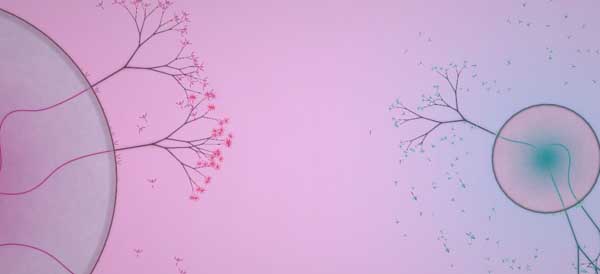
Eufloria is an RTS where space seedlings navigate and colonize asteroid fields, against identical AI opponents doing the same, where the goal is to dominate the field. It gives simplified concept visuals (space is usually a light pastel background, asteroids are perfect circles, and all units are 2D) amid a pleasant ambient soundtrack.
So is the game "relaxing" as it promises, and is it good? I uttered no shortage of curse words while figuring out its system of hard counters. Now, if there where footmen, archers, and cavalry, that would have been a non-issue, but figuring out that mutated super-seedlings are ideal against thistle defenses... that took me a couple levels of trial and error. Once you understand the system, the game quickly settles into basic, if calming, repetition as you expand from your base outward.
The single-player campaign is paired with a brief text story, rarely longer than a haiku poem at the introduction and conclusion of each level. But it was interesting enough to keep me going to see what happens next. Often at the beginning of a level you are given a little strategy puzzle you need to overcome before expanding and conquering the asteroid field.
Strategy does eventually go deeper than its initial presentation suggests, but never gets overly complicated. Unit abilities are determined by the asteroids from which they grow, so you pick and choose your asteroids accordingly. Units are produced automatically depending on how many seedlings there are planted, or instead you can grow defense "thistles" in contested areas of space. Each asteroid has a limit to the number of plants it can grow. At later levels, you will plant randomly generated flower buds to enhance either your seedlings or defense structures. The difficulty ranges from easy to moderate--it never sets out to kick your ass, though with more aggressive and discerning AI it probably could at least try.
Controls are straightforward. You move seedlings and flowers from asteroid to asteroid by clicking and dragging. You pan, zoom in and out, and select what kinds of seedlings and how many from any asteroid, and then direct them to attack or colonize. it is a simple and effective system using only a two button mouse and scroll wheel. It lacks only the ability to set way points.
What I find interesting is this: it is like an RTS distilled to its most basic essence. Staring at the white background and perfect circles, it is easy to imagine this exact game in any other RTS theme. The flower pollen could be orcs, the flowers ogres, and asteroids mountains, all in a fantasy kingdom. Or, pollen could be marines, flowers could be fighter squadrons, and asteroids Islands in the Pacific during WW2. Or, it could be in space but you are playing some variant of zerg, tyranids, or Aliens with a capital "A," all consuming planets. But transcending all that, in this game we are simple flowers colonizing the circles the game designers could have called anything but chose to call asteroids.
Bottom line: As an RTS fan, I found it interesting enough. It kept me occupied for the duration of its campaign, and its minimalist story kept me wondering "what happens next?" It would be a better value at $10, but at $20, I've certainly paid more and gotten less from other games. Eufloria accomplishes well what goals it sets for itself.
Recommendation: Good for Indie game fans, or RTS'ers looking for something different.
Eufloria is an RTS where space seedlings navigate and colonize asteroid fields, against identical AI opponents doing the same, where the goal is to dominate the field. It gives simplified concept visuals (space is usually a light pastel background, asteroids are perfect circles, and all units are 2D) amid a pleasant ambient soundtrack.
So is the game "relaxing" as it promises, and is it good? I uttered no shortage of curse words while figuring out its system of hard counters. Now, if there where footmen, archers, and cavalry, that would have been a non-issue, but figuring out that mutated super-seedlings are ideal against thistle defenses... that took me a couple levels of trial and error. Once you understand the system, the game quickly settles into basic, if calming, repetition as you expand from your base outward.
The single-player campaign is paired with a brief text story, rarely longer than a haiku poem at the introduction and conclusion of each level. But it was interesting enough to keep me going to see what happens next. Often at the beginning of a level you are given a little strategy puzzle you need to overcome before expanding and conquering the asteroid field.
Strategy does eventually go deeper than its initial presentation suggests, but never gets overly complicated. Unit abilities are determined by the asteroids from which they grow, so you pick and choose your asteroids accordingly. Units are produced automatically depending on how many seedlings there are planted, or instead you can grow defense "thistles" in contested areas of space. Each asteroid has a limit to the number of plants it can grow. At later levels, you will plant randomly generated flower buds to enhance either your seedlings or defense structures. The difficulty ranges from easy to moderate--it never sets out to kick your ass, though with more aggressive and discerning AI it probably could at least try.
Controls are straightforward. You move seedlings and flowers from asteroid to asteroid by clicking and dragging. You pan, zoom in and out, and select what kinds of seedlings and how many from any asteroid, and then direct them to attack or colonize. it is a simple and effective system using only a two button mouse and scroll wheel. It lacks only the ability to set way points.
What I find interesting is this: it is like an RTS distilled to its most basic essence. Staring at the white background and perfect circles, it is easy to imagine this exact game in any other RTS theme. The flower pollen could be orcs, the flowers ogres, and asteroids mountains, all in a fantasy kingdom. Or, pollen could be marines, flowers could be fighter squadrons, and asteroids Islands in the Pacific during WW2. Or, it could be in space but you are playing some variant of zerg, tyranids, or Aliens with a capital "A," all consuming planets. But transcending all that, in this game we are simple flowers colonizing the circles the game designers could have called anything but chose to call asteroids.
Bottom line: As an RTS fan, I found it interesting enough. It kept me occupied for the duration of its campaign, and its minimalist story kept me wondering "what happens next?" It would be a better value at $10, but at $20, I've certainly paid more and gotten less from other games. Eufloria accomplishes well what goals it sets for itself.
Recommendation: Good for Indie game fans, or RTS'ers looking for something different.