Science is based on faith?

Recommended Videos

MrHide-Patten

New member
Jun 10, 2009
1,306
0
0
As valid as the point is still using faith in relation to science gets my knickers in a bunch. As comedian Tim Minchin summarized; "Science adjusts its views based on whats observed, faith is the denial of observation so that belief can be preserved".
 

Tanakh

New member
Jul 8, 2011
1,512
0
0
xPixelatedx said:
I know mentioning Extra Credits here is somewhat taboo, but I am not so much interested in them as much as the can of worms they just inadvertently opened. In their recent two videos they pointed out that some of science's roots were grounded in belief, because we are dealing with things we cannot prove (however likely they may be). This started a discussion that caused a lot of people to become rather defensive and upset. They recently made their closing statement on the argument and I have to say I agree with them.
Science is still based on evidence, it just so happens the evidence we currently have for any given topic could be wrong, we might not be seeing the whole picture or the limitation of us being human is whats causing us to error (in other words we will never know the answer). Because of all that we have to take some degree of faith into it to make many of our theories work at all. I just think people are frightened at the idea that science might not be entierly infallible, even though it's usually not a big deal when our facts turn out to be wrong. After all, if we knew everything, we wouldn't learn anything.

What do you guys think?
Well, since you are asking nicely and since freaking DotA 2 queue doesn't want to pop:

1) In "hardcore siences" (physics, chem, etc.) when you say you have "proved" something it means just one thing: you have a complete mathematical proof of it.

2) Almost all the mathematical proves require arithmetic, certanly all the ones applied to the "real world" and having any kind of usefulness.

3) Gödel proved almost a century ago that you can't formulate a complete and consistent theory capable of expressing arithmetic in natural numbers ( http://en.wikipedia.org/wiki/G%C3%B6del's_incompleteness_theorems ). That is either you know how to do operations in numbers OR you are sure those are the correct operations derivated from your theory.

4) With that you can prove that with curren math and sience, you can't prove that arithmetic is right ( http://en.wikipedia.org/wiki/Hilbert%27s_second_problem ).

5) Thus you just showed that using math you can't be sure if arithmetic is right, therefore anything that uses arithmetic might be wrong.

Alternatively you can just go the physics way:

1) To do sience and be sure there's no error you need perfect messures.

2) You can't messure at quantic level the position and energy of anything ( http://en.wikipedia.org/wiki/Uncertainty_principle ).

3) Therefore any sience you do is a well learnt guess.

I will gladly clarify any obscure parts and would love to know if this solves your question. In short, yeah, sience uses "faith", but saying that is BS right of a dipshit ass! Because if you call sience "faith based" then EVERY FREAKING THING IN THE UNIVERSE IS FAITH BASED, including your exsistence and every freking thing you have think, been, feel, see, taste, etc, making the word meaningless. TBH the argument is just a some words that can be argued to make sense, but full of crap.

funnydude6556 said:
I mean without faith do you think Sir Issac Newton could have spent so long locked up in a lab trying to find a way to prove a magical entity like Gravity keeping everything on earth was actually a form of science? But I'm not saying religious faith, like Shepard said in Serenity ""When I talk about belief, why do you always assume I'm talking about God?"
Humm... good news, I think writing that sentence makes you elegible to recive a cash refound from your history teacher. At a quick glance and not having deep knolwedge about Newton:

- He had TONS of faith but not especially in sience, he was a fervent alchemist and a man of God. However he seemed to belive that God created the world and then he GTFO, that he had little to no invervention, that spirits and devils were bs and satan didn't exsist.

- He spend lot's of time in a lab, but that time was alchemy time, not sience time at all.

- His work with gravity is purely (AFAIK) theoretical, he didn't do anything of it in a lab or proved anything, just did theorical framework.

- He didn't spend his time doing it because he wanted. He was quarentined due a epidemic.

- His work is only tangencially about gravity. In general the principia mathematica is made to use a new mathematical tool that he created (the calculus) on mass, motion and related subjects, since gravity (in the newtonian framework) is just a byproduct of mass that affects the motion it was one of the chapters.

 

Legion

Were it so easy
Oct 2, 2008
7,186
0
0
Souplex said:
Unless you do the studies/experiments yourself, you're taking someone else's word for it on the results.
That's taking it on faith.
That's the way I look at it as well.

It's all well and good saying that something has been proven via science to be correct, but the vast majority of the people believing in it haven't actually witnessed these results for themselves. So they are believing in them based upon faith.
 

xXGeckoXx

New member
Jan 29, 2009
1,778
0
0
mechashiva77 said:
Not trying to censor your discussion and it's totally your choice, but don't you think this would be better in Religion and Politics?
Nope it is about science. Faith does not imply religion.

Souplex said:
Unless you do the studies/experiments yourself, you're taking someone else's word for it on the results.
That's taking it on faith.
As a person involved in research I can say that even if you are doing the studies yourself you are taking it on faith.
 

Yopaz

Sarcastic overlord
Jun 3, 2009
6,087
0
0
Actually science is based on disbelief. Not accepting facts for what they are, asking questions about established facts and questioning reality.

I believe in science so I can say that faith is a good part of it. A scientist isn't satisfied with that. A scientific statement means that it's possible to prove it wrong and that's what a scientific experiment is supposed to accomplish.
 

Tanakh

New member
Jul 8, 2011
1,512
0
0
xXGeckoXx said:
As a person involved in research I can say that even if you are doing the studies yourself you are taking it on faith.
And again, you could say that, but then you would have to admit that every perception and every tought you ever had, every action, every motion and ever feeling, every freaking aspect about anything in the whole creation and outside needs to be taken on faith.

And among those, among everyfukingthing, sience is among the ones that requires the lest faith.

So, using the word without consideration yeah... you could say that, but in context? Lulz, no.
 

FLSH_BNG

New member
May 27, 2008
179
0
0
Asita said:
Before anyone jumps on this, it's worth pointing out that a Theory is the highest level of explanation in science and that no, a 'proven theory' does not become a 'Law'. The two are distinct concepts, the difference between which is perhaps best described thusly: Laws are observations, Theories are explanations for observations, which is why we have both the Law and Theory of Gravity. The former does not replace the latter, nor does the latter invalidate the former. It's also worth noting that contrary to popular usage, the word "Theory" in science is not used to describe uncertainty (on the contrary, a theory must be very well vetted with the available data to be described as such). Point of fact, the colloquial use of the word 'theory' better fits the scientific term 'hypothesis' than it does the scientific use of the word 'theory'.
I'm certainly glad you brought this point up!
I really start to grind my teeth when I'm confronted by people who say thing's like, "That's just a theory, you don't have proof!"
It may be "just a theory," but so is gravity and I don't see you trying to disprove it by jumping off of buildings and floating away!

But I'm the kind of person who thinks that people shouldn't even be allowed to know about a word's existence without knowing its meaning(s)and how to use it PROPERLY.
 

BoredAussieGamer

New member
Aug 7, 2011
289
0
0
To answer the question posed by the title:
Short answer, no. Long answer: NO NOW FUCK OFF IT'S 3AM! (It wasn't really I just needed some flavour context)

Here's the TLDR basis of faith: "I believe in X despite seeming really really implausible, because I have faith."
Here's the TLDR basis of science: "I am pretty certain that X is causing Y because despite sounding crazy, hundreds of my peers have shown that it happens through testing."
 

Scars Unseen

^ ^ v v < > < > B A
May 7, 2009
3,028
0
0
Science isn't based on faith any more than religion is. Faith is simply belief without understanding. You can have faith in science, and you can have faith in religion, but science is based on observation and experimentation while religion is based on written and oral transmission of past testimony.

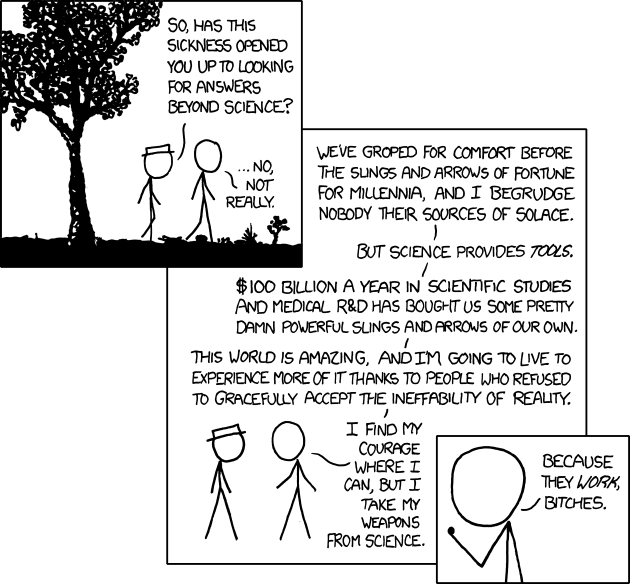
Laymen have faith(or do not) that scientists are conducting experiments properly and thoroughly before reporting their findings. Theists have faith that the testimony they take their wisdom from is based on true events and has been been transmitted accurately and without secular tampering. So no, science is not based on faith, but people put their faith in science everyday. For my part, I think XKCD puts it better than I can:

 
Apr 5, 2008
3,736
0
0
Not only can we never really be certain about many things (the specifics of evolution comes to mind), for the majority of people who are not themselves scientists or researchers, we are effectively having to take their word on such things. It is in effect, no different than religion, childrens' learning from their parents or most forms of education...we trust that what we are being told is true.

Unless one is him or herself doing the testing/research and observing the results, we are taking the conclusions presented based on faith alone.

Many things are easily observable and are difficult to dispute. Gravity, water displacement, electricity, combustion, etc are among those that we can easily observe the results of ourselves. However, a random person who we've never met telling us XYZ is beneficial to the heart or ABC is a carcinogen should always be taken a pinch of salt. I don't know the person, how can I know that they or their research has any credibility?

In particular, I'm usually sceptical about most discoveries in very specific fields, particularly those with no tangible or quantifiable outcome. Astrophysics, archaeology, meteorology, applied physics to name a few, are fields in which almost everything is guesswork and/or built only on previous discoveries which themselves have a questionable basis. Add to this media and government agenda and/or bias (this [http://thelede.blogs.nytimes.com/2009/11/02/let-scientists-write-drug-laws-says-fired-british-expert/], for example) and I personally find cause to question the vast majority of reports with which the public are presented daily.
 

maninahat

New member
Nov 8, 2007
4,397
0
0
I'm not sure if I'm talking about the same thing as the OP (which seems to be about the philosophical differences between faith and empiricism), but from a historical perspective, science was very much grounded in religion.

As the best educated in medieval European society, monks often were at the fore front of scientific study. Names like Copernicus, Mendel, and Eilmer of Malmesbury (a lesser known, but nevertheless inspiring individual) crop up. There was never any concern about "science vs religion", as God was unquestionably seen as the creator. Their mentality was that science was simply a means of better understanding what God had created, so there was nothing to worry about at all - a far cry from the stupid Creationist debates you have in this day and age.

Meanwhile, religious doctrine in other nations required scientific and technological developments. In muslim countries, for instance, there was a need to accurately determine where Mecca was, no matter how many hundreds or thousands of miles away you happened to be standing. Thus, a great deal of advancements in charts, astronomy, astrolabes and compasses came as a consequence of trying to maintain this religious practise.
 

dvd_72

New member
Jun 7, 2010
581
0
0
Scars Unseen said:
Science isn't based on faith any more than religion is. Faith is simply belief without understanding.
Shall I explain to you where faith comes into science? Well, it all comes from the foundation of science which is philosophy.

Solipsism is one of the first. We have to take it on faith that the world outside of our mind is real and not a dream or simulation. Without believing in that nothing we do in science, no matter how rigorous, is pointless. Science relies on our observations of the world being valid in order to function.

As explained in the extra credits video, there are several postulates in geometry that cannot be proven and must be taken on faith. We use them because they work, but we have nothing beyond that to support them, therefore we have to have faith in these postulates in order to apply these geometrical rules.

A more recent example is the Schrodinger equation. We know it works, an with it we are able to extract a wealth of useful information about a quantum system. But how was it formulated? Why is it how it is? Well we don't really know. We use it because the results we get from it correspond with observations.

Much of science is supported by logic and observations, but there are several fundamental ideas that one must take on faith in order to be able to use science otherwise the whole thing crumbles. On the bright side if these ideas turn out to be untrue science will adjust, or the whole of reality has no meaning so it wouldn't matter anyway!
 

xXGeckoXx

New member
Jan 29, 2009
1,778
0
0
Tanakh said:
xXGeckoXx said:
As a person involved in research I can say that even if you are doing the studies yourself you are taking it on faith.
And again, you could say that, but then you would have to admit that every perception and every tought you ever had, every action, every motion and ever feeling, every freaking aspect about anything in the whole creation and outside needs to be taken on faith.

And among those, among everyfukingthing, sience is among the ones that requires the lest faith.

So, using the word without consideration yeah... you could say that, but in context? Lulz, no.
Exactly what I am saying. Yes it requires the least faith but faith never the less. Everything requires faith therefore science being part of everything requires faith, to deny that would not be particularly scientific.
 

maninahat

New member
Nov 8, 2007
4,397
0
0
Yopaz said:
Actually science is based on disbelief. Not accepting facts for what they are, asking questions about established facts and questioning reality.

I believe in science so I can say that faith is a good part of it. A scientist isn't satisfied with that. A scientific statement means that it's possible to prove it wrong and that's what a scientific experiment is supposed to accomplish.
That's quite a good way to put it. I was going to say something about the need for scientists to at least take some faith, in the sense that they are required to go out on a limb, defying common knowledge or common sense to make progress (like asking if heavier objects don't fall faster), but your explanation makes more sense.
 

Arluza

New member
Jan 24, 2011
244
0
0
Faith is belief without evidence, and science doesn't roll like that. Science runs tests, multiple trials, etc, so as to know with more certainty. While we can never be 100% sure of something, we can be 95%, or even 99%, and that makes the likelihood of something being incorrectly said as true to be very false as low. As science does more tests and trials, the % chance of something false being claimed to be true becomes smaller.

To believe something on faith is to hold something to be true, and never test it. When someone says that they take something on faith, it means that they believe without evidence, and/or in the face of evidence showing them wrong. So no, science does not rely on faith. Some philosophers say science is required to take on faith that they exist, but that is getting into the idea of us living in what is the Matrix, and even if that were the case, the Matrix would be the reality we can observe. EC shot themselves in the foot, and I find it more than a little insulting to academia that a man working in an accredited college could write something like that and then keep it in.
 

Colt47

New member
Oct 31, 2012
1,065
0
0
I got halfway through their retort episode and decided it best not to open the can of worms further. This is not an argument about faith and confidence as much as the definition of the words in natural language. Faith is not a technical term and does not have a single understood definition. Likewise, it can be philosophically argued if any of the definitions even apply to science at all given how science works. Faith isn't inherently required for science to operate: instead what is required is merely an assumption that can be built into a testable hypothesis.

However, I will not argue the fact that people do in fact have faith in science. Blind faith, in fact. In my opinion, this is caused by a lack of knowledge in how to properly assess the results of an individual study and news outlets not accurately presenting the significance of the study. If some study proves chocolate is good for people the outlet will rarely ever mention what the study was comparing chocolate to or how much it actually helps in regards to a condition. Maybe the study is saying it's healthy in comparison to Toffee, or that it plays a barely statistically significant role in heart health.

To put things simply: trying to argue faith into science is like trying to dig a strait path to the bottom of the map in Terraria: Even if somehow you manage to not hit water, magma pockets, or a chasm, you'll still eventually hit the massive sea of magma at the bottom.

Edit: Conviction is probably a better word than faith anyway.
 

chadachada123

New member
Jan 17, 2011
2,309
0
0
One way that I've found to help explain this whole thing is this: Do we live in the Matrix? Are we just living a computer simulation? Does anyone outside of yourself actually exist?

All of these questions are completely unknowable. The very existence of the computer in front of you could be false, your computer could merely be a hallucination or a dream or a simulation.

That said, science is essentially working on this premise: IF there is an objective universe with rules, AND we accept that it can never be known for certain, then let's play along and see if we can discover these rules for ourselves to as high of a degree of certainty as possible. Every test in science is falsifiable, and this is where faith and science differ. You think that gravity, or the existence of atoms, or evolution doesn't exist? Disprove them, then.

Any scientist worth his weight in salt will, if being strict and literal, agree that nothing in the real world is certain or absolute. When they say something like, "gravity exists," they are really meaning "gravity exists in *this* universe with near-absolute certainty." But the common man wouldn't understand this philosophical concept unless it is explained in detail.

Other science-inclined posters, please, correct any problems you see with my post. (Another facet of science is that we would much rather be proven wrong and learn the truth than to continue believing in falsehoods. There is no use in perpetrating lies.)
 

dvd_72

New member
Jun 7, 2010
581
0
0
Arluza said:
Faith is belief without evidence, and science doesn't roll like that. Science runs tests, multiple trials, etc, so as to know with more certainty. While we can never be 100% sure of something, we can be 95%, or even 99%, and that makes the likelihood of something being incorrectly said as true to be very false as low. As science does more tests and trials, the % chance of something false being claimed to be true becomes smaller.

To believe something on faith is to hold something to be true, and never test it. When someone says that they take something on faith, it means that they believe without evidence, and/or in the face of evidence showing them wrong. So no, science does not rely on faith. Some philosophers say science is required to take on faith that they exist, but that is getting into the idea of us living in what is the Matrix, and even if that were the case, the Matrix would be the reality we can observe. EC shot themselves in the foot, and I find it more than a little insulting to academia that a man working in an accredited college could write something like that and then keep it in.
While in general science does do tests on hypotheses in order to advance our knowledge there are things that must be taken on faith not because we haven't or don't want to test them, but simply because we can't. As I've said before, Solipsism is one of the foundations of science, that we have to take on faith and without being able to test it, that the reality we perceive outside of our minds is real and not a dream or the entirety of science becomes nothing more than a farce.

People seem to think that when someone says science is based on faith that all of it is faith which anyone can see is wrong. The simple fact of the matter is that there are some foundational ideas that must be taken on faith for not only science, but life to have any kind of meaning.
 

Something Amyss

Aswyng and Amyss
Dec 3, 2008
24,756
0
0
texanarob said:
MeChaNiZ3D said:
There is a difference between what is reasonable to assume and what is possible. Science does not suggest some wild pie in the sky explanation and then say "Well you can't prove that isn't true", they look at evidence to determine the best explanation they can come up with. If a better one that fits the EVIDENCE more closely comes along, they go with that. But faith isn't even that, it's a belief in something whether or not the evidence is there, and that has no place in science.
I believe in many things without evidence. I believe the people posting on this thread to be separate individuals behind computers around the world posting their opinions. Alternative explanations include that someone somewhere is messing with me, using multiple accounts to generate a lot of nonsense, or that this is merely a dream.
Of course, two of those opposing ideas are patently ridiculous.

I also believe that God not only exists and created us, but that he has given His Son as our path to salvation. A much bigger claim, but one I feel science will either never manage to prove, or the proof would take so long I'd be dead before they got there. I don't try to claim my belief is science, but merely observe that all evidence supports my belief.
What evidence would that be, exactly?
 

Cyfu

New member
Nov 25, 2010
394
0
0
hahahaha... that's funny.
no science is not based on faith. science is based on evidence.
/thread