BloatedGuppy said:
I get that, and I suspect it's because it's not an issue for you. Think of it as...let's see. Think of being, say, a black man in 1950's America...and issues of race are very important to you. And let's say a show comes along, and it has a black character, and he's a moron and a buffoon, and is illustrative of many of the ways in which you feel your race is unfairly portrayed in the media. The show is also an excellent comedy. Can you criticize the show for what you perceive as racism, despite the fact it's irrelevant to the show's quality as a comedy? Would that not be a legitimate, rational, or valid criticism? Could you not have that discussion, without insinuating that every show going forward would need to significantly alter itself to cater to a minority opinion?
While MoeMints made a good point about this, I'd like to bring up another. What games are doing something similar to this with women?
I'm trying to think of how to describe this properly but I guess I'll try it this way.
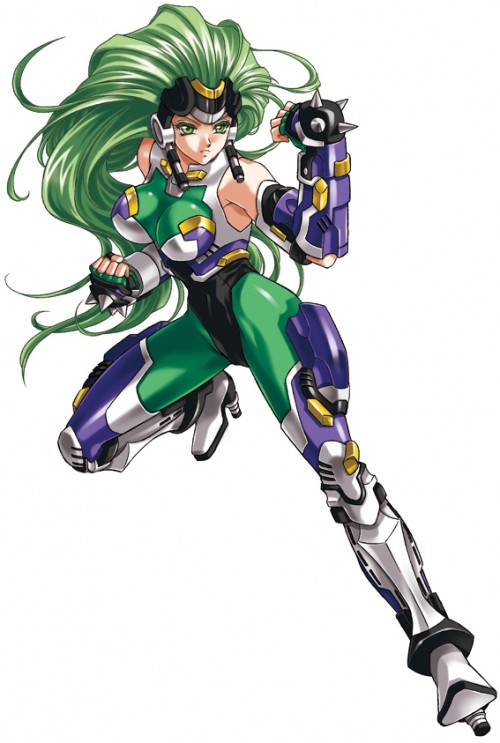
Let's look at, as an example, Aschen Brodel from Super Robot Taisen: Endless Frontier.
Now from the character's design, she has big breasts and is wearing a skintight outfit (Further, she has a form called DTD where the green parts of her outfit disappear). Now, the problem here is that feminism would often point to her body and outfit and cry sexism and talk about how it's portraying women poorly. But how is it doing that? How is just a character's physical appearance portraying women poorly? The character herself is actually very smart and is often the first one to point out the ridiculousness or stupidity of situations or people. She's also frequently mocking the character Haken whenever he's trying to be cool or hit on women. She's also just as powerful and competent a fighter as the two male protagonists in the game (The game actually has 4 female PC's and 2 male PC's)
But what is often brought up is simply a character's physical characteristics, it's as if people assume the person playing such a game is going to completely filter out any good characterization and just assume girls are only important for their bodies.
Let's bring up another character from a game I have, Pamela Ibis, from Mana Khemia.
Here's a character that seems to have many of the traits that most people would call stereotypically girly. She likes dolls, she's likes cute things, enjoys attention and can be a bit spoiled at times. This character is also very kind and is considered a friend amongst all the PC's. She's also just as much a fighter as any of the other characters. One can look at this character and just see a stereotypical depiction of a girl. Usual feminist rhetoric would say this character is perpetuating a negative stereotype about girls. This would be in spite of the fact that she's still participating with the guys, she's still fighting, she's still contributing to the group, and furthermore, she's not the only representation of girls. There's also the other three girls of the 8 PC's and they are all different from her.
This is one of the problems with feminism in games, people take a single facet of a character or look at a single moment with them and cry foul. Even in the case of the Sorceress from Dragon's Crown, she's sexually appealing, but she's also one of the PC's and she's a powerful magic user. The character is not wholly defined by that aspect and the people playing the game don't just look at the character that way because they play as her and care about how strong the character is in regards to the gameplay. The fact that she knows magic also means that she has to be intelligent enough and have studied enough to use it.
The example you use, or what you intended it to mean, is that it is portraying a certain kind of person as being stupid and that is all they are known for. But in many examples people use to claim that gaming is telling people women are weak or only meant for eye candy, the character are not in fact merely defined by being someone to rescue or having an attractive body.