

[HEADING=1]Sub/jective Reviews[/HEADING]
I am starting a new review series that I am going to do every holiday/time off from education. The series will be split into segments, where I discuss the different aspects(gameplay, visuals, audio, story, multiplayer(if any)) of a game in their own given category. Most notably, I will provide what I find to be an objective assessment of those different sections. What this means however, is that I will provide any objective information that I can, which will usually be limited to a list of features, a bug/glitch count during my playthrough and a run-down of the options. I will take both the subjective portion of the game and the objective into account during the final assessment. I will not provide scores, as I am opposed to that idea to begin with, as it causes readers to glaze over key information in any review.
Why am I doing this? Many people are clamouring for game reviews to be more 'objective', so I'll address that wanting, if only to highlight exactly how limited true objectivity is in application to reviewing.
For the time being, I will focus on indie games. I am open to suggestions, so long as the games are available on PC/Steam and so long as they aren't something that has been talked about too much, as I don't believe that I will add anything significant to that discussion.
Why am I doing this? Many people are clamouring for game reviews to be more 'objective', so I'll address that wanting, if only to highlight exactly how limited true objectivity is in application to reviewing.
For the time being, I will focus on indie games. I am open to suggestions, so long as the games are available on PC/Steam and so long as they aren't something that has been talked about too much, as I don't believe that I will add anything significant to that discussion.
Critique is encouraged and appreciated. If you see something you'd like to be added/improved, post ahead!
The PC that the games will be played on:
[li]Intel i5 3470 @ 3.2Ghz Quad Core Processor[/li]
[li]Kingston Hyper-X 2x4GB DDR3 RAM @ 1337Mhz[/li]
[li]Zotac Nvidia Geforce GTX 670 2GB[/li]
[li]Acer 23.6" Monitor 1920x1080 @ 60Hz[/li]
[HEADING=1]Gunpoint[/HEADING]
[HEADING=2]Intro![/HEADING]
Right from the outset we have another interesting indie title on offer. Developed by a former PC Gamer reviewer, Tom Francis, Gunpoint sits in the infrequent position of serving as evidence for or against the idea that games journalists may or may not have the necessary knowledge of the medium to be able to create an engaging end product. From first impressions, the game offers up a noir aesthetic and atmosphere: the main character is a freelance investigator and the environments primarily include offices and warehouses. You could be forgiven for drawing comparisons between it and Nightshade(or better known as the game that spawned many image macros, gifs and YTPs from Jontron's video on the game), however the similarities end with the trenchcoats.
Gunpoint has a lot on offer and is Tom Francis' first official foray into games design. Promising an engaging detective noir story, with the inclusion of stealth elements means that the game has quite the potential to live up to, considering that its competition on the indie scene includes the likes of Stealth Bastard and Mark of The Ninja. The proof is in the pudding, and with that in mind, join me on an analytical journey through Gunpoint.
[HEADING=2]Story![/HEADING]
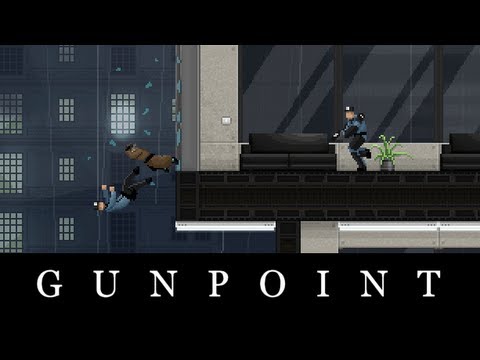
You play as Richard Conway, freelance investigator, as you go through an average week's worth of work with him; breaking into corporate bureaus; breaking down doors; punching a police-man's teeth out; bunny-hopping across streets; flinging yourself out of 3rd story windows, etc. The story begins just as Richard acquires a pair of 'Bullfrog' trousers, enabling him to leap great distances and heights, without granting him any control to manipulate the trajectory in-flight. Whilst testing these out(and falling flat on his arse out of an apartment building several stories below), you become embroiled in a series of plots, involving corporate espionage, personal vendettas, police corruption and murder. As you advance through the game, you shift between several parties, whilst making decisions on who you aid at what time.
The story feels like an answer to a question. Many of the features included in the game feel like they were created out of response to some unspecified wanting from the current state of gaming. The narrative is where this idea shines the brightest, as it is something you wouldn't expect from a game in the indie scene. Whilst most might resort to simply focusing on a core mechanic and letting everything else(story, characterisation) trickle down from gameplay(see: [a href=http://www.escapistmagazine.com/forums/read/326.863812-Sub-jective-Reviews-Fez#21552712]Fez[/a]), Gunpoint doesn't choose any specific part of game from which to deride all the other core elements from. The story feels well-developed and offers enough twists and turns throughout that it will remain engaging whilst at the same time not outstaying its own welcome. The plot isn't entirely linear either. Whilst the final few missions are fixed, there are lots of tiny individual choices that you can make through the games' dialogue choice system, offered either at the start or the end of a mission. Whilst the impact may not always be significant, it offers up a nice little sprinkling of importance to the the individual and sometimes seemingly inconsequential decisions you make: you begin care about the story because you have agency over the moment-to-moment gameplay and over the tiny details given by the dialogue choices.
The game benefits significantly from strong writing. Individual sub-plots are unfolded in a gradual manner that keeps your attention and endears you to the characters on display. It should also be mentioned that the game is pretty funny too. Unlike humour in most games, Gunpoint gives you a few deadpan one-liners, and occasionally allows you to roleplay as a carefree detective through dialogue options. The indirect method of story-telling(during missions, the action doesn't draw attention away from what you are doing, so it feels like things are progressing organically without your intervention) brings to mind fond memories of the earlier Thief games, which also had a suitably straight-man protagonist in a rather bizarre and too-dark-for-its-own-good world. Richard often feels like an outsider; he is frequently used by several shady characters to further their own agendas, but he never feels like he needs to pick sides out of some self-righteous sense of moral duty or other higher-power reasoning. He is refreshingly relatable because of this: Why is Richard going after a guy who sits behind layers upon layers of security and alarms? Because he insulted his hat.
That is not to say that the game is just a constant stream of humour either. There are some tiny moments within the game which can cause you to feel genuine guilt or sadness. Overall, the game has a stable tone throughout and emulates the concept of a short story. It doesn't correlate to some grand narrative involving the fate of the world, or uncovering some dark past about Richard's love for hats. It is a week in his shoes, and it is a rather fun, if brief, rollercoaster ride because of that.
[HEADING=2]Gameplay![/HEADING]
The central mechanic is stealth. At the beginning of a mission, you are given an objective, and a side objective. From there on in, you can choose your own approach to the situation, but there is a slight element of direction ever present. You die very quickly: one shot is all it takes, so unless you feel brave, or if you have concocted some clever tactic which involves the manipulation of guard AI behaviours, you'll want to avoid them. You can take them out by jumping onto them directly, or by falling onto them from above. The game's shop provides you with many tools which expand your arsenal and your options in which to approach any given situation. You can also climb walls, and break through windows via jumping. The game doesn't initially show you the cone of vision of the guards, but it's only a momentary hindrance. As the game's challenge escalates, you begin to have a solid grasp for whether or not a guard will or will not see you, even if you get tools that give you this information, resulting in organic player-skill progression, which reflects strong design.
One specific tool, which elevates the game's already solid stealth system, is Crosslink. It allows you to re-wire devices along a network; let's say you want to turn off the lights on the floor so that you can sneak past a guard. The light switch is wired to the lights, but with Crosslink, you click+drag the switch to instead open a door, and for the lights to be turned on by a security camera. That way, when you walk through the gate, the lights will go off; the guard will go to the switch, but instead open a gate, which alternates his patrol route(guards always go for the light switch when the lights go off, and they always patrol the entire floor; opening a door extends their route), enabling you to sneak past.
It's a simple, but effective accessory that can often be used to execute elaborate strategies. However, it isn't an optional extra, as around the early-mid game, you need to purchase it to continue the story. Nonetheless, it changes up the pace and the way you approach the game, which is commendable, considering how little it takes for your mindset to completely change in an already methodical game.
The mechanics allow for an organic, and simultaneously directed approach. Each mission has a fixed end objective, and you die in one hit, but the method through which you get to the objective feels like it was your own. You never feel like the game is forcing you down a corridor, but neither do you ever feel that you are overwhelmed by options. It hits the sweet spot in terms of pacing, allowing you to decide how quickly you want to go through a level, whether it's jumping through windows like a maniac, or if you want to set up a chain of dominos using Crosslink. You don't get to fool around though. Each mission has four assessment objectives: Violence, Noise, Time and Witnesses, so there is a constant element of pressure everytime you feel like going through with a risky idea. It reinforces the game's 'subconscious direction' method of pacing: you don't want to loiter around forever with a master plan, nor do you want to run around like a fool. The objectives keep you thinking on the spot and make you more receptive towards the game's environment.
The gameplay is not without some issues though. If it weren't for the game's short run time, it wouldn't be too much of a leap to see that the story cuts off just at the point where ideas begin to run dry, and when the Crosslink mechanic might begin to show its seams. Aside from a few upgrades that act like add-ons to Crosslink, there isn't much that changes the game as much.
The actual, non-item upgrades are also pretty linear, which may beg the question to as to why they're there in the first place. You gain points at the end of every mission that you can use to upgrade the range of your Bullfrog jumps, the speed at which a jump is charged up, or (once you've gained the necessary pre-requisite items) your battery capacity. The first two impact play the most, as they might allow you to execute more daring jumps and tactics, whereas the battery charge just gives you more chances in which to use Crosslink add-ons. The add-ons however, range in usefulness. One allows you to re-wire guns, which can make guards shoot other guards(or just disable their guns, but why would you want to do something as boring as that?), another lets you electrocute guards by over-charging switches, and the third one negates noise when breaking glass when jumping through. The last upgrade is incredibly useful, as it reduces your Noise rating at the end, and it doesn't alert guards to your position when entering a building from the outside(sometimes you are locked out and this is your only option), whereas the gun re-wire only works if you want to kill another guard or if you require to run straight past another guard(however, more often than not, you can simply sneak past them if you take a moment to assess the situation). The 'electrocuted switches' add-on is almost useless. It only works on switches, and more often than not, it's simply easier to lure a guard next to a power socket and incapacitate them that way, since the power sockets vary significantly in availability and positioning from level to level.
There's also an upgrade which makes the first bullet fired at you miss, but this is at odds with the stealth mentality of the game. You could build a strategy around running around the level rapidly, but you won't get very far in doing that, as the design necessitates some thought. The autosave function is also frequent and generous enough that if you screw up, you can almost immediately go back to a previous point and attempt a different strategy. The upgrade feels arbitrary, like it was added for the sake of being another upgrade to pad out the shop.
[HEADING=2]Objective Assessment:[/HEADING]
Fully re-bindable keys. Controlled through keyboard and mouse. No controller support. Controls are on the whole, tight and responsive.
[HEADING=2]Visuals![/HEADING]
The aesthetic is quite simplistic and utilitarian. The game doesn't have anything in particular that may inspire awe in its visuals, but it has enough of an identity that from screenshots alone, you'd be able to identify the game rather quickly. It can be argued that this is because of the type of gameplay that was chosen; not many 2D stealth games revolve around the infiltration of offices and warehouses, so it could be that the 'halfway transparent house' level design is the reason why its so distinct. Nothing about the style screams 'sci-fi' or 'noir', but the simple artwork doesn't detract from the experience, nor enhances it in any way. It's there to serve as framing for the narrative and the gameplay, and whilst it uses standard 2D pixels, the enemies and Richard are easily identifiable and distinct from a distance.
The level design isn't all that amazing either: there's little variation between 'a bureau', 'an apartment block' and an 'underground warehouse'. The structure is there to serve the gameplay, which I can understand. The game's strengths like in its writing and mechanics, not in the art design, which may have been as a result of the limitations of GameMaker and the small production budget. Simply put; it gets the job done, certainly, but memories of the game will likely not focus on the specific white warehouse that you entered that one time.
[HEADING=2]Objective Assessment:[/HEADING]
Adjustable resolutions are available, as are windowed/fullscreen/borderless windowed options. Game requires restart in order to be changed. V-sync is available. Colour-blind mode is also available. Due to the game being 2D, extensive visual options aren't necessary.
[HEADING=2]Audio![/HEADING]
The pure audio of rain and other miscellaneous noises is simple and are there to establish the environment, but only to a point. It is looped, so the rain effects are not amazing, but that's not the main attraction of the game anyway.
The music is quite good. It's simplistic, going for a typical 'noir' sound, [a href=https://www.youtube.com/watch?v=AASeTbHFvSQ]meaning pianos and saxophones[/a], but it fits the sleuth feel of the story and the moment-to-moment gameplay. This is occasionally mixed in with [a href=https://www.youtube.com/watch?v=Bj7sZn0dCTU]more cyber-punk effects[/a], but still retains the sensibility of standard 'noir', not quite reaching Deus Ex Human Revolution's level of music/theme hybridism(though that is unfair, as the two games have vastly different budgets).The music doesn't intrude upon the game, and is pleasant enough that it doesn't get annoying either.
A neat little touch is that upon entering Crosslink mode, the music immediately switches to being more cyber-punk, which is another neat little touch that the game offers. Whilst it might seem that like with the visuals, the audio is here to get its job done, it still manages to contain quite a refreshing and engaging sound to it, gently reinforcing the noir/detective feel of the game whilst standing up a nice piece of music by itself. Considering the small budget, this soundtrack is a bit admirable, in all honesty, as Francis could've just as easily gone for a more dull soundtrack, but I am glad that he didn't.
[HEADING=2]Objective Assessment:[/HEADING]
Separate sliders for sounds and music are available. No master slide.
[HEADING=2]Tangent/Thematic Discussion![/HEADING]
Not much to really discuss here, Gunpoint is a pretty solid game, and a very strong entry into professional games development for Tom Francis! It does bear to mind that an extensive knowledge of the medium can manifest itself as real talent in creation. It's good that a modestly priced game such as this can come out as effectively as it did, and manage to stand out from its competitors.
I personally appreciate the focus on narrative and mechanics. It's not necessarily a gripe per se, but I do tend to lose just a little bit of interest when I hear that an indie 2D game has been released, and that its main selling points are an excellent visual design and audio production. It's all well and good, and the importance of indies is to provide a more specialised counter-part to the increasingly, jack-of-all-trades-master-of-none approach that far too many AAA games have adopted. I see the point in tackling something that only an indie can tackle, and it is in line with the idea of an indie programmer having the same sort of general 'idea' as an indie musician or artist. It's just that in becoming the norm, it begins to confine the development philosophy and diverts it from what it really should be about. Games like Super Meat Boy established the central conceit of specialisation during the indie renaissance, but I don't believe that it should ever be restricted to a solitary element. Independent games development should be embodied by unfettered experimentation, with the focus being given to the intended end result of the experiment. The games shouldn't just be 'artsy platformers'. I realise that that's not an easy thing to do either, but an artistic vision, especially in games shouldn't be defined by standard artisitic terms, from what the general public see as being 'artisitic'. Braid is successful because of its soundtrack and visual style, yes, but that is only one way of providing a game as a work of art.
I mentioned that Gunpoint felt like an answer to a question. I think this is what it was answering to. "Is a game artistic because of it's audiovisual presentation and gameplay specialisation?". Gunpoint says no. It gives us an alternative. That a game may still be a game and culturally significant without going the easy route, without being labelled 'artsy' because it behaves like a painting and acts like a NES game. Gunpoint tells us that you can have complex gameplay and a fantastic story, and still be no less significant or important than Braid or [a href=http://www.escapistmagazine.com/forums/read/326.863812-Sub-jective-Reviews-Fez#21552712]Fez.[/a]And I salute it for that.
[HEADING=1]Final Assessment![/HEADING]
Gunpoint is a surprisingly strong game. In being Tom Francis' first professional design outing, it fills me with hope that the guy has a bright future ahead of him. Gunpoint is an achievement in terms of its narrative and gameplay, not because it is bombastic, or tries to speak of higher concepts, but because it is simple and effective, setting it apart from heavy hitters such as Stealth Bastard and Mark of The Ninja. It is an alternative to the standard 'indie 2D platformer' which makes it refreshing. The stealth system is fun and methodical, and evolves in a way so as to enhance the already solid gameplay. The Crosslink mechanic feels like a core extension of the game, rather than a tacked-on gimmick, making the game memorable, despite its brevity.
With a branching story that warrants for at least two playthroughs, and a level editor, Gunpoint is the sort of relaxing Sunday afternoon game that you can sink your teeth into, leaving you with a content smile as you progress through the complex story and figure out solutions to the game's many missions.
Oh yeah, the game also features an epilogue system: upon finishing the game, you compile your own unique 'final word to the story', which is kind of neat.
Showcased here: http://www.pentadact.com/category/conwaysblog/?K=8&U=21&C0=2&E1=2&C1=5&E2=1&C2=2&C3=3&C4=3&C5=3
[HEADING=2]Final Objective Assessment![/HEADING]
Game has a suite of visual options, satisfactory of a 2D game, including v-sync, adjustable resolutions, windowed/full screen/borderless modes and colour-blind mode. Separate audio sliders are available for music and sound. No master slide. Controls are fully re-bindable, no controller support. Bug-free during play, and ran at a solid framerate of 60fps.At around 2h 30m, the game is valued at around £2.4 per hour. With another playthrough to see all content, it's £1.2 per hour. Level editor included. Steam Workshop support is active and available.