

[HEADING=1]Sub/jective Reviews[/HEADING]
This is an ongoing review series that I'll stick to in as regular a fashion as possible. My review format is centralised around breaking criticism down into subjective and objective components so as to cast a wide a net as possible, and to be as informative to the reader as I can make it. I personally feel that too many games journalists nowadays just make reviews into streams of information, rather than specifiying and breaking down specific components of a game, so I'm putting this format forward as something I'd like to see practiced more often, as I believe it makes discussions more holisitic and informative.
Initially, this began as a reaction to people wanting more objective reviews, so I thought to put that forward as a gimmick, but over time, it grew to be a genuinely effective way for me to organise my own thoughts about a game. At the end of the day, these reviews are primarily about me trying to pick a game to pieces to find as much worth in it as possible, because the industry has evolved so far that it can comfortably have games that are popular just for their sound assets, visual presentation or gameplay alone.
Initially, this began as a reaction to people wanting more objective reviews, so I thought to put that forward as a gimmick, but over time, it grew to be a genuinely effective way for me to organise my own thoughts about a game. At the end of the day, these reviews are primarily about me trying to pick a game to pieces to find as much worth in it as possible, because the industry has evolved so far that it can comfortably have games that are popular just for their sound assets, visual presentation or gameplay alone.
Criticism is encouraged! If you see something you'd like to be added or improved, don't hesitate to post below!
Reviewer's build:
[li]Intel i5 3470 @ 3.2Ghz Quad Core Processor[/li]
[li]Kingston Hyper-X 2x4GB DDR3 RAM @ 1337Mhz[/li]
[li]Zotac Nvidia Geforce GTX 670 2GB[/li]
[li]Acer 23.6" Monitor 1920x1080 @ 60Hz[/li]
[HEADING=1]Hotline Miami 2: Wrong Number[/HEADING]
[HEADING=2]Intro[/HEADING]
Another Sunday, another review. Considering that I've revisited Hotline Miami formally last week, I thought that it's only appropriate to do the same for it's sequel this week. It garnered considerably less attention from the gaming press than the initial game, and I can understand why. As I detailed previously, it was an incredibly focused dose of ultra-violence and adrenaline, something incredibly simple yet also effective enough to outlive its initial appearance as a hidden gem.
As it happens with these sorts of things, naturally, 2 had some big shoes to fill. Initial trailers already showed it off as more of the same, but bloodier, bigger and more detailed. In theory, that's all you'd really want to ask for out of not only a game, but from a follow up to an experience as gonzo as HM. In practice, well, what we saw was pretty much what we got, but for some reason, lightning didn't strike twice. It's not as if the game had undergone any drastic changes in vision or style, just that we, as an audience just didn't get swept away by it as much as we thought we would. The fantastic music was still there, so too was the gameplay and the psyched-out atmosphere, but something was evidently missing. A feeling of cohesion perhaps? Perhaps HM was just novel and colourful enough to stand out in what had otherwise been a year of people getting bored of the current console generation? It's difficult to say.
That apathy and, well, disappointment is a major reason of why I think it's necessary to review Hotline Miami 2 alongside it's predecessor. It isn't a story of undeserved criticism, far from it; but it is an interesting case study that we've seen happen many times over, where just 'more of the same' isn't good enough. It's just that in this case, it wasn't at the cutting edge such as with [a href=https://www.youtube.com/watch?v=dejO6aiA7bs]Fallout 4[/a] or [a href=https://www.youtube.com/watch?v=pdDv_def3Yg]Borderlands 2[/a]. It's a case study, and that's why I think it's important to take a look at Hotline Miami 2.
[HEADING=2]Story![/HEADING]
Immediately we run into the crux of why HM2 fell short. The story, in contrast to it's leaner, younger sibling, is much more lavished. A great amount of detail has gone into putting in a grander story, with multiple characters, timelines and locations. The game runs you through about one or two characters' stories per chapter, each of which tie into a greater narrative that is presented in medias res. Events unfold not in sequence, but clarity is given as they overlap with previous sequences. That is to say, a late game character will conclude an earlier story out of the blue, and you won't understand what happened until you reach that same point in the story later on. All props to Dennaton for managing to squeeze out so much out of a game that was otherwise incredibly cryptic and worked better on symbolism than anything else. All in all, there are about 13 or so playable characters in the game with a total of about 9 stories between them. They often overlap and reference previous events in the game, HM1 events and even events preceding the original game. In terms of variety, there's a lot to go around, with each character bringing their own version and justification for extreme violence. The Cop does it in the name of justice, and is frequently questioned for his cavalier attitude as well as reckless disregard for safety and due process(outright killing a surrendered criminal at one point), the Writer is primarily non lethal, so he gets by on melee weapons and knocking enemies unconscious rather than killing everyone, since he's not actually involved in all the murder, and the Fan Club is a variety of styles blended between four vigilantes, ranging from chainsaws to machineguns, by a group of people who idolise the previous game's protagonist.
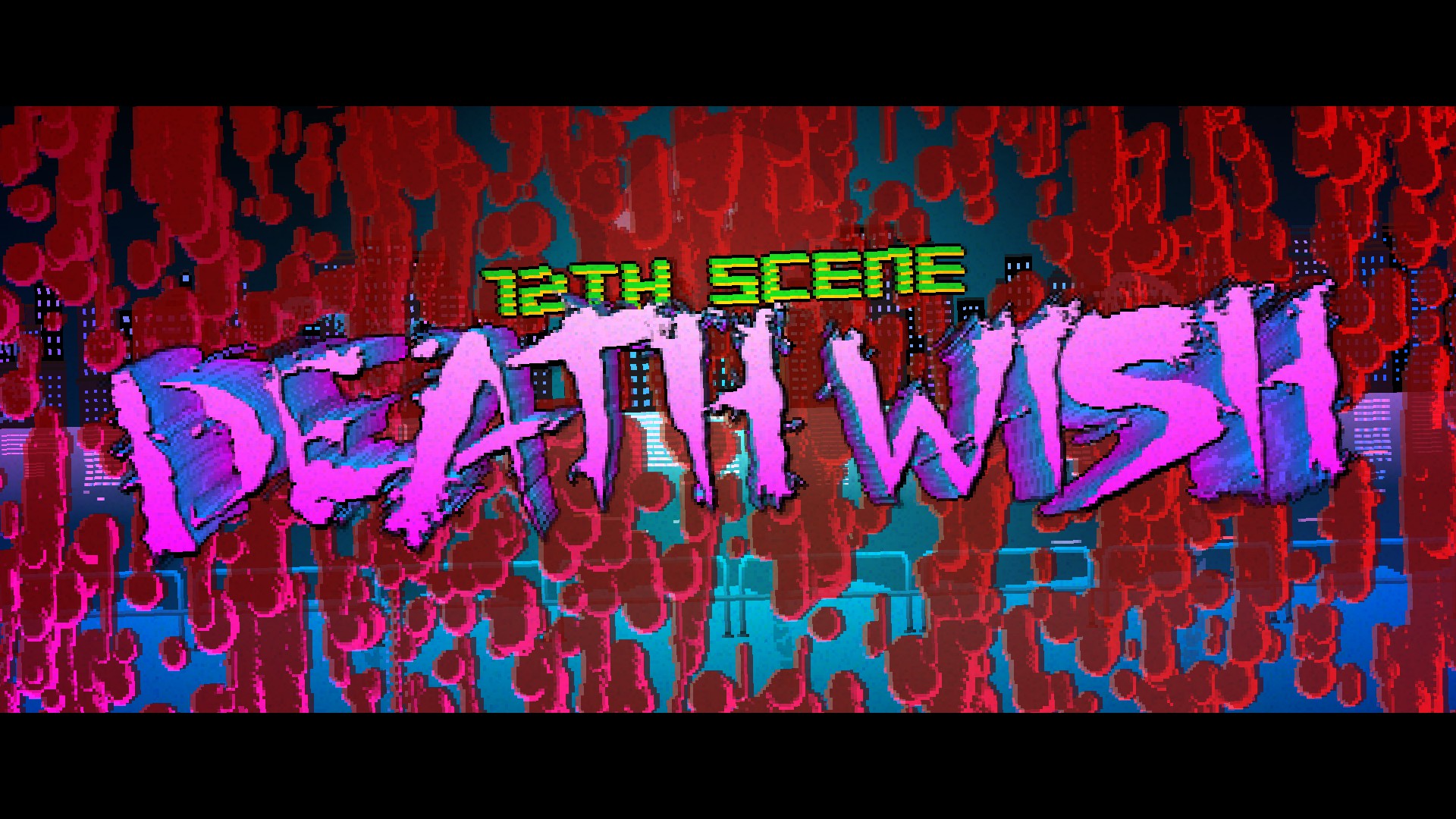
As a whole narrative, Hotline Miami 2 isn't particularly satisfying. There's too much going on at once at too many different timelines to make sense of what's happening. In the original, we only had to deal with one character, but his descent into madness was quick and was signposted by the environment. Simply put, it was through the presentation that we saw the change, but in HM2, it's up to the dialogue to carry this burden. This works, to an extent, but when you have so many frequent occurrences of characters being unrelenting psychopaths, it begins to wear down a bit when you switch between them. It's not that they are interchangeable, only that whatever point the fractured narrative serves to make is rendered somewhat moot by this. There isn't enough of a grasp to any one of the characters for you to become particularly invested, and after a while, all the mutilation, blood and craziness begins to get samey. It's a problem of direction and pacing; although the Writer sections do help change up your strategy, the emotional feedback loop of HM1 is much weaker here. In the original, each sequence would be preceded by a quick intro and succeeded by a quick outro where there was a frequent cycle of heating up and cooling down that helped carry you to the next level.
It was well balanced to ensure that you don't get overwhelmed or exhausted by the game, but here, due to the more bloated design and greater emphasis on narrative, there are fewer quiet moments. Dialogue serves primarily as a setup for the next level, but it ignores the repetitive, yet oddly calming procedure in HM1 of leaving your apartment and meeting the guy with the glasses. Here, listening to exposition and watching the grimaces of the game models gab off about 'murder this' and 'murder that' just doesn't work as well. This brings it all back again to the simple fact that the game lacks focus. Maybe it's a reflection of writing more than direction, but I personally never felt all that involved in the game's story. The characters flew by way too quickly to give any of them satisfying arcs or enough showtime to make me care. As fantastic as some of the set pieces here are, and there quite a few that are striking, their weight is undermined by a breezy plot that is running on empty due to excess. Simply put, there's just not enough material to work with to stretch out as large a story as the devs intended.

That brings me to another point, and that's the game's tone. HM1 once again takes the prize in this category due to its leanness, whereas HM2 is much more interested in exploring gray areas. To me, it shows a fundamental difference that can be summed up as follows: Hotline Miami 1 talked about if its fun to casually engage in violence, leaning heavily on 'yes', but with qualifiers. Hotline Miami 2 leans on this idea far too much and enters schlock-y B-movie territory as a result, exploring instead how violence manifests and perpetuates itself. It runs the gamut from war, to vigilantism through to hedonism, but it is much more presumptuous than HM1 was. In my opinion, it stands as too heavily directed, and this isn't a claim I make out of hand; the game's level select screen shows each individual chapter as a VHS box set, and one of the stories includes a B-movie actor losing his grip on reality. My problem with this is that whereas HM1 was lean out of necessity, it was just cryptic enough that it could present its message with few cues. You understood what it was about simply through playing, whereas HM2 relies much more heavily on presentation and explanation. The story is flawed because it is too detailed where it should have been vague. It brings to mind again that HM1 was an instant dose of escapist violence, whereas HM2 expands on this in a much more safer way, and that's just to make it even more gonzo than it was before. All the subtle atmosphere and world building is resigned to the background whereas before it was a necessary part of the game. The story is just too flabby to be enjoyable, because it doesn't fit what Hotline Miami was.
[HEADING=2]Gameplay[/HEADING]
On the gameplay front, little has actually changed since Hotline Miami 1. The Run and Gun floor-plan mechanic is still there, preserved in it's visceral entirety, though with a few tweaks that at times make it more entertaining, and at others, help to showcase the game engine's faults. I mentioned in last week's review briefly that HM1 suffered from a few clipping issues as well as bugs. In HM2, the problem is much more prominent. You frequently get stuck on terrain or environmental detailing, and it isn't exclusive to particular levels; this is something that happens across almost every level that I can remember. The AI behaviour also isn't fixed anymore, so restarting a run because one part went wrong no longer guarantees you the same safety net that you had back in HM1 upon restarting. There are many more factors in this case that can go awry, and as a result, the trial and error dynamic is made particularly infuriating, and it extends beyond just the level you're stuck on. The levels this time around are much more larger than they were in HM1, so losing progress and getting dumped back to the start of a level is even more infuriating than it was before, but it stings even more than before, because guaranteeing another successful run isn't certain: you don't know if the enemies won't suddenly change their pathing, leading you to situations where you can clear out the whole room by the skin of your teeth and then suddenly, a dog you didn't see runs up and insta-kills you. I've been in many situations where 'frustrating' feels like an understatement, because these sorts of moments increase in frequency as you progress through the game, since the levels just keep getting bigger and more crowded.
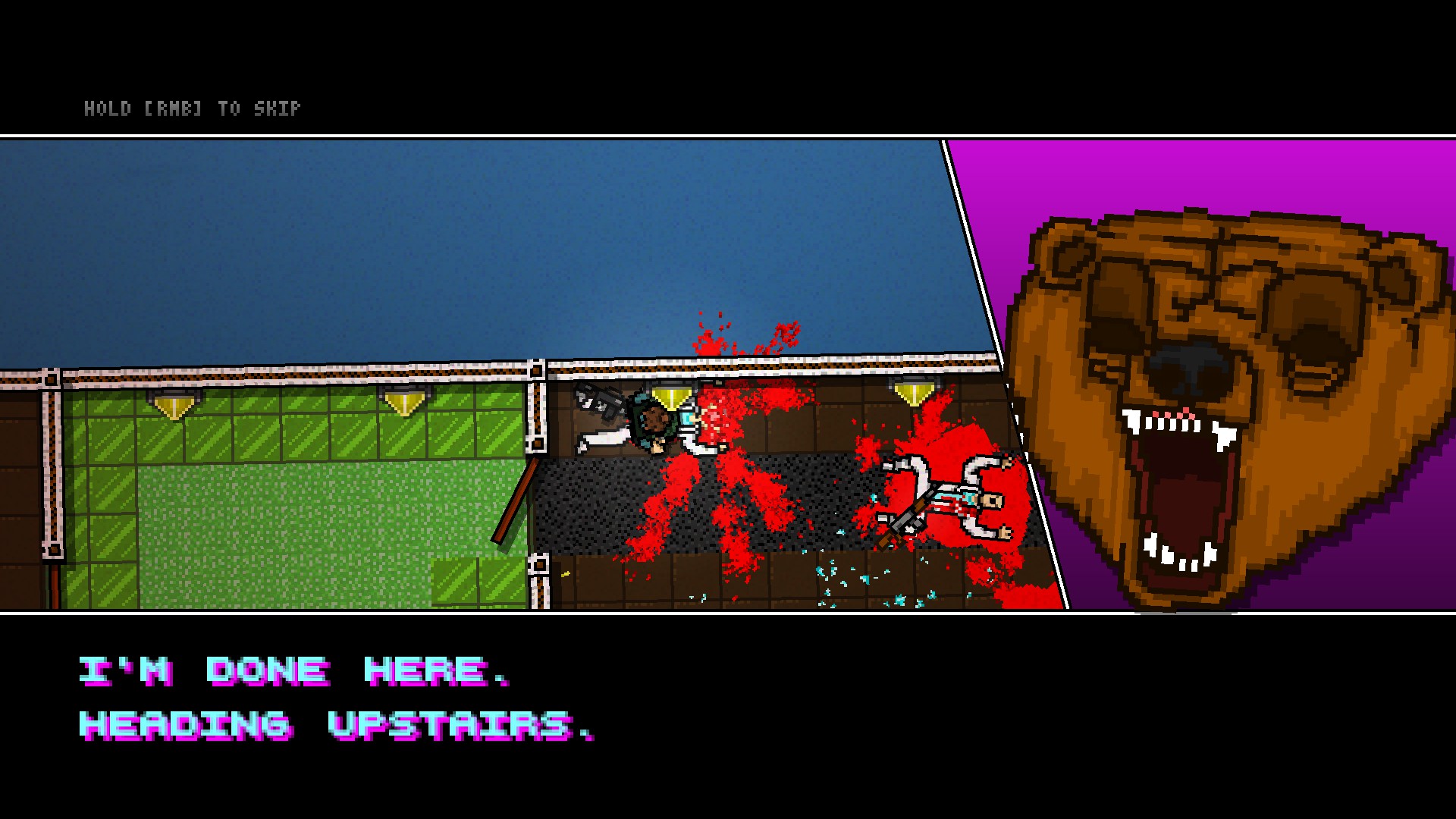
Another gripe to take up is the weapon variety. You have access to a much larger arsenal this time around, including pistols, smgs, assault rifles, chains and LMGs. Most of these are just there for additional flavour, and are functionally just cosmetic variations. An Uzi is mechanically identical to an LMG, it's just the sound assets that change up. However, the problem is that these additional weapons do little to vary up the gameplay. You do run into many more armed enemies than you did in HM1, but shootouts are annoyingly commonplace. This isn't good for the sole reason that the game is framed around quick exchanges, not long-range shootouts or waiting around the corner for enemies to run into your kill zone. Essentially, you learn to rely on weapons much more, so the gameplay feels much more formulaic than it used to be. The experimental aspect hasn't gone out the window, so much as it has become sidelined.
This is further compounded by the introduction of character builds. Each of the characters has their own mechanic attached to it, such as a dodge roll or dual-wielding mp5s. In theory, this helps make the game more varied, since you have more flexibility in approaches. The most striking variation in this field is the twin Swans characters, where one wields a chainsaw, and the other, a firearm. They are probably the most exciting, because they allow for quick room-to-room sprees the most, so it's always fun to just dash through the level, firing and swinging around like a maniac without being punished too much by the game. In practice however, this is an exception, since many of the other characters are resigned to very basic variations. Some start off with certain weapons, such as a katana or nunchucks, but they are just window dressing that doesn't do much to alleviate the boredom. There are also some characters which are suspiciously similar to some of the masks from HM1, such as the Tiger character, who has the exact same mechanic of instakill punches as Tony from the original.
Overall though, there isn't too much to criticise gameplay-wise that I haven't already mentioned in the Story section. The biggest issues come from flabby game design and a lack of polish, but otherwise, the level structure and the core principles remain the same. It's just a shame, that like with the atmosphere, the additions brought forth in the sequel serve to mostly undermine, instead of elevate the game. Otherwise, there's still a good amount to enjoy without hesitation.
[HEADING=2]Objective Assessment:[/HEADING]
Fully re-bindable keys with gamepad support to boot.
[HEADING=2]Visuals[/HEADING]
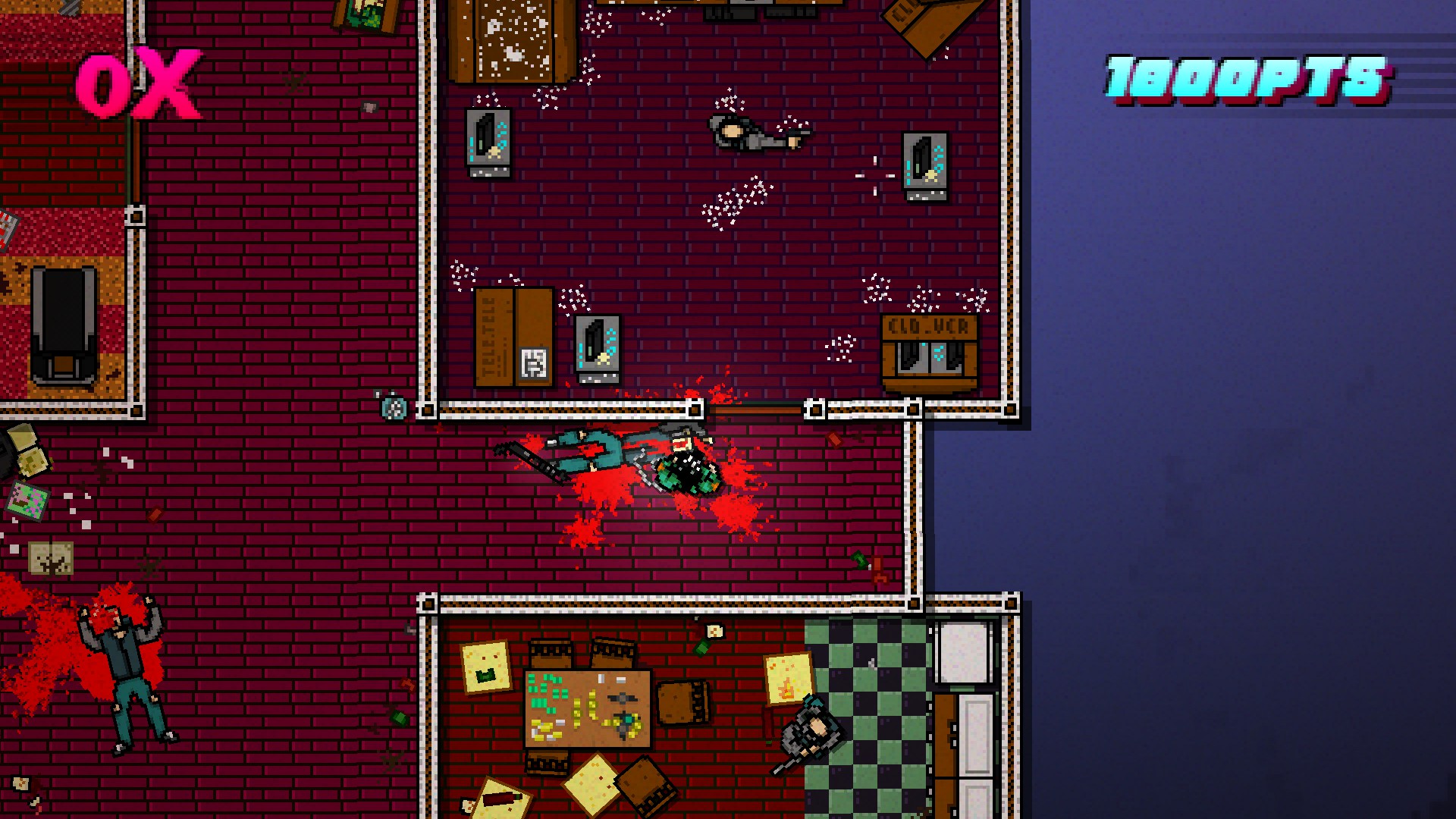
The visuals this time around are much more impressive. A lot more detail has gone into the level design in order to build up levels as wholesome areas so that they aren't just detached portions of houses. Levels range from skyscraper floors to restaurants to sewers and even to an actual bad acid trip. In terms of production, the visual fidelity hasn't changed much, only that the pixel art as well as the environmental design is more refined. This is one of the few areas where additional resource allocation was not something that made the game unfocused or worse, in fact, I welcome the increased budget here. Scenes are afforded much more detail, to the point where the game has actual cutscenes. Sure, they're just distractions, but the better visual detail as well as the more rigid direction does help establish a strong visual presentation. Scenes are vivid, colourful and brutal, but they feel even more striking than they felt last time around. Whilst in HM1, the visuals reinforced the atmosphere, here, the visuals help establish a cohesive sense of place. Loading screens have palm trees run past apartment blocks, and the garish pink neon is now mixed with a slew of other blindingly saturated colours lifted straight out of something like Dark Star. Some of the most impressive sequences come right at the end, where, without spoiling, things do end up taking a turn for the strange and suddenly our characters find themselves struggling to make sense of reality. The end sequences as well as the select few interludes really do help raise the game's presentation up by several notches. If there's one part where Miami has evolved as a game, it's in the visuals. The game looks different, but as if all the tones from the previous game have wonderfully matured into a completely different world.
[HEADING=2]Objective Assessment:[/HEADING]
Good suite of resolution options, as well as fullscreen on/off and vsync.
[HEADING=2]Audio[/HEADING]
The soundtrack too is a significant improvement over the first game. Stylistically, it's difficult to say which one is better, since they both try to achieve different things as soundscapes. HM1 went for a more trippy, twitchy aesthetic that reinforced the idea that you were playing as if you were tweaked on something. Hotline Miami 2 though, goes full 80s and sounds like part of an impressive B movie, something that wouldn't feel out of place in something like Turbo Kid. The variation and production here is so varied, colourful and strange that it is staggering. You go straight from one of Carpenter Brut's overwhelming synthesizer tracks to a quiet El Huervo piece where the percussion moves in time to raindrops. It is very impressive, so much so, that the cynical part of me thinks that this is where most of the budget went. It's hard to believe that Dennaton managed to get a hold of so many different artists, (featuring some who worked on HM1's soundtrack like Jasper Byrne and Peturbator) and mash them together into an amazing cacophony that is equal parts what I would call noisewave and 80s homage. I find it almost impossible to pick out a single track that I enjoyed the most, because each one of these is so vibrant and immersing that it's difficult to cherry pick frivolously.
If I had to make any other comparisons, it'd be to Undertale's soundtrack. Both have had a lot of work go into them, and one is a much more laudable effort, since Undertale had it composed specifically for the game. However, in painting soundscapes, HM2 is Undertale's creepy older brother. The music here is equal parts unsettling, ruthlessly aggressive, incredibly camp and meditative. It is expertly selected, and that's why I don't make the previous comparison lightly. Both are equally deserving praise for just how well they manage to make music work with their games. In the case of HM2, I truly do feel that it is what saves it. If the soundtrack had been disappointing as well, then the game would have been a non-starter entirely. It is one of the few things that made me grit my teeth, press 'r' and give the level another go before giving up completely. It makes you want to push yourself, because the rhythms are so well matched and tuned to the game's standard pace of action that you replay levels over and over again just to get combos in time with the music. Nothing feels more badass than getting the Combo Master achievement whilst Roller Mobster or Le Perv blare in the background. Again, this is one of the areas where the spirit of the original Hotline Miami has evolved in a sensible way. Here, there is no compromise or flab; that original cocktail of intoxicating aggression is still here and more potent than ever. Even if the game glitches out or if the story begins to drag on, the one thing that will keep you going is the curiosity to hear the next track in the setlist.
[HEADING=2]Objective Assessment:[/HEADING]
Separate sliders for SFX and Music.
[HEADING=1]Final Assessment[/HEADING]
So overall, is Hotline Miami 2 a worthy successor to HM1? Honestly? I don't think so. The elements are there, and they can be incredibly entertaining, but the shoes it has to fill are way too big to ever be feasibly walked in. HM1 came in a tipping point in gaming, where we began to think of violence more and more as a form of expression and as a new avenue of exploration. It blew us away, however briefly, with its lean, aggressive presentation and tight design to give an experience that is scant provided nowadays; a quick dose of adrenaline that is hard to shake off and not make you want to go for a few more levels. In contrast, Hotline Miami 2 has too much flab to ever compare to its predecessor favourably. The great soundtrack as well as the impressive visual flair hold it up well, but they still serve as a reminder that there is a limit to how much you can improve a concept as unique as the Miami series. I'm not going to say that Dennaton didn't try, for they most certainly put in a lot of effort into this game. The detail gone into the story alone shows an experimentation that is rare in sequels, but at the same time, the lack of flexibility, theme-vise, beyond ultra violence is mildly disappointing. HM1 hit hard both when it was quiet and when it was loud. In contrast, HM2 rarely hits you at all, and that it feels like a fluke, even a bit cheap. The persistent bugs, the more repetitive levels and the scattershot narrative really do bring this game down to a spin off rather than a confident new entry in the series. I'm not sure what an ideal Hotline Miami 2 would be like, or even if that is in any way possible, but what we have here is an earnest effort that fell flat only as a result of just how impressive the original was. Borderlands 2 this is not, for it shows far more ambition than that; as a standalone game, it could even work well enough to provide an unconditional recommendation, but considering how cheap and accessible the original is, there's little reason to recommend HM2 over HM1, if only maybe for the soundtrack alone. All in all, it was an experience that I had fun with, but it didn't leave me with a smile on my face like HM1 did, instead, it left me just a bit disheartened.
[HEADING=2]Final Objective Assessment[/HEADING]
Good options suite for a 2D game, with visual options, audio options and re-bindable keys with controller support.
Bought on release for 12 Pounds, with a current playtime of 9 hours. Still cheaper than going to see a movie, but only with replays, otherwise the game lasts for about 6 or so hours at your average playthrough.
[a href=http://www.escapistmagazine.com/forums/read/326.863812-Sub-jective-Reviews-Fez]Fez[/a]
[a href=http://www.escapistmagazine.com/forums/read/326.863888-Sub-jective-Reviews-Gunpoint]Gunpoint[/a]
[a href=http://www.escapistmagazine.com/forums/read/326.864186-Sub-jective-Reviews-Receiver]Receiver[/a]
[a href=http://www.escapistmagazine.com/forums/read/326.867550-Sub-jective-Reviews-Year-Walk] Year Walk[/a]
[a href =http://www.escapistmagazine.com/forums/read/326.867930-Sub-jective-Reviews-Limbo] Limbo[/a]
[a href=http://www.escapistmagazine.com/forums/read/326.878083-Sub-jective-Reviews-Metro-2033-Redux]Metro 2033: Redux[/a]
[a href=http://www.escapistmagazine.com/forums/read/326.932276-Sub-jective-Reviews-Dirt-3]Dirt 3[/a]
[a href=http://www.escapistmagazine.com/forums/read/326.932588-Sub-jective-Reviews-Undertale]Undertale[/a]
[a href=www.escapistmagazine.com/forums/read/326.932978-Sub-jective-Reviews-Hotline-Miami]Hotline Miami[/a]