

[HEADING=1]Sub/jective Reviews[/HEADING]
This is an ongoing review series that I'll stick to in as regular a fashion as possible. My review format is centralised around breaking criticism down into subjective and objective components so as to cast a wide a net as possible, and to be as informative to the reader as I can make it. I personally feel that too many games journalists nowadays just make reviews into streams of information, rather than specifiying and breaking
down specific components of a game, so I'm putting this format forward as something I'd like to see practiced more often, as I believe it makes discussions more holisitic and informative.
Initially, this began as a reaction to people wanting more objective reviews, so I thought to put that forward as a gimmick, but over time, it grew to be a genuinely effective way for me to organise my own thoughts about a game. At the end of the day, these reviews are primarily about me trying to pick a game to pieces to find as much worth in it as possible, because the industry has evolved so far that it can comfortably have games that are popular just for their sound assets, visual presentation or gameplay alone.
down specific components of a game, so I'm putting this format forward as something I'd like to see practiced more often, as I believe it makes discussions more holisitic and informative.
Initially, this began as a reaction to people wanting more objective reviews, so I thought to put that forward as a gimmick, but over time, it grew to be a genuinely effective way for me to organise my own thoughts about a game. At the end of the day, these reviews are primarily about me trying to pick a game to pieces to find as much worth in it as possible, because the industry has evolved so far that it can comfortably have games that are popular just for their sound assets, visual presentation or gameplay alone.
Criticism is encouraged! If you see something you'd like to be added or improved, don't hesitate to post below!
Reviewer's build:
[li]Intel i5 3470 @ 3.2Ghz Quad Core Processor[/li]
[li]Kingston Hyper-X 2x4GB DDR3 RAM @ 1337Mhz[/li]
[li]Zotac Nvidia Geforce GTX 670 2GB[/li]
[li]Acer 23.6" Monitor 1920x1080 @ 60Hz[/li]
[HEADING=1]Hotline Miami[/HEADING]

[HEADING=2]Intro[/HEADING]
The "review per week" shtick is starting to weigh down on me. After a relatively succesful two weeks, I suddenly am overcome once again with university work, so there's just not as much time to get back into this. In any case, you have to play with the cards you're dealt. In this instance, I chose to go with Hotline Miami; it's a game that I fond memories of, and it is one of the shining gems of modern indie development. There's enough material here to give it some coverage, as well as to flex some of those reviewing muscles I'm trying to develop. It sure beats slogging through Kane & Lynch 1 and 2 as a 'gonzo indulgence in gritty violence', I can tell you that. However, even with these qualifiers, Miami occupies such a special place as a game that it is difficult to cover anything indie, or otherwise, sidelined in games at all without brushing past it. Being released around the same time as Spec Ops The Line, it is a progenitor of using violence as metaphor in games. Not to some puritannical extent though, but I do believe that it sits in the same camp as Metal Gear Solid 2 and Undertale. It's preoccupation with viscera and heavy action brings us to reflect more on how violence is explored in our medium, not how it is just 'bad', on top of the fact of just how fun it is to just mindlessly rush through it. Just for that reason alone, I think there exists a place for this game in articles for as long as that theme remains current in gaming.
[HEADING=2]Story![/HEADING]
You play as a non-descript psychopath enacting murder on a series of Russian gangsters in 80's Miami. The story unfolds as a series of violent sequences as you kill your way through about 20-odd stages, interpsed by pauses as meeting up with his friend, who, inexplicably works several jobs at once, as a pizza delivery guy, as a bartender and as a 7/11 manager. You also have occassional hallucinatory sequences where Jacket is confronted by three masked people in a dark room, who shout at him cryptically about his past crimes. Both of these make you question what is and isn't real, since the only real sense of progression of the story is clearing levels, whereas these sequences happen almost as if they're completely detached from everything else.
It is far easier and economical to treat Hotline Miami as a surrealist story than as a straightfoward and cohesive narrative. Everything is told and presented in as vague a manner as possible. Finding out who is behind the telephone, who Jacket really is and why he is massacring Russian gangs is not the point of what's at stake here. The game is a series of violent moments and confrontational reflection. You beat a room by the skin of your teeth, when suddenly, the music cuts out and is replaced by a dull tone as you backtrack through the level back into your car, looking back at all the corpses you left you in your wake. Dennaton have constructed everything deliberately so as to quickly work within the gameplay's cycle of risk/reward, and the story is built around this. The narrative justifications are unimportant, because what matters here is seeing the protagonist go into fits of rage as he slaughters his way past every room: that primal urge and CoD-like adrenaline rush is the main focus here, and it is also what the developers want you to consider. They want you to consider to what extent you choose to blaze through the enemies, to what extent you enjoyed it or felt obligated to continue.
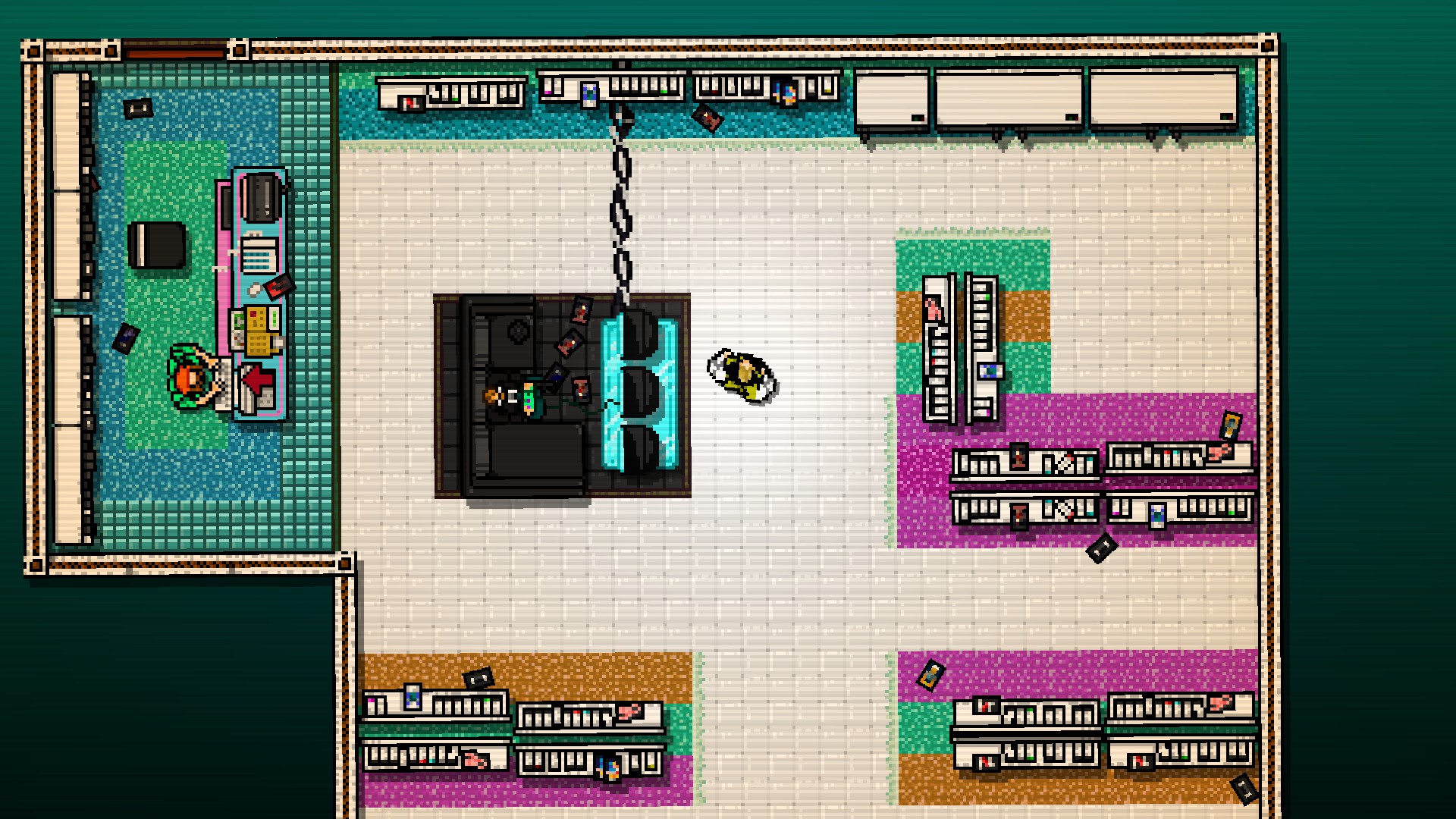
In this respect, the story isn't nearly as confrontational as something like Spec Ops or Metal Gear Solid 2. You are never directly confronted with what you have done; the camera doesn't pan around to show singed corpses, nor do the words "Solid Snake Simulation" echo around an empty chamber. There isn't enough time to give pause for that: you always want to just quickly put in one more room before signing off, never feeling like you are being drained by the game, therefore resultng in less time for you to doubt the story. It's an intense game; the vagueness of the narrative helps establish a hazy atmosphere, where you're not sure of what is actually happening inside the game, (something that the sequel had expanded on, to some gamers' chagrin) the barebones details working so well in creating a nauseating atmosphere of impulse, rage and dissassociation. The music is a key part of this, arranged as a series of 80s homage tracks in the vein of Drive's OST(which itself, was a [a href=http://www.eurogamer.net/articles/2012-11-10-the-creators-of-hotline-miami-on-inspiration-storytelling-and-upcoming-dlc]huge inspiration when making the game[/a]), featuring many pulsating, trippy beats and overlapping synthesizers peppered with drum machines. This ensemble isn't big or orchestral, but like with Undertale, it is so immensely focused that the disparate elements merge so well together that the end result is an enveloping experience. Miami's story and atmosphere isn't something to discuss, but rather, to experience. As I mentioned above, in the true spirit of 'what have you done?'(or horror-lite, I suppose) games, it is in participating that you truly understand what was intended in the making of the game.
[HEADING=2]Gameplay[/HEADING]
Miami is presented as a top-down 2d run and gun, the standout points being its brutal difficulty and that it is presented from a floor plan map perspective. Doors are clearly signposted, as well as windows and rooms, so you have advance knowledge of where the enemies are, however, all it takes to kill you is one hit. Therefore, the gameplay is very quick, and unforgiving; the key to beating each stage lies equal parts in improvisation, planning, and AI exploitation. You have to time your throws, punches and shots well enough so that you don't get caught out of position, but at the same time, you need to be able to adapt to new situations. Such as getting spotted early and having to suddenly deal with five guys aiming down at you with shotguns. Understanding AI behaviour, such as hearing (for if you shoot around like Rambo, they will investigate the gunfire) and aggro timing is also a necessary component in mastering the game. The systems aren't particularly intricate, and there are a good amount of exploits, such as throwing a weapon to an off-screen opponent, or by slamming them into doors to temporarily knock them out. The level of strategy and strategic flexibility isn't staggering, nor is it particularly revolutionary. The selling point is the speed of the action, but pioneers such as Super Meat Boy have long since also perfected the formula of run/die/repeat. Rather, it is through that speed and the game's brutal difficulty that makes the gameplay so intoxicating. Memories won't stem from throwing a knife accidentally down a hallway, and killing a guy. Instead, you will remember gracefully running from enemy to enemy, killing them in beat to the music and not once being touched, as well as finally beating a room that took you 20 odd tries after perfectly executing precise combos.

Like I mentioned above, the gameplay is just succinct, visceral and adrenaline-inducing as a twitch shooter. It's all about the moment to moment gameplay, and this aspect is the focal point of the game. Everything happens in a blur: you die and you win in a blur, with levels only taking a few minutes at maximum. You never slog through any one particular stage, rather, you finish one particularly frustrating segment, and then take a break after having worn yourself out with the typical 'if I just did this' syndrome that inevitably crops up, especially in boss fights. However, Miami never feels cheap. You never feel like the game forces you into a situation, you are free to experiment and try out rooms in any order you wish, and restarting is just a button press away. In addition, unlike it's sequel, the rooms are small enough that you never feel that you have lost much progress between floors if you accidentally die. The learning experience is quick and built on trial and error, so you rarely feel screwed out of fun because the game glitched out or something, although that can happen.
If I had to criticize the gameplay, and I will, it's that the game is very brief. Clocking in at around 3-5 hours, it is a brief, but intoxicating surge of violence, but the game runs out of ideas fairly quickly. Unlocking new masks, which give you special abilities, whilst fun, does not diversify the core experience enough so that you don't eventually fall into habits when approaching new levels. I don't expect the game to suddenly become a turn-based JRPG, but at the same time, it is evident that the game finishes at the exact same time that the gameplay begins to run out of steam. Paradoxically, it also includes a stealth section, which is just as annoying as it used to be the Xbox/Ps2 generation: something I had hoped games had grown out of. Despite narrative explanations, it is still infuriating to have to instead play the game by actively avoiding lines of sight and just following an implicit route to escape the facility. It is very jarring to say the least, and stops the game's pacing dead, instead of offerring variety, as I assume was originally intended by Dennaton.
Another issue is that the game's engine isn't bug-free. Occassional clipping issues, collision detection and sometimes inconsistent AI behaviour do put a blemish on what is otherwise excellently tight game design, but it is nowhere near as big an issue as it is in Hotline Miami 2. It's clear that HM1 had a lot of polish go into it, but the fact that the bugs are still there 3 years down the line is annoying. Not embarrassing, since this was a one-hit wonder of a game, but still otherwise occassionally irritating.
[HEADING=2]Objective Assessment:[/HEADING]
No re-bindable keys, but gamepad support available.
[HEADING=2]Visuals[/HEADING]
The game is presented through a very strange, almost 16 bit aesthetic. It's not visually impressive; looking rather like it was assembled using GameMaker or other such utility, but it helps to establish a particularly grimy and glitchy facade. The primary colours at hand are neon blue and hot pink; the 80s in condensed form. However, instead of the game being littered with disco balls and atrocious haircuts, it all comes across as sleazy and B-movie like. I mentioned how one of the main inspirations was Drive, but it is a far cry from the Refn flick in question. Whereas the film enjoyed a clean presentation contrasted with scenes of gratuitous violence, Miami is steeped in almost every visual aspect in it's own gonzo nature. Nothing looks clean, safe or welcoming; the camera sways just enough so that the level looks unstable; the bright, saturated colours make everything come across as an acid trip, and the blood and guts being sprayed about everywhere completes the vision of 80s-as-Gomorrah. Not one of the characters is presented as clean or attractive; everyone is ugly, deformed or otherwise abused, and that would probably be the best way to describe the game's aesthetic. . It's grimy and dirty, and yet, there is something appealing about it. Visually, it speaks to that part of us that finds sleaze just a bit enticing, to see something malformed or dirty and to just indulge yourself in it.
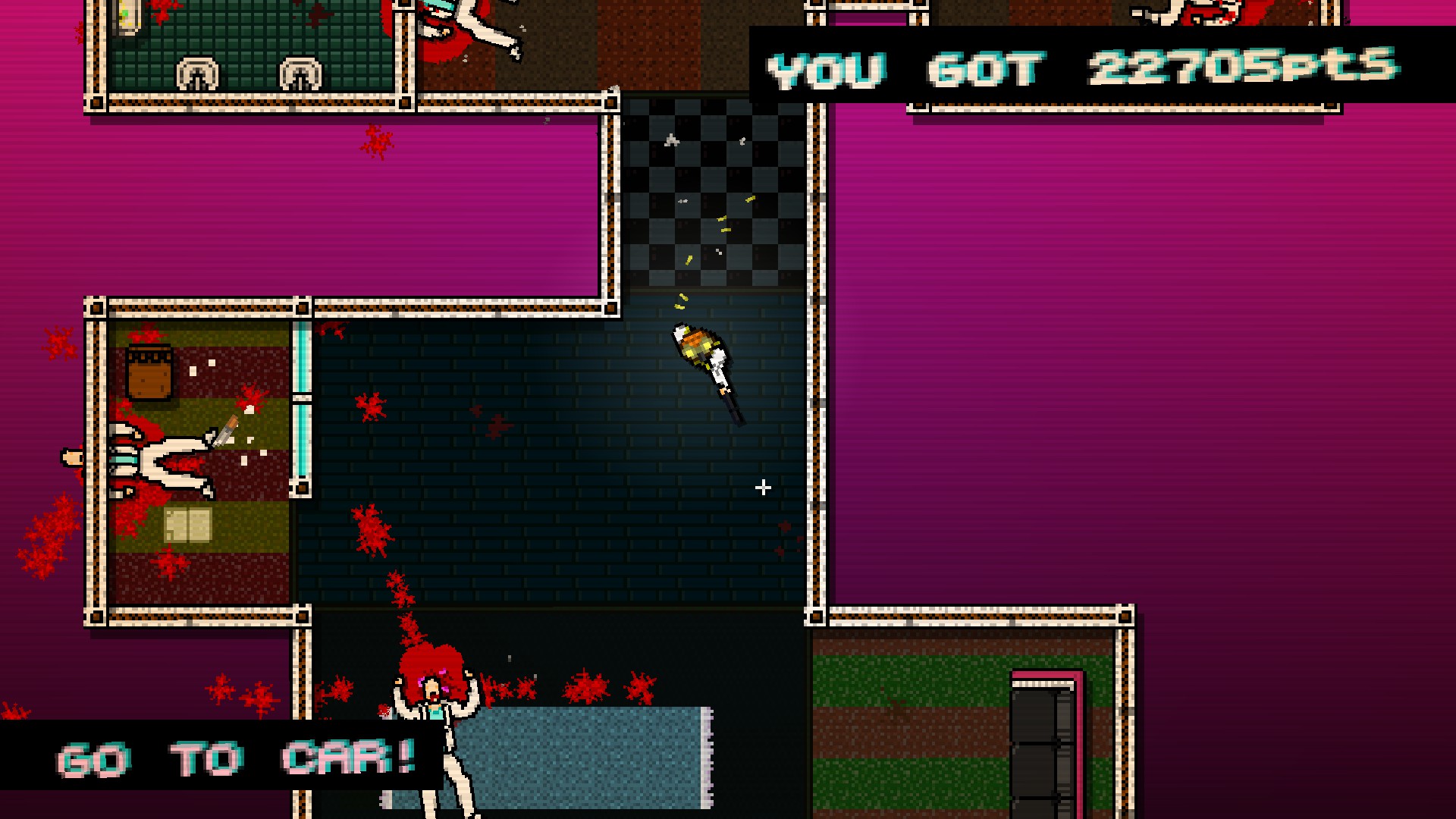
What I find the most impressive is how it manages to achieve all of this on such a simplistic visual design. It doesn't have scenes as opulent or as horrific as it's sequel, yet it still paints a convincing mindscape of the 80s Miami that it wants to revel in. Even the title screen has a VHS lo-fi filter on it, with palm trees rolling back in the distance. It is amazingly focused in this aspect, and it it is very memorable, even if it isn't as enrapturing in its art style as something like Journey.
[HEADING=2]Objective Assessment:[/HEADING]
Resolution options available, as well as windowed and v-sync.
[HEADING=2]Audio[/HEADING]
What can be said about the game's audio that hasn't been said already? A blend of 80s homage, disco revival and trip electronica: the OST works wonderfully to reinforce the atmosphere I talked so much about. It transitions so easily from pulse pounding action to the cool off period inbetween you finishing up the level and getting home, that it doesn't surprise me that people still praise the soundtrack to this day. Dennaton have been particularly attentive in choosing what music to go with which level, offering enough variety so that every level has a distinct look and sound to it. I also like that the music has brought otherwise obscure artists attention from the gaming community: I always enjoy it when games work together with other industries to try and promote budding creators, and the efforts shown in Hotline Miami make it sound like these people were born to compose game soundtracks. The way that the beat engages you into a pulsating frenzy as run around the room, punching anything with legs, to the way that the score summary screen mellows you out as the adrenaline comes down, all of it: is so well arranged, that it's difficult to criticise it. This lo-fi, highly synthetic sound that covers the entire game is a match made in heaven. It works with the primal instinct of the gameplay, the sleazy depravity of the visuals and the surreal storyline so well that it throws you right into the bad acid trip it wants to be.
If there were any criticisms to offer, it's that just like the gameplay, the soundtrack isn't particularly varied. The music focuses on the cycle of getting the player pumped up and then cooled off, and it does it with enough diversity that it's not a stickler, but in comparison to its successor, it does work as a sign of its lower budget. HM2 was much wilder in its musical composition, stretching both the sounds at play to their limit, as well as the tones themselves. HM1 does just enough to get by and sell you the atmosphere, although it wasn't out of reach for it to be just a bit tighter so that it would transcend the game altogether and become a collaborative concept album.
[HEADING=2]Objective Assessment:[/HEADING]
Music sliders available, but no SFX sliders.
[HEADING=1]Final Assessment[/HEADING]
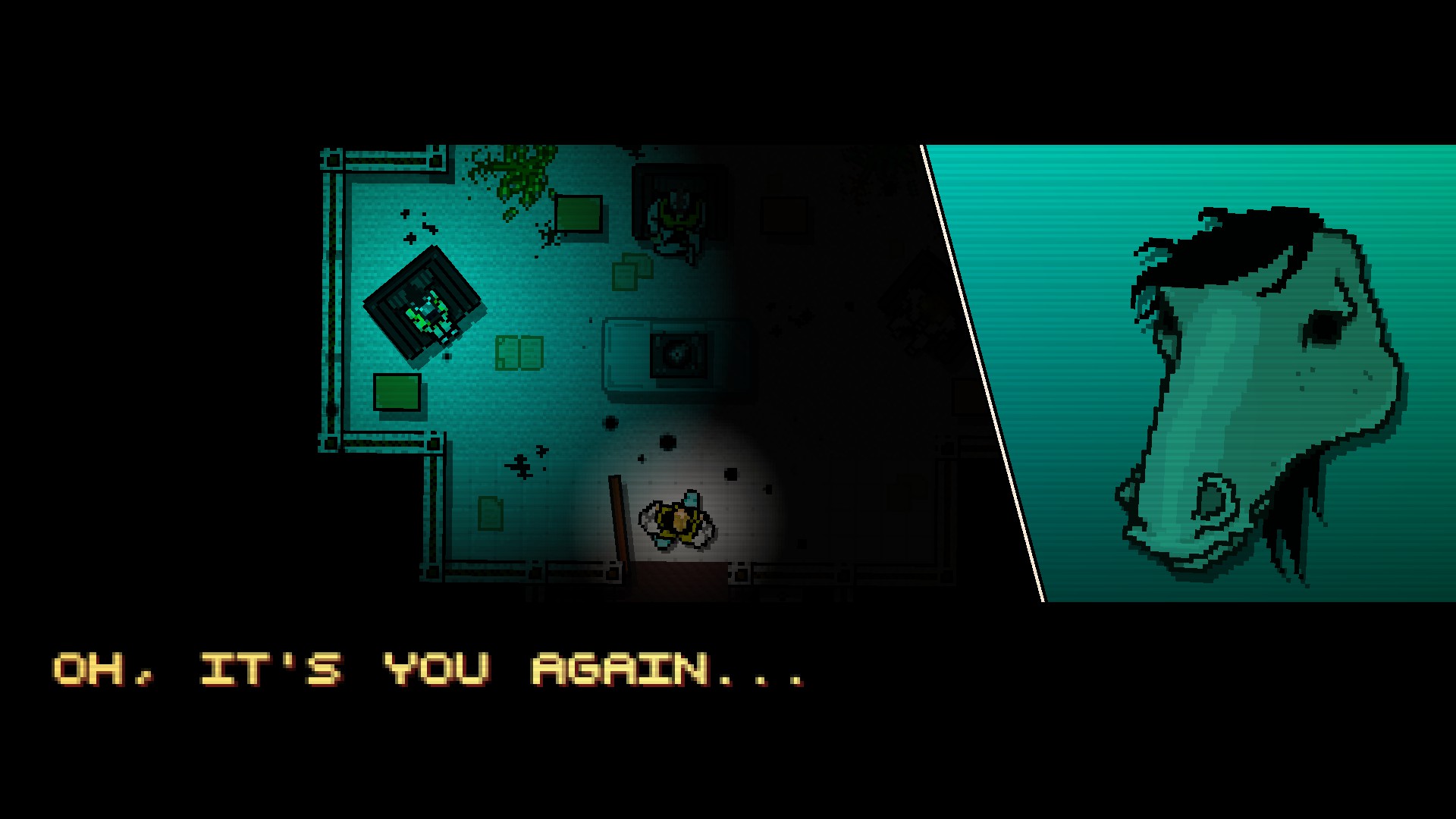
In summary, there's a lot to love in Hotline Miami. The pulse-pounding action, the dirty, yet oddly inviting visuals and the teeth-grinding music are all wonderfully assembled under a surrealist atmosphere to sell you a succinct and visceral, although short, package. There is little to complain about Hotline Miami: it lives as a cousin to its bigger budget brothers of Metal Gear Solid 2 and Spec Ops The Line. Although it indulges in violence to a sometimes suspect degree, it never berates you for it as explicitly as they do. It lets you enjoy the havoc, but tethers you just enough to make you question the situation. It is nowhere near as colourful as Undertale, but it is easily as focused and well assembled as them that I believe it stands on its own legs in this newly emergent sub-genre of 'what have you done' games. Unlike This War of Mine, it doesn't distance you with resource management: it throws you right into the brink so that you thrash around and rage your way to the end of the level. In satisfying that primal itch for cathartic violence, it is an exemplar in this field. I would want to call it an exceptional B-movie, but I don't feel like there's been any real compromise here. It is a true embodiment of the indie spirit, just like Undertale, in how well assembled it is, so that it never feels like a lesser experience. Hotline Miami is one of the shining gems of modern gaming, and I sincerely hope to see many like it in the coming years.
[HEADING=2]Final Objective Assessment[/HEADING]
Few options, especially in gameplay and audio. Reviewer has currently played about 5 hours of the game, initially bought at a (standard sale) price of ?1.74. Suffice to say, it is way cheaper than seeing a movie and as satisfying as seeing The Raid.
[a href=http://www.escapistmagazine.com/forums/read/326.863812-Sub-jective-Reviews-Fez]Fez[/a]
[a href=http://www.escapistmagazine.com/forums/read/326.863888-Sub-jective-Reviews-Gunpoint]Gunpoint[/a]
[a href=http://www.escapistmagazine.com/forums/read/326.864186-Sub-jective-Reviews-Receiver]Receiver[/a]
[a href=http://www.escapistmagazine.com/forums/read/326.867550-Sub-jective-Reviews-Year-Walk] Year Walk[/a]
[a href =http://www.escapistmagazine.com/forums/read/326.867930-Sub-jective-Reviews-Limbo] Limbo[/a]
[a href=http://www.escapistmagazine.com/forums/read/326.878083-Sub-jective-Reviews-Metro-2033-Redux]Metro 2033: Redux[/a]
[a href=http://www.escapistmagazine.com/forums/read/326.932276-Sub-jective-Reviews-Dirt-3]Dirt 3[/a]
[a href=http://www.escapistmagazine.com/forums/read/326.932588-Sub-jective-Reviews-Undertale]Undertale[/a]