
[HEADING=1]Sub/jective Reviews[/HEADING]
This is an ongoing review series that I'll stick to in as regular a fashion as possible. My review format is centralised around breaking criticism down into subjective and objective components so as to cast a wide a net as possible, and to be as informative to the reader as I can make it. I personally feel that too many games journalists nowadays just make reviews into streams of information, rather than specifying and breaking down specific components of a game, so I'm putting this format forward as something I'd like to see practiced more often, as I believe it makes discussions more holistic and informative.
Initially, this began as a reaction to people wanting more objective reviews, so I thought to put that forward as a gimmick, but over time, it grew to be a genuinely effective way for me to organise my own thoughts about a game. At the end of the day, these reviews are primarily about me trying to pick a game to pieces to find as much worth in it as possible, because the industry has evolved so far that it can comfortably have games that are popular just for their sound assets, visual presentation or gameplay alone.
Initially, this began as a reaction to people wanting more objective reviews, so I thought to put that forward as a gimmick, but over time, it grew to be a genuinely effective way for me to organise my own thoughts about a game. At the end of the day, these reviews are primarily about me trying to pick a game to pieces to find as much worth in it as possible, because the industry has evolved so far that it can comfortably have games that are popular just for their sound assets, visual presentation or gameplay alone.
Criticism is encouraged! If you see something you'd like to be added or improved, don't hesitate to post below!
Reviewer's build:
[li]Intel i5 3470 @ 3.2Ghz Quad Core Processor[/li]
[li]Kingston Hyper-X 2x4GB DDR3 RAM @ 1337Mhz[/li]
[li]Zotac Nvidia Geforce GTX 670 2GB[/li]
[li]Acer 23.6" Monitor 1920x1080 @ 60Hz[/li]
[HEADING=1]Undertale[/HEADING]

[HEADING=2]Intro[/HEADING]
This was going to happen sooner or later. This wasn't a game I had initially lined up for review, but time is tight, and I'm currently sitting on Dark Souls II, Endless Legend as well as Dungeon of The Endless. Neither one of these is particularly welcoming or easy to initially review, hell, the story sections alone fill me with mild dread as to how I'd have to tackle them(maybe more so for the Endless games). Whilst considering what I should do for week 2, I remembered that I entertained the idea of reviewing Undertale. It makes sense to strike while the iron is hot, I mean, it has a good amount of coverage at this point in time, as well as enough meat on its bones to make a review viable. However, at the same time, it relies on expectations. It is review un-friendly because you can't properly inform your average gamer about it to justify the cost without inadvertently diminishing the first impressions that it so much relies on. That, and the fact that the fanbase is a bit worrisome in how rabid they are sometimes. I can understand the praise, but it sometimes feels so overwhelming that it reminds me of Portal, and how that game's humour and charm was eventually watered down through excessive quoting and a sometimes almost zealous fanbase.
Whatever the case may be, I had a choice between diving into something that I have a good enough grasp of, or flagellating myself through the several hours required to fully grasp the other games I mentioned. Might as well dive into Undertale then.
[HEADING=2]Story![/HEADING]
This is what I meant by Undertale being difficult to review. I can describe the premise and what you are doing for the majority of the game, but it has to remain cryptic. It is quite frustrating to have to write about this, and this is one of the reasons why I think Undertale's impact will diminish over time. When people make comparisons to how Undertale deconstructs gameplay, Spec Ops The Line gets mentioned, but I do think this comparison is much more apt than it initially appears. Both have problems when it comes to working with player expectations. We've all heard how the WP scene will "shock you" and "make you feel horrible about what you did", and whilst it is a powerful moment in the game, it is only the tip of the iceberg, doomed to become overrated. Yes, what happens is horrible, but you're telling people that they will experience exactly what you did, when you went in blind, and that's just not going to happen. People will breeze past that scene, might be a bit disturbed and then think "that was it?". In a strange way I suppose, anti-spoiler culture as well as cases like Spec Ops have helped people to act more sparingly when selling these sorts of games, but that's where we approach the second problem: surprise.
Undertale's story is full of gradual revelations and quirky character moments. I did enjoy them, but I can't describe why, because they rely on surprise. The entire game is built on surprise, working off of the same gaming heritage as Earthbound, and working it's hardest to subvert expectations as much as its granddaddy. It is inherently built around that idea of "not being your average game", and that raises unfortunate implications. In the case of one of my friends, he had a hard time enjoying the game precisely because it was so vehemently praised. He thought it off-putting because it naturally is disappointing and enervating when it fails to live up to those expectations. Undertale's secrecy and insistence upon it reminds me of when you try to get someone into that one album you really like by continually selling it. It just doesn't work: you want them to discover it naturally and gradually work around it until they can come to a conclusion where they're more likely to appreciate it, cause it is on their own terms. Insisting that something is great, and have someone thrust into it at the slightest curiosity puts an unnecessary burden onto both the game and the person in question. But I suppose that's enough waffling for now, since I've no other gripes left to give without turning this into a full on rant.
You play as a non-descript child who fell down a cave. The game contextualises the situation in the intro, by describing an ancient conflict between humans and monsters, which the latter lost and were forced to retreat underground. Whilst playing outside, you accidentally slip down into the underground, putting you on a quest to get out. Along the way, you'll meet a diverse cast of characters, who, to Tobyfox's credit, are well rounded and colourful enough to help consistently pad out the doldrums. During this quest, you are met with many decisions on how to approach monsters as well as situations that will shape the end of the game in a significant way.
...And that's about it. Anything else requires some form of spoiler that would diminish the game.
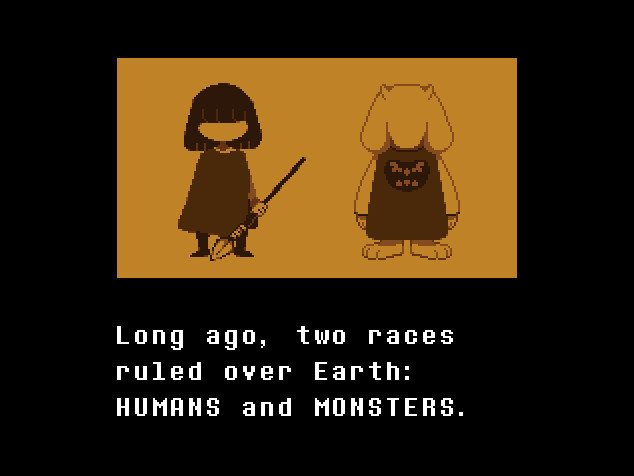
I'm not going to lie and say that I don't enjoy Undertale's story. It's story is fairly standard once you examine it, but the journey is creatively paced out and the curveballs that stand out to me the most are equal parts tragic and hilarious, and it takes genuine effort to pull something like that off competently. It channels the spirit of nostalgia and sincerity, and still finds ways to play with archetypes as well as expectations, polished to an incredibly high standard. It does annoy me that it relies so much on surprise, but I suppose it depends by what standards we are judging this part of it. In comparison to Spec Ops, Undertale does not have as much symbolism, depth and inferrence as SOTL does. It does not create a mindscape where every single minute element of design reinforces the story, nor does it burn quite as slowly to reveal the meta textual elements, simply put, there isn't much to analyse. And I don't consider that a bad thing: it's refreshingly light and entertaining in that regard, and that's probably what makes it so endearing. As much as I feel I idolise indie development over AAA production way too much, it truly has an 'indie spirit' about it. It understands what it's focus is, and it only works on that, with little expansion but also with little meandering. The story is well assembled and satisfying, and in a year where writing has been quite sloppy in some places (such as Metal Gear Solid V and Fallout 4), I do understand why Undertale's writing is so much beyond just being appealing to so many players due to how concise it is.
[HEADING=2]Gameplay![/HEADING]
The meat of the game is played out through JRPG style combat screens, but with a difference. Every encounter you have with monsters can either be fought or negotiated over a series of dialogue choices or through an Earthbound/Paper Mario-y combat system that allocates damage dealt via timing instead of attack type. What's fun is that every monster has their own character, and taking the dialogue options can lead to funny or charming scenarios. It brings me back to my previous point, that Undertale is a game of moments, and this is where this idea shines the brightest. The actual gameplay is not particularly satisfying: you aren't being challenged by doing the right attack or the right dialogue option on the right monster, which gets progressively harder to execute or determine as the story progresses. In actual fact, it remains largely static, with skilled input being required in defense, where the monsters' attacks manifest themselves in a Bullet Hell style mini-game, where you avoid projectiles. This part too doesn't escape the game's charm, as each monster you encounter has different mini-games, which are directly tied to their character. It runs the gamut of simply dodging spikes to answering quizzes, which ties back to its central appeal.
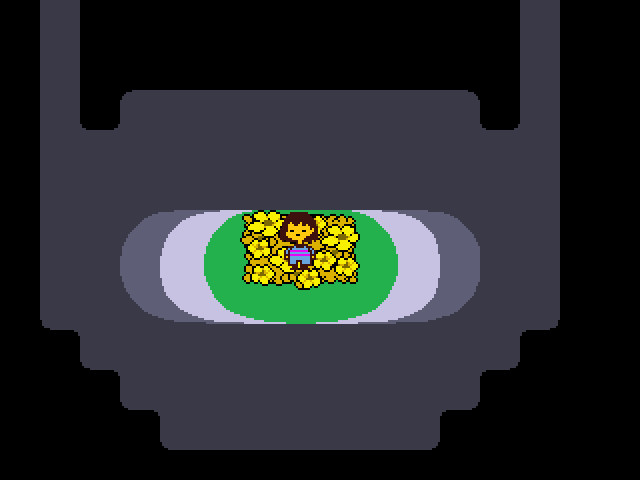
If I had to criticise the gameplay, it's that in certain runs, it isn't particularly deep. Replaying the game will net you the same combat options as before, so the humour will begin running dry, as will the rather bland attack mechanics. This isn't a game to be replayed though, but in borrowing from traditions, Undertale doesn't escape challenge as part of that heritage. The Bullet Hell sections get progressively more difficult the further you go on, but you don't get enough practice to actually get good at them, since every monster has a wildly different attack pattern that you can only acclimatize to through trial and error. This came to a head on one of the last fights, where it took me about 5 attempts to beat a particular boss. It was quite annoying, and although this is more on me not being good enough at this particular section, I definitely am not the only one who has been frustrated by the arbitrary difficulty of these sections, because they are so detached from the rest of the game. It's in these instances of frustration that you realise the potency of the humour and how easily it can wear thin. It brings me back again to the fact that you have to beat the game and its various endings once: replaying doesn't net you anything to add to your enjoyment of the game(in the classic sense of replaying at least). It's not built for replayability, and I can live with that, but I don't think that some sections are beyond being just a bit tighter to prevent these niggles from detracting from the overall experience.
[HEADING=2]Objective Assessment:[/HEADING]
Re-bindable keys with gamepad support.
[HEADING=2]Visuals![/HEADING]
As per the gameplay, the aesthetic is retro 8-bit, borrowing just a bit from Earthbound in this sensibility. The main character is similarly squat as the kids from that game, and some of the environments share that same type of juxtaposition of childlike wonder against existential horror. The aesthetic is probably the least interesting part of the game for me. It's rudimentary, and whilst it does look nice in certain instances, it isn't much to write home about. Character designs are creative, but owing to Tobyfox's production history, the subject matter tends to borrow more than a bit from Homestuck, with some characters looking almost imported in how similar their design is. As far as criticism is concerned, it does avoid the pitfalls of a lot of 8-bit homage games by thankfully not making the colours blindingly bright, instead opting for a more sombre pallette, as befits an underground kingdom. There are a few visual gags that are striking to one extent or another, but ultimately I'd leave the art style at "functional". There is no one section in the game that made me stop playing and just look at what was going on: writing and gameplay are this game's strengths. Vistas aren't lent any sense of scale due to impressive design, but due to the emotional weight behind them: the end of the game has a lot of empty corridors to work through, which reinforce the uneasiness built up to that moment, but this is secondary at best as a technique of presentation in Undertale.
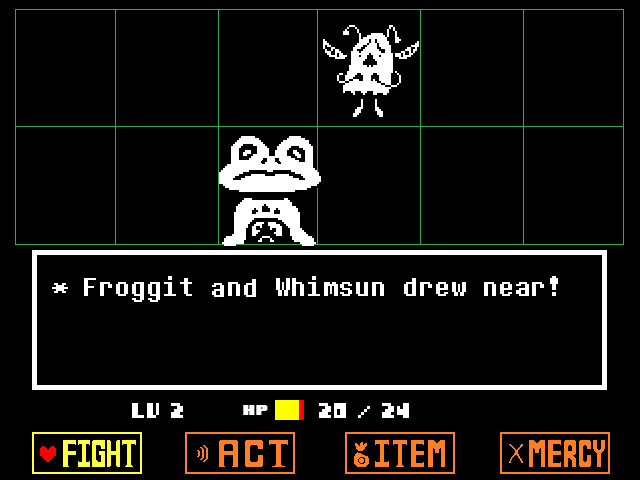
I am grateful that Tobyfox did not opt to use the aesthetic as a crutch though. With the spirit of nostalgia being the main spectre that hovers over the production, 8 bit was an appropiate choice, and to the game's credit, I never felt as if any scene would have worked better if it was done in full 3D or aided with a larger visual budget. As it stands, it works fine, and the character designs help a lot in bringing across personality through visuals, but again, this has more to do with the game's relation to Homestuck than out of spectacular character design direction.
[HEADING=2]Objective Assessment:[/HEADING]
Few graphical options: windowed and fullscreen modes(techinically), but no resolution options: game defaults to your main display's native resolution.
[HEADING=2]Audio![/HEADING]
I'll divide this into two parts: the audio design and the soundtrack, since they are quite different.
Audio design in Undertale is your usual pick and mix of chirpy 8 bit homage. A lot of bitcrushing and sound effects that, although being outdated in my honest opinion, are still insisted upon. I personally found them a little bit grating at times, especially in the aforementioned boss fight that gave me a good amount of trouble. Frustration and loud chirping noises don't exactly help ease up the situation, since more often than not, they contribute to a sense of forced cheerfulness that can put off some people. Initially, it did take some getting used to: this is not Super Meat Boy, where the OST is retro but the sound design is modern but basic. A friend of mine found it so off putting that he could only play the game in sessions at a time, because his hearing was even less acclimatized to it than my own. I'm not going to berate Tobyfox for this decision, because this isn't driven by a single production. Whereas I conceded that the 8 bit style is something we just accept nowadays and can deal with, the sound effects are something that I can personally do without. It's easy and relatively cheap to access sound libraries or commissions to get rid of that ennervating feeling that these sorts of games sometimes create. In Undertale, it is especially pertinent due to the soundtrack.
The music here has had a lot of effort put in, and it is a given. Tobyfox's background returns as a topic of discussion, due to his involvement with music production on Homestuck, and whilst some tracks don't sound particularly amazing, he still exemplifies a skill at being able to suit the mood and tone with music. There are a lot of callbacks in the OST, most of which come from other old JRPGs such as Chrono Trigger, with some being more deliberate and obvious references than others. Nonetheless, the music is the unsung hero of the foundation of writing and gameplay that make this game work as well as it does. The setlist is eclectic, but never overbearing nor disparate, with fast pieces for boss fights and pained, slow chords for long journeys down corridors. The final set of fights have particularly fantastic music that help sell them as a definite conclusion. They are significantly more intense and layered in production, going as far as sounding almost orchestral. The soundtrack is suprisingly excellent at manipulating the player as well as reinforcing the story, and this is why I find the audio design to be so strange. Undertale's music is solid, but impressive in how varied it is and how thematically appropiate its pieces are, whereas the actual audio design just feels a bit lazy in comparison. I'm not asking for Brian Blessed to announce "SAAAAAAAAAAAAVVVVVVVVVVVVVIIIIIIIIINNNNNNNNNNNNNGGGGGGGGGGGGG!", just that the blemish in what is otherwise excellent audio direction can really work together to gradually begin creating distaste for the game. Not everyone experiences or enjoys retro sensibilities in the same way, and whilst design and visuals are something we can live with, lo-fi audio feels less throwback and more regressive sometimes. It's part of why Shovel Knight didn't grow on me that much, because that emphasis on authenticity got in the way of letting the game stand by itself. Undertale's audio design suffers from the same problem, punctuated by just how much effort has gone into the music.
[HEADING=2]Objective Assessment:[/HEADING]
No audio sliders.
[HEADING=1]Final Assessment![/HEADING]
Overall, it's difficult to avoid the allure of Undertale. It has a skill to emotional manipulation that I haven't seen executed this competently in a long while. Brothers: A Tale of Two Sons attempted something similar, but I personally feel that it never got as far as it could have due to it's brevity and breakneck speed of rushing through all the emotional peaks. Undertale doesn't have that problem. The story burns at just the right pace and balances out lulls and high points so that character moments, encounters and story beats surprise you and can make you laugh at their absurdity and soak in their sincerity. Whilst the comment that "it has a lot of heart" has been thrown around a lot, I'd like to think of it less as a labour of love, but more of a display of extremely tight design. The elements in question work together so well to enhance themes at hand precisely because the game is so focused: everything works like it should have to achieve the ultimate goal. Whilst there are some nitpicks, like the "evil" ending feeling a bit arbitrary and underdeveloped in comparison to the "true" ending, it only really serves to highlight exactly how personal a game Undertale is. Whilst to me, it doesn't reach the lofty heights of Spec Ops The Line, it still does a damn fine job of displaying an almost Tarantino-like playfulness with gaming, gamers and its own heritage. Undertale will likely not be a game that will stand the test of time, it isn't built to be that sort of game, but it will be fondly remembered as a hidden gem, and that's where it works best. It is at its best when you go into it bleary-eyed and truly throw yourself into the experience: it devotes itself to surprises and moment-to-moment story. Sometimes to it's detriment, because the fanbase has made this game rather unbearable for the few people who couldn't escape the hype, and I will stress that the pacifist ending is the way to go in terms of narrative satisfaction and thematic consistency, but ultimately, when Undertale works, it truly works in enrapturing you in a vibrant story that is difficult to shake off when you're done.
[HEADING=2]Final Objective Assessment![/HEADING]
Barely any options to speak of outside of gamepad support. Game was bought at RRP of ?6.99, with current time clocked at 8.8 hours, averaging at a price/hour ratio of ?0.80/hour.
[a href=http://www.escapistmagazine.com/forums/read/326.863812-Sub-jective-Reviews-Fez]Fez[/a]
[a href=http://www.escapistmagazine.com/forums/read/326.863888-Sub-jective-Reviews-Gunpoint]Gunpoint[/a]
[a href=http://www.escapistmagazine.com/forums/read/326.864186-Sub-jective-Reviews-Receiver]Receiver[/a]
[a href=http://www.escapistmagazine.com/forums/read/326.867550-Sub-jective-Reviews-Year-Walk] Year Walk[/a]
[a href =http://www.escapistmagazine.com/forums/read/326.867930-Sub-jective-Reviews-Limbo] Limbo[/a]
[a href=http://www.escapistmagazine.com/forums/read/326.878083-Sub-jective-Reviews-Metro-2033-Redux]Metro 2033: Redux[/a]
[a href=http://www.escapistmagazine.com/forums/read/326.932276-Sub-jective-Reviews-Dirt-3]Dirt 3[/a]
[a href=http://www.escapistmagazine.com/forums/read/326.932978-Sub-jective-Reviews-Hotline-Miami]Hotline Miami[/a]
 .
.