The Dumbification of Gaming

Recommended Videos

Slycne

Tank Ninja
Feb 19, 2006
3,422
0
0
poiumty said:
I see the casual crowd on the PC as a side-effect of casual games becoming widespread. On consoles, that is.
I don't think that's the case. The casual console games market really haven't caught on until recently(you could point to it really taking off in 2006 with the Wii), where as PC casual gamers can trace back to Minesweeper and Solitaire(early 90s), started rising in scope with the advent of Flash(mid to late 90s) and has really started expanded as they have begun plugging into social networking, see Farmville's apparently 62 million active users.

I have yet to see anyone blaming PC gamers for AAA console games becoming easy and simple.
Mention Farmville and you'll get PC and console gamers alike complaining about how games are becoming easier to cater to a wider crowd.
 

Waaghpowa

Needs more Dakka
Apr 13, 2010
3,073
0
0
world of warcraft is a great example of developers designing games to attract as many people as possible. Back when it came out, it was very difficult, they slowly turned down the overall difficulty in the Burning Crusade. Wrath of the Lich came along and it was so easy you needed very little as far as strategy to complete and encounter, by comparison. A lot of people blamed the casuals for it because Blizzard wanted to appease the people who still paid to play, but played the least. At least with Cataclysm, Blizz has admitted that their changes in Wotlk were a mistake and have currently changed the game appropriately to a happy medium of difficulty.

I would also like to note, the new "Deus Ex: Human Revolution" will feature a difficulty known as "Deus Ex", fun :D
 

ReiverCorrupter

New member
Jun 4, 2010
629
0
0
Traun said:
You are correct(ahh...the level design of Heretic,Hexen...Dark Force), however I disagree on one of your points. I believe that the niche market is big enough to support developers, yes they aren't going to sell 10 million copies, but they can sell enough to be comfortable.
Example being Team ICO and CDProject Red - they are selling games for (relatively) small audience and they've been successful, same as the guys with Amnesia. There is a market for everyone, and I believe that sooner or later we will realize that. The market for games with "wide appeal" is over saturated, it's just a matter of time before publishers decide to be more flexible with their money.
It all comes down to development costs. I'd love to see Halo Wars 2, because I like the cut down fast paced RTS gameplay, but that's an extreme niche market so it probably won't happen. But if they make it easier for developers to produce games, I think you'll see a lot more niche games.

When we reach photo-realism development will shift back into gameplay and we'll see a lot more experimentation and a lot more niche games. Development costs will go way down too, and games will start to get cheaper.
 
Feb 13, 2008
19,429
0
0
I dunno if it's really about gaming anymore. It's about our core shifting from people willing to work at things to people demanding to be spoonfed things.

What are the games we enjoy the most? Minecraft, HALO, Half-Life... Are any of them "easy"? Nope
Is Peggle "easy"? Well...it's simple, but it's not easy.

But some of the more recent games? Try failing on them. Try really hard not to win, while still learning.

It's really tough not to win. Even on Street Fighter IV, with my first character, I leapt through the first eight characters with a simple series of commands.

Then up pops Seth. SLAM SLAM SLAM. Dead.

Ok...new tactic. SLAM SLAM SLAM. Dead.

Ok, redo the tutorial. SLAM SLAM SLAM. Dead.

So, most of this game it walks me through, and then to artificially inflate it, it sets me up against a baddie that can only be beaten by grinding skills?

Isn't that just like Civilization, Diablo, World of Warcraft, Modern Warfare, Bioshock and all the other recent games?

I think that's where the accusation of dumbing down comes from. Triple A titles have used Gamification to realise that you have to make the start of the game stupid and then stick an insurmountable wall in the way to lengthen playtime. Whether that wall is 1337 multiplayers, level relative bosses or simply collecting rings.

And this whole thing started very early on. But on those games were we climbed the insurmountable wall, we love them - because we spent time on it, beating them.

So we've been the ones asking for the dumbing down, but who "we" are has been changing since the hobby went mainstream. And it's only because it's mainstream that we have all the games to choose from.

But I will agree with Shamus, no blaming each other over it. This is a far more prevalent attitude than just gaming.
 

Woodsey

New member
Aug 9, 2009
14,548
0
0
Agreed for the most part, although I'd argue the relevance of the BioShock and System Shock comparison, considering they're in different genres almost. I'm not sure who the first group was to coin the whole 'spiritual successor' thing when it came to BioShock, but I'm pretty sure it wasn't the developers. BioShock's a shooter, System Shock is much more of a mix.

For some games, the supposed "dumbing down" that they've endured is really just the result of a clearer vision, Mass Effect 2 being the prime example.

As for the console wars, I would hope that when we PC gamers talk about games being dumbed down for consoles, we mean the consoles themselves, and not the people who play them.

What's most important with this whole thing is that developers establish a proper difficutly curve, and decent (and short) tutorials. As long as its accessible to begin with you can progressively get more and more complicated.
 

Slycne

Tank Ninja
Feb 19, 2006
3,422
0
0
poiumty said:
Farmville, however, became popular only after such a term as the "casual crowd" was solidified. There was the huge advent of the Wii before that. You can't really attach Solitaire and Minesweeper to any type of demographic. Every PC gamer has played those.
Still like I said, the casual market was already strong on the PC before Farmville or the Wii. It really emerged in the mid 90s on the PC with the advent of Flash(the widely popular Bejeweled started in 2001 as a Flash web game) and all various internet gaming portals. Pretty much every major provider or brand had their own - AOL, MSN, Yahoo, etc, and that in addition to all the other sites that existed, like BigFishGames and Pogo.com.

These all came to fruition long before the Wii and I don't see much of a case being made for a strong console casual gaming crowd before that system.
 

Mr. Omega

ANTI-LIFE JUSTIFIES MY HATE!
Jul 1, 2010
3,901
0
0
There is a line between making a game "simple" and making a game "dumb".

Making it so that you don't need to memorize what EVERY SINGLE KEY on your keyboard does and limiting it so that you can just use a few keys and still do just about everything without having to go through a sea of menus? That's "simple".

Making it so that there area few keys that do everything and then every few minutes going "HEY! REMEMBER THAT KEY? IT DOES THIS! IT DOES THIS! REMEMBER? YOU PROBABLY DON'T REMEMBER, BUT THAT KEY DOES THIS, AND THIS'D PROBABLY HELP RIGHT ABOUT HERE! REMEMBER?", thinking the player is too stupid to figure out what action would help. That's "dumb".

Making it so that if you die 8 times, you can skip the level, if so you chose, or maybe ramp the difficulty down? That's "simple".

Offering it the first time you die? That's "dumb".

Not having over 100 troops that really only have 10 functions, with some that are so situational that most end up useless, but make navigating menus hard? That's "simple".

Making something where the best strategy in ANY situation is "run first, shoot gun, die, respawn, repeat until enemy is dead"? That's dumb.

Remembering gamers only have 10 fingers? That's "simple".

Assuming gamers only have 10 IQ points? That's "dumb".
 

Imperioratorex Caprae

Henchgoat Emperor
May 15, 2010
5,499
0
41
I don't blame consoles at all, or console-lovers, or PC lovers either. I blame the infatuation with "best graphics evar". The race to have the best looking game seems to be more important than the content for the most part. And the high end graphics needed to play tends to limit the actual gameplay by either console or the PC owner's wallet (I don't know about the rest of the world but I can't afford a $300 video card every 4 months just to play at the max settings of whatever game came out yesterday).
Ok I might be making grandiose statements but its a problem.
Minecraft is an example of a decent game (I'm not going to go into detail, its STILL IN BETA PEOPLE) with minimal graphics. Seems more like the content is the most important feature rather than the look of the game.
RDR and GTA 4 are also good examples of trading off graphics for gameplay though there are parts of those games I'd give up for some tweaks to the engine so world objects don't randomly appear because I drove/rode my horse a bit too fast for the engine to keep up...
Blame developers in the end, or marketers... whoever's call it is to sacrifice content for look. And maybe blame NVIDIA/AMD for making graphics cards every 2 weeks (lol).
 

NickCooley

New member
Sep 19, 2009
425
0
0
The blame (for lack of a better word) lies solely at the feet of developers, not consoles, PC's, Casual or "Hardcore" or any other stupid group the mouth breathers care to think up. Anyone telling you otherwise is stirring shit. (It's a box of wires and circuits ffs not a religion, how petty can you get?)

But I'd happily stick with FPS's as they are now instead of the old "find the key, kill the doods, find the key, kill the doods, find the key, kill the boss, repeat" How I played Doom and the like when I was a nipper I don't know, going back now it's just tediousness in pixel form. And for all the complaints about modern day shooters, of which there are many and a lot of them justified I'd rather dangle my Jacobs in a vice and spin the handle till I pass out than go back to the endless slew of WW2 shooters.

Mind you, what they did to C&C was criminal, oh Kaine, how I miss thee.

So the point I'm trying to get at here, in my own convoluted, round about way is that while games may be getting easier difficulty isn't the only measuring stick of quality. Sure games in the past were more of a challenge and that brought out some true classics there were still about an equal amount of shitty games as there are today. Oh yeah and the whole fanboys are tards thing, can't forget that.
 

Mouse One

New member
Jan 22, 2011
328
0
0
There's difficulty, and there's "dumbed down". Difficulty can be achieved simply by having tougher enemies (more hit points, more powerful attacks), debuffing the player's abilities, speeding up the gameplay, removing "hail mary" items like health packs/potions, etc.

Dumbed down is more about reducing player choice. If before, a player had three corridors to waltz down, and now only has one route, it's dumbed down. If a player could design a character with 30 options before, and now only has four (all of which will be maxed by game's end), again-- dumbed down. If a player could talk to twenty NPCs before, but now can only talk to the one with the big flashing arrow over his head...you get the idea.

The diff is that the former is easy to design, and moderate with a slider on the options page. The latter is fundamental game design.

But. How much of that reduction in choice is real? To echo the Extra Punctuation video on the "Illusion of Choice", if there is really only one or two optimal builds for that character with 30 odd ability choices, is it really that different from our streamlined game? If talking to all those NPCs only results in a few throw away lines that contribute nothing to the narrative, perhaps it is really no different than the game with the flashing yellow arrow over the guy you really need to talk to, except in time wasted on repetitive uninteresting gameplay.

I was struck by Dragon Age 2's FedEx missions. Yes, they were silly. You find an item and immediately know who to give it to, and that someone was typically on your way to an actually interesting plot point (unlike said FedEx quest). But isn't that what FedEx quests really boil down to? I don't think the answer is to do quests like DA2, but neither do I think that those quests contribute much in other games.

Perhaps the real answer is not to return to the Byzantine game mechanics of days past, but to focus on new and better forms of gameplay. Streamlining a game down to "push button, save princess" is no good. But neither is "push 300 buttons, save princess". There's ways of challenging with simple game mechanics (Portal, anyone?), after all.

 

Hyper-space

New member
Nov 25, 2008
1,361
0
0
Mr. Omega said:
Making it so that you don't need to memorize what EVERY SINGLE KEY on your keyboard does and limiting it so that you can just use a few keys and still do just about everything without having to go through a sea of menus? That's "simple".
Oh god this, this is pretty much the crux of most older RPG's (such as Baldurs Gate, Icewind Dale, Planescape: Torment etc). For example, memorizing spells in Baldur's Gate 2: to learn a spell you first have to find a scroll, then you open up your inventory (menu count: 1), right click the scroll (menu count: 2), click memorize (menu count: 3), rearrange the spells, open up yet another menu to rest (menu count: 4) and watch a small clip of a couple of beds. Holy shit, thats 4 unnecessary menus and a small cut-scenes which add nothing to the experience and there are no penalties for resting whenever.

If i were to re-make the system, i would make it so that you would first find the scroll, then just open up your spellbook (menu count: 1) and put the scroll into an empty slot and then find an inn or set up camp and rest. This would reduce the menu surfing to just one menu and make it so that resting actually requires thought and not just clicks.
 

Zay-el

New member
Apr 4, 2011
269
0
0
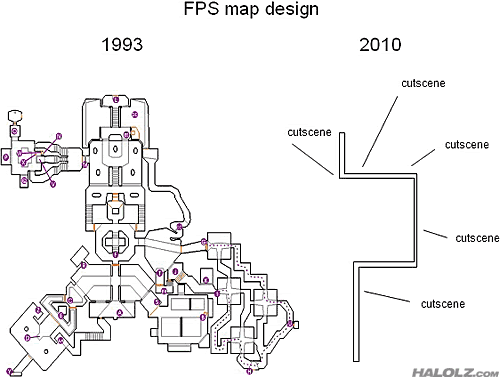
Irridium said:
Feel this picture is appropriate:

To be fair, even back in the day I often found myself getting incredibly frustrated with levels that just would not end, EVER. Jedi Knight: Mysteries of the Sith was amongst the worst offenders. Not to mention that with the big levels, they artifically lengthened the gametime of each as well, with keys, levers and all that stuff. I'd rather take something in between, perhaps branching levels or such.
 

Lancer873

New member
Oct 10, 2009
520
0
0
I think that one of the best ways to reconcile this is through optional side-challenges, the sort you'll find in LittleBigPlanet or LocoRoco. The main path is actually fairly easy, but there are several branches where you'll find huge challenges with great rewards, and there's also rewards for doing it well (like not getting hurt/killed, or beating the level quickly). I've always thought it's the best way to bridge the gap between the casual and the hardcore. I've helped dozens of less experienced players get the tougher optional prizes in LittleBigPlanet, and I've also met plenty of experienced players that are clearly hardcore like myself. Acing levels in LBP (1 and 2) is a fun and crazy challenging feat, but you don't have to do it at all if you don't want to. If you do it, though, you can get some of the best prizes in the game (like the "paperboy" costume in LBP2, or the original sackboy concept in LBP1). It encourages challenge without forcing it on the player, so the casual can train his way up to the hardcore if he wants, or just get through the levels if he's only interested in having fun.
 

RA92

New member
Jan 1, 2011
3,078
0
0
Am I just seeing PC and console gamers agreeing with each other for once (other than calling the Wii a bag of dicks)? Shamus, you've done the impossible. Kudos. This article will be referenced quite a lot in the future.

I remember the old days when each platform (PC, Sega, PS and Nintendo) used to give us entirely different gaming experiences. Now, all we get are watered down multi-platform titles.

draythefingerless said:
I has an idea. Devs invented Hard difficulty level. They invented Very Hard difficulty level. use it.
A 'hard' mode neither changes enemy AI (just increases the HP) nor linear level and gameplay structure.
 

Hristo Tzonkov

New member
Apr 5, 2010
422
0
0
What's worse is that it's getting increasingly hard to pick up an old title you know and love.Mainly because a dumbed down title means a cleaner design and less bugs.I mean cmon how much time do you spend modding Fallout 2 before you start playing it just to have a non raging experience.Dumbing down isn't that amazingly bad.I think the achievements are what's bad...The hard difficulties are mostly gimmicks and are easily doable so people can get more achievements.If you wanna play casually play on casual.I like my hard difficulties merciless to your every mistake.Hence why there was a quicksave.Notion on the was.
 

lawdjayee

New member
Dec 13, 2007
30
0
0
I like the way Shamus brought two the PC and console "dumb down" arguments together; they are rarely in the same place at the same time. The use of the term "dumb down" I've always thought to be revealing, tho; the criticisms come from people who like to think of themselves as smart, and like to flatter themselves that succeeding at a game testifies to their intelligence.

I think he mistakes causation. People who make games wanted, like good capitalists, to profit from their labors as much as possible, and to do that they needed to appeal to a broader and broader audience. Developments in graphics technology weren't natural or inevitable; they were required to show those who were not enthusiasts what the heck they were actually doing, to compete with film and television. The larger budgets made design by committee (in both its best and worst senses) inevitable; as did the involvement of major players in the technology industry who now dominate the industry.
 

Dastardly

Imaginary Friend
Apr 19, 2010
2,420
0
0
Shamus Young said:
Experienced Points: The Dumbification of Gaming

Shamus wants us to stop fighting and get along.

Read Full Article
This isn't a new concept. Games used to have ways of making the game harder on yourself. Back when games had fewer moving parts, it was as simple as "Go to Menu - Increase Difficulty - Monsters now have more health and stronger attacks and appear in larger numbers." And that was it. Ta-da.

A lot of developers are still stuck in those days. One enemy is too easy, so we'll give you two or ten. Difficulty is just a matter of adjusting the magnitude of existing game elements, throttling a couple numbers in the mix up to 11, and voila.

New Vegas is a great example of games using a sort of "modular difficulty." There are game elements present that you might or might not use. The more you choose to use, the more challenging the experience. Want easy mode? Play it on normal mode and put your skill in Energy Weapons. Want a bit more challenge? Try melee. Still more? Move to hardcore and use guns (with all that weighty ammo). Not satisfied yet? Melee in hardcore mode, and go do all those side quests.

There's another type of game that has used this sort of modular difficulty for a long time: pen and paper RPGs. The best GMs are the ones that tailor the mechanics to the group--use this rule, ignore that one, keep track of this stat, but completely dismiss these. They allow the players to determine the level of challenge and micromanagement of the game. The manual is just a sourcebook, not a Bible. The writers weren't afraid to create rules that only a small minority of the players might actually use, but they'll be there if you want them.

But with tight budgets and timetables, developers are generally unwilling to spend time creating any modes or mechanics they're not utterly convinced will see constant use. They don't want to "waste" the time including mechanics for creating your own handgun ammo if they're not going to just plain require everyone to use it... which means most of these potential tools are left out of the box.
 

Zom-B

New member
Feb 8, 2011
379
0
0
This is why traditional table top board games will never die. One person can come up a with a good game, make a prototype and have a successful game made out of it. It could even be self published. I'm not saying indie video game developers can't or aren't doing the same thing, but it's far easier to make a deep, complicated, confusing, smart, thoughtful, bewildering game out of tokens and dice and paper and cardboard than it is to code a similar game with all that entails. (Or so I assume, not being a programmer myself. But anyone can sit down with an idea and cut shapes out of paper or cardboard and roll dice and think up rules)

Even digitizing those components of those games for use on something like Microsoft's Surface display will be easier than producing a full fledged video game.

And this makes me happy.
 

WanderingFool

New member
Apr 9, 2009
3,989
0
0
Irridium said:
Feel this picture is appropriate:


Not sure what's sadder, the fact that FPS's have basically become hallways, or that I can run that DOOM map with my eyes closed...
I honestly dont think either of those are truly appealing. While the "corridor" shooter maps are limiting, the large area maps are practically made to take as long as possible, by having a key open a door on the other side of the map, which said door belongs to a room with a key to another door on the other other side of the map.

I think what needs to be done is a shooter that features the best of both designs. the open roam of the older maps, and the constant progress-pushing of the new "maps".

Also, I think we need to have more developers drop the photo-realistic graphics quest and instead use a more artistic approach, like Borderlands and their cel-shading, comic book effect. Graphics should not be item #1, despite what some may say. While bad graphics may hinder the experience, decent, okay, good, and great graphics are just as good, and take less time and money than, "OMGZ DIS ARE AWSUM GRAPX!!1!"*

*[sub]IDK, I tried to mimic the style of... hell what are they even referred to now?[/sub]
 

danhere

New member
Apr 5, 2010
98
0
0
I played Splinter Cell: Conviction when it first came out on Normal difficulty. Last week, I replayed it on Hard difficulty only to realize that the only difference is the amount of hits you can take before you die. The AI stays the same, upgrading weapons isn't any harder (in fact, there is only so much that you need to upgrade).

This all comes from the fear of innovation. Sure, the games that are being released look a lot a like, but developers are also unwilling to experiment with variety within a game. When the difference between difficulties is just the damage you take, there's a problem. Any other changes usually come through making the game more of a grind. Hardcore mode in Fallout:NV is a good example of making things more difficult through a twist; the gameplay changes significantly in the process. I can't imagine something like this taking up drastically more development time either, since the majority of the game remains the same. However, it does expand options for the player.

The opposite is true as well. Games need to be accessible to more people in order to progress as a medium. After all, books, movies, and television all have target audiences of different demographics and it is all because they were adopted on a mass scale. Grandma won't be playing Dragon Age anytime soon (and Mom won't be playing Dead Space, or at least that's what EA tells me), but thinking about the expansion of the medium on a smaller scale is definitely important. I recall the YouTube videos that were posted on this site a month or two ago of the dad playing Portal. That's definitely a start. Portal isn't a very demanding game, but proves to be extremely engaging. And to give people more options, Valve included those challenge and advanced maps for people who felt like they could have gotten more from the game.