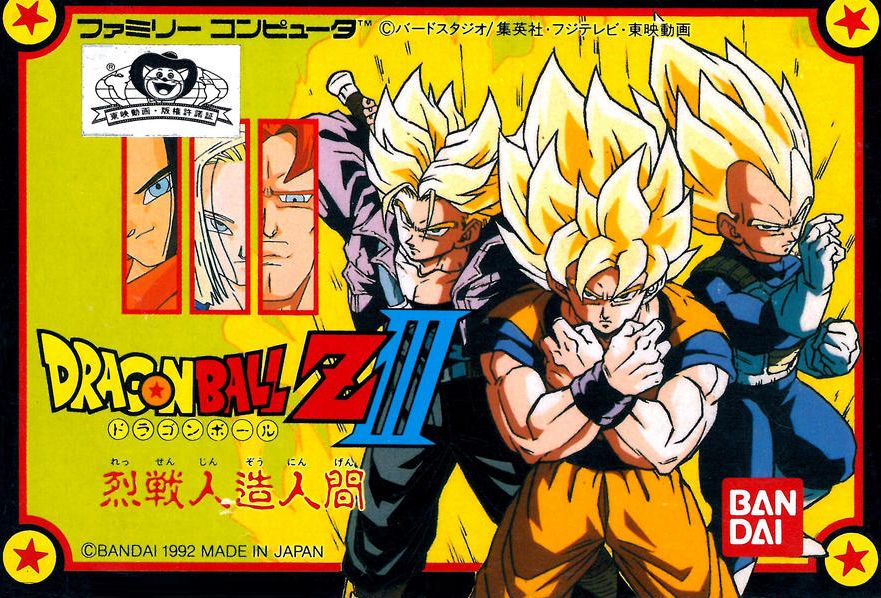
Game No. 155

Title: Dragon Ball Z: Kyoshu! Saiyan
Developer: TOSE Software Co.
Platform: Famicom
Release Date: October 27, 1990 (Japan)
Comment: Released exactly a year after Goku Den, Kyoshu! Saiyan was the first console game to be based upon the Dragon Ball Z portion of the anime series. In terms of gameplay, the title both preserved and altered the card game mechanics of the preceding installments but abandoned the board game progression in favour of an openly traversable overworld.
The story is set during the Vegeta Saga and details Goku's attempt to thwart a pair of Saiyans, extraterrestrials with a warlike bent, who are searching for the titular Dragon Balls.
While still viewed from a top-down perspective, TOSE appears to have taken a cue from contemporaries such as Dragon Quest and Final Fantasy and endowed the game with a freely navigable overworld. In conjunction with this more open-ended approach, a journal has been added to the menu system in order to help players keep track of their current objectives. Actual movement is still card-based though, as one must still draw cards which decide how many squares one may move. But cards also fill other functions this time around, oft acting as items do in other role-playing games. Some are battle-specific, others can only be used outside of combat, and some may be used under both circumstances. Scattered throughout the world are various mini-games that serve to provide Goku and his allies with opportunities to gain experience points and cards. In addition to Goku, the party stars six other characters from the manga and anime, including his former adversary Piccolo, his oldest son Gohan, as well as brothers-in-arms Krillin, Yamcha, Tien Shinhan, and Chiaotzu. The battle system has been subjected to a number of revamps. Firstly, fights are now presented with the use of animated sequences. Second, the numerical values of cards don't dictate who gets to attack any longer, as both sides get their offensive turns, but the one who draws a card with the higher value gets to strike first. Should the player and the computer controlled opponent draw a card of the same value, the player gains the initiative. Also, defensive values are given at the bottom of the same card, instead of separate ones. Furthermore, distinctions are now made between Regular cards, which execute attacks whose symbol does not match that of the currently chosen combatant; Master cards, whose symbol do match that of the currently selected fighter and thus will produce a much more powerful attack; and Ki cards, which unleash special attacks at the cost of Ki points.
Yet again, I have been unable to find any sales figures for this title and critical examinations keep eluding me.
Title: Dragon Ball Z: Kyoshu! Saiyan
Developer: TOSE Software Co.
Platform: Famicom
Release Date: October 27, 1990 (Japan)
Comment: Released exactly a year after Goku Den, Kyoshu! Saiyan was the first console game to be based upon the Dragon Ball Z portion of the anime series. In terms of gameplay, the title both preserved and altered the card game mechanics of the preceding installments but abandoned the board game progression in favour of an openly traversable overworld.
The story is set during the Vegeta Saga and details Goku's attempt to thwart a pair of Saiyans, extraterrestrials with a warlike bent, who are searching for the titular Dragon Balls.
While still viewed from a top-down perspective, TOSE appears to have taken a cue from contemporaries such as Dragon Quest and Final Fantasy and endowed the game with a freely navigable overworld. In conjunction with this more open-ended approach, a journal has been added to the menu system in order to help players keep track of their current objectives. Actual movement is still card-based though, as one must still draw cards which decide how many squares one may move. But cards also fill other functions this time around, oft acting as items do in other role-playing games. Some are battle-specific, others can only be used outside of combat, and some may be used under both circumstances. Scattered throughout the world are various mini-games that serve to provide Goku and his allies with opportunities to gain experience points and cards. In addition to Goku, the party stars six other characters from the manga and anime, including his former adversary Piccolo, his oldest son Gohan, as well as brothers-in-arms Krillin, Yamcha, Tien Shinhan, and Chiaotzu. The battle system has been subjected to a number of revamps. Firstly, fights are now presented with the use of animated sequences. Second, the numerical values of cards don't dictate who gets to attack any longer, as both sides get their offensive turns, but the one who draws a card with the higher value gets to strike first. Should the player and the computer controlled opponent draw a card of the same value, the player gains the initiative. Also, defensive values are given at the bottom of the same card, instead of separate ones. Furthermore, distinctions are now made between Regular cards, which execute attacks whose symbol does not match that of the currently chosen combatant; Master cards, whose symbol do match that of the currently selected fighter and thus will produce a much more powerful attack; and Ki cards, which unleash special attacks at the cost of Ki points.
Yet again, I have been unable to find any sales figures for this title and critical examinations keep eluding me.