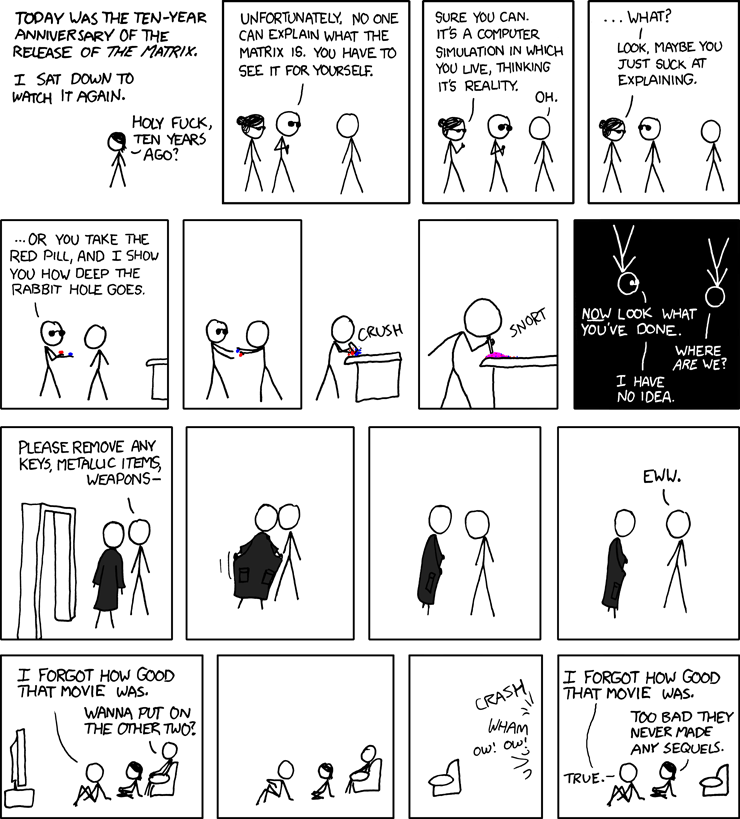
So over these past few days I've re-watched one of my favourite film series. The Matrix trilogy. The last time I saw them (years ago) I really liked them, but some of it went over my head. I never really understood all the hate for the sequels though. At the time I enjoyed them all around the same amount. After watching them again I feel more capable to talk about them, so I thought I might as well start up a conversation.
I've often heard people criticize the 2 sequel films for focusing too much on action and the "real" world instead of the world of The Matrix, while the first film was a lot more thought provoking. I can see why people would make these criticisms, but I don't think they are entirely true.
The first film in the series was the most concept heavy, but it wasn't the only one to deal a lot in these kind of themes. A lot of the philosophical themes in the first film are there to set the scene for the series and explain the world. They did deal with them in some depth but that wasn't the whole point of the film. It's a sci-fi action film, not a lecture. The Cartesian concepts of reality and our experience of it are mostly a way to explain how The Matrix works, and the whole series is building up a world and a story based on the idea that it is all real, instead of dealing with the question of "what if". It takes that as a starting point instead of it being the message behind the film.
Reloaded does still have a lot of philosophical themes in it, but instead of focusing on the question of reality is focuses on the idea of free will. This is talked about a little in the first film but in the second it becomes the focus of the more thoughtful dialogue. The Oracle, The Merovingian, and The Architect all talk about it at length. It examines the difference (or lack thereof) between humanity and the machines, and adds extra depth to the idea of The Matrix itself and the purpose of the characters in the film. People often say about this film that it focuses too much time on the "real world", and I agree to some extent. But I don't believe the problem is with where the story takes place, but what happens there. The events in The Matrix are much more interesting because that is where all the characters who have interesting dialogue happen to reside. There's also the potential for better action scenes in The Matrix because of the supernatural powers granted to characters in there. The overall run time of the film doesn't actually spend that much time away from The Matrix, but when it does it fails to deliver. Most of the events that happen are political. It's characters discussing how to defend themselves from the impending attack on Zion. Although this is a crucial part of the plot it's far less interesting than the other high concepts and fantastical action being thrown about.
There are some parts of the real world scenes that could have been much more interesting to give more focus too instead, but aren't given the time they should have had. For example they show the relationship between Link and his wife. It's clearly an attempt to show more relatable and human aspect to this part of the world, but we aren't really given enough time for it to work. But perhaps the biggest missed opportunity is with Neo's experience with being treated as a messiah figure and how he deals with it. This is given hardly any attention at all, and is only shown very briefly. This could have added a whole lot to the film if it got the attention it deserved, but was instead ignored in favour of political talks and defence plans. But I think overall the film is still fantastic. It may have some bigger flaws than the first, but the action sequences and the cinematography are better.
The third film however, drops the ball quite badly. It's not necessarily a bad film, it just doesn't include a lot of what made the first 2 films so interesting. This is kind of understandable since the plot of the film doesn't really require any more investigation in to the nature of The Matrix and is more of just a conclusion to the story. It doesn't need to explain any more esoteric topics, since everything that needed to be explained already has been. The point of the film is just to show resolution to the conflict. Although I think this is kind of sad, since the philosophical aspect of the series is one of the biggest things that makes it stand out, it's not necessarily a bad thing for the overall effectiveness of the narrative. The problem is, it doesn't do a great job of concluding the series. The film focuses a huge amount of attention on the real world. The events taking place here aren't quite as tedious as in Reloaded, but it's still not as interesting as events in The Matrix (throughout the whole series at least). Since the main focus of the film is the attack on Zion it shows a lot of action sequences and some relatively impressive cinematography instead of the boring talking which took up most of the real world events of the last film. But there's nothing really quite as compelling about it as the events in The Matrix. Again, it lacks the interesting dialogue and is mostly focusing on action set pieces that aren't really relevant to the overall plot.
The events in The Matrix don't really do much to compensate for this either. The film hardly spends any time there and the events that happen there are among the worst in that setting through the whole series. There aren't any compelling conversations and the fight sequences are short and less ambitious. Even the big fight at the end between Neo and Smith feels stunted. There are some very impressive shots in the fight, but it doesn't really feel like it was what the whole series should have been building up too. Other fights in Reloaded felt a lot better paced and exciting. It also ends far too quickly and abruptly. Neither look like they have fought to their fullest capability but suddenly Neo just decided he's going to let himself die. Obviously, this is what was supposed to happen but it didn't feel momentous, it felt like kind of a cop out. Where's the ultimate battle and the epic crescendo they seemed to be building to?
The epilogue of the film left huge plot holes too. The machines apparently give "peace" to the humans because of Neo's actions in saving The Matrix, but it's never shown what the conditions for this peace are. The humans are not all freed from The Matrix and there seems to be no reason why the machines would keep their truce. It's specified that The Matrix still exists and the machines still keep humans captive. Only those who choose to leave The Matrix actually got freedom. But the whole reason for the war was that the machines were using the humans. They wanted to destroy the machines so they could free everyone, or at least free all the humans thus destroying the machines. They failed at that, yet there is peace? And how exactly were people allowed to exit The Matrix? Did the machines just tell everyone that they were in it and give them the chance to leave? If they did that then what about the people who stayed? Did they just wipe their memory and put them back to being slaves, or were they allowed to continue in the knowledge that their whole life isn't real? Why would the machines even honour the agreement at all after they got what they wanted? The events of the film do nothing to solve the conflict between the humans and the machines. All that happens is that Neo stops Smith from taking over the real world. It's a complete mess. The only saving grace of the film is it's few action sequences, that are fun to watch, but are mostly inferior to other action scenes in the previous films.
So yeah, those are my thoughts. I really didn't expect it to come to this much text, but it just happened to come to that as I was writing it. I just hope that it doesn't turn out I'm a decade late to the conversation.
I've often heard people criticize the 2 sequel films for focusing too much on action and the "real" world instead of the world of The Matrix, while the first film was a lot more thought provoking. I can see why people would make these criticisms, but I don't think they are entirely true.
The first film in the series was the most concept heavy, but it wasn't the only one to deal a lot in these kind of themes. A lot of the philosophical themes in the first film are there to set the scene for the series and explain the world. They did deal with them in some depth but that wasn't the whole point of the film. It's a sci-fi action film, not a lecture. The Cartesian concepts of reality and our experience of it are mostly a way to explain how The Matrix works, and the whole series is building up a world and a story based on the idea that it is all real, instead of dealing with the question of "what if". It takes that as a starting point instead of it being the message behind the film.
Reloaded does still have a lot of philosophical themes in it, but instead of focusing on the question of reality is focuses on the idea of free will. This is talked about a little in the first film but in the second it becomes the focus of the more thoughtful dialogue. The Oracle, The Merovingian, and The Architect all talk about it at length. It examines the difference (or lack thereof) between humanity and the machines, and adds extra depth to the idea of The Matrix itself and the purpose of the characters in the film. People often say about this film that it focuses too much time on the "real world", and I agree to some extent. But I don't believe the problem is with where the story takes place, but what happens there. The events in The Matrix are much more interesting because that is where all the characters who have interesting dialogue happen to reside. There's also the potential for better action scenes in The Matrix because of the supernatural powers granted to characters in there. The overall run time of the film doesn't actually spend that much time away from The Matrix, but when it does it fails to deliver. Most of the events that happen are political. It's characters discussing how to defend themselves from the impending attack on Zion. Although this is a crucial part of the plot it's far less interesting than the other high concepts and fantastical action being thrown about.
There are some parts of the real world scenes that could have been much more interesting to give more focus too instead, but aren't given the time they should have had. For example they show the relationship between Link and his wife. It's clearly an attempt to show more relatable and human aspect to this part of the world, but we aren't really given enough time for it to work. But perhaps the biggest missed opportunity is with Neo's experience with being treated as a messiah figure and how he deals with it. This is given hardly any attention at all, and is only shown very briefly. This could have added a whole lot to the film if it got the attention it deserved, but was instead ignored in favour of political talks and defence plans. But I think overall the film is still fantastic. It may have some bigger flaws than the first, but the action sequences and the cinematography are better.
The third film however, drops the ball quite badly. It's not necessarily a bad film, it just doesn't include a lot of what made the first 2 films so interesting. This is kind of understandable since the plot of the film doesn't really require any more investigation in to the nature of The Matrix and is more of just a conclusion to the story. It doesn't need to explain any more esoteric topics, since everything that needed to be explained already has been. The point of the film is just to show resolution to the conflict. Although I think this is kind of sad, since the philosophical aspect of the series is one of the biggest things that makes it stand out, it's not necessarily a bad thing for the overall effectiveness of the narrative. The problem is, it doesn't do a great job of concluding the series. The film focuses a huge amount of attention on the real world. The events taking place here aren't quite as tedious as in Reloaded, but it's still not as interesting as events in The Matrix (throughout the whole series at least). Since the main focus of the film is the attack on Zion it shows a lot of action sequences and some relatively impressive cinematography instead of the boring talking which took up most of the real world events of the last film. But there's nothing really quite as compelling about it as the events in The Matrix. Again, it lacks the interesting dialogue and is mostly focusing on action set pieces that aren't really relevant to the overall plot.
The events in The Matrix don't really do much to compensate for this either. The film hardly spends any time there and the events that happen there are among the worst in that setting through the whole series. There aren't any compelling conversations and the fight sequences are short and less ambitious. Even the big fight at the end between Neo and Smith feels stunted. There are some very impressive shots in the fight, but it doesn't really feel like it was what the whole series should have been building up too. Other fights in Reloaded felt a lot better paced and exciting. It also ends far too quickly and abruptly. Neither look like they have fought to their fullest capability but suddenly Neo just decided he's going to let himself die. Obviously, this is what was supposed to happen but it didn't feel momentous, it felt like kind of a cop out. Where's the ultimate battle and the epic crescendo they seemed to be building to?
The epilogue of the film left huge plot holes too. The machines apparently give "peace" to the humans because of Neo's actions in saving The Matrix, but it's never shown what the conditions for this peace are. The humans are not all freed from The Matrix and there seems to be no reason why the machines would keep their truce. It's specified that The Matrix still exists and the machines still keep humans captive. Only those who choose to leave The Matrix actually got freedom. But the whole reason for the war was that the machines were using the humans. They wanted to destroy the machines so they could free everyone, or at least free all the humans thus destroying the machines. They failed at that, yet there is peace? And how exactly were people allowed to exit The Matrix? Did the machines just tell everyone that they were in it and give them the chance to leave? If they did that then what about the people who stayed? Did they just wipe their memory and put them back to being slaves, or were they allowed to continue in the knowledge that their whole life isn't real? Why would the machines even honour the agreement at all after they got what they wanted? The events of the film do nothing to solve the conflict between the humans and the machines. All that happens is that Neo stops Smith from taking over the real world. It's a complete mess. The only saving grace of the film is it's few action sequences, that are fun to watch, but are mostly inferior to other action scenes in the previous films.
So yeah, those are my thoughts. I really didn't expect it to come to this much text, but it just happened to come to that as I was writing it. I just hope that it doesn't turn out I'm a decade late to the conversation.