In the Believing in Science is Bloody Stupid [http://www.escapistmagazine.com/forums/read/18.216972-Believing-in-Science-is-Bloody-Stupid] many put forth alot of whacky ideas about what science is. Most of you were very wrong. This thread discusses the nature of science and what it is.
Science is not a set of theories. Science is not The Truth(tm).
Science is what we use to get theories. Science is what you should do to find something that looks like The Truth(tm).
Science is a method [http://en.wikipedia.org/wiki/Scientific_method]. Science is a large collection of instructions on how you should go about when you want to bring forth a new theory, or check up on old ones.
Here's how you go about to use the scientific method to create a theory.
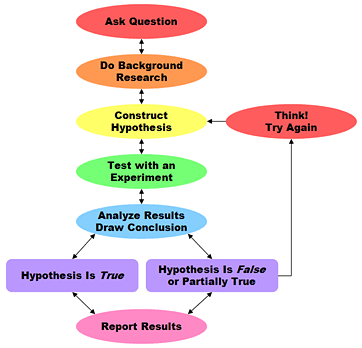
Gravity for instance is not science... it's a theory... a model... an abstract facsimile that we use to try to figure out what will happen in real life when we drop you tossers off of a high building. The theory of gravity was created by using the scientific method. But the theory of gravity itself is not science.
The difference between science and faith is this:
- Faithers will say "This is the way it is! It's not even a theory it is FACT and TRUTH, period!"
- Scientists will say "This is just a model of real life... we have no idea what real life is or why it works... but our model, this theory of ours, works exactly the same... as far as we can tell for the moment".
The main flaw of faith is that it can never predict the future or what will happen when we try a theory for a new set of circumstances. If it could, it wouldn't be faith but science. Theories that have been tested using the scientific method can predict things. This is what the scientific method does for a theory: it certifies that the theory can make accurate predictions.
Assuming Yahtzee used Element 99 from his Singularity review [http://www.escapistmagazine.com/videos/view/zero-punctuation/1883-Singularity] to shove the apple down Isaac Newton's throat and choke him... this is how you would go about to form the theory of gravity, using science.
One day you get particularly annoyed with a tosser and send him on long walk off of a short cliff, just for the lulz. To your amazement your notice that the tosser accelerates rapidly downward, until the rocks at the bottom of the cliff reduces the tosser to a big messy pile of goo and gore.
This is an immensely fascinating experience, and so the question forms in your mind: "Why did that tosser smash himself against the canyon floor, just because you shoved him?".
Anyway... for now you are happy that the world is rid of this tosser and in a cheerful mood you tell your friend about the experience.
"You know"... says Friend... "I too had that happen a while back! I rear-ended this tosser on a motorway bridge because he wouldn't get out of my way, then I got out and shoved him and... Wheeeeeeee-splat!, he was kind enough to make himself much less annoying".
The brilliant mind that you are you are starting to see a pattern here, so you ask around a bit: "Hey, did you ever shove a tosser in such a way they go splat on the ground?". Most people will say "No... when I shove tossers they mostly just get angry with me and shove back". But a few will say "Yeah! I had that happen to me too... I shoved a tosser in such a way that they went *splat*!". Your background research shows that you are onto something useful here. So you go over to the nearest bar and order yourself a pint or six to enhance your sharp intellect and try to see the full picture.
At around five minutes before closing time the hawt lady who just can't keep her hands off of you, in your charming fashionably inebriated state, cries out "You're a bloody tosser!" and gives you a hard shove. To your amazement you find you have slipped off of the bar-stool and you are now on the floor with early onsets of hangover-headaches. As hard as the floor planks just hit you, insight invades your mind: "Shoves makes tossers smack into the ground!" You have constructed your hypothesis.
The next morning you have figured out a way to test this hypothesis. You call Friend and tell him to bring a camera. The two of you go out and round up all the tossers you can find, and start shoving, just to see what happens. This is the experiment.
After a few days of this you sit down watch all the videos. You analyze the data. The results are depressing: most tossers remained just as annoying as before... often even worse. Your hypothesis said that shoving a tosser would make him go "splat" and cease being annoying. But that's not what happened in the experiment. It only happened to a few tossers, not all. You draw the conclusion that the hypothesis is only partially true. That's not good enough for you.
So you and Friend go to the bar and have a dozen pints to share. You sit down to think. What was wrong? Clearly it wasn't the shoves because you tried everything from a nudge to a push to kicking them in the groin and still just a few splatted. Also you had this one tosser that did splat, but only because he stumbled out into traffic and hugged the front of a bus, so you dismiss him as a false positive. It was hilarious, and something to be investigated later... but that's not what you are after.
Or is it?! Friend bring the missing piece to the puzzle... the part of the hypothesis that makes it complete: it's all about where you do the shove!
Encouraged by this you set about to do a new set of experiments. This time you don't just hang about the local town but you embark on an ambitious science project where you tour the world and shove tossers in all various kinds of locations.
As you come out of the coma a few months later, after Luddites and other enemies of science and progress forcibly puts an end to your experiment with large amounts of violence, you watch the footage you captured with your camera very closely and try to find the hidden pattern. You again analyze the data. Finally you jump out of your seat and shout it out: "Shoving tossers off of high places makes them less annoying, because there is this thing called gravity that makes them go splat on the ground!". You have drawn a new conclusion and this time is seems to check out with the data gathered in the experiment. The hypothesis has been proved to be true.
So you upload all your videos to YouTube. On your channel page you also present your theory of gravity: "Near high places, there is this thing called gravity... and if you push a tosser off of the high place, gravity will make him much less annoying". This is publishing your data and reporting your results - and you quickly become one of the most popular channels on YouTube.
Most of the comments are the usual stuff... "First!", "LOL, PWNED!" and "That is so fake". But your more faithful and intelligent followers start doing experiments of their own. And just as your theory predicts, it is soon shown that when shoving a tosser off of a high place, he does indeed go "splat" on the ground and become much less annoying. Your theory has been subjected to peer review and almost all across the board, everyone seems to be getting results that are consistent with your theory. The community has reached consensus that the theory seems to be valid.
We don't know yet what this "gravity" thing is, what it looks like or even why it works. But it has now been established - with the scientific method - that there is a phenomena that happens every time you shove a tosser out of a high place.
And so you have used science to prove the existence of gravity and how it works. For your scientific achievement you win Da Intarwebs and a buckit.
/S
Science is not a set of theories. Science is not The Truth(tm).
Science is what we use to get theories. Science is what you should do to find something that looks like The Truth(tm).
Science is a method [http://en.wikipedia.org/wiki/Scientific_method]. Science is a large collection of instructions on how you should go about when you want to bring forth a new theory, or check up on old ones.
Here's how you go about to use the scientific method to create a theory.
Gravity for instance is not science... it's a theory... a model... an abstract facsimile that we use to try to figure out what will happen in real life when we drop you tossers off of a high building. The theory of gravity was created by using the scientific method. But the theory of gravity itself is not science.
The difference between science and faith is this:
- Faithers will say "This is the way it is! It's not even a theory it is FACT and TRUTH, period!"
- Scientists will say "This is just a model of real life... we have no idea what real life is or why it works... but our model, this theory of ours, works exactly the same... as far as we can tell for the moment".
The main flaw of faith is that it can never predict the future or what will happen when we try a theory for a new set of circumstances. If it could, it wouldn't be faith but science. Theories that have been tested using the scientific method can predict things. This is what the scientific method does for a theory: it certifies that the theory can make accurate predictions.
Assuming Yahtzee used Element 99 from his Singularity review [http://www.escapistmagazine.com/videos/view/zero-punctuation/1883-Singularity] to shove the apple down Isaac Newton's throat and choke him... this is how you would go about to form the theory of gravity, using science.
One day you get particularly annoyed with a tosser and send him on long walk off of a short cliff, just for the lulz. To your amazement your notice that the tosser accelerates rapidly downward, until the rocks at the bottom of the cliff reduces the tosser to a big messy pile of goo and gore.
This is an immensely fascinating experience, and so the question forms in your mind: "Why did that tosser smash himself against the canyon floor, just because you shoved him?".
Anyway... for now you are happy that the world is rid of this tosser and in a cheerful mood you tell your friend about the experience.
"You know"... says Friend... "I too had that happen a while back! I rear-ended this tosser on a motorway bridge because he wouldn't get out of my way, then I got out and shoved him and... Wheeeeeeee-splat!, he was kind enough to make himself much less annoying".
The brilliant mind that you are you are starting to see a pattern here, so you ask around a bit: "Hey, did you ever shove a tosser in such a way they go splat on the ground?". Most people will say "No... when I shove tossers they mostly just get angry with me and shove back". But a few will say "Yeah! I had that happen to me too... I shoved a tosser in such a way that they went *splat*!". Your background research shows that you are onto something useful here. So you go over to the nearest bar and order yourself a pint or six to enhance your sharp intellect and try to see the full picture.
At around five minutes before closing time the hawt lady who just can't keep her hands off of you, in your charming fashionably inebriated state, cries out "You're a bloody tosser!" and gives you a hard shove. To your amazement you find you have slipped off of the bar-stool and you are now on the floor with early onsets of hangover-headaches. As hard as the floor planks just hit you, insight invades your mind: "Shoves makes tossers smack into the ground!" You have constructed your hypothesis.
The next morning you have figured out a way to test this hypothesis. You call Friend and tell him to bring a camera. The two of you go out and round up all the tossers you can find, and start shoving, just to see what happens. This is the experiment.
After a few days of this you sit down watch all the videos. You analyze the data. The results are depressing: most tossers remained just as annoying as before... often even worse. Your hypothesis said that shoving a tosser would make him go "splat" and cease being annoying. But that's not what happened in the experiment. It only happened to a few tossers, not all. You draw the conclusion that the hypothesis is only partially true. That's not good enough for you.
So you and Friend go to the bar and have a dozen pints to share. You sit down to think. What was wrong? Clearly it wasn't the shoves because you tried everything from a nudge to a push to kicking them in the groin and still just a few splatted. Also you had this one tosser that did splat, but only because he stumbled out into traffic and hugged the front of a bus, so you dismiss him as a false positive. It was hilarious, and something to be investigated later... but that's not what you are after.
Or is it?! Friend bring the missing piece to the puzzle... the part of the hypothesis that makes it complete: it's all about where you do the shove!
Encouraged by this you set about to do a new set of experiments. This time you don't just hang about the local town but you embark on an ambitious science project where you tour the world and shove tossers in all various kinds of locations.
As you come out of the coma a few months later, after Luddites and other enemies of science and progress forcibly puts an end to your experiment with large amounts of violence, you watch the footage you captured with your camera very closely and try to find the hidden pattern. You again analyze the data. Finally you jump out of your seat and shout it out: "Shoving tossers off of high places makes them less annoying, because there is this thing called gravity that makes them go splat on the ground!". You have drawn a new conclusion and this time is seems to check out with the data gathered in the experiment. The hypothesis has been proved to be true.
So you upload all your videos to YouTube. On your channel page you also present your theory of gravity: "Near high places, there is this thing called gravity... and if you push a tosser off of the high place, gravity will make him much less annoying". This is publishing your data and reporting your results - and you quickly become one of the most popular channels on YouTube.
Most of the comments are the usual stuff... "First!", "LOL, PWNED!" and "That is so fake". But your more faithful and intelligent followers start doing experiments of their own. And just as your theory predicts, it is soon shown that when shoving a tosser off of a high place, he does indeed go "splat" on the ground and become much less annoying. Your theory has been subjected to peer review and almost all across the board, everyone seems to be getting results that are consistent with your theory. The community has reached consensus that the theory seems to be valid.
We don't know yet what this "gravity" thing is, what it looks like or even why it works. But it has now been established - with the scientific method - that there is a phenomena that happens every time you shove a tosser out of a high place.
And so you have used science to prove the existence of gravity and how it works. For your scientific achievement you win Da Intarwebs and a buckit.
/S