It's been a bad day so far. I always bring my car in for a minor repair to discover something else needs fixing as well and lose my shirt in the process. It has nothing to do with the mechanics, all of whom my parents and I have known most of our lives, it's just the nature of owning a Volvo. Expensive to fix, built like a tank. A trendy, yuppie tank, but still...
Anyhow I digress. I was trying to take a nap before writing this review so I would be more coherent, but the news on my car got me too flustered to relax. If this review is below par then I apologize and if there's a strong enough outcry I'll redo it. For now consider this the definitive review.
Girl Genius is by Phil and Kaja Foglio and originally was a periodical comic book and is now online. This review is being done at the request of Escapist member McClaud who made me feel bad every time I had something negative to say about the comic when he told me he was a "distant friend of the Foglios." Fortunately for him I didn't find a lot to gripe about.
Before divulging too much information let me just say this is one of those comics that isn't for everyone. I read Inverloch before Girl Genius and, for those who didn't read the Inverloch review, I didn't like the former very much. Soldiering onward I hoped Girl Genius would appeal to me more. Still, at the beginning of Girl Genius my reaction was something like a roll of the eyes and a muttering of "is this some kind of steampunk Harry Potter?"
The answer? Well, yes and no. It is definitely steampunk, a sub-genre of science fiction that I have developed a true affection for thanks largely to Bioshock (aside: even if the gameplay of Bioshock doesn't grab you the storytelling is fantastic, I mean really great, it's so sadistic and sinuous in its nature I just was enthralled by it). This is a much lighter (mostly) tale set in an alternate/similar universe to our own. The one word that leaps out at me when I think of Girl Genius is originality.
Originality is something very difficult to effectively execute in any medium of storytelling. It isn't necessarily a bad thing to have archetypal characters and events in a story if the story does little things differently or has compelling enough aspects to make you enjoy it. When you begin to see the success of the archetypal work copied almost to the cut and paste degree of the Terry Brooks Shannara series, well, that's when you're retreading something too much and running out of good presentation. Brooks sets up a compelling fantasy universe, quite similar to, but not mirroring, Tolkien's and creates a truly iconic figure in the Druid Allanon to keep much of the reader's interest. Except he then recycles the same exact plot for every book after the first two. I mean this quite literally, the plot is EXACTLY THE SAME. It is sort of like reading Redwall by Brian Jacques and then moving on to other novels in the series only to discover his plots are simply rehashes of the first, but at least he has the decency to surprise by dramatically killing some of the more exciting characters in heroic fashion.
My point is that you can be successful keeping with a formulaic approach that mirrors another work you admire/want to blatantly rip off, but you won't really shake the foundations of the world by doing it. That being said, some Tolkien-esque works are as good stand alone with enough originality thrown in (and dear God I hope my own books someday fit that category) and if that originality is just different enough you can tell a very good story worth reading, like the first Dragonlance Trilogy.
So if what I am saying is that retreading certain archetypes and tropes threatens to create a cycle of retelling and eventually dry the well of its few original ideas then why do so many people write those books/comics? Well, because it is safer than trying to do something dramatically different and new. Take my impressions of Inverloch, which definitely was unlike most fantasy stories I have read. I didn't like it, even though I recognized the uniqueness of some of its parts, overall it didn't "do it" for me. This is the risk you run with trying to do something different, it is the same reason Hollywood releases sequels that should never be made, like the ridiculous Crank sequel out now. Why did they even make the first one? Garbage premise, garbage action-for-action's-sake junk. But it sold, so let's rehash it and find an excuse to do it again.
But thankfully there are people out there who do try to do something different now and again and they get noticed. Take the aforementioned Harry Potter series. Now, I liked the first three to four (I forget at which point I began to dislike the direction of the series) novels because it was original and different and, even better, it got kids to read again. Don't mistake the importance of children reading, no matter what Harold Bloom says, it was a worthwhile venture. But, as most probably know, it took J.K. Rowling an enormous amount of time and effort to get the first book published (and yet new Danielle Steele novels come out weekly it seems, the world is a stupid place) and it was mostly due to the fact it wasn't a "safe" seller. Too much that was different or unpopular at the time, it just didn't scream "cash cow" to anyone. Sure does now though.
And that, after much exposition, is the crux of the issue. If the new and daring work that at least tries to do something significantly different succeeds it almost always succeeds overwhelmingly. True, it might still be absolute malarkey like Twilight, but if it makes it then it really makes it. This is what happened with Girl Genius.
Backtracking to my initial comment you can understand I wasn't wild about it when I first started reading it. Obviously that changed if I just spent paragraphs explaining the impact of well thought out originality and attributed it to this comic. Let me just qualify that statement by saying it is far from perfect and I am going to point out some serious issues I have with it, but overall I like it. It does something new and interesting and it has enough good characters and some very nice, emotive artwork to convey the story.
So down to brass tacks. The conceptual design involves a world that is Earth, but Earth where technology is heavily reliant on the creation and use of "clanks" (large, robotic contraptions theoretically propelled by steam or something like it) that make up the backbone of armies, work staff and... well mostly armies. See, Baron Klaus Wulfenbach amassed a great army of clanks to defeat a strange and deadly enemy known only as The Other and in doing so conquered much of Europe and holds dominion over his lands from his floating castle (a giant blimp) with an iron fist. He descends on one of his holdings with his son Gilgamesh to investigate and meets an incompetent student of clank creation, Agatha, during a tense encounter with her master. The master ends up dead and Agatha is sent home. It turns out Agatha is a powerful Spark (one who can create incredibly complex clanks and other machines) and she is captured and taken to Castle Wulfenbach where the inevitable love interest with Gilgamesh arises.
To divulge anything further would really be giving a lot away. To sum up some of the better points: clearly Klaus is of German ancestry and he employs Jagermonsters, humanoid warriors who love to fight, but despite their fearful appearance are not necessarily brutes. They rapidly became one of my favorite unique features of the comic. Also, there is a nice evolution of Agatha's clank skills and their purpose which drives the story and leads to her encountering truly memorable characters along the way. By far Klaus, Gilgamesh, Agatha, and the Jagers represent the best characters in the story, but there are almost innumerable minor ones that join and then depart only to reappear later. Some are quite intriguing, well, most are really, but this brings us to my main criticism.
There are just too many characters and too many minor, intertwining plots in this story. I suspect the Foglio's have some massive, room-sized flowchart somewhere in their work station that shows how all the players and plots eventually come together sensibly and conclusively, but there's no way even they could make sense of it! Truly the plot is dense, complex, and thoroughly compelling. There was one dramatic point in the story where I couldn't tell what the hell was happening, why, or what the aftermath was all about, but I forged ahead gamely because the bright spots outshine the missteps just enough to keep me going. I'm sure a dedicated reader could make sense of it all given enough time and effort, but really that's not what I want to be doing or I would just try making sense of Robert Jordan's Wheel of Time series (may he rest in peace).
The fact is as much as the complexity and overabundance of characters bothers me I can't find any real plot holes (at least no major ones) that can't be explained by going back through the archives to discover the solution. It might not be an obvious one and sometimes I felt dumb because I could not remember the significance of Minor Character #547, but none of ever seemed to fall flat. Sure, the weave is intricate, but at least it all seems to fit together correctly and that is satisfying to a degree.
I don't want my problems with the characters and plot to deter anyone from at least trying Girl Genius because when you push through the complexity with an eye towards only the most basic questions (who is Agatha really and what is her role in this world?) and relationships (will Agatha and Gil finally get together?) you're left with a pretty enjoyable piece. Add in the fact that Baron Wulfenbach is one of the best "is he a bad guy or not" characters and you have enough to keep you slugging it out with the nefarious attempts of the creators to derail themselves with too many happenings. Stick to the core of the comic and I think there is something really good tucked away there.
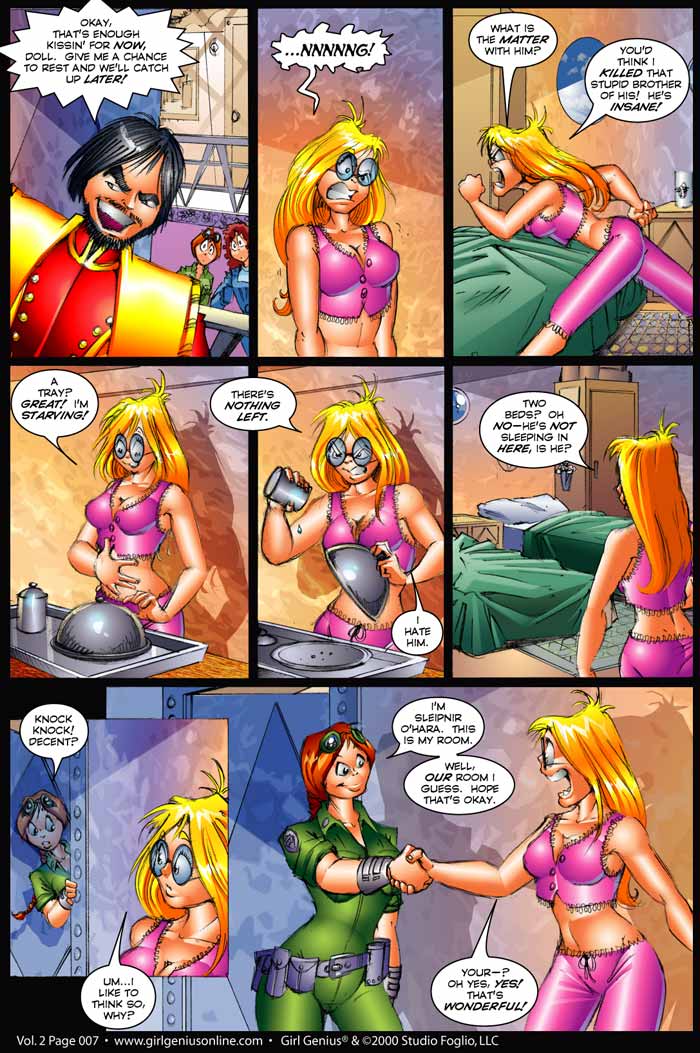
As for the appearance, this is one of the nicer looking comics around. The first several comics are black and white, which is okay, but the coloring of the rest of the comic is extremely impressive. It definitely shows hints of eastern influence, especially in emotional facial expression, which is exaggerated, but maintains a distinct look all its own. The meshing of art styles is subtle, and I think that is the best way to describe it. You are going to look at it and be reminded, either all at once or in bits and pieces, of other art styles or fantasy works. The fact that all of these blend together creates that unique feel I was raving about before. This is a very original piece and a well done one. I consider it a rarity and one everybody should at least dip their feet into. If you choose to go swimming in it after that just remember, I warned you the deep end was really deep.
You can find Girl Genius at http://www.girlgeniusonline.com/comic.php?date=20021104 at least if you want to start from the beginning (you do). Now, I am going to sit back and watch the voting for the next review while pondering if robbing my local convenience store would cover my car repairs.
Note - Phil and Kaja refer to their work as "gaslamp fantasy" a term I have never heard of and which means I am probably incorrect in referring to their work as "steampunk with fantasy elements."
Anyhow I digress. I was trying to take a nap before writing this review so I would be more coherent, but the news on my car got me too flustered to relax. If this review is below par then I apologize and if there's a strong enough outcry I'll redo it. For now consider this the definitive review.
Girl Genius is by Phil and Kaja Foglio and originally was a periodical comic book and is now online. This review is being done at the request of Escapist member McClaud who made me feel bad every time I had something negative to say about the comic when he told me he was a "distant friend of the Foglios." Fortunately for him I didn't find a lot to gripe about.
Before divulging too much information let me just say this is one of those comics that isn't for everyone. I read Inverloch before Girl Genius and, for those who didn't read the Inverloch review, I didn't like the former very much. Soldiering onward I hoped Girl Genius would appeal to me more. Still, at the beginning of Girl Genius my reaction was something like a roll of the eyes and a muttering of "is this some kind of steampunk Harry Potter?"
The answer? Well, yes and no. It is definitely steampunk, a sub-genre of science fiction that I have developed a true affection for thanks largely to Bioshock (aside: even if the gameplay of Bioshock doesn't grab you the storytelling is fantastic, I mean really great, it's so sadistic and sinuous in its nature I just was enthralled by it). This is a much lighter (mostly) tale set in an alternate/similar universe to our own. The one word that leaps out at me when I think of Girl Genius is originality.
Originality is something very difficult to effectively execute in any medium of storytelling. It isn't necessarily a bad thing to have archetypal characters and events in a story if the story does little things differently or has compelling enough aspects to make you enjoy it. When you begin to see the success of the archetypal work copied almost to the cut and paste degree of the Terry Brooks Shannara series, well, that's when you're retreading something too much and running out of good presentation. Brooks sets up a compelling fantasy universe, quite similar to, but not mirroring, Tolkien's and creates a truly iconic figure in the Druid Allanon to keep much of the reader's interest. Except he then recycles the same exact plot for every book after the first two. I mean this quite literally, the plot is EXACTLY THE SAME. It is sort of like reading Redwall by Brian Jacques and then moving on to other novels in the series only to discover his plots are simply rehashes of the first, but at least he has the decency to surprise by dramatically killing some of the more exciting characters in heroic fashion.
My point is that you can be successful keeping with a formulaic approach that mirrors another work you admire/want to blatantly rip off, but you won't really shake the foundations of the world by doing it. That being said, some Tolkien-esque works are as good stand alone with enough originality thrown in (and dear God I hope my own books someday fit that category) and if that originality is just different enough you can tell a very good story worth reading, like the first Dragonlance Trilogy.
So if what I am saying is that retreading certain archetypes and tropes threatens to create a cycle of retelling and eventually dry the well of its few original ideas then why do so many people write those books/comics? Well, because it is safer than trying to do something dramatically different and new. Take my impressions of Inverloch, which definitely was unlike most fantasy stories I have read. I didn't like it, even though I recognized the uniqueness of some of its parts, overall it didn't "do it" for me. This is the risk you run with trying to do something different, it is the same reason Hollywood releases sequels that should never be made, like the ridiculous Crank sequel out now. Why did they even make the first one? Garbage premise, garbage action-for-action's-sake junk. But it sold, so let's rehash it and find an excuse to do it again.
But thankfully there are people out there who do try to do something different now and again and they get noticed. Take the aforementioned Harry Potter series. Now, I liked the first three to four (I forget at which point I began to dislike the direction of the series) novels because it was original and different and, even better, it got kids to read again. Don't mistake the importance of children reading, no matter what Harold Bloom says, it was a worthwhile venture. But, as most probably know, it took J.K. Rowling an enormous amount of time and effort to get the first book published (and yet new Danielle Steele novels come out weekly it seems, the world is a stupid place) and it was mostly due to the fact it wasn't a "safe" seller. Too much that was different or unpopular at the time, it just didn't scream "cash cow" to anyone. Sure does now though.
And that, after much exposition, is the crux of the issue. If the new and daring work that at least tries to do something significantly different succeeds it almost always succeeds overwhelmingly. True, it might still be absolute malarkey like Twilight, but if it makes it then it really makes it. This is what happened with Girl Genius.
Backtracking to my initial comment you can understand I wasn't wild about it when I first started reading it. Obviously that changed if I just spent paragraphs explaining the impact of well thought out originality and attributed it to this comic. Let me just qualify that statement by saying it is far from perfect and I am going to point out some serious issues I have with it, but overall I like it. It does something new and interesting and it has enough good characters and some very nice, emotive artwork to convey the story.
So down to brass tacks. The conceptual design involves a world that is Earth, but Earth where technology is heavily reliant on the creation and use of "clanks" (large, robotic contraptions theoretically propelled by steam or something like it) that make up the backbone of armies, work staff and... well mostly armies. See, Baron Klaus Wulfenbach amassed a great army of clanks to defeat a strange and deadly enemy known only as The Other and in doing so conquered much of Europe and holds dominion over his lands from his floating castle (a giant blimp) with an iron fist. He descends on one of his holdings with his son Gilgamesh to investigate and meets an incompetent student of clank creation, Agatha, during a tense encounter with her master. The master ends up dead and Agatha is sent home. It turns out Agatha is a powerful Spark (one who can create incredibly complex clanks and other machines) and she is captured and taken to Castle Wulfenbach where the inevitable love interest with Gilgamesh arises.
To divulge anything further would really be giving a lot away. To sum up some of the better points: clearly Klaus is of German ancestry and he employs Jagermonsters, humanoid warriors who love to fight, but despite their fearful appearance are not necessarily brutes. They rapidly became one of my favorite unique features of the comic. Also, there is a nice evolution of Agatha's clank skills and their purpose which drives the story and leads to her encountering truly memorable characters along the way. By far Klaus, Gilgamesh, Agatha, and the Jagers represent the best characters in the story, but there are almost innumerable minor ones that join and then depart only to reappear later. Some are quite intriguing, well, most are really, but this brings us to my main criticism.
There are just too many characters and too many minor, intertwining plots in this story. I suspect the Foglio's have some massive, room-sized flowchart somewhere in their work station that shows how all the players and plots eventually come together sensibly and conclusively, but there's no way even they could make sense of it! Truly the plot is dense, complex, and thoroughly compelling. There was one dramatic point in the story where I couldn't tell what the hell was happening, why, or what the aftermath was all about, but I forged ahead gamely because the bright spots outshine the missteps just enough to keep me going. I'm sure a dedicated reader could make sense of it all given enough time and effort, but really that's not what I want to be doing or I would just try making sense of Robert Jordan's Wheel of Time series (may he rest in peace).
The fact is as much as the complexity and overabundance of characters bothers me I can't find any real plot holes (at least no major ones) that can't be explained by going back through the archives to discover the solution. It might not be an obvious one and sometimes I felt dumb because I could not remember the significance of Minor Character #547, but none of ever seemed to fall flat. Sure, the weave is intricate, but at least it all seems to fit together correctly and that is satisfying to a degree.
I don't want my problems with the characters and plot to deter anyone from at least trying Girl Genius because when you push through the complexity with an eye towards only the most basic questions (who is Agatha really and what is her role in this world?) and relationships (will Agatha and Gil finally get together?) you're left with a pretty enjoyable piece. Add in the fact that Baron Wulfenbach is one of the best "is he a bad guy or not" characters and you have enough to keep you slugging it out with the nefarious attempts of the creators to derail themselves with too many happenings. Stick to the core of the comic and I think there is something really good tucked away there.
As for the appearance, this is one of the nicer looking comics around. The first several comics are black and white, which is okay, but the coloring of the rest of the comic is extremely impressive. It definitely shows hints of eastern influence, especially in emotional facial expression, which is exaggerated, but maintains a distinct look all its own. The meshing of art styles is subtle, and I think that is the best way to describe it. You are going to look at it and be reminded, either all at once or in bits and pieces, of other art styles or fantasy works. The fact that all of these blend together creates that unique feel I was raving about before. This is a very original piece and a well done one. I consider it a rarity and one everybody should at least dip their feet into. If you choose to go swimming in it after that just remember, I warned you the deep end was really deep.
You can find Girl Genius at http://www.girlgeniusonline.com/comic.php?date=20021104 at least if you want to start from the beginning (you do). Now, I am going to sit back and watch the voting for the next review while pondering if robbing my local convenience store would cover my car repairs.
Note - Phil and Kaja refer to their work as "gaslamp fantasy" a term I have never heard of and which means I am probably incorrect in referring to their work as "steampunk with fantasy elements."