Surprise!
I know, I said that the voted comic was going to be next, but I'm visiting my former college (I guess it's my alma mater even though I'm only a first year alum) and I'm doing so to get my work done on my novel and made the mistake of checking out one of the requested comics I have never read. Yes, I was supposed to do Mega Tokyo next, but xkcd got more requests and I had heard of it before, so I figured I would just look at a couple while taking a break from writing.
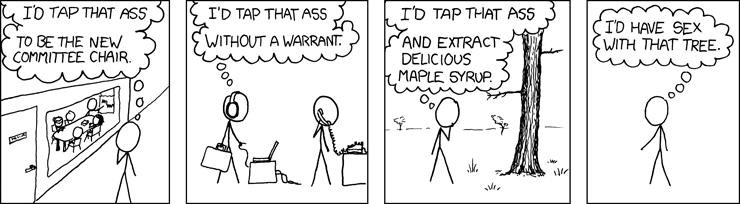
Yeah, that plan fell pretty flat. xkcd, by Randall Munroe, can best be described as an even more surreal/intelligent Farside, and just as insightful and funny. This means that xkcd falls squarely into the "required reading" category of comics. Of the webcomics I have reviewed so far, each one seems to have a niche audience that it is trying to appeal to. xkcd is just quirky and bizarre, but should be accessible and funny to almost everyone, though not on every page. To better sum up the learning curve with xkcd, I'll use author Randall Munroe's own words:
"Warning: this comic occasionally contains strong language (which may be unsuitable for children), unusual humor (which may be unsuitable for adults), and advanced mathematics (which may be unsuitable for liberal-arts majors)."
Sadly I fall into the last category. With a bachelor's degree in European History and European Literature you would think I of all people would struggle with this comic, but I didn't. Instead, I was mesmerized by it. Even the mathematical humor that I didn't get still intrigued me, because this is comic that is both amusing and philosophical at nearly every turn. A greater dissection of what makes xkcd so great is forthcoming, but first I want to take a digression into comparison so you can really see where the genius of it comes from.
Before we had webcomics I, and many other people, exclusively read newspaper funnies for our amusement. Of those a few became true classics and most were filler. Among the classics you could count Peanuts by Schultz, Calvin and Hobbes by Watterson, and Farside by Larson (not a complete list, but these three are the pinnacle in my eyes). Gary Larson's Farside was the most intelligent of these and also the most surreal. Larson's humor was so good that upon second viewings of many strips the reader would "get it" more than they did the first time. It was successful layering of humor in a comic done subtly and seamlessly that made Farside so brilliant. If I were to make a list of comics that every person must read before they die a collection of Larson's Farside cartoons would be near the top.
I bring up Larson because he is who I am inevitably reminded of as I read xkcd. xkcd isn't ripping off of Farside in the same way the atrociously unfunny Close to Home tries to, it seems in many ways to be an homage to that particular style. Munroe doesn't limit himself to the one-panel gags Larson used almost exclusively, but the oddity of the writer is eerily similar, if slightly geekier in xkcd. Another thing that really strikes me when comparing the two is the philosophical side to many of the comics. Larson is always going for the punchline, but he still managed to slide some thought-provoking imagery and dialog into his pieces from time to time. Munroe is usually very funny as well, but sometimes his comics are sad or upsetting when they are thoughtful and I sincerely do not mean that as a criticism. Sometimes, I have a difficult time telling when Munroe is trying to be funny and when he is deathly serious (more on that later).
One of Munroe's comics openly states that he is promoting surreal humor and questions how many people reading his work "get it." I find I understood almost all of the comics that didn't contain mathematics or systems that I don't have the educational background for, which I would say means that Munroe's surrealism is doing a good job of getting across the point or joke. As for the complexities, well, the man worked for NASA so I think we just have to accept those. Some of these comics will fly over your head, just like they did mine, and Munroe makes no apologies and he shouldn't. As one of his stick figure characters says in an early sketch: "Before you talk to me I should warn you, I'm kind of strange." That's alright, most of us are going to accept that we are all a little weird.
It was those early sketches that sucked me in, because they had no rhyme or reason. Some were landscapes and others just simple, one panel humor. I always start comics from the beginning of their archives, but I could have gone from the site's randomizer to any comic (xkcd does validate the presence of the randomizer) due to the lack of connectivity between most strips. I would recommend starting from the beginning in this case though, just as part of the experience, unless the early stuff doesn't grab you. According to Munroe's FAQ page he began scanning old sketches from his younger days into his computer so he wouldn't lose them, then posted a few on the web. People liked them enough that he turned it into a hobby and later a means of income. The humble beginnings are intriguing because they show that Munroe can draw, startlingly well at times, but that he often chooses not to. Most of his images are of stick figures, a few slight variations exist but stick figures nonetheless. It's not the same as Order of the Stick where there is definitely an artistic flair to the stick figures, these are just sketches. Some look hastily done, others carefully created, but the feeling of flipping through someone's high school notebook and looking at doodles remains and that has a delightful charm all it's own.

Aside from the general observations there are a few things about xkcd that really stand out, either as common traits or themes. For one, Munroe always has a cursor activated text message with each comic, just hold your cursor still over the image to get it. These can be alternately hilarious and thought-provoking but they always add something good to the strip. Also, Munroe apparently saw Jurassic Park and developed a terrible fear of raptors because of it. Raptor attacks become a recurring gag that never loses its gleam, including a hilarious comic showing Munroe's most common Google searches. Other than the raptors, which rarely show up physically in the comic, there aren't recurring characters in the traditional sense. There's the stick figure with a black hat who seems a bit malicious, a fellow with a white tartan that is rather slow, several women (identified by longish hair), and an array of plain figures of various temperaments. It is unclear if these are characters or simply extensions of Munroe's thoughts and personality. I'm inclined to believe the latter, because he seems much more interested in theme and concept than character or plot. As to the last, there is none except on occasion where Munroe concocts a short, and ridiculous, scenario revolving around one theme or another. This is where the comic is at its weakest because it forces Munroe to stay within some degree of continuity and this is a piece that excels simply because each one-shot is completely different from the previous one. Munroe keeps you nicely off-balance, making each comic all the more entertaining and funny because you never really expected it. That is where the magic of xkcd really stands out.
But as I said the comic is not always funny and when it is, even more so than Farside, it is insightful. The piercing tone of some of the comics really got me thinking. There are some where the insight is so poignant, so sharp, that it is upsetting and generates a powerful emotional response. Most notably there are the reflective comics that deal with the loss of a love in one of the figure's lives (whom I presume represents Munroe). These constant sad reflections that periodically pop up make me ask who this person is that our author can't forget. And really, when you're pondering something like that in the middle of a humorous comic and actually, truly, want to know, hasn't there been a pretty remarkable achievement by the author? Or is this simply a recurring joke I am too sentimental to see the humor in? Or, even more curious, is this the author's joke for himself that only he gets a laugh out of? But really, most of all, isn't the fact I am so perplexed proof of how truly impressive this comic is, that it can alternately make me laugh out loud and be inwardly reflective in the span of one click? The more I read it the more I find myself truly admiring what is going on here and the more I wonder if Munroe is just laughing at me for analyzing his comic so meticulously. Even if he is I harbor him no ill will, I think he's created a comic that everyone is going to get something out of for themselves.
Consider the fact that I, the aforementioned liberal-arts major, cannot do any kind of moderately complex math. And yet in one of Munroe's comics he creates a formula to calculate how long it will take him to forget someone he loved. Holding the cursor over the comic the reader is treated to the pop-up text, "sometimes you do math to keep from crying," which all at once is both amusingly odd and heartbreaking. That he can come up with something like that, using a formula I am sure would be funnier to a math major, and still get me thinking is a great example of how good Munroe really is. Then again, he may be sitting back and chuckling at all of this analysis I am putting into his clever doodles. The fact is, their cleverness is what makes me wonder how much of a joke he is playing on me and that is just another testament to how truly well crafted his work is.
If there is a weakness to it then it is the same one that Larson's masterpiece had: its strangeness. xkcd is very odd and it likes it that way, but some readers are not going to be able to penetrate the occasionally complex and always bizarre humor, though I strongly urge everyone to try. Also, the math and engineering humor is going to be completely meaningless to many, like me, but don't let that hinder your enjoyment of the comic because Munroe doesn't overload you with it. Be glad that this work is out there and revel in it, because this is definitely one of the best comics you can read anywhere if you have the time. Just remind yourself if you feel disinterested, every comic is different, check out enough and something is going to make you laugh uncontrollably. Trust me.
Check out Randall Munroe's quirky comic at www.xkcd.com
And, on a final, more personal note, find the comic about Clark Gable having tourette's. Thank me later.
EDIT: xkcd isn't capitalized! Rest assured piles of shame have been heaped upon me by... myself.
NOTICE - Some reviews have had artwork removed until I get permission from the creator's to display it, I had to go back and double-check their site guidelines to make sure I wasn't doing anything illegal or frowned-upon.
I know, I said that the voted comic was going to be next, but I'm visiting my former college (I guess it's my alma mater even though I'm only a first year alum) and I'm doing so to get my work done on my novel and made the mistake of checking out one of the requested comics I have never read. Yes, I was supposed to do Mega Tokyo next, but xkcd got more requests and I had heard of it before, so I figured I would just look at a couple while taking a break from writing.
Yeah, that plan fell pretty flat. xkcd, by Randall Munroe, can best be described as an even more surreal/intelligent Farside, and just as insightful and funny. This means that xkcd falls squarely into the "required reading" category of comics. Of the webcomics I have reviewed so far, each one seems to have a niche audience that it is trying to appeal to. xkcd is just quirky and bizarre, but should be accessible and funny to almost everyone, though not on every page. To better sum up the learning curve with xkcd, I'll use author Randall Munroe's own words:
"Warning: this comic occasionally contains strong language (which may be unsuitable for children), unusual humor (which may be unsuitable for adults), and advanced mathematics (which may be unsuitable for liberal-arts majors)."
Sadly I fall into the last category. With a bachelor's degree in European History and European Literature you would think I of all people would struggle with this comic, but I didn't. Instead, I was mesmerized by it. Even the mathematical humor that I didn't get still intrigued me, because this is comic that is both amusing and philosophical at nearly every turn. A greater dissection of what makes xkcd so great is forthcoming, but first I want to take a digression into comparison so you can really see where the genius of it comes from.
Before we had webcomics I, and many other people, exclusively read newspaper funnies for our amusement. Of those a few became true classics and most were filler. Among the classics you could count Peanuts by Schultz, Calvin and Hobbes by Watterson, and Farside by Larson (not a complete list, but these three are the pinnacle in my eyes). Gary Larson's Farside was the most intelligent of these and also the most surreal. Larson's humor was so good that upon second viewings of many strips the reader would "get it" more than they did the first time. It was successful layering of humor in a comic done subtly and seamlessly that made Farside so brilliant. If I were to make a list of comics that every person must read before they die a collection of Larson's Farside cartoons would be near the top.
I bring up Larson because he is who I am inevitably reminded of as I read xkcd. xkcd isn't ripping off of Farside in the same way the atrociously unfunny Close to Home tries to, it seems in many ways to be an homage to that particular style. Munroe doesn't limit himself to the one-panel gags Larson used almost exclusively, but the oddity of the writer is eerily similar, if slightly geekier in xkcd. Another thing that really strikes me when comparing the two is the philosophical side to many of the comics. Larson is always going for the punchline, but he still managed to slide some thought-provoking imagery and dialog into his pieces from time to time. Munroe is usually very funny as well, but sometimes his comics are sad or upsetting when they are thoughtful and I sincerely do not mean that as a criticism. Sometimes, I have a difficult time telling when Munroe is trying to be funny and when he is deathly serious (more on that later).
One of Munroe's comics openly states that he is promoting surreal humor and questions how many people reading his work "get it." I find I understood almost all of the comics that didn't contain mathematics or systems that I don't have the educational background for, which I would say means that Munroe's surrealism is doing a good job of getting across the point or joke. As for the complexities, well, the man worked for NASA so I think we just have to accept those. Some of these comics will fly over your head, just like they did mine, and Munroe makes no apologies and he shouldn't. As one of his stick figure characters says in an early sketch: "Before you talk to me I should warn you, I'm kind of strange." That's alright, most of us are going to accept that we are all a little weird.
It was those early sketches that sucked me in, because they had no rhyme or reason. Some were landscapes and others just simple, one panel humor. I always start comics from the beginning of their archives, but I could have gone from the site's randomizer to any comic (xkcd does validate the presence of the randomizer) due to the lack of connectivity between most strips. I would recommend starting from the beginning in this case though, just as part of the experience, unless the early stuff doesn't grab you. According to Munroe's FAQ page he began scanning old sketches from his younger days into his computer so he wouldn't lose them, then posted a few on the web. People liked them enough that he turned it into a hobby and later a means of income. The humble beginnings are intriguing because they show that Munroe can draw, startlingly well at times, but that he often chooses not to. Most of his images are of stick figures, a few slight variations exist but stick figures nonetheless. It's not the same as Order of the Stick where there is definitely an artistic flair to the stick figures, these are just sketches. Some look hastily done, others carefully created, but the feeling of flipping through someone's high school notebook and looking at doodles remains and that has a delightful charm all it's own.
Aside from the general observations there are a few things about xkcd that really stand out, either as common traits or themes. For one, Munroe always has a cursor activated text message with each comic, just hold your cursor still over the image to get it. These can be alternately hilarious and thought-provoking but they always add something good to the strip. Also, Munroe apparently saw Jurassic Park and developed a terrible fear of raptors because of it. Raptor attacks become a recurring gag that never loses its gleam, including a hilarious comic showing Munroe's most common Google searches. Other than the raptors, which rarely show up physically in the comic, there aren't recurring characters in the traditional sense. There's the stick figure with a black hat who seems a bit malicious, a fellow with a white tartan that is rather slow, several women (identified by longish hair), and an array of plain figures of various temperaments. It is unclear if these are characters or simply extensions of Munroe's thoughts and personality. I'm inclined to believe the latter, because he seems much more interested in theme and concept than character or plot. As to the last, there is none except on occasion where Munroe concocts a short, and ridiculous, scenario revolving around one theme or another. This is where the comic is at its weakest because it forces Munroe to stay within some degree of continuity and this is a piece that excels simply because each one-shot is completely different from the previous one. Munroe keeps you nicely off-balance, making each comic all the more entertaining and funny because you never really expected it. That is where the magic of xkcd really stands out.
But as I said the comic is not always funny and when it is, even more so than Farside, it is insightful. The piercing tone of some of the comics really got me thinking. There are some where the insight is so poignant, so sharp, that it is upsetting and generates a powerful emotional response. Most notably there are the reflective comics that deal with the loss of a love in one of the figure's lives (whom I presume represents Munroe). These constant sad reflections that periodically pop up make me ask who this person is that our author can't forget. And really, when you're pondering something like that in the middle of a humorous comic and actually, truly, want to know, hasn't there been a pretty remarkable achievement by the author? Or is this simply a recurring joke I am too sentimental to see the humor in? Or, even more curious, is this the author's joke for himself that only he gets a laugh out of? But really, most of all, isn't the fact I am so perplexed proof of how truly impressive this comic is, that it can alternately make me laugh out loud and be inwardly reflective in the span of one click? The more I read it the more I find myself truly admiring what is going on here and the more I wonder if Munroe is just laughing at me for analyzing his comic so meticulously. Even if he is I harbor him no ill will, I think he's created a comic that everyone is going to get something out of for themselves.
Consider the fact that I, the aforementioned liberal-arts major, cannot do any kind of moderately complex math. And yet in one of Munroe's comics he creates a formula to calculate how long it will take him to forget someone he loved. Holding the cursor over the comic the reader is treated to the pop-up text, "sometimes you do math to keep from crying," which all at once is both amusingly odd and heartbreaking. That he can come up with something like that, using a formula I am sure would be funnier to a math major, and still get me thinking is a great example of how good Munroe really is. Then again, he may be sitting back and chuckling at all of this analysis I am putting into his clever doodles. The fact is, their cleverness is what makes me wonder how much of a joke he is playing on me and that is just another testament to how truly well crafted his work is.
If there is a weakness to it then it is the same one that Larson's masterpiece had: its strangeness. xkcd is very odd and it likes it that way, but some readers are not going to be able to penetrate the occasionally complex and always bizarre humor, though I strongly urge everyone to try. Also, the math and engineering humor is going to be completely meaningless to many, like me, but don't let that hinder your enjoyment of the comic because Munroe doesn't overload you with it. Be glad that this work is out there and revel in it, because this is definitely one of the best comics you can read anywhere if you have the time. Just remind yourself if you feel disinterested, every comic is different, check out enough and something is going to make you laugh uncontrollably. Trust me.
Check out Randall Munroe's quirky comic at www.xkcd.com
And, on a final, more personal note, find the comic about Clark Gable having tourette's. Thank me later.
EDIT: xkcd isn't capitalized! Rest assured piles of shame have been heaped upon me by... myself.
NOTICE - Some reviews have had artwork removed until I get permission from the creator's to display it, I had to go back and double-check their site guidelines to make sure I wasn't doing anything illegal or frowned-upon.