What makes a character more evil: actions or intent?

Recommended Videos

bartholen_v1legacy

A dyslexic man walks into a bra.
Jan 24, 2009
3,056
0
0
SPOILERS FOR WITCHER 3: HEARTS OF STONE AHEAD, BUT I'VE TRIED TO KEEP THEM AS VAGUE AS POSSIBLE

I've been playing nothing but Witcher 3 for the past 3 weeks or so, and recently completed the Hearts of Stone expansion. Through one specific character I started to think of the question in the title.

See, in Witcher 3 there are two characters who pose an interesting comparison. On one hand you have the main antagonist of the main story: Eredin, a genocidal, megalomaniacal, ruthless conqueror who's willing to slaughter untold millions to achieve his goal, but is ultimately acting out of a sympathetic desperation rather than deliberate dickishness. He is a complete bastard, but you can understand why he's doing what he's doing.

Eredin


Gaunter O'Dimm

On the other hand we have Gaunter O'Dimm, aka Master Mirror, from Hearts of Stone and... well, to explain his identity is a spoiler, but the short, non-spoiler version is that he is capable of a great deal, and up to no good.
is possibly the Witcher universe's equivalent of Satan. A seemingly omnipotent, omniscient, conniving schemer who makes pacts with mortals and grants their wishes only to have them turn out horribly wrong, and reaping their souls for himself as a result.

While both these characters commit horrible deeds, their motivations and scale differ vastly. As mentioned, Eredin is ultimately taking a "can't make an omelette without breaking a few eggs" approach that leads to slaughter on an unimaginable scale, while O'Dimm seems to act out of pure malice and capriciousness, but focuses only on individuals at a time, thus limiting the amount of misery he's bringing to the world.

Who is more evil in this case? Do we look at the end result or what these characters sought from the start? Remember, Eredin is clearly a villain, he's not slaughtering innocents by accident, but neither is he deliberately seeking them out out of sadism. He seems them as obstacles on his path nothing more. O'Dimm, by comparison, is deliberately seeking to cause misery and fuck people over.

Another comparison like this would be Griffith and Wyald from Berserk:
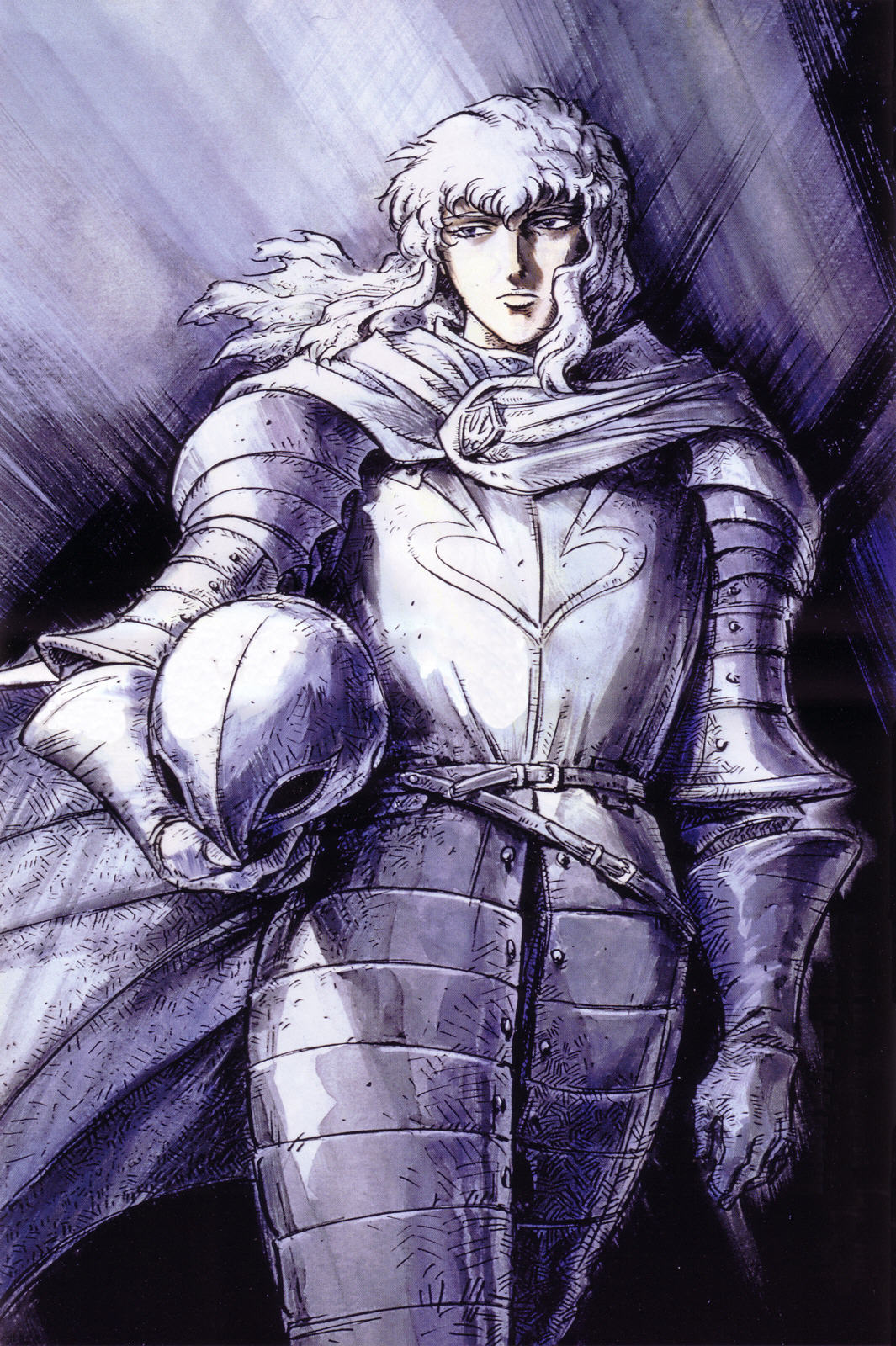
Widely considered to be the most evil character in the series, or at least holding the record for the worst thing to have been committed in it. But since his return to the physical world, his presence has been nothing but a boon on humanity, and his part of the story is nothing but an endless parade of heroic rescues and noble liberation. So far, anyway. Everyone is assuming his ultimate motivation can't be good, but his main goal from the beginning of the series (getting his own kingdom) has been achieved, and the point which the story is at now he seems nothing but a kind, wise and good ruler.


As you might guess from his creep-tastic stare in that picture, this guy is nothing but a piece of shit. A completely rotten,
irredeemable, reprehensible socio-and psychopath with no moral compass, no capacity of empathy, and no other goal in life except pillaging, raping and pleasure at the expense of others. But since his ambitions are limited, so is his capacity for evil. This guy will never lead a genocide or a tyrannical kingdom with an iron fist.
Here we have another case of intent vs. action. One has the capacity, and demonstrated willingness, to cause suffering on a massive scale, but seems to be acting ultimately out of noble motivations, while the other has nothing behind the surface but malice, but is limited in his capacity for acting it out.

Discuss!
 

Wrex Brogan

New member
Jan 28, 2016
803
0
0
Depends on the actions (not a lot of ways to have a 'good' Genocide, for example) but intent tends to be the 'Evil' indicator. Even the most noble of actions gets twisted and polluted if the intent behind them is manipulative/malicious/sadistic.

That said, a combination of the two tends to be important for the character to have any weight to them - someone with evil intent but none of the actions can often come across as pathetic rather than sinister, while a character with noble and good intentions who commits horrendous actions can be just as horrifying as a villainous character. 'I did what I Had To Do/The Ends Justify The Means' aren't tropes that get associated with good and pure characters often for a reason.

(and then you get things like individual universe rules that can throw everything around - Virus-bombing a planet so that no life can exist there might seem like a horrendous act of mass-murder in the Mass Effect Universe regardless of intent, but in Warhammer 40K that's considered someone's day job.)
 

happyninja42

Elite Member
Legacy
May 13, 2010
8,577
2,994
118
I lean more towards actions. You can have bad intentions but never act on them. And you can have bad intentions that end up having positive outcomes. For example, you decide to start a charity organization to help millions of people in need, but you do it for tax evasion purposes without really caring about helping anyone. Or you do it for ego stroking. Either intention has a net positive result.

As others have pointed out, actions are far less ambiguous. Killing an entire group of people is rarely a good action, no matter the reason.

So I go more with actions.
 

Goliath100

New member
Sep 29, 2009
437
0
0
I think the headline need to be changed because the interesting/intended question seems to be Intended Evil on a Small Scale vs Necessary Evil on a Large Scale.
 

Silentpony_v1legacy

Alleged Feather-Rustler
Jun 5, 2013
6,760
0
0
Oh actions, no doubt. Who is more evil, Stewie who intends to conquer the world, kill his mother, and whatever, but just spends all his days make pseudo-gay jokes and fucking a teddy bear, or Eric Cartman who made a dude eat his own parents?

Actions.

Same reason someone who intends to be good isn't as good as someone who acts good.
 

PainInTheAssInternet

The Ship Magnificent
Dec 30, 2011
826
0
0
inu-kun said:
Kinda like comparing Hitler to Stalin,
If you want a contrast, I'd say between Hitler/Stalin and a cannibal serial killer like Jeffrey Dahmer. One was very distanced from the act of killing but killed millions upon millions, the other killed a few but it was very personal and depraved. Of course, that's just asking which one is more evil.

OT:

If you intend to do harm but prevent doing it, I'd say you're evil trying to be good. If you intend good but keep doing evil things, I'd say your intent doesn't matter.
 

cthulhuspawn82

New member
Oct 16, 2011
321
0
0
I dont really believe in objective morality, so I wouldn't call anyone good or evil. With that in mind, I would say actions are all that matter. Although, someones intent might be relevant in predicting future actions.
 

Canadamus Prime

Robot in Disguise
Jun 17, 2009
14,331
0
0
The problem with a question like this is that good and evil are often hard to quantify and are never as cut and dry as they are in children's cartoons from the 80's. Sometimes "evil" actions are necessary because there is no other option, or rather the alternative is even worse. Would you call the person who has to make such a decision "evil?"
 

09philj

Elite Member
Legacy
Mar 31, 2015
2,154
950
118
Actions can only be judged within the context of their intent. The end may or may not justify the means.
 

Saltyk

Sane among the insane.
Sep 12, 2010
16,755
0
0
Well, evil can be hard to define in many ways. I think it's like porn. It's kinda hard to describe, but you know it when you see it.

For example, I'd say that most people would say that as a general rule, killing people is wrong. Seems pretty simple and straight forward.

However, what if you're killing a murderer? Someone who is a real a present risk to others. Is that evil?
What if you're killing someone who is suffering to put them out of their misery? Is it evil to give them that peace and let them end their life on their own terms?

Those may not be so easy to answer. And yet, does that make the original stance that killing people is wrong incorrect? I don't think it's as easy as saying that intentions matter or that actions are the key factor.

Let's say that I save a million people. Let them go on to live happy and productive lives. And even make sure that they, and their progeny, are secure after the fact. But what if my intentions are that I want to rule those people and be given their praise? I'm not acting for some sort of good will or philanthropy, but to fulfill my own narcissism and gain power for the sake of having power which I have no intention of sharing or giving up.

Am I good or evil?

Let's say that I kill an entire civilization. Eradicate them all. Down to the women, children, and even the animals. Erase every trace of their people. Figuratively, and perhaps literally, salt the Earth so that nothing will ever rise again. But those people were dedicated to killing all other people. That they wanted to kill and destroy everyone here and that we care for. And that the only way to protect everyone from dying a violent death was to exterminate those threats.

Am I good or evil?

I think the answer is that it's a complicated dance of intentions and actions. And that there is no simple answer. A person can do terrible crimes for a noble reason. Likewise a person can do great things for greedy and conceited purposes. The road to Hell just as easily be paved with good intentions as the road to Heaven can be paved with bad intentions.

In works of fiction, the most evil villains are those with evil intents and actions. A villain that performs evil for noble reasons or one that performs good for vile reasons are each sort of equal in my mind. They're simply villains in different ways. But I'd say that performing evil to do good is a lot more understandable and relatable in my book.
 

JohnZ117

A blind man before the Elephant
Jun 19, 2012
295
0
21
Actions are just actions, they can be anything. Context is what gives meaning, morality. Killing can be an act of murder, or an act of defense or mercy. Cannibalism can be a desperate act of survival or ... Sex is an action, as well, but when one ignores refusal of consent, then it becomes rape. Intent is what helps give context, morality.
 

Trunkage

Nascent Orca
Legacy
Jun 21, 2012
9,635
3,260
118
Brisbane
Gender
Cyborg
PainInTheAssInternet said:
inu-kun said:
Kinda like comparing Hitler to Stalin,
If you want a contrast, I'd say between Hitler/Stalin and a cannibal serial killer like Jeffrey Dahmer. One was very distanced from the act of killing but killed millions upon millions, the other killed a few but it was very personal and depraved. Of course, that's just asking which one is more evil.

OT:

If you intend to do harm but prevent doing it, I'd say you're evil trying to be good. If you intend good but keep doing evil things, I'd say your intent doesn't matter.
Maybe another example is Mao's (I cant remember the name) program, where he wanted to industrialise China and set up factories for farmers to go to. Killed millions through starvation. Doing good with evil results.

There's something I learnt from economics called the Bootlegger and Baptist problem. Its a commentary on Prohibition. In the 1800s, there were huge problems with domestic violence hence particularly women wanting the change laws on alcohol, but organised crime was able commandeer the situation to their own purposes. Was prohibition evil because it caused more death? Maybe, but then a large portion of the population wanted it - it wasn't a dictator. Perhaps the evil is spread out. That's also not taking into consideration what evil was happening before. Many women still have to pay the price of alcoholics.

Another case child beggars in places around India. Westerners in particular give them money because they are in a dire situation. But they are being handled by an adult who wants to make money (usually not a parent). To get more sympathy, and more money, these adults will cut limbs off the child to make them more worthy of donation. So many people think that we shouldn't give money to these children to save them from amputation. The problems is that if they don't get money, no one will care for them and they will die. Are you more evil, if you donate, because you are damaging a child or if you don't donate, you possibly killing the child.

Sorry its not about "bay guys", this is more about understanding the term evil.
 

breadsammich

New member
May 5, 2011
132
0
0
I really dislike using the term evil in any context except fiction. Even calling Hitler evil is a mistake in my opinion because it completely writes off all the circumstances and motivations that led him to do what he did, which makes it more likely to happen again. Calling a person or group "Evil" is almost giving them a pass. Not in the sense that you're condoning what they did but more that you are saying, "oh, there's no way to stop people from being like that, they're just evil".

I feel like maybe there's a better way to say all that, but so much of it seems contradictory that wording it well becomes difficult.
 

Frankster

Space Ace
Mar 13, 2009
2,507
0
0
breadsammich said:
I really dislike using the term evil in any context except fiction. Even calling Hitler evil is a mistake in my opinion because it completely writes off all the circumstances and motivations that led him to do what he did, which makes it more likely to happen again. Calling a person or group "Evil" is almost giving them a pass. Not in the sense that you're condoning what they did but more that you are saying, "oh, there's no way to stop people from being like that, they're just evil".
I heartily agree with this and also add that on the flipside, once people consider themselves "good", they feel like they get a free pass for everything. Good vs Evil dichotomy is so retarded, people tend to be much more complex then that, or at least i'd like to think so..


Anyways on topic:
I'm actually going to argue for intent mattering more then actions. Maybe i'm biased cos i'm used to doing things that appear bad in the eyes of others, but my intentions had a selfless motive behind them (i.e: i take the fall for a friend over something they did, so i end up looking bad and guilty, in the eyes of others my actions damned me, but they do not know my intent so draw the incorrect conclusion).

We are not talking about positive effects after all, but what makes a character "evil" or shall we say.

A torturer psycho rapist who just happens to trip on a rock that releases a spirit that brings about world peace and cures everyone of their problems isn't a "goodie" anymore then an innocent pure hearted selfless soul who trips on a rock and releases an EVIL spirit that kills everyone in horrible ways isn't evil.
 

Tsun Tzu

Feuer! Sperrfeuer! Los!
Legacy
Jul 19, 2010
1,620
83
33
Country
Free-Dom
Intention translating into action.

Maliciousness.

Someone just...wanting to or feeling like being a dick, as folks here have already pointed out, is in no way comparable to actually doing shit.

Being truly evil is just putting your money where your mouth is. Less talking, more whipping it out and fucking the world in every available orifice.
 

Frankster

Space Ace
Mar 13, 2009
2,507
0
0
LostGryphon said:
Being truly evil is just putting your money where your mouth is. Less talking, more whipping it out and fucking the world in every available orifice.
I..need an adult?

Seriously i'm stealing that quote xD
 

Bobular

New member
Oct 7, 2009
845
0
0
I personally think that if two people commit the same level of evil then it is the one who did it with evil intentions that is the most evil.

Example 1
Light from Death Note kills loads of people but he does it to make a better world (at least that's how it starts). He's still evil for his actions but he's not as evil as say The Major from Hellsing who kills people because he likes to.

Example 2
Lordgenome from Gurren Lagaan may be an evil overlord who set up a whole system to keep Humanity opressed, but he thinks he's doing it for Humanity's own good as opposed the more evil Frieza from Dragonball Z who conquered planets because he could.
 

ghostrider9876

New member
Aug 5, 2011
66
0
0
Saltyk said:
Let's say that I save a million people. Let them go on to live happy and productive lives. And even make sure that they, and their progeny, are secure after the fact. But what if my intentions are that I want to rule those people and be given their praise? I'm not acting for some sort of good will or philanthropy, but to fulfill my own narcissism and gain power for the sake of having power which I have no intention of sharing or giving up.

Am I good or evil?

Let's say that I kill an entire civilization. Eradicate them all. Down to the women, children, and even the animals. Erase every trace of their people. Figuratively, and perhaps literally, salt the Earth so that nothing will ever rise again. But those people were dedicated to killing all other people. That they wanted to kill and destroy everyone here and that we care for. And that the only way to protect everyone from dying a violent death was to exterminate those threats.

Am I good or evil?

I think the answer is that it's a complicated dance of intentions and actions. And that there is no simple answer. A person can do terrible crimes for a noble reason. Likewise a person can do great things for greedy and conceited purposes. The road to Hell just as easily be paved with good intentions as the road to Heaven can be paved with bad intentions.
QFT.

This right here says it all. What makes a character evil is a *combination* of their intents and actions, and it's highly situational. And there can be layers upon layers. For instance:

Sir William murders his master King John, who was generally beloved and benevolent, in cold blood. That's evil.
But in secret, John was a major figure in a cult attempting to raise an ancient evil god, and the public good stuff was to trick people into not suspecting him. So William had noble reasons for his actions, and killed an evil man.
Except John was actually a double-agent, infiltrating the cult in his kingdom to bring it down from the inside. So now William's actions have prevented John from stopping them, so they can resurrect their evil deity. Now William has done something very bad.
But wait! The cult was wrong about the nature of their deity. Angry at being summoned, it slaughters them all and destroys their legacy, so a bunch of horrible people die and nobody can ever rebuild the cult. So it's a net positive.
So now, was William's action good or evil? What about John's?

It's a weird example just off the top of my head, but you get my meaning.
 

sageoftruth

New member
Jan 29, 2010
3,417
0
0
inu-kun said:
Kinda like comparing Hitler to Stalin, both are unimaginably evil and the answer "who is worse" depends heavily on where you came from rather than an actual metric.

While it heavily depends on circumstances, I'd say the person who is more evil is the guy doing it for "noble goals". Because in real life the solution to a problem is rarely completely one way, and a person committing genocide "for the greater good" is a bigger piece of shit than a murderer because at least the murderer knows he is a piece of shit.
That logic doesn't seem to resonate with me. Someone who refuses to acknowledge that he's doing evil things (note, I'm just using "evil" for discussion purposes here) is definitely insufferable, but I don't think that makes him more evil. If he needs to use mental gymnastics to delude himself into believing he's the good guy, then it shows that he has a conscience, which comes across as far less evil than some sociopath who openly embraces his evil side. If the delusion was stripped away, only the hypocrite would stop committing acts of evil.

Of course, good causes can enable some people to do far worse things, since it serves as a mental justification for their actions. Still, if we're talking about two people who are both doing equally bad things, then I think the person who's lying to himself to avoid cognitive dissonance would be the better of the two, simply because he's faced with that cognitive dissonance in the first place.
 

FalloutJack

Bah weep grah nah neep ninny bom
Nov 20, 2008
15,485
0
0
Not that I give a damn about Witcher series, but the answer is yes. See, intent is important, but doing something horrible and then claiming good intentions seems like bullshit, especially as you scale up the disaster.