In his
Oval Office address on Wednesday,
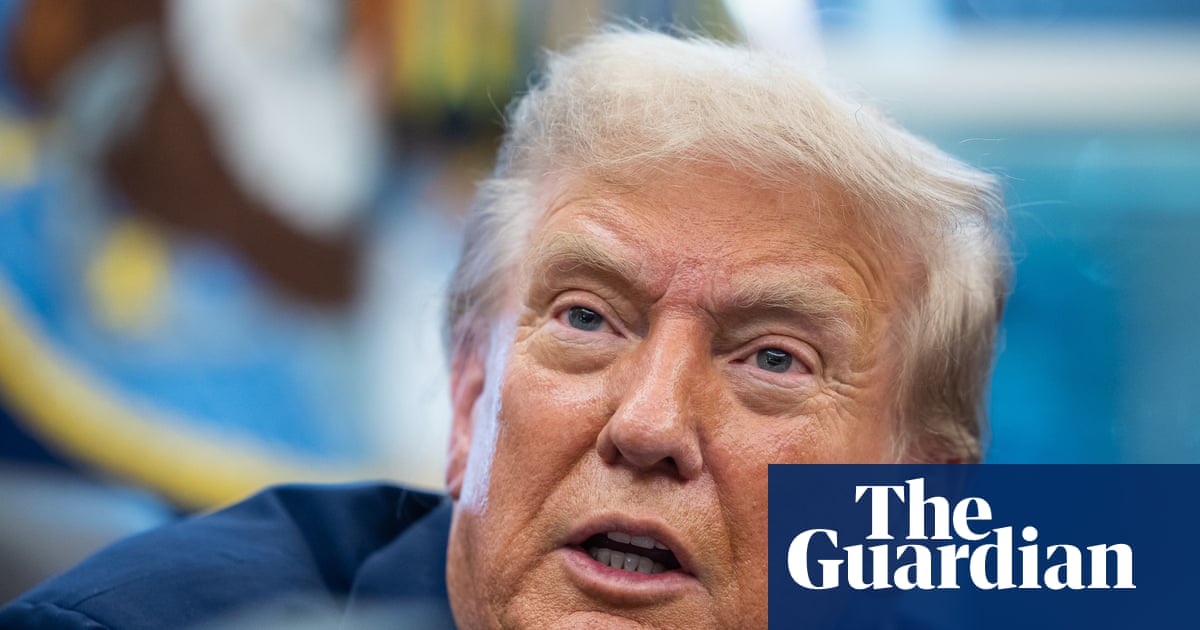
Donald Trump sought to blame the “radical left” for
Charlie Kirk’s killing while the shooter’s identity and motivations remained unclear. Trump promised an unspecified crackdown that could also target “organizations” that he claimed contributed to political violence.
Trump’s speech underscored an aggressive effort to pin the attack on the left while ignoring his own role in fomenting politically motivated violence.
On Thursday morning, the Wall Street Journal
reported, citing an internal document and one source close to the investigation, that the ammunition inside what federal law enforcement believes is the weapon used in the shooting was engraved with “expressions of transgender and antifascist ideology”. But law enforcement officials have not identified a suspect in the shooting, nor have they made any statements about a potential motive.
‘We are in a war’: rightwing media vow retribution for Charlie Kirk killing
Read more
Sitting behind the Resolute desk on Wednesday, Trump nonetheless said: “Those on the radical left have compared wonderful Americans like Charlie to Nazis and the world’s worst mass murderers and criminals. This kind of rhetoric is directly responsible for the terrorism that we’re seeing in our country today, and it must stop right now.
“It’s long past time for all Americans and the media to confront the fact that violence and murder are the tragic consequence of demonizing those with whom you disagree day after day, year after year, in the most hateful and despicable way possible,” Trump added.
That runs contrary to the bulk of the president’s rhetoric over the past several years. On the campaign trail, Trump said that it was impossible to get along with political rivals.
“These are horrible people. Oops, we should get along with everybody. They’re horrible people. Some people you just can’t get along with,”
he said in the final days of the 2024 presidential campaign.
Trump has used
dehumanizing rhetoric against immigrants and frequently accuses his political rivals of crimes, including Barack Obama, whom he accused of
“treason” in July.
“Coming together is what we ought to be doing. Not pointing fingers of blame,” Chuck Schumer, the top Democrat in the US Senate, said on Thursday.
“This moment requires leadership that brings the American people together as opposed to trying to further divide us,” said Hakeem Jeffries, the Democratic leader in the US House. “Political violence in any form against any American is unacceptable, [and] should be denounced by everyone.”
During
the 2016 campaign, Trump encouraged violence against protesters at his rallies. “I’d like to punch him in the face,” Trump said at a 2016 rally in Las Vegas. “You know what they used to do to a guy like that in a place like this?” he went on. “They’d be carried out on a stretcher, folks.”
skip past newsletter promotion
Sign up to This Week in Trumpland
Free newsletter
A deep dive into the policies, controversies and oddities surrounding the Trump administration
Enter your email address
Privacy Notice: Newsletters may contain information about charities, online ads, and content funded by outside parties. If you do not have an account, we will create a guest account for you on
theguardian.com to send you this newsletter. You can complete full registration at any time. For more information about how we use your data see our
Privacy Policy. We use Google reCaptcha to protect our website and the Google
Privacy Policy and
Terms of Service apply.
after newsletter promotion
Again framing political violence as something caused by the left, Trump’s list omitted examples in which Democrats were targeted with political violence. He did not mention the
Democratic Minnesota lawmakers shot earlier this summer, one of whom was killed. Trump also did not mention
an arson attack on the Pennsylvania governor’s mansion, currently occupied by the Democrat Josh Shapiro, and a recent shooting in which
a police officer was killed at the headquarters for the Centers for Disease Control and Prevention in Atlanta.
In his remarks on Wednesday calling for an end to charged rhetoric, Trump also glossed over how Kirk’s speech was often incendiary. “Charlie Kirk traveled the nation, joyfully engaging with everyone interested in good-faith debate,” the president said. “On campuses nationwide, he championed his ideas with courage, logic, humor and grace.” He didn’t mention how Kirk had called for people he disagreed with
to be deported, called Martin Luther King Jr
“awful”, endorsed the racist
great replacement theory that immigrants will replace white Americans, and decried empathy. “I can’t stand the word ‘empathy’, actually. I think empathy is a made-up new age term that does a lot of damage,”
Kirk said in 2022. He also recently
tweeted, “Islam is the sword the left is using to slit the throat of America,”
and said last year that “Democrats “stand for everything God hates”.
In his Oval Office address, Trump said: “My administration will find each and every one of those who contributed to this atrocity and to other political violence, including the organizations that fund it and support it, as well as those who go after our judges, law enforcement officials and everyone else who brings order to our country.”
There’s no evidence yet that anyone was involved in Kirk’s murder beyond the shooter, but Trump’s comments show an eagerness to clamp down on
civil society groups. Trump has also attacked judges who have ruled against him, prompting them to face
a wave of threats and harassment. Trump also issued a blanket pardons to those involved in the attack on the US Capitol on 6 January 2021, including those who attacked police officers.
Trump went on to list a series of examples in which
Republicans were targeted with political violence. “From the attack on my life in Butler, Pennsylvania, last year, which killed a husband and father, to the attacks on Ice agents, to the vicious murder of a healthcare executive in the streets of New York, to the shooting of House majority leader Steve Scalise and three others, radical left political violence has hurt too many innocent people and taken too many lives,” he said. There is no evidence that Trump’s would-be assassin in Butler had political motivations.



 www.foxnews.com