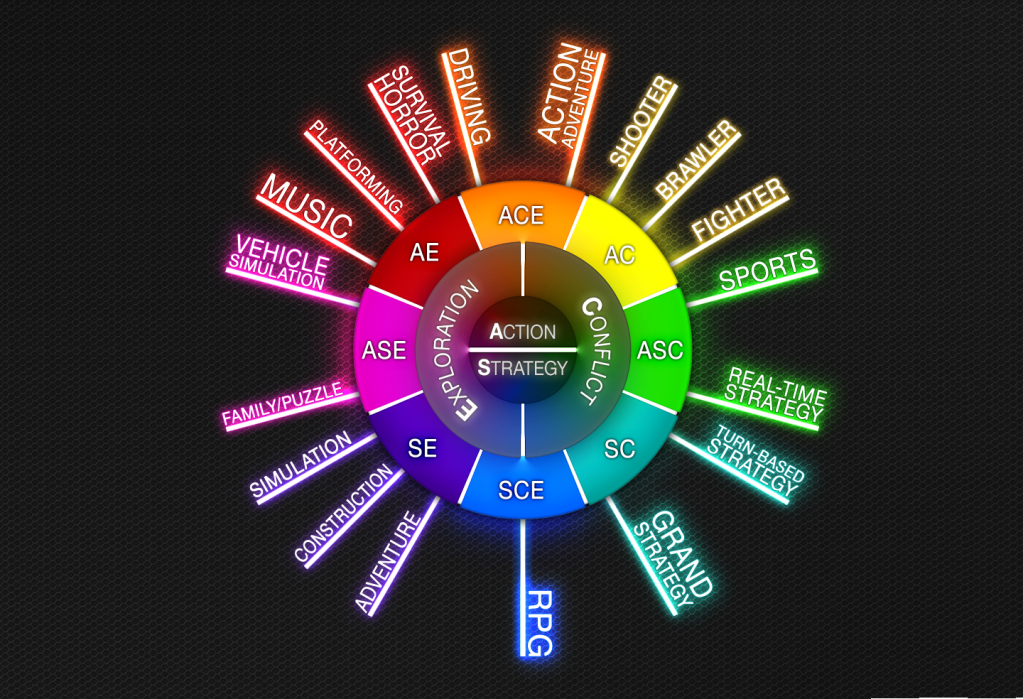
Indeed, AE sounds fair. The issue is that it should be as far as possible on the A side of the A/S axis, since music games have (almost) no strategy element. But you can't do that without sacrificing the E/C distinction, so I'm really just providing an example for my first point.Delusibeta said:I don't follow. Music games are in Action/Exploration, which seems fair.coolguy5678 said:(I'm also not sure why you put music games where you did. Take Guitar Hero - ignoring Star Power, it's entirely devoid of strategy. The game literally tells you what the optimum set of input is.)

283: Introducing The Escapist's Genre Wheel
- Thread starter Russ Pitts
- Start date
Recommended Videos


To those who are "seeing problems" (i.e. action-RPG), I don't see any problems identifying something as action and RPG at the same time. Comma separated, of course. If you want just one of them, find the dominant genre and call it that dominant genre X plus-some-elements-of-Y.

Hmmm. An interesting notion though it causes me a few personal conflicts about how things fit.
Where would you place the Legend of Zelda for instance?
It's commonly considered an RPG or an Action Adventure game depending on who you ask, but it's main gameplay features revolve around solving environmental puzzles and fighting things. (although, to be fair, bosses are also often puzzles of a sort, but you still need quite good reflexes.)
The contradictions a game like this presents would lead towards trying to shift it towards the middle of opposing areas.
Further, while you might be able to group certain things together as being similar, this too presents problems when I consider my own tastes;
What am I to make of liking platformers, but disliking survival horror?
Or finding Real time strategy OK, while hating sports games?
In fact, going through how all the existing genres supposedly fit onto this system, it strikes me how many supposedly closely related game styles there are where I quite like one type, but dislike the other.
Then again, while I have preferences, and certain types of thing that I dislike, I play just about anything in the end, so I guess what turns me off about a game has little to do with it's genre.
Where would you place the Legend of Zelda for instance?
It's commonly considered an RPG or an Action Adventure game depending on who you ask, but it's main gameplay features revolve around solving environmental puzzles and fighting things. (although, to be fair, bosses are also often puzzles of a sort, but you still need quite good reflexes.)
The contradictions a game like this presents would lead towards trying to shift it towards the middle of opposing areas.
Further, while you might be able to group certain things together as being similar, this too presents problems when I consider my own tastes;
What am I to make of liking platformers, but disliking survival horror?
Or finding Real time strategy OK, while hating sports games?
In fact, going through how all the existing genres supposedly fit onto this system, it strikes me how many supposedly closely related game styles there are where I quite like one type, but dislike the other.
Then again, while I have preferences, and certain types of thing that I dislike, I play just about anything in the end, so I guess what turns me off about a game has little to do with it's genre.


I think people are focusing far too much on the words on the outside of the graph. I'd say that they're there simply for one reason: clarification. They are for a general sampling of games of that genre.
In that light, many of the problems being discussed simply become problems of deciding where on the wheel certain games fall. The genre titles can be viewed more as guidelines.
Next, cross-genre games. If you aren't going to (effectively) ignore the genres on the outside of the graph, then decide which parts the game is based on, and go from there. Even in that case, there will always be games that defy this chart. There will never be a perfect chart, but this is a one of the better ones.
Anyway. If we view this from a mildly art perspective, you've got to remember that complementary colors make brown when combined. Make of that what you will. Next, colors nearby to each other can clash horribly when placed next to each other. Just because you like one game doesn't mean you're bound to like similar games. In fact, they game you dislike may have elements that you liked in the other, but either don't quite fit with the one you do like or you just hate it.
The last way I'd say you can use this chart is not to assign games around the outside, but give them varying distances from the center. For instance, a game that is equal parts of all 4 would go straight in the middle (minecraft has been given as an example.)
I'm gonna stop now. If you want more of my opinion, ask.
In that light, many of the problems being discussed simply become problems of deciding where on the wheel certain games fall. The genre titles can be viewed more as guidelines.
Next, cross-genre games. If you aren't going to (effectively) ignore the genres on the outside of the graph, then decide which parts the game is based on, and go from there. Even in that case, there will always be games that defy this chart. There will never be a perfect chart, but this is a one of the better ones.
Anyway. If we view this from a mildly art perspective, you've got to remember that complementary colors make brown when combined. Make of that what you will. Next, colors nearby to each other can clash horribly when placed next to each other. Just because you like one game doesn't mean you're bound to like similar games. In fact, they game you dislike may have elements that you liked in the other, but either don't quite fit with the one you do like or you just hate it.
The last way I'd say you can use this chart is not to assign games around the outside, but give them varying distances from the center. For instance, a game that is equal parts of all 4 would go straight in the middle (minecraft has been given as an example.)
I'm gonna stop now. If you want more of my opinion, ask.



What about the so-called "action rpg" genre, where a very well designed game can find itself squarely in the middle of strategy, exploration, conflict and action?
Though, that may explain why most action rpgs tend to feel incomplete in some aspects.
Otherwise I found it quite comprehensive; a good, logical look at where relative games seem to fit in. I find myself in a bit of everything on the wheel, as well as wondering why the action/conflict hemisphere is the only one that tends to be recognized as "video game" by people outside of the "gamer" group. They'll still recognize that others within the circle as games, but if asked to define games through a frame of reference, most people will think first and foremost of halo, call of duty and gears of war (assuming they recognize these titles). Why is it that those games define the industry to outsiders more than civilization, mass effect, silent hill, dragon age, gran tourismo, the sims, guitar hero and even wii sports?
Though, that may explain why most action rpgs tend to feel incomplete in some aspects.
Otherwise I found it quite comprehensive; a good, logical look at where relative games seem to fit in. I find myself in a bit of everything on the wheel, as well as wondering why the action/conflict hemisphere is the only one that tends to be recognized as "video game" by people outside of the "gamer" group. They'll still recognize that others within the circle as games, but if asked to define games through a frame of reference, most people will think first and foremost of halo, call of duty and gears of war (assuming they recognize these titles). Why is it that those games define the industry to outsiders more than civilization, mass effect, silent hill, dragon age, gran tourismo, the sims, guitar hero and even wii sports?

A sound idea.
Odd thing for me though is, what I do and don't like seems to be fairly evenly spread around the entire wheel - which is a bit... disconcerting.
i.e. the Games I like include (but are no means limited to):
- Civilization Series (SC Turn-Based Strategy)
- C&C Pre-Generals (ASC Real-Time Strategy)
- Runescape and the Zelda Series (SCE RPG)
- The Sims 1, 3 (SE Simulation)
- NFS: Shift, Gran Turismo 5 (ASE Vehicle Simulation)
- Mario, Commander Keen (AE Platforming)
- GTA Pre-4, Timesplitters (ACE Driving & Action Adventure?)
I find it odd that my tastes seem to be so evenly spread about the wheel. Infact, the only segment I do not appear to like is AC.
Often when people ask me what games I like, I reply "Games which are fun" - the same with music and film. There are no particular genres that I seem to love over others. I simply enjoy media which I find to be good. True, my what I "like" and what I "dislike" tends to focus more on certain areas, like I would say a large majority of my favourite music resides in 80s rock'n'roll, electronic, pop and classical. But I think that is more down to gravitating toward areas I have most experience in. In most cases where someone highly recommends a game to me and I get it despite thinking it won't be for me, I will like it. Not because of it's particular genre, but simply because it is a good, compelling, enjoyable game. For example, I bought minecraft just to see what the fuss was about - i couldn't really see how it would an enjoyable game, at least for me, but I (after working out what the hell i was supposed to do: note to notch, a tutorial is badly needed) found I thourougly enjoyed the game, simply because it's well designed and fun. And the things not even in beta yet!
Do I just defy the formula with my oddness, or am I missing something?
Odd thing for me though is, what I do and don't like seems to be fairly evenly spread around the entire wheel - which is a bit... disconcerting.
i.e. the Games I like include (but are no means limited to):
- Civilization Series (SC Turn-Based Strategy)
- C&C Pre-Generals (ASC Real-Time Strategy)
- Runescape and the Zelda Series (SCE RPG)
- The Sims 1, 3 (SE Simulation)
- NFS: Shift, Gran Turismo 5 (ASE Vehicle Simulation)
- Mario, Commander Keen (AE Platforming)
- GTA Pre-4, Timesplitters (ACE Driving & Action Adventure?)
I find it odd that my tastes seem to be so evenly spread about the wheel. Infact, the only segment I do not appear to like is AC.
Often when people ask me what games I like, I reply "Games which are fun" - the same with music and film. There are no particular genres that I seem to love over others. I simply enjoy media which I find to be good. True, my what I "like" and what I "dislike" tends to focus more on certain areas, like I would say a large majority of my favourite music resides in 80s rock'n'roll, electronic, pop and classical. But I think that is more down to gravitating toward areas I have most experience in. In most cases where someone highly recommends a game to me and I get it despite thinking it won't be for me, I will like it. Not because of it's particular genre, but simply because it is a good, compelling, enjoyable game. For example, I bought minecraft just to see what the fuss was about - i couldn't really see how it would an enjoyable game, at least for me, but I (after working out what the hell i was supposed to do: note to notch, a tutorial is badly needed) found I thourougly enjoyed the game, simply because it's well designed and fun. And the things not even in beta yet!
Do I just defy the formula with my oddness, or am I missing something?


I really, really like this. I think the "genre-defying" games don't necessarily break it, either. Rather, it allows you to look a little more closely at the game. It may also create and interesting situation where the player determines the genre by their own interests: if the game could be on either side of the wheel with equal validity, then the focus that is more important to the player will be the one they identify as dominant. Maybe not the definitive genre chart for this reason, but definitely an effective and useful one.
(And depending on how relative you think the truth is, maybe it is definitive)
(And depending on how relative you think the truth is, maybe it is definitive)

I do think many games can go in several genres, action rpg, survival horror puzzler etc.
Also as a puzzle game geek, little disapointed that puzzle and family are in the same section...
As always though really truely impressed by the level of debate on the escapist. Keep it up everyone.
Also as a puzzle game geek, little disapointed that puzzle and family are in the same section...
As always though really truely impressed by the level of debate on the escapist. Keep it up everyone.

Awesome job. I'm sure I'll argue more when I'm not coming off a 6 hour dwarf fortress bender....

Conflict vs exploration and action vs strategy are good dimensions for comparing games.
When you put them on a circle however, only pure action or strategy games appear to allow a blend of conflict and exploration.
I reckon it would have worked better on a 2 dimensional chart.
Finally, when a game clearly belongs to an established genre like a shooter or diablo clone, then it's still more informative to call it a shooter or tpl, than an A-C.
When you put them on a circle however, only pure action or strategy games appear to allow a blend of conflict and exploration.
I reckon it would have worked better on a 2 dimensional chart.
Finally, when a game clearly belongs to an established genre like a shooter or diablo clone, then it's still more informative to call it a shooter or tpl, than an A-C.
Hmm. Fair enough. I think when I wrote this, I wasn't working off how they defined exploration in the article but the more literal definition of exploration, where you explore, rather than being the opposite of direct conflict. I suppose massive clicking to kill enemies is direct conflict, even if it is a simple control, and the difficulty of surviving what is attacking you shouldn't have any bearing on if it is or isn't direct conflict. So environment is actually anything you can't actually "deal with" by directly conflicting with it.econael said:PvZ should be even more to the left of the chart!Nojh said:So I need to disagree with some of your placements. I can't see how Plants vs Zombies has any real exploration elements. I could see how someone might consider the zombies to be "surviving the environment" but is that really exploration or is it simply just conflict?
You're seldom actively in conflict with the zombies, mostly you're focusing on placing the plants, battling with lack of space, fog, barren terrain and the *type* of zombies, but rarely single zombies. They're mostly stacked up on each other and you don't pay much attention to them, except if it's a giant and you have to place bombs to kill him, that would be a direct conflict part.
Are you kidding/trolling me?Nojh said:Also I contest your placement of Diablo 2. We call it an action-RPG because back in the day, it was one of the first RPGs to let you walk around and hit things in real time but if you analyze the gameplay, It is mostly all your stats. You move and you click a lot, occasionally hitting other buttons to fire off different more complicated abilities. In otherwirds you have a mostly indirect influence on what is happening on the screen. Diablo is also all about looking around enviroments and finding loot. Classic exploration. Conflict is where things are a little iffy in my opinion. For the most part all the creatures you find in diablo aren't really in anyway similar to you. They're all "trash" mobs that are pretty much apart of the background and environment. Only a few of the bosses, Diablo in particular, stand out as something that you go toe to toe against, which is why I say it straddles the SE/SCE line. Which would ironically place it more as Adventure or RPG than the ususal "Action-RPG" we call it.
Not having enough real conflict is what most of the Diablo2 clones do wrong.
In D2, you can escape the trajectory of missiles, so can the enemies. Position is imperative. Flash-like reflexes are also.
Trash mobs... Have you been in hell? Hardcore + hell?
Of course when you're 99 and all geared up, most mobs are trash, but on the way to there, there are enough things which can easily kill you in a second or two if you're not paying attention.
Btw, since when do enemies need to be as strong as you? Then you wouldn't be able to kill hordes of them, now where's the fun in that =)
Bosses being toe-to-toe with you? Wtf? They are insanely imba (Duriel) or can 2 hit you (Mephisto, Diablo) if you're not careful and cheese them.
Don't take it personal if it's not true, but you sound like you haven't played much of D2.
Do you know what an Adventure is? Monkey Island. That's an Adventure. Not D2.

So are traps that you can disable direct conflict, or environment?

Thats really clever, hope it becomes accepted as default here on the escapist if not wider spread.
It got me thinking, where would you place action RTS? (or whatever the accepted name for the genre is) games like DotA, HoN, LoL and demigod. They incorporate elements of RTS (beeing based on RTS mods) but instead of controlling the army and base buiilding, you controll only one hero, RPG style where you level up, buy gear and while small compared to real RPGs you still have a skill tree. While you only controll a single unit, it's still highly strategic, and youhave to work as a team.
Exploration/conflict is easy to determine, theres just about as little exlporation as you can get, and you have 2 teams with an equal number highly balanced (hopefully) heroes competing on a symetrical map with even bases and creeps, it's almost pure conflict.
As for teh action/strategy part, it requires split second decisions nd good reaction in order to play well, but at the same time, you the team need to have a plan from the start, many games are more or less won before the actual game starts based on heroes picked by the teams, and how they chose to lane them. IMO it takes a spot between action and strategy.
I just had to ask because i got currious as to where on the chart you'd put it.
It got me thinking, where would you place action RTS? (or whatever the accepted name for the genre is) games like DotA, HoN, LoL and demigod. They incorporate elements of RTS (beeing based on RTS mods) but instead of controlling the army and base buiilding, you controll only one hero, RPG style where you level up, buy gear and while small compared to real RPGs you still have a skill tree. While you only controll a single unit, it's still highly strategic, and youhave to work as a team.
Exploration/conflict is easy to determine, theres just about as little exlporation as you can get, and you have 2 teams with an equal number highly balanced (hopefully) heroes competing on a symetrical map with even bases and creeps, it's almost pure conflict.
As for teh action/strategy part, it requires split second decisions nd good reaction in order to play well, but at the same time, you the team need to have a plan from the start, many games are more or less won before the actual game starts based on heroes picked by the teams, and how they chose to lane them. IMO it takes a spot between action and strategy.
I just had to ask because i got currious as to where on the chart you'd put it.

I think copycatalyst has a good point, and his five point maps do a better descriptive job for gameplay genres.
They also account better for Grand Strategy (and to a lesser extent RTS and TBS, as they tend to have smaller environments), which I don't think you've placed very well. GS games tend to have a significant exploratory component, because they tend to be games of imperfect information (games of imperfect information are ones where any individual player doesn't know everything about the game at once. Poker, for instance, is imperfect information, you know what you have in your hand, you don't know what your opponents have in theirs. Chess is a game of perfect information by contrast, both players can see all of the pieces all of the time.)
Because the player has imperfect information, they need to explore the gameworld in order to fill the gaps in the information they possess, and that's generally an ongoing process because you're exploring a fundamentally dynamic world (your opponents are moving as well as you).
Grand Strategy, and to a lesser extent RTS and TBS have much greater exploratory content than your wheel indicates. And I'd suggest that fighting games have a lot less. They're almost the most "pure" expressions of conflict in a videogame, they're games of perfect information, with nothing left to explore.
They also account better for Grand Strategy (and to a lesser extent RTS and TBS, as they tend to have smaller environments), which I don't think you've placed very well. GS games tend to have a significant exploratory component, because they tend to be games of imperfect information (games of imperfect information are ones where any individual player doesn't know everything about the game at once. Poker, for instance, is imperfect information, you know what you have in your hand, you don't know what your opponents have in theirs. Chess is a game of perfect information by contrast, both players can see all of the pieces all of the time.)
Because the player has imperfect information, they need to explore the gameworld in order to fill the gaps in the information they possess, and that's generally an ongoing process because you're exploring a fundamentally dynamic world (your opponents are moving as well as you).
Grand Strategy, and to a lesser extent RTS and TBS have much greater exploratory content than your wheel indicates. And I'd suggest that fighting games have a lot less. They're almost the most "pure" expressions of conflict in a videogame, they're games of perfect information, with nothing left to explore.