4 Science Mistakes Star Wars: Episode VII Needs to Fix

Recommended Videos

Drathnoxis

I love the smell of card games in the morning
Legacy
Sep 23, 2010
6,509
2,464
118
Just off-screen
Country
Canada
Gender
Male
Thunderous Cacophony said:
But on the other hand, hiding out on a forest moon that doesn't have enough gravity to make humans feel comfy seems like a perfect, non-intuitive place to build a secret Rebel base.
You don't know that, in fact, given evidence shown in the movie it seems to have gravity equivalent to earth. Endor probably has a core of extremely dense material, and also if the base is located on the far side of the moon the planet's gravitational pull would contribute to the force of of the moon's. Also the moon would probably be tidally locked so there wouldn't be any worry of the moon's rotation screwing things up.
 

Piorn

New member
Dec 26, 2007
1,097
0
0
So the original trilogy was basically WW2 in Space, magic swords are an outdated weapon and now everyone uses guns for obvious reasons.
So you'd expect that in the past, fights were more medieval knight based. Maybe have crossbow-like Lasers, with long reload times. But Nope, they had even more guns, making you wonder why lightsabers exist in the first place.

I'm so sick of lightsabers. They're so overused and have completely lost the impact they originally had. A magic sword only works if not Everyone has one.
 

Starbolt-81

New member
Jan 7, 2009
20
0
0
Need to get my nerd on and offer rebuttal on two of these 'mistakes' you refer to.

Mistake 3: Space Fighters Use Aerial Flight Dynamics & Tactics

You are correct regarding the dynamics of space flight of course, but you fail to recognize the tactical considerations of a dogfight in space.

Imagine an X-wing chasing down a TIE fighter, when that TIE fighter suddenly spins on its axis and begins firing back at the X-wing while continuing along on its initial direction.
True, such a thing is possible, but tactically suicidal. Lets not forget that if the TIE fighter were to do this it would be traveling in a straight line at a presumably constant speed for however long it would take to execute a roll to fire on its pursuer, making it a very easy target for the X-wing to light up.

Imagine how many more shots a TIE Fighter can get in on a long, rebel capital ship when it's weapons are pointed at the vessel throughout its entire strafing run.
Again, tactical suicide. Im sure theres nothing the gunners on a capital ship would love more than a target that flew past in a straight and predictable line.

Fighter craft in Star Wars visibly bank, or roll, as they turn in space. So why do Star Wars spacecraft bank? Because it looks good.
Sure, it does look good, but there's surely more to it. Inertia isn't a factor worth considering here, the extended universe novels often mention the existence of a technology known as Inertial dampeners (or acceleration compensators as they sometimes are referred to) which can negate its effects. However when maneuvering in space, especially in a dogfight, it would seem like common sense to roll your ship so that you can get a visual on where you are going and what other objects/ships might be within the vicinity. The X-wing in particular seems to have a fairly large blind spot over its nose section which could undoubtedly obscure a potentially fatal impact. Not to mention pitching and rolling would presumably make you a harder target for your enemy to hit.

Mistake 2. Misused Jargon

A few people have already explained this one in earlier posts quite well, but i feel compelled to expand on it. As far as I know (mostly from reading the EU novels), in the Star Wars universe Hyperspace travel is subject to a number of hazards which need to be avoided:

"Traveling through hyperspace ain't like dusting crops, boy! Without precise calculations we could fly right through a star or bounce too close to a supernova, and that'd end your trip real quick, wouldn't it?"
As I understand, the galaxy is mapped with a vast network of Hyperspace lanes: safe corridors of space that are stable and free of hazards that could potentially endanger a ship. These routes are monitored constantly to ensure safe travel between planets, and generally these routes tend to pass by major systems where trade and commerce make travel profitable (hence why they are sometimes referred to as the hyperspace trade routes). Not only does that make constant monitoring viable, but also makes it possible for governments to police these routes to deter piracy.

With regards to the whole Kessel Parsec debate, it makes sense when you consider that the trade routes aren't always direct, and smugglers in particular are always looking for shortcuts in order to avoid authorities or customs patrols. This carries with it an inherent danger, since the further away from the established routes you go, the greater your risk of running foul of some unmapped asteroid field or black hole.
So, if the Kessel run is a trip from A to B along these hyperspace routes, we can assume that making it in less than 12 parsecs means that Han Solo managed to find a few ways to shorten the trip considerably, either through luck or skill, which would make it boast-worthy.

/end nerd rant :p
 

Gordon_4_v1legacy

New member
Aug 22, 2010
2,577
0
0
Groverfield said:
A fully 3-dimmensional control scheme that would facilitate the ability to perform such maneuvers would require about 9-axis for rotation, as well as probably 6 engine thrusters. I could see someone brain in a jar like greivous able to pilot such a ship, but nothing humanoid or with less than six highly manipulative appendages would work.
Babylon 5 managed it with the Starfury.


ExileNZ

New member
Dec 15, 2007
915
0
0
Rhykker said:
4 Science Mistakes Star Wars: Episode VII Needs to Fix

Sometimes, a science faux pas takes away from a movie. Here are four science mistakes that Star Wars has made in the past that Episode VII can either address or avoid.

Read Full Article
I'm afraid I have to take issue with your sandwich comment. I don't know about you, but for long-distance travel which I have to do myself (driving as opposed to, say, flying), I'm perfectly capable of measuring the time required in sandwiches.Phrases like "This is a 3-sandwich trip" or "Great, I got here in only two sandwiches" are commonplace in my household. This expands into larger units too, because any trip that requires more than 3 or 4 sandwiches will also require water and probably an ice pack, so anything above four sandwiches is a picnic basket (or hamper, or chilly bin, or whatever your local jargon dictates).
 

wooty

Vi Britannia
Aug 1, 2009
4,252
0
0
Do, do we not think that we're over-analyzing a sci-fi fantasy series a wee bit?

I'm sure it was made for entertainment, not for a third year dissertation paper.
 

Angelous Wang

Lord of I Don't Care
Oct 18, 2011
575
0
0
OP said:
So what do midi-chlorians add to the picture, here? They don't explain the Force. They don't have any appreciable impact upon the narrative other than serving as a convenient, quantifiable measure of Force potential. They just raise more questions while making the Force seem a little less fantastical.
Midi-Chorains make perfect sense.

Midi-Chorains are routers.
The Force is the internet, the force user is a PC and the Midi-Chorains are routers that send the PC's data requests to the internet.

---

The Force is a Galaxy wide energy field (seemingly alive because it has all the spirits of the dead people inside it trying to influence the living) that has duel positive and negative energy layers to it (Lightside/Darkside).

Midi-Chorains are able to make the force do things directly. Midi-Chorains also send back certain feedback to the Force users form the force (such as darkside corruption) depending on which energy layer is used.

Force users do not access the force directly, instead they have Midi-Chorains in their body and force users sub-concisely (though Qui-Gon claimed you can do it concisely too) command the Midi-Chorains to make the force do the things they want.

Midi-Chorains access ether the Lightside/Darkside energy layers based on the Force users mental state, if the user is emotional they access the Darkside, if the user is calm they access the Lightside.

After constant use of particular energy layer Midi-Chorains will sort of default to that energy layer (not to say you can?t go back, but it?s just becomes harder to use the other side).
 

Coruptin

Inaction Master
Jul 9, 2009
258
0
0
Midichlorians explain why everyone can't just use the force if they really really believe in their hearts they can.
It also explains why the both chosen ones are genetically related when otherwise it could've been anyone.
I like midichlorians because it makes the Jedi more special. Not everyone can be a Jedi and that's the way it should be.
 

Deimir

New member
Jul 3, 2008
69
0
0
TiberiusEsuriens said:
Rhykker said:
A parsec is a unit of distance equal to 3.26 light-years, or 19 trillion miles. Given the context, and clarified in the Star Wars Extended Universe, the Kessel Run is a well-known smuggling route in space. Someone who has never heard the term "parsec" before would think Han is boasting about the speed of his ship, suggesting that it was able to make the run faster than any other ship. But when we realize that a parsec is a unit of distance, any obvious meaning he was trying to convey becomes muddled. How can the ship complete the run in less distance?
As crazy as it sounds, #2 is not a completely valid complaint. The Kessel Run IS a well-known smuggling route in the Star Wars universe. The reason is because near Kessel is a large cluster of black holes, called the Maw. Needless to say, black holes are very dangerous and should be avoided at all costs, so all ships flying in the area give them a WIDE birth. This is because most people are smart and cautious.

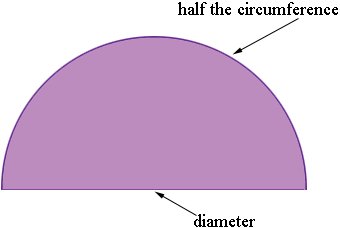
Han Solo is not that smart and certainly not cautious. Instead of flying the long way around the Maw (along the circumference) he obtained a map of the individual holes' gravitational fields and flew through it (across the diameter). This may not be what George Lucas originally meant (point #1, bad writing) but the jargon makes sense. If it weren't for the "Fast ship?" line, Han would not be boasting about speed but his ingenuity in never getting caught.


half the circumference ~= 12 parsecs
diameter < half the circumference
diameter < 12 parsecs
As an addendum to this, another EU novel made the point that a ship can travel deeper into a gravity well without being pulled out of hyperspace by going faster, allowing for a shorter route by trimming even closer to the various black holes in the Maw.

Granted, all of this is pretty much useless now that the EU has officially been set aside.
 

Rhykker

Level 16 Scallywag
Feb 28, 2010
814
0
0
ExileNZ said:
Rhykker said:
4 Science Mistakes Star Wars: Episode VII Needs to Fix

Sometimes, a science faux pas takes away from a movie. Here are four science mistakes that Star Wars has made in the past that Episode VII can either address or avoid.

Read Full Article
I'm afraid I have to take issue with your sandwich comment. I don't know about you, but for long-distance travel which I have to do myself (driving as opposed to, say, flying), I'm perfectly capable of measuring the time required in sandwiches.Phrases like "This is a 3-sandwich trip" or "Great, I got here in only two sandwiches" are commonplace in my household. This expands into larger units too, because any trip that requires more than 3 or 4 sandwiches will also require water and probably an ice pack, so anything above four sandwiches is a picnic basket (or hamper, or chilly bin, or whatever your local jargon dictates).
You are my favorite person.

I want to see a show in which they measure everything with regards to food intake.

"How much time before the bomb goes off?"

"We've only got two sandwiches!"
 

Lightknight

Mugwamp Supreme
Nov 26, 2008
4,860
0
0
Rhykker said:
TiberiusEsuriens said:
Rhykker said:
A parsec is a unit of distance equal to 3.26 light-years, or 19 trillion miles. Given the context, and clarified in the Star Wars Extended Universe, the Kessel Run is a well-known smuggling route in space. Someone who has never heard the term "parsec" before would think Han is boasting about the speed of his ship, suggesting that it was able to make the run faster than any other ship. But when we realize that a parsec is a unit of distance, any obvious meaning he was trying to convey becomes muddled. How can the ship complete the run in less distance?
As crazy as it sounds, #2 is not a completely valid complaint. The Kessel Run IS a well-known smuggling route in the Star Wars universe. The reason is because near Kessel is a large cluster of black holes, called the Maw. Needless to say, black holes are very dangerous and should be avoided at all costs, so all ships flying in the area give them a WIDE birth. This is because most people are smart and cautious.

Han Solo is not that smart and certainly not cautious. Instead of flying the long way around the Maw (along the circumference) he obtained a map of the individual holes' gravitational fields and flew through it (across the diameter). This may not be what George Lucas originally meant (point #1, bad writing) but the jargon makes sense. If it weren't for the "Fast ship?" line, Han would not be boasting about speed but his ingenuity in never getting caught.


half the circumference ~= 12 parsecs
diameter < half the circumference
diameter < 12 parsecs
That's well-put, and when fully explained, it's no longer a mistake. I feel as though the Expanded Universe really addresses a lot of the "issues" with Star Wars, but unfortunately, what's seen in the movies is what's seen in the movies. The audience can't possibly intuit that explanation given what little context was presented.

So in sum... The EU did a great job at making Han's line make sense. But it's still a mistake in the movie, because it doesn't come across like that. I'd be cool with Han giving the explanation you outlined in Ep 7 :)
Eh, the main inconsistency here is in Han's age and the particulars of differences in relative time when traveling that fast. Either you take 40 years to travel that far at light speed or you travel at speeds that make you experience however amount of time it ends up taking as though they were far less time but when you get back home everyone you've ever known is aged those years if they didn't go with you.

The 40 years is just a space holder for anyone who actually does the math on this (12*3.26 light years equals 39.12 years if traveling at the speed of light). But seeing as lore has han doing this twice (a second time with Luke) and no comment regarding age of them and their contemporaries...

Was Chewie with Han on the first run by chance? If so, this also presents a problem with him being in the first movie. Do we know that the falcon is capable of FTL speeds even?
 

artanis_neravar

New member
Apr 18, 2011
2,560
0
0
Rhykker said:
4 Science Mistakes Star Wars: Episode VII Needs to Fix

Sometimes, a science faux pas takes away from a movie. Here are four science mistakes that Star Wars has made in the past that Episode VII can either address or avoid.

Read Full Article
I always just assumed that Qui-Gon was just a little...odd, and that he invented the idea of midiclorians all on his own, an idea that no one else believes. When he mentions Anakin's count to Yoda and Windu they are just sitting there thinking, "oh no not this crap again, just smile and nod and maybe he'll go away"
 

Rhykker

Level 16 Scallywag
Feb 28, 2010
814
0
0
artanis_neravar said:
Rhykker said:
4 Science Mistakes Star Wars: Episode VII Needs to Fix

Sometimes, a science faux pas takes away from a movie. Here are four science mistakes that Star Wars has made in the past that Episode VII can either address or avoid.

Read Full Article
I always just assumed that Qui-Gon was just a little...odd, and that he invented the idea of midiclorians all on his own, an idea that no one else believes. When he mentions Anakin's count to Yoda and Windu they are just sitting there thinking, "oh no not this crap again, just smile and nod and maybe he'll go away"
Best. Explanation. Ever.

Qui-Gon always hit that gin a little too hard.

<img src="http://digitaldeconstruction.com/wp-content/uploads/2012/05/Star-Wars-Alcohol.png"/img>
 

JamesBr

New member
Nov 4, 2010
353
0
0
I think this article makes a mistake in assuming Star Wars is actually Science Fiction and therefore should involve harder science. To quote a TvTropes article:

"It's the story of a farmboy who meets an old wizard, learns magic and swordfighting from him, and then fights an evil wizard and a dark knight. He travels throughout strange lands were he meets monsters, rescues princesses, and....flies a spaceship. Because all this takes place in another galaxy where space aliens fight with laser guns and manual labor is done by robots."

So it's a fantasy story in a science-fictionesque setting. Really the only thing 'science-fiction' about it is space. EVERYTHING else about Star Wars is pure Fantasy. Make the swords out of steel instead of light and change the space-ships into regular ships and you have Standard Fantasy Setting (TM). As such, I'm not really sure these issue "need" to be fixed at all if they are considered acceptable for the fantasy genre.

Besides, space-dog-fights are way more visually interesting than having everyone control like the ship in Asteroids.
 

gunny1993

New member
Jun 26, 2012
218
0
0
There are only certain instances when science needs to be treated properly in fiction

I.e: When the fiction in question is trying to be scientific: I.e if there's a 10 minute explanation into why something is like it is, it should be correct.

Example: Prometheus and the whole fegging plot: Tried to be clever, was factually inaccurate and the plot revolved around these erroneous features.

Example of it being done properly: Event Horizon and the explanation of how the ship worked, this was done perfectly, it didn't try to be clever, just gave an analogy that made sense then never brought it up again.

Nitpicking inaccuracies when they're not important is just anal and the only people who do it are weak ass psudeo-scientists who don't have the skills to do real science where it is needed.
 

Nowhere Man

New member
Mar 10, 2013
422
0
0
Yes! Please keep the half baked science away from the mystical all encompassing Force. Abrams can easily retcon midichlorians out of the way without pretending they were ever mentioned by adding in a line like the following or something similar:

Luke: Midichlorians? But they don't prove anything. Even Master Yoda mentioned to me during my training on Dagobah that he's come to realize they were merely a manifestation of the Force and not the cause of it. He seemed so solemn when he told me this. The Old Jedi Council was well meaning, but made many mistakes in it's time.
 

CaitSeith

Formely Gone Gonzo
Legacy
Jun 30, 2014
5,374
381
88
I agree with #1, but changing the others would do more harm than good. By doing so, Star Wars would become less of a unique fun universe and more of a scientifically accurate generic sci-fi movie. What you are asking is the equivalent of "the Kingdom of the Crystal Skull" for Star Wars (an artifact with mythological divine powers? Nah! Aliens!).
 

geizr

New member
Oct 9, 2008
850
0
0
On mistake #2, there is another way of viewing this that could actually make it a valid statement.

Often in General Relativity, physicists will choose what are known as natural units such that c = 1 and G = 1, c being the speed of light in vacuo and G being the gravitational constant. In natural units, both time and space have the same measure of distance. Even further, is the fact that when talking of trajectories along space-time, one no longer speaks separately of the time it took and the distance traversed. Instead, one only speaks of the proper time (for time-like trajectories with velocities less than the speed of light) or proper distance (for space-like trajectories moving faster than light) measured along the curve one takes through space-time. Both these measures, in natural units, have units of distance, which then one would convert by appropriate multiplications of c and G to get the normal physical units of time and space separately to which we are accustomed. There are special trajectories that have a proper time and proper distance measure of zero. These are the trajectories traversed by light itself.

Different trajectories would have different measures of proper time or proper distance, and would require different velocities at points along the trajectory in order to maintain the trajectory. The measurement of the proper time/distance along the trajectory is obtained by integrating the metric along the trajectory. In normal flat space-time, with normal physical units, the metric would look like this:

ds^2 = -c^2*dt^2 + dx^2 + dy^2 + dz^2

and in natural units, like this:

ds^2 = -dT^2 + dx^2 + dy^2 + dz^2

In a non-flat space-time, as occurs in the presence of a gravitating body, like, say, a black hole, the metric would be very different, and there would be multiplying functions in front of the square-differentials for each of the coordinates, like so:

ds^2 = -F(T, x, y, z) dT^2 + H(T, x, y, z) dx^2 + K(T, x, y, z) dy^2 + L(T, x, y, z) dz^2

or, even more generally

ds^2 = g_{u,v}*dx^{u}*dx^{v}

where g_{u,v} are the components of the metric and dx^{u} is a coordinate differential dT, dx, dy, or dz. Each of the metric components g_{u,v} can be functions of the coordinates, as prescribed by Einstein's equation,

R_{u,v} - 1/2*g_{u,v}*R = 8*pi*G*T_{u,v}

where R_{u,v} is the Ricci tensor and R the Ricci scalar, both of which define the local space-time curvature. G is the gravitational constant, and T_{u,v} is the stress-energy tensor that defines the distribution of mass-energy.

In general when trying to solve for trajectories through space-time, one finds what is called the geodesic path. This is the path that traverses the shortest distance of proper time/distance through the space time. According to General Relativity, the most natural and easiest path for an object to follow through space-time would be the geodesic. Any other path would require applying a real force (here's a shocker: gravity, in General Relativity, is NOT a force at all) to resist the object's tendency to follow a geodesic path from wherever it happens to be. For a flat space-time, the geodesic is to proceed in a constant direction at a constant velocity. In a gravity environment, the geodesic is to accelerate toward the gravitating body (I think you can guess where this is going!).

In an environment such as the Maw, the space-time would be severely warped and contorted, and the geodesic paths would very likely be ones that take you straight into one of the black holes. However, if you can sidle up close to a geodesic and just barely miss being on it, you can traverse the region along a near optimal path without falling into one of the black holes. The closer you are to this optimal path, the shorter your proper time/distance measure will be along the trajectory you follow, approaching the proper time/distance measure along the geodesic itself. Now, if you are measuring the proper time/distance along the trajectory you follow in natural units, then you could easily speak of the distance (i.e. parsecs) traveled along that trajectory, and you want to have a smaller number to be more impressive because it means you got the closest to the geodesic without being on it such to fall into a black hole.

Now, granted, Lucas likely was not thinking of all this; he likely didn't have much known of GR at all other than some dude named Einstein came up with it and E=mc^2. He may have had the whole curvature thing, too, but it's very unlikely he understood the gritty mathematical details. In fact, it is very likely Lucas simply heard the word "parsec" used at some point in the context of outer space and just assumed it was some measure of time because it has "sec" in it (sec = seconds). Even so, it turns out, by lucky accident, that the way he ends up talking about doing 12 parsecs for the Kessel run can, in fact, be valid, but only from a certain point of view.

ADDENDUM: Realized I forgot to make the distinction of proper time and proper distance more clear when working in normal physical units. In normal physical units, proper time and proper distance are related by

ds^2 = -c^2*dK^2

where dK is the proper time differential. In natural units, it would just look like

ds^2 = -dK^2

and time and space become interchangeable as having the same units. So, even Lucas' notation in the novelization of "standard time units" would still be valid under this scheme as long as time-like trajectories are followed through the space-time. For space-like trajectories, one can only validate the statement under natural units.

Of course, we all know what Lucas really meant and the fact he didn't have a clue what he was talking about. But, it still sounds cool, if you're willing to squint your eyes really hard through GR lenses.

 

Ishigami

New member
Sep 1, 2011
830
0
0
I disagree on #3.
Realistic physics in space combat would make it hard to comprehend as the most effective way to evade fire in such a scenario is randomly executed erratic movement.
It would result in sort of a Michael Bay action aesthetic with too much stuff happening at the same time resulting in sensory overload.
The space combat in the prequel trilogy was ass but not because of the ?wrong? physics. It was ass because we didn?t care about the characters and already knew they would be fine anyway.