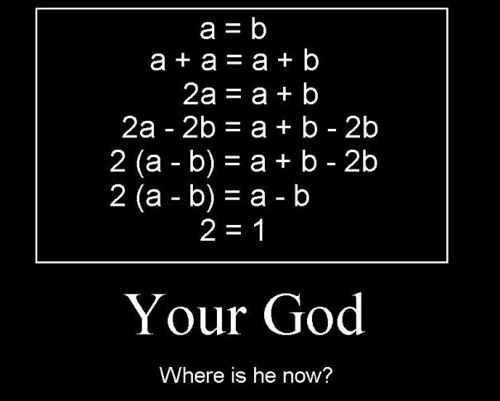
I might have just disproved math.

Recommended Videos

TheMann

New member
Jul 13, 2010
459
0
0
Oh my, a math thread. Let me flex my geek muscles.

For most intents and purposes you cannot divide by 0. This is easily shown by basic algebra. I know a lot of people know this stuff already, but I'll try to be methodical about it.

First let's start with normal division. In order for x/y=z to be true, then algebraically, z*y=x must also be true. For example: 10/5=2. Re-arraigned, 2*5=10, so the original equation must be true.

Now let's see what happens with zero:

In order x/0=y to be true, then y*0=x must also be true. However, for any numerical value this simply cannot happen. Say the statement is made that 7/0=3. In order for this to work then 3*0=7. But this obviously isn't true. 3*0=0, and by extension any value for x in the original statement won't hold up because any value multiplied by 0 will equal 0. Therefore in the case of x/0, wherein x is in the domain of all real numbers (and I'm pretty sure all complex too):

x/0=DNE, with DNE being the infamous mathematical abbreviation for Does Not Exist. You cannot divide by zero.

HOWEVER:

The case of 0/0=x is indeed different, as mentioned by the OP. This, of course, in no way "disproves" mathematics. Here's what happens:

If the statement is made that 0/0=3 then 3*0=0 must be true, and indeed it is.
If the statement is made that 0/0=7 then 7*0=0 must be true, which it also is.
If a completely arbitrary number is used like 0/0=3179.145 this still holds up.
Therefore any value of x fulfills the requirement to be the solution for 0/0=x.

This is not the same as DNE. Since values for x exist that count a solutions, even though it can be anything. 0/0 and any function that reduces to 0/0 is known as an Indeterminate Form. 0/0 is also not the only indeterminate form (inf=infinity because this forum isn't recognizing the symbol for it.) inf/inf also has this property, as well as other function that can be transformed into those two examples such as 0*inf, 1^inf, 0^0 inf^0 and inf-inf.

This comes into play a lot in aspects of differential calculus, particularly with l'Hopital's rule. [http://en.wikipedia.org/wiki/L%27H%C3%B4pital%27s_rule] This can be really freaking useful when evaluating derivatives as it simplifies the process considerably.

Umm, yup. This is me geeking out on math for the hell of it. Brings back memories of MATLAB and caffeine.

 

Zorg Machine

New member
Jul 28, 2008
1,303
0
0
Dividing by zero doesn't work. If we take schrödingers cat as an example: if you open the box and say "nope, the cat is dead. I just disproved quantum fysics." you have completely missed the point.

0/0 does not equal 0. Yes you "proved" that it dies but you completely missed the point that 0/0 is an exception and equals error.
 

spartan231490

New member
Jan 14, 2010
5,184
0
0
Zack1501 said:
So, I have an interesting math based question. If you don't like/hate math or don't understand basic algebra(I understand if you don't) just hit the big THE ESCAPIST logo in the corner and that will bring you home.

I wanted to know zero divided by zero equals. I tried to do at algebraically. This is what I did:

-The answer I was trying to get will be represented by x
0/0=x
-I times both sides by zero
0=0x
-This equals out to be 0=0 because anything times 0 is 0.
-This proves that x can be any number. for example if 5=x than 0=5*0 still is 0=0
-I rearrange 0=0x to be:
0/x=0
-Now since x can be any number now lets say x=0
-That makes this:
0/0=0
-And since x=0/0 (Right in the beginning^) and 0=0/0 also then x=0
-If you fallowed so far and remember that x can be any number then that means zero can also be any and every number. So 0 can now equal 5 or any other number.

I realize something is most likely wrong here.
So tell me escapist, Did i Disprove math?
Edit: I see the error now. Its not that x equals 0 its that at one point x CAN = 0
You can't multiply both sides of an equation by 0 in algebra. that's your problem.
 

Blade1130

New member
Sep 25, 2011
175
0
0
My half-assed way of making my Calc teacher hate me, is to take the limits of indeterminates and claim that's the answer. For instance:

(inf = infinity)
0 / 0 =~ 0.00000000001 / 0.0000000001 =~ 1 (Therefore 0 / 0 = 1)
0 ^ 0 =~ 0.00000000001 ^ 0.0000000001 =~ 1 (Therefore 0 ^ 0 = 1)
0 ^ inf =~ 0.00000000001 ^ 999999999999 =~ 0 (Therefore 0 ^ inf = 0)
inf ^ 0 =~ 9999999999999 ^ 0.0000000001 =~ 1 (Therefore inf ^ 0 = 1)
0 * inf =~ 0.00000000001 * 999999999999 =~ 1 (Therefore 0 * inf = 1)

I'm pretty sure there are answers to these (though I'm probably wrong), since L^Hopital Rule is pretty much an indirect way of solving indeterminates. But whatever, I'm too lazy to do anything with that. It's the weekend.
 

silversnake4133

New member
Mar 14, 2010
683
0
0
So you "disproved" math by doing math? Huh, what a conundrum that is. Dude, math is very versatile, you can work your way around almost anything in math if you know how. Like for instance getting 2+2 to equate to 5. Also, you can't divide by zero at any time what so ever even if the numerator was zero. It just doesn't work like that. And zero is mostly viewed as a place-holder, it doesn't really have a value to it. If anything zero is "the absence of a number" so as long as "x" isn't in the denominator, "x" can equal any number depending on the equation you use it in. This isn't even basic algebra, it's basic math.
 

Melon Hunter

Chief Procrastinator
May 18, 2009
913
0
0
mcnally86 said:
FalloutJack said:
Maze1125 said:
FalloutJack said:
I believe it's fair that I started calling bullshit when we started on imaginary numbers, as though working with ones that actually exist wasn't good enough.
Imaginary numbers are just a name, they aren't actually any more imaginary than the real numbers.
Physicists use imaginary numbers to solve real problems every single day. Without imaginary numbers we wouldn't have the monitors you're using to read the posts people make on this site, they have very real and practical uses.

The same is true of a lot of maths. It may start as someone's "cool idea", but so many many advances in science have come from maths that someone just made up for the hell of it. If mathematicians waited until maths was useful before they came up with it, then our technology would be at least 50 years behind where it is today.
That part was actually a joke, the imaginery VS real bit. However, I'm going to need some citation on the part of you stating that imaginery numbers have an application beyond thought experiment. Since 'i' is literally representing a paradox, and that this is actually the tamest aspect of math acting less like science and more like philosophy, it smacks of carelessness. "We didn't feel like figuring out where this leftover piece of the puzzle actually comes from, so here, have a Lowercase-I." This is where math sort of falls short for me. I understand the logic you place behind it, pass the course, and move on...but it doesn't cry out as the pinnacle of precision anymore. And Discreet Mathimatics is very much this. It's the metaphysics of math that gives way to some interesting thoughts, but it's not logic and it's not science anymore. You follow my meaning, right?
Ham radio operators live off imaginary numbers. A lot of electronic work requiring frequency use triangulation with j. BTW its j now not i. j got the job as the imaginary letter because the i could be confused with other letters used in electronic math. Basically you graph real numbers on the x line of a graph and the imaginary fellows on the y line. I won't explain why because I don't know your background in radio operation but the easiest example is the impedance of a wire carrying a signal can be calculated with the help of algebra and imaginary numbers.
Mathematicians use i, engineers use j. J is used in engineering because i already denotes electrical current. As a lot of AC power theory uses complex numbers, you can see how this would otherwise lead to confusion. But i is the normal letter used for the square root of -1.
 

Evil the White

New member
Apr 16, 2009
918
0
0
Zack1501 said:
You never divide by zero. That's what breaks math. Generally in this manner:

5*0 = 0

(5*0)/0 = 0/0

As x/x = 1,

5 = 1

Also, if you ever do any advanced math, then you also learn you can accidentally eliminate possible solutions. Plus there is i, matrices, polar diagrams, and some very weird equations, including Euler's formula.
 

meepop

New member
Aug 18, 2009
383
0
0
Promethax said:
I think you lost all mathematical credibility as soon as you used "times" as a verb.
I think he's doing something perfectly normal, at least in America. Many people say "You times/timesd these numbers". It gets on my nerves, but from what I've seen, they don't realize it's "multiplied".

OT: Good points. I think you did make some errors, though. But I'm not a math teacher.
 

gritch

Tastes like Science!
Feb 21, 2011
567
0
0
Starik20X6 said:
You disproved math? No. This, on the other hand...

Incorrect. In order to get your answer of 2=1 you had to divide both sides by (a-b). And since a=b, a-b=0. You cannot divide by zero.
 

Trivun

Stabat mater dolorosa
Dec 13, 2008
9,830
0
0
Zack1501 said:
So, I have an interesting math based question. If you don't like/hate math or don't understand basic algebra(I understand if you don't) just hit the big THE ESCAPIST logo in the corner and that will bring you home.

I wanted to know zero divided by zero equals. I tried to do at algebraically. This is what I did:

-The answer I was trying to get will be represented by x
0/0=x
-I times both sides by zero
0=0x
-This equals out to be 0=0 because anything times 0 is 0.
-This proves that x can be any number. for example if 5=x than 0=5*0 still is 0=0
-I rearrange 0=0x to be:
0/x=0
-Now since x can be any number now lets say x=0
-That makes this:
0/0=0
-And since x=0/0 (Right in the beginning^) and 0=0/0 also then x=0
-If you fallowed so far and remember that x can be any number then that means zero can also be any and every number. So 0 can now equal 5 or any other number.

I realize something is most likely wrong here.
So tell me escapist, Did i Disprove math?
Edit: I see the error now. Its not that x equals 0 its that at one point x CAN = 0
None of that holds any logical value whatsoever, the amount of logical fallacies present is beyond belief. And they all boil down to your treatment of the number zero as a regular integer, when in fact it is a special integer with various unique properties. The most important one being that you cannot divide by zero. At all. Not even 0/0. So your first statement is untrue, and since you use that as the basis for the rest of your 'theory', the entire theory is also untrue. QED.
 

gritch

Tastes like Science!
Feb 21, 2011
567
0
0
But I've got my own mathematical paradox for you guys. It has been disproven but I can't quite recall how.

0=0, this is correct.
0+0=0 is correct.
Therefore, I can add infinite amounts of zeroes together and the result will equal 0
0=0+0+0+0+... +0n
1-1=0 is correct.
Therefore I can add infinite amounts of (1-1) together and the result will equal 0
0=(1-1)+(1-1)+...+(1-1)n
Since this is addition, I can use the associate property and rearrange the parentheses as thus:
0=1+(-1+1)+(-1+1)+...+(-1+1)n
Since -1+1=0 and this series proceeds to infinity all (-1+1) terms can be reduced to 0, yielding the result:

0=1
 

Vhite

New member
Aug 17, 2009
1,978
0
0
1 = 2
I just made the whole universe twice as large as it was before this post. You, of course, cant see it because you are part of this universe.
I love arithmancy.
 

Blade1130

New member
Sep 25, 2011
175
0
0
gritch said:
Since this is addition, I can use the associate property and rearrange the parentheses as thus:
0=1+(-1+1)+(-1+1)+...+(-1+1)n
Since -1+1=0 and this series proceeds to infinity all (-1+1) terms can be reduced to 0, yielding the result:

0=1
You lost a -1 in using the associative property. If you have:
0 = (1 - 1) + (1 - 1)...

You end up with the same number of 1's as -1's, but when you move the parentheses you need
0 = 1 + (-1 + 1) + (-1 + 1) ... - 1

The way you did it it have a unequal number of 1's and -1's, which is an incorrect associative property use.
 

gritch

Tastes like Science!
Feb 21, 2011
567
0
0
Blade1130 said:
You lost a -1 in using the associative property. If you have:
0 = (1 - 1) + (1 - 1)...

You end up with the same number of 1's as -1's, but when you move the parentheses you need
0 = 1 + (-1 + 1) + (-1 + 1) ... - 1

The way you did it it have a unequal number of 1's and -1's, which is an incorrect associative property use.
That was my knee jerk reaction the first time I saw this too, but the problem is you really can't have an even or odd number of infinite terms. If one thinks of infinity in this case as a series of continuously repeating (-1+1), then yes your argument works but by using mathematics this is difficult to prove. Infinite and zero are odd concepts to humans.
 

Blade1130

New member
Sep 25, 2011
175
0
0
gritch said:
That was my knee jerk reaction the first time I saw this too, but the problem is you really can't have an even or odd number of infinite terms. If one thinks of infinity in this case as a series of continuously repeating (-1+1), then yes your argument works but by using mathematics this is difficult to prove. Infinite and zero are odd concepts to humans.
No, you're misinterpreting what I'm saying. You're doing (1 - 1) to infinity, thus you MUST have the same number of +1's & -1's, an infinite number, but the same infinite of 1's as -1's. The way you did it, you have an extra +1 at the beginning without the -1 at the end to compliment it. You may have an infinite number of (1 - 1)'s, but when you do it that way, you have an extra +1 at the beginning. That's the mistake.

You're saying:
(1 - 1) * inf = 0
which is correct, but when you pull the associative property part you're getting an extra one and changing it to:
(-1 + 1) * inf + 1 != 0

Edit: Holy crap I just realized that when you substitute (1 - 1) with 0, you get 0 * inf = 0 but I just said 2 posts back:

Blade1130 said:
0 * inf =~ 0.00000000001 * 999999999999 =~ 1 (Therefore 0 * inf = 1)
Either I just broke math too, or indeterminites really are indeterminite.
 

Simple Bluff

New member
Dec 30, 2009
580
0
0
gritch said:
But I've got my own mathematical paradox for you guys. It has been disproven but I can't quite recall how.

0=0, this is correct.
0+0=0 is correct.
Therefore, I can add infinite amounts of zeroes together and the result will equal 0
0=0+0+0+0+... +0n
1-1=0 is correct.
Therefore I can add infinite amounts of (1-1) together and the result will equal 0
0=(1-1)+(1-1)+...+(1-1)n
Since this is addition, I can use the associate property and rearrange the parentheses as thus:
0=1+(-1+1)+(-1+1)+...+(-1+1)n
Since -1+1=0 and this series proceeds to infinity all (-1+1) terms can be reduced to 0, yielding the result:

0=1
That's very clever. Unfortunatly though, if you ever study Analysis, you'll find a find a simple (if, frankly, anticlimactic) way of disproving that logic - periodic sums like the one above are always "divergent" (ie, does not tend to a single, finite, value). Therefore it has no limit, which by extension means that it doesn't "behave" well. You can't simply factor out one of the ones, the same way that you cannot simply divide by zero, because operations like that are not defined in this context.
Bear in mind I don't have a degree in Maths, or anything else for that matter, so my explanation may not be entirely accurate. And even if it is, it's probobly not the best way of explaining it.

Anyway, here's another fun paradox, disproved by the same logic:

Let S = 1 + 2 + 4 + 8 + 16 +... (etc.)

Take 1 from both sides: (S - 1) = 2 + 4 + 8 + 16 +...

Factor out the 2 on the RHS: (S - 1) = 2(1 + 2 + 4 + 8 +...)

But recall S = 1 + 2 + 4 + 8 + 16..., so we have

(S - 1) = 2S

Rearrange to get 2S - S = -1

S = -1

But S = 1 + 2 + 4 + 8 + 16 +...

So 1 + 2 + 4 + 8 + 16 +... = -1 (!!!)

WHAT HAS SCIENCE DONE
 

nuba km

New member
Jun 7, 2010
5,050
0
0
Zack1501 said:
So, I have an interesting math based question. If you don't like/hate math or don't understand basic algebra(I understand if you don't) just hit the big THE ESCAPIST logo in the corner and that will bring you home.

I wanted to know zero divided by zero equals. I tried to do at algebraically. This is what I did:

-The answer I was trying to get will be represented by x
0/0=x
-I times both sides by zero
0=0x
-This equals out to be 0=0 because anything times 0 is 0.
-This proves that x can be any number. for example if 5=x than 0=5*0 still is 0=0
-I rearrange 0=0x to be:
0/x=0
-Now since x can be any number now lets say x=0
-That makes this:
0/0=0
-And since x=0/0 (Right in the beginning^) and 0=0/0 also then x=0
-If you fallowed so far and remember that x can be any number then that means zero can also be any and every number. So 0 can now equal 5 or any other number.

I realize something is most likely wrong here.
So tell me escapist, Did i Disprove math?
Edit: I see the error now. Its not that x equals 0 its that at one point x CAN = 0
you are wrong because 1 simple reason, you can't divide by zero, not even zero, even if you could that would give you the number 1 meaning x is equal to 1, no matter how you rearrange the equation the number 1 would be a solution an almost always the only solution.
also in your equation x can equal anything for one possible form of the equation. you rearranged x so it was only able to be equal to 0, x does not have a range of values (as there is no sign, and even if you used those signs the only possible values for x would be 0 respectively) it's ONLY possible value for your equation to work is 0.

also using algebra fro the square root of negative numbers is only there to represent an idea not a number like any 0.XXXX... repeating endlessly is more of a representation of an idea then a number, so it won't add up if used in a context out side of its meant usage and sometimes even within its usage as the reason we use the representation of an idea is because you can't actually use real numbers for it in the first place.