
Kansas may halt cursive education
- Thread starter senordesol
- Start date
Recommended Videos

Some people prefer using cursive for their default handwriting so I'm interested if the state will still provide some ways to learn it.

There are two types of handwriting, printed and cursive, they're both done with pen and paper.blackrave said:Then please describe difference, because apparently I don't understand what you mean by "cursive writing" and "handwriting"Coppernerves said:We're not talking about handwriting, we're talking about cursive, when you join the letters up instead of taking the pen off the page, it's hard to read, and with modern pens which often only mark when you press down hard, often slower than writing letters separately.
The uses of handwriting in day to day life in the western world are mainly taking notes, and writing reminders and calendar entries, all of which are only read by the person who writes them, as a memory aid.
Nevertheless the skill of handwriting clearly should be preserved in case of electromagnetic pulses or attacks on electrical infrastructure.
Aren't these things the same?
In cursive,or "joined up" handwriting you write a letter, then the next letter, without taking the nib of the pen off the page, so the letters are "joined up", some people, with some pens, especially fountain pens and gel pens, find this quicker than printed.
In printed handwriting, you write each letter individually, with small spaces between letters, this is generally easier to read than cursive handwriting.
As I grew up, some teachers would make me do one, and some would make me do the other, the result is that I handwrite slowly, and messily, in a mostly printed script, but with many of the ends of letters pointing to the beginnings of the next and some letters fully joining onto the next.

I imagine they'll do it the same way people learn things like changing your own oil, shed-building or mowing the lawn (all skills more useful than joined up writing) - In their own damned time.crimson sickle2 said:Some people prefer using cursive for their default handwriting so I'm interested if the state will still provide some ways to learn it.
Alternatively, one could look at things like Art, Music, Religious education, certain types of Maths, etc. as not being directly useful to most people, but do help to identify personality types and develop well-rounded individuals. Joined-up writing might fall in under art, under this thinking.

No, I don't write everything in the, Country Blueprint font, and I do not contruct every letter all of the time. I have a sort of, "Lettering shorthand," that I use when I write out in the real world - all caps, even spacing, and I allow some sloppiness for the sake of brevity. That way, everything I write can be read by anyone that can understand English - ALWAYS.Mimsofthedawg said:so you mean to tell me that you HAVE to write letters in the wakey font in your embedded image?tsb247 said:As a Kansas resident, all I can say is that I was taught cursive in grade school. I used it a little, and then I went back to using regular print after that. In highschool, when I started learning drafting, I lettered everything, and I never looked back from there. I think it's a good thing that the education system here is trimming out the more useless things so they can focus on teaching more useful skills.
By the way, engineering lettering is THE single most inefficient way to write things down. However, it looks badass when it's done!
And no, I do not use lettering guides when I am taking notes.
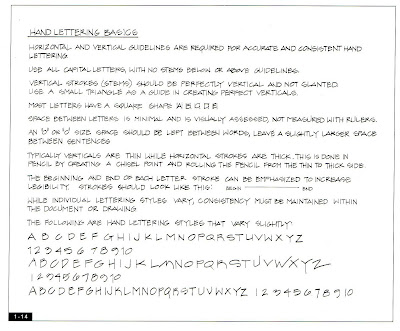
Cause if so, you are crazy sir.

However, when I work on a blueprint, the lettering guides and eraser shields come out.


I dont know about the left handed thing myself, the BBC decided Mr shiny foreheads pencils where important...... Not that the BBC has anything important going on. I'm guessing by your comments and what they said on the program that left handed people have to adapt, still I cannot comment on that.Cavan said:Are you talking about true cursive or about having a mostly joined up style? If you're talking about true cursive than I can agree with that, nobody writes 100% in joined up just for the sake of it, everybody develops their own style. The majority write in a mostly joined up fashion and as a result very few people print.J Tyran said:Actually most people in England either don't or cant use it. This was on the news the other day funnily enough and experts described it as "dead" not even "dying" and only a small minority of people, usually people into calligraphy actually bother with it.
The topic apparently came about because of the photos of David Cameron's pencils, he is left handed and cannot write well in ink because of smudges.
I am also left handed and it mostly depends on what type of ink you're using as to whether you smudge, older fountain pens are probably the worst. Newer gel pen types don't smudge most the time. I also developed a rather slanted writing style to compensate for having my hand at an angle to avoid the ink while I was using ink pens as a child, which is what I revert to for speed. Like I said I can't comment on what the newest generation of children are being taught anymore, but for people roughly my age in their late teens and early twenties it is still considered the norm.
That may be as a result of my area or the fact that my secondary school was one of those faffing around kind of grammar schools with 400 years of history. All I can say is that what I am saying is true for the people around me and the people around those people I have asked.
However I can comment about the joined up writing, I am 30 and they never bothered when I was at school. I went to a shitty school in a rough and shitty council estate belonging to a shitty local education authority. The "National Curriculum" was the new thing on the block and all the schools like that, the ones starved of cash by over a decade of Tory neglect where simply bothered about ticking boxes. They had more important things on their mind than fancy hand writing, making sure the pupils could speak and write at least a few sentences in an EU language. The education of the pupils mattered little it was all about ticking boxes and trying to keep the pupils from battering each other and tearing the school apart.
Oh, trying to find cash for toilet paper and to fix the leaks in the roof was a big deal too.
You must have gone to a better school but believe me when I say most schools in the last 20 years have not made fancy hand writing a priority.

I (unlike may people it seems) never actually reverted to print once I started writing in cursive. By the time it stopped being enforced on me I was kinda just used to it. Huh.

I always write lowercase s in cursive whenever its the last letter of word. Little habit that I picked up.
I had fond memory of learning cursive. My teacher would pour foamy shavingcream or some sort on our desk, tell us to gently lather it across the table and tell us to practice using our index finger. Good times.
I had fond memory of learning cursive. My teacher would pour foamy shavingcream or some sort on our desk, tell us to gently lather it across the table and tell us to practice using our index finger. Good times.
Dude, its Kansas. Its a state that Americans forget it exists.Evil Smurf said:proper handwritting is an art! Silly America


I'm exactly the same. I learned "joined up" handwriting when I was about 6 or 7 and have always used it ever since. I have known a few people who write in print (all in capitals as well oddly enough) but I just found that slow and tedious compared to cursive which was just tedious. The only kids who wrote in print all the way up to when I left finished A levels in 2003 were those considered "Special". For everyone else, it had to be cursive or typedRainmaker77 said:UK here.
Cursive or 'joined up writing' as we call it here is definitely the norm, so much so that I can't actually recall reading anything hand written recently that was not.
It's so engrained to me that I actually struggle printing my name on documents, I simply don't naturally write like that and it's an effort to do so.
National past-time.Gatx said:Also you people from the UK, so condescending.

Holy crap, a time traveler from the past! How are you sir and what decade do you hail from?neverarine said:some of theses people are gonna meet a harsh reality when they hit that university professor who only accepts work written in cursive and who only writes in it, there always is one...
I kid, I kid, but really, in America anyways this is *never* going to be an issue. Teachers usually like written assignments to be typed, and if they do allow handwritten stuff they sure as hell don't care about the handwriting style.
Besides, if an American university Professor ever required this, then they would have to teach it because I promise most of their students wouldn't be able to. I highly doubt they would even be allowed to make that a requirement.
ie, from what you're saying I can surmise that you could "Touch-type", though you prefer to look at the keys, which is not what I was saying (As I elaborated with the hide-and-seek referral).PhunkyPhazon said:Actually, I do look at the keys when I type. Not because I can't type without doing so, but because I just do it faster this way.
I'm talking about the people who have to look at the keyboard and find letters individually, and can't type easily. You've probably seen them "Now where's the s key gone." It's almost an inevitability if you're helping parents or grandparents with computers. They can barely type at all, really.
Personally I prefer to see the output of what I'm typing, but whatever floats your boat.

My problem is, typing classes don't really work. Kids are stubborn. I cheated my way through typing while the teacher wasn't looking. Sure, I started to type on my own when a couple of years later, but teaching kids to type and write in cursive is a waste of time. MAke them lear more math and science. America is falling behind fast, and learning how to type won't fix it.
My problem is, typing classes don't really work. Kids are stubborn. I cheated my way through typing while the teacher wasn't looking. Sure, I started to type on my own when a couple of years later, but teaching kids to type and write in cursive is a waste of time. MAke them lear more math and science. America is falling behind fast, and learning how to type won't fix it.
My problem is, typing classes don't really work. Kids are stubborn. I cheated my way through typing while the teacher wasn't looking. Sure, I started to type on my own when a couple of years later, but teaching kids to type and write in cursive is a waste of time. MAke them lear more math and science. America is falling behind fast, and learning how to type won't fix it.
You seem to be forgetting that the keyboards have been around a lot less than mass writing has, and that kids who were born after the internet born are just shy of being in puberty/ slightly over right now.Zack Alklazaris said:The only thing I have ever had to do is sign my name in cursive and even that you can pretty much write whatever the fuck you want as long as your consistent about it.
Take cursive out and get kids typing. We have kids born AFTER the internet boom who still type with their indexes at 35 wpm. Its sad.
I use cursive mostly, although I don't join up all the words, I write in my own style really which has just evolved from everyone acknowledging that English classes were mostly bullshit, hell, I learnt more about paragraph structure and writing good answers from History GCSE than I did English.
The web took off publicly in the early 90s, making "kids who were born after the internet" around 20...Not being shy of puberty.Sizzle Montyjing said:You seem to be forgetting that the keyboards have been around a lot less than mass writing has, and that kids who were born after the internet born are just shy of being in puberty/ slightly over right now.Zack Alklazaris said:The only thing I have ever had to do is sign my name in cursive and even that you can pretty much write whatever the fuck you want as long as your consistent about it.
Take cursive out and get kids typing. We have kids born AFTER the internet boom who still type with their indexes at 35 wpm. Its sad.
I use cursive mostly, although I don't join up all the words, I write in my own style really which has just evolved from everyone acknowledging that English classes were mostly bullshit, hell, I learnt more about paragraph structure and writing good answers from History GCSE than I did English.
In school we were taught to write with joined-up letters as standard. Writing each letter individually is considered to be something only small children do.
Only in America can they regard something as ordinary as writing without needing to stop-start all the time as something "special" and call it cursive.
Only in America can they regard something as ordinary as writing without needing to stop-start all the time as something "special" and call it cursive.
Just a thought I had, some people have mentioned that it will only ever be useful for signatures. Even that will be dead soon, documents will need biometric signatures like a thumbprint or maybe all documents will be digital and devices will have retina scans for signatures.
Imagine it you fill out your document on a phone, tablet or PC, use the built in camera to take a retina scan and it attaches to the document. Then you use either NFC to hand it over to someone there and then (if you didn't use their device to fill it in) or perhaps there will be cheap disposable data transfer formats like a microSD of a few KB with built in RF features so no need to plug anything in, just swipe it over a reader. Although why you wouldn't just send it over the internet I don't know, little disposable data chips could come in handy though.
Fuck it, writing and paper will die in developed countries soon enough.
Imagine it you fill out your document on a phone, tablet or PC, use the built in camera to take a retina scan and it attaches to the document. Then you use either NFC to hand it over to someone there and then (if you didn't use their device to fill it in) or perhaps there will be cheap disposable data transfer formats like a microSD of a few KB with built in RF features so no need to plug anything in, just swipe it over a reader. Although why you wouldn't just send it over the internet I don't know, little disposable data chips could come in handy though.
Fuck it, writing and paper will die in developed countries soon enough.
It's not ordinary though as most languages do not connect entire words into one long swirly line. And again, as mentioned over and over in this thread...It's not just America, it's the majority of the world with the exception of England and parts (yes, only parts) of Australia.Olrod said:In school we were taught to write with joined-up letters as standard. Writing each letter individually is considered to be something only small children do.
Only in America can they regard something as ordinary as writing without needing to stop-start all the time as something "special" and call it cursive.
Also cursive is a word in the Oxford dictionary, it's not something Americans arbitrarily made up.