Poll: 0.999... = 1

Recommended Videos

Piflik

New member
Feb 25, 2010
255
0
0
Coldie said:
Piflik said:
See...perfectly correct and logical...
There is no such thing as 'end of infinity'. Please try harder next time, lest the infinity stares back into you.
I know there is no end to infinity...that's why I called it theoretical 'end'

This whole argument is a theoretical one, since there is no such thing as infinity in reality ;)
 

Coldie

New member
Oct 13, 2009
467
0
0
Piflik said:
I know there is no end to infinity...that's why I called it theoretical 'end'
There's no theoretical end to infinity, either. Infinity is infinite, it has no end. At all. It might have a beginning, but never an end. It might be countable or uncountable, but it never, ever ends. Ever.
There is never a zero, there are only 9s. When you shift the digits left, it's still just 9s going on forever. If there's ever a shortage of digits, you could just shift it left and mine the integer part for a nine, then repeat (forever!).

Math is so simple, yet so easily misunderstood.
 

Lyx

New member
Sep 19, 2010
457
0
0
Jaime_Wolf said:
Then you disagree with the question, not the result (since the answer of an incoherent question cannot be true or false). Assuming you take the view that this is an erroneous question, you should probably realize that you are, in the end, arguing that all real numbers are only processes (Values having multiple representations stems from the nature of constructing representations of real numbers. So you can, for any real number, create a number system that forces you to conclude that the values are processes). As soon as you take such a view, you either have to abandon a notion of equality altogether or you have to say that they're equal. So nothing is really ever gained.

Och jaime. See, we (from my POV) don't even generally disagree with each other. I am very well aware, that i have been walking on very thin ice by making a distinction between numbers and processes (the connection is that "values" (i dont know the right word) can indeed be represented as direct numbers as well as processes, so that indeed a process and number can refer to the same value). We're on the same line about the background-theory.

What i disagree with - as hinted earlier - is purely the definition of the "term" infinity. See, i'm someone who defines a lot of things different than others. That is because i do not just accept terms simply because someone says so. I look at how the terms are used, how they are related to other terms, and so on - so, i have a tendency to define terms according to which meanings are actually communicated with them (instead of the claimed meaning). I'm aware that this approach has some pitfalls and issues, but while being aware about them, this approach has served me very well for many years.

In the case of infinity, i look at what happens in practice when it is used. And that is simply a repetition-process. That this is how most people understand this term, is all too visible precisely with the 0.999... question. When someone says "add 9's infinite times", then i take it to mean just that.

Sure, you can argue that how doing precisely this, makes little sense, if one considers the theoretical backgrounds - and that therefore, we should "correct" the result to what makes sense. I don't even disagree that "functions" like this should work different than "infinite times 9". But as mentioned earlier, if the instruction should be different, then use a different instruction, not the "wrong" one with the "right" meaning.

So, our disagreement ultimately is simply one of language, not one of concept.
 

brunothepig

New member
May 18, 2009
2,163
0
0
smithy_2045 said:
brunothepig said:
havass said:
If x = 0.999999...
Then 10x = 9.9999...
Therefore, 10x - x = 9
Which implies 9x = 9
Thus, x = 1
x also = 0.99999...

In conclusion, I have just proven 1 = 0.9999...
No, no no no. The problem with that proof is the whole infinity thing. Infinity is just a concept. Basically, 10x0.999.. should equal 9.999..8
Because infinity is supposed to be, well, forever, the 8 is kinda ignored in that proof, but it should be on the end of that never ending number. You see why it's a problem?
OT: I think my stance on this is rather obvious. 0.9 recurring doesn't equal 1. It is in fact, 1x10^(-infinity) less.
Which is equivalent to zero. Which means there is no difference. Which means .999... = 1
It isn't equivalent to zero. That was my point, infinity is the concept of "as close as you can get without being it"... Kinda. 1x10^(-infinity) would equal 0.(an infinite number of zero's)1.
Basically, the difference between 0.9 recurring and 1 is infinitesimally, immeasurably small. But they are not equal.
 
Jun 11, 2008
5,329
0
0
popa_qwerty said:
Glademaster said:
havass said:
If x = 0.999999...
Then 10x = 9.9999...
Therefore, 10x - x = 9
Which implies 9x = 9
Thus, x = 1
x also = 0.99999...

In conclusion, I have just proven 1 = 0.9999...
I hate this theorem worse than the making 2=1 through dividing by 0.

OT: Yes technically speaking in maths 0.9999... is equal to one. For more counterintelligence ideas. Since every atom is mostly empty space me, you, your family, the walls around you and everything you have ever known is mostly empty space. Thus everything ever is a waste of space:p.
and this world of empty space is nothing but what we conseve it to be;;ps

pardon my bad English[/quoteMeh
Meh it's fine. Only 1 word spelt wrong. Although it is funny how we never actually touch thigns either on an atomic level.
 

CrashBang

New member
Jun 15, 2009
2,602
0
0
BlacklightVirus said:
havass said:
If x = 0.999999...
Then 10x = 9.9999...
Therefore, 10x - x = 9
Which implies 9x = 9
Thus, x = 1
x also = 0.99999...

In conclusion, I have just proven 1 = 0.9999...
I prefer:

b0.b1b2b3b4... = b0 + b1(1/10) + b2(1/10)^2 + b3(1/10)^3 + b4(1/10)^4 ...

if |r| < 1 then kr + kr^2 + kr^3 + ... = kr/(1-r)

So for 0.9...:

0.(9) = 9(1/10) + 9(1/10)^2 + 9(1/10)^3 + ... = (9(1/10))/(1-(1/10)) = 1
That's not maths! That's mystical, magical witchcraft! Burn the witch!
(Maths wasn't my strong point in high school)
 

Rainforce

New member
Apr 20, 2009
692
0
0
yes, 0.99999 is 1, but only in the weak human interpretation of the concept of Mathematics.
 

Lma0nade

New member
Jul 25, 2010
110
0
0
zfactor said:
havass said:
If x = 0.999999...
Then 10x = 9.9999...
Therefore, 10x - x = 9
Which implies 9x = 9
Thus, x = 1
x also = 0.99999...

In conclusion, I have just proven 1 = 0.9999...
Uh, wait, the second part will have one less 9 after the decimal point than the first part.

x = 0.9999999999
10x = 9.999999999

So the 10x - x would actually equal 8.9999999991, not 9.

Back on topic, .999999999999999999999999999999999999999999999999999999999999999999999999999(and so on) does not equal 1 because 1 is 1.0000000000000000 not (above .999...). They are two different numbers which can be rounded to each other, but are not equal to each other.
 

Redingold

AAAAAAAAAAAAAAAAAAAAAAAAAAAAAAAA
Mar 28, 2009
1,633
0
0
Pirate Kitty said:
No.

0.999 is 0.999.

1 is 1.
Yes, very good, but can you demonstrate why 0.999... is not equal to 1? Here, I'll prove that it is, and you can try and find a problem with my proof.

Redingold said:
M'kay. The number 0.999... is equal to an infinite series 0.9 + 0.09 + 0.009 + 0.0009 and so on. If you know anything about slightly advanced maths, you'll know that the sum of an infinite geometric series is equal to a/(1-r) when |r| < 1 (explained below for those who aren't so good at maths)

In our example here, a, the first term, is 0.9, and r, the common ratio, is 0.1 (because each term is the previous term multiplied by 0.1).

So we have 0.9/(1-0.1) which equals 0.9/0.9 which equals 1.

Explanation of maths involved:

A geometric sequence is one where each term is the previous term multiplied by some number r. The first term is a, the second term is ar, the third term is ar[sup]2[/sup] and so on. The nth term is ar[sup]n-1[/sup].

The sum of a geometric series to n terms, which we shall call S[sub]n[/sub], is therefore equal to a + ar + ar[sup]2[/sup]...+ ar[sup]n-2[/sup] + ar[sup]n-1[/sup]

Multiplying by r, we get rS[sub]n[/sub] = ar + ar[sup]2[/sup] + ar[sup]3[/sup]...+ ar[sup]n-1[/sup] + ar[sup]n[/sup]

Subracting rS[sub]n[/sub] from S[sub]n[/sub] leads to S[sub]n[/sub] - rS[sub]n[/sub] = a - ar[sup]n[/sup]

This means S[sub]n[/sub](1-r) = a(1 - r[sup]n[/sup])

And S[sub]n[/sub] = a(1 - r[sup]n[/sup])/(1-r)

Now, to find the sum to infinity, n must be equal to infinity. If |r| > 1, r[sup]infinity[/sup] is infinite. If |r| < 1, r[sup]infinity[/sup] is equal to zero. (If |r| = 1, we end up with 0/0, and I don't wanna go there (it's not 1)).

Thus, S[sub]infinity[/sub] = a(1 - r[sup]infinity[/sup])/(1-r) = a(1-0)/(1-r) = a/(1-r) when |r| < 1

Satisfied now?

Rainforce said:
yes, 0.99999 is 1, but only in the weak human interpretation of the concept of Mathematics.
Really? I suppose you have some strong, alien mathematics where 0.999... is not equal to 1, then. Could I see it?
 

Redingold

AAAAAAAAAAAAAAAAAAAAAAAAAAAAAAAA
Mar 28, 2009
1,633
0
0
Pirate Kitty said:
No.

0.999 is 0.999.

1 is 1.
Yes, very good, but can you demonstrate why 0.999... is not equal to 1? Simply saying that they are each equal to themselves does not show that they are not equal to each other. Here, I'll prove that 0.999... is equal to 1, and you can try and find a problem with my proof.

Redingold said:
M'kay. The number 0.999... is equal to an infinite series 0.9 + 0.09 + 0.009 + 0.0009 and so on. If you know anything about slightly advanced maths, you'll know that the sum of an infinite geometric series is equal to a/(1-r) when |r| < 1 (explained below for those who aren't so good at maths)

In our example here, a, the first term, is 0.9, and r, the common ratio, is 0.1 (because each term is the previous term multiplied by 0.1).

So we have 0.9/(1-0.1) which equals 0.9/0.9 which equals 1.

Explanation of maths involved:

A geometric sequence is one where each term is the previous term multiplied by some number r. The first term is a, the second term is ar, the third term is ar[sup]2[/sup] and so on. The nth term is ar[sup]n-1[/sup].

The sum of a geometric series to n terms, which we shall call S[sub]n[/sub], is therefore equal to a + ar + ar[sup]2[/sup]...+ ar[sup]n-2[/sup] + ar[sup]n-1[/sup]

Multiplying by r, we get rS[sub]n[/sub] = ar + ar[sup]2[/sup] + ar[sup]3[/sup]...+ ar[sup]n-1[/sup] + ar[sup]n[/sup]

Subracting rS[sub]n[/sub] from S[sub]n[/sub] leads to S[sub]n[/sub] - rS[sub]n[/sub] = a - ar[sup]n[/sup]

This means S[sub]n[/sub](1-r) = a(1 - r[sup]n[/sup])

And S[sub]n[/sub] = a(1 - r[sup]n[/sup])/(1-r)

Now, to find the sum to infinity, n must be equal to infinity. If |r| > 1, r[sup]infinity[/sup] is infinite. If |r| < 1, r[sup]infinity[/sup] is equal to zero. (If |r| = 1, we end up with 0/0, and I don't wanna go there (it's not 1)).

Thus, S[sub]infinity[/sub] = a(1 - r[sup]infinity[/sup])/(1-r) = a(1-0)/(1-r) = a/(1-r) when |r| < 1

Satisfied now?

Rainforce said:
yes, 0.99999 is 1, but only in the weak human interpretation of the concept of Mathematics.
Really? I suppose you have some strong, alien mathematics where 0.999... is not equal to 1, then. Could I see it?
 

Coldie

New member
Oct 13, 2009
467
0
0
brunothepig said:
It isn't equivalent to zero. That was my point, infinity is the concept of "as close as you can get without being it"... Kinda. 1x10^(-infinity) would equal 0.(an infinite number of zero's)1.
Basically, the difference between 0.9 recurring and 1 is infinitesimally, immeasurably small. But they are not equal.
Infinity is not "as close as you can get without being it", the term you're thinking of is asymptote - approached infinitely close, but never met. Infinity is anything it damn wants to be, it could approach, it could meet, it could intersect. There's no such thing as a 1 in the end of an infinite string of 0s. 10[sup]-infinity[/sup] equals 0. It is equivalent to zero. It's not asymptotically close to zero (as you propose), it is zero.

I need some popcorn.
 

DTWolfwood

Better than Vash!
Oct 20, 2009
3,715
0
0
but the more u add the more the difference between the 2 becomes apparent no? i mean no 1 will consider 999,999.99 = 1,000,000.00 your always short. but i guess if you never expand .999+ sure its equal to 1. I believe the entire movie of Office Space depends on this lol
 

Piflik

New member
Feb 25, 2010
255
0
0
Coldie said:
Piflik said:
I know there is no end to infinity...that's why I called it theoretical 'end'
There's no theoretical end to infinity, either. Infinity is infinite, it has no end. At all. It might have a beginning, but never an end. It might be countable or uncountable, but it never, ever ends. Ever.
There is never a zero, there are only 9s. When you shift the digits left, it's still just 9s going on forever. If there's ever a shortage of digits, you could just shift it left and mine the integer part for a nine, then repeat (forever!).

Math is so simple, yet so easily misunderstood.
No...sorry, but you're wrong. You cannot shift the digits in any number and just call it a day. Infinite or not. If you take 0.9999... and multiply it with 10, there is a 0 at the end, not a 9. Regardless of how many 9s you write in that number. If you want to prove me wrong, you would have to actually write that number with infinite 9s, and even if you can pull that one of, I still assume that there would be a 0 at the end when you multiply it with 10...

Actually, there really is no such thing as infinity. It is a theoretical concept, but it doesn't exist. Every number has an end. Always.
 

Lyx

New member
Sep 19, 2010
457
0
0
Coldie said:
brunothepig said:
It isn't equivalent to zero. That was my point, infinity is the concept of "as close as you can get without being it"... Kinda. 1x10^(-infinity) would equal 0.(an infinite number of zero's)1.
Basically, the difference between 0.9 recurring and 1 is infinitesimally, immeasurably small. But they are not equal.
Infinity is not "as close as you can get without being it", the term you're thinking of is asymptote - approached infinitely close, but never met. Infinity is anything it damn wants to be, it could approach, it could meet, it could intersect. There's no such thing as a 1 in the end of an infinite string of 0s. 10[sup]-infinity[/sup] equals 0. It is equivalent to zero. It's not asymptotically close to zero (as you propose), it is zero.

I need some popcorn.
That counterargument is so....... i dont even know why i pressed the reply button. The only thing 0.000... has in common with 0.999... is the instruction to repeat digits - except of here: THEY SERVE NO PURPOSE - THE TARGET WAS ALREADY REACHED BEFOREHAND.
 

brunothepig

New member
May 18, 2009
2,163
0
0
Coldie said:
Infinity is not "as close as you can get without being it", the term you're thinking of is asymptote - approached infinitely close, but never met. Infinity is anything it damn wants to be, it could approach, it could meet, it could intersect. There's no such thing as a 1 in the end of an infinite string of 0s. 10[sup]-infinity[/sup] equals 0. It is equivalent to zero. It's not asymptotically close to zero (as you propose), it is zero.

I need some popcorn.
Sorry you're right, that was a clumsy way of saying it. I'm tired...
Anyway, I remember talking about my math teacher with this, and he told me how to debunk it, but I've forgotten... Like so many other things from my Specialist Mathematics class... I'm just gonna have to say, they aren't equal, but I forget how to prove it. I believe it's a proof by contradiction... Google it if you want.
Enjoy your popcorn.
 

Redingold

AAAAAAAAAAAAAAAAAAAAAAAAAAAAAAAA
Mar 28, 2009
1,633
0
0
Piflik said:
Coldie said:
Piflik said:
I know there is no end to infinity...that's why I called it theoretical 'end'
There's no theoretical end to infinity, either. Infinity is infinite, it has no end. At all. It might have a beginning, but never an end. It might be countable or uncountable, but it never, ever ends. Ever.
There is never a zero, there are only 9s. When you shift the digits left, it's still just 9s going on forever. If there's ever a shortage of digits, you could just shift it left and mine the integer part for a nine, then repeat (forever!).

Math is so simple, yet so easily misunderstood.
No...sorry, but you're wrong. You cannot shift the digits in any number and just call it a day. Infinite or not. If you take 0.9999... and multiply it with 10, there is a 0 at the end, not a 9. Regardless of how many 9s you write in that number. If you want to prove me wrong, you would have to actually write that number with infinite 9s, and even if you can pull that one of, I still assume that there would be a 0 at the end when you multiply it with 10...

Actually, there really is no such thing as infinity. It is a theoretical concept, but it doesn't exist. Every number has an end. Always.
Wrong. Consider multiplying 0.999... by 10. The second decimal place becomes the first decimal place, the third decimal place becomes the second decimal place and so on. The n+1th decimal place becomes the nth decimal. However, the n+1th decimal place is a 9, because every decimal place is a 9. Thus, when we've multiplied out number by 10, every nth decimal place will be a 9.

Also, pi goes on forever.
 

Coldie

New member
Oct 13, 2009
467
0
0
Piflik said:
Actually, there really is no such thing as infinity. It is a theoretical concept, but it doesn't exist. Every number has an end. Always.
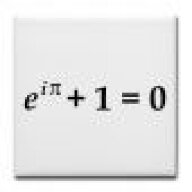
Infinity is very prominent a mathematical concept. It's quite real, I assure you. And, as redundant as it is redundant, infinitely long numbers are, in fact, infinitely long. They never have an end. Here, let me show you, an infinitely long number that has an infinite number of digits after the decimal point and no end ever:


Quite a famous transcendent number, especially prominent in trigonometry and geometry. Also it's infinitely long and has a finite value.

Some infinitely long numbers have a repeating pattern, for instance 1/3 is just infinitely repeating threes. The notation for such numbers is 0.(periodic pattern), so 1/3 = 0.(3) or 1/7 = 0.(142857).

So if you take 0.(9): 1 - 0.(9) = 1 x 10[sup]-infinity[/sup] = 0.
You can find the detailed calculations in the first couple pages of the thread.

Don't try to understand it, just accept it as the universal and absolute truth. Because that's what it is. Elementary Arithmetics.
 

Redingold

AAAAAAAAAAAAAAAAAAAAAAAAAAAAAAAA
Mar 28, 2009
1,633
0
0
Pirate Kitty said:
Redingold said:
Nope. Still wrong.

One is one.

Example: I am holding one cup. I am holding 0.999 cup.

Which one of these is wrong?

Pretty easy stuff, guys ^^
Please address my point. I have used mathematics, you have repeatedly stated absolutely nothing noteworthy.

Find a flaw in my maths or shut up.