You, sir, need to brush up on your philosophy. Start with Solipsism and work your way out from there.Cyfu said:hahahaha... that's funny.
no science is not based on faith. science is based on evidence.
/thread

You, sir, need to brush up on your philosophy. Start with Solipsism and work your way out from there.Cyfu said:hahahaha... that's funny.
no science is not based on faith. science is based on evidence.
/thread

'dvd_72 said:You, sir, need to brush up on your philosophy. Start with Solipsism and work your way out from there.Cyfu said:hahahaha... that's funny.
no science is not based on faith. science is based on evidence.
/thread
well science has to accept without evidence (on faith) that the world outside our minds is reality and not a dream or simulation. Without that, nothing science does has a point.Cyfu said:'dvd_72 said:You, sir, need to brush up on your philosophy. Start with Solipsism and work your way out from there.Cyfu said:hahahaha... that's funny.
no science is not based on faith. science is based on evidence.
/thread
Wait, is this really a scientific belief? I mean, has this been accepted by the scientific community? if it has then I withdraw my previous statement.
I guess.... but this is just fucking ridiculous though. they guy that came up with shit had to be bat-shit crazy xDdvd_72 said:well science has to accept without evidence (on faith) that the world outside our minds is reality and not a dream or simulation. Without that, nothing science does has a point.Cyfu said:'dvd_72 said:You, sir, need to brush up on your philosophy. Start with Solipsism and work your way out from there.Cyfu said:hahahaha... that's funny.
no science is not based on faith. science is based on evidence.
/thread
Wait, is this really a scientific belief? I mean, has this been accepted by the scientific community? if it has then I withdraw my previous statement.


Actually the process you describe is basically the same that has created most of the present understanding of christianity.Darken12 said:That's the difference between science and religion. Science questions the things it takes on faith constantly, and keeps questioning and testing over and over again. In religion, questioning your faith is a big no-no.

NO.Jacco said:I don't watch EC so I don't know the context in which they said that but science as science can never TRUELY be proven. We can be 99.99999999999 ad nauseum % sure but we can never be 100% sure.
For instance, we know gravity works because we interact with it every day. But its still a "theory" as we don't completely understand it, hence the name "Theory of Gravity." Evolution is the same way. We think it happened and is happening and have evidence to support that, however we can never proof 100% that evolution is real. That's what science is. A constant revision of what we think we understand to something more likely.


I like that. To anyone who cares, here's a quote that I like (and isn't as callous as you think):Da Orky Man said:I think I have a suitable quote for this:
'Science knows it doesn't know everything; otherwise, it would stop.'
I've been saying this several times but I'll say it again, while most of science requires rigorous tests in order for a hypothesis to become an expected theory there are some fundamental ideas about reality that one MUST accept on faith not because we don't want to question it, but because it is impossible to engineer a test for. Solipsism is one of these where we must accept that the world outside of our mind is reality. (At this time at least) we cannot test if the outside world is a dream or not, we cannot know that our mind isn't being fed information to make us think we experience reality. All we can do is accept that what we see is real without evidence, or deny the outside world as real in which case nothing really matters does it?Ranorak said:I'm sorry, but I have no faith in doing my SDS-PAGE.
I know it works.
It worked before, not just once but millions of times.
It's results match the calculated and expected results all the time.
People who make the argument "if you don't do the tests yourself, you have to have faith he's right!"
NO!
The whole point of science is that before any of those tests are considered valid, is when someone replicated it.
AKA, the default position is "You messed up, or did something wrong!"
Only after the results can be replicated AND used as a model to predict a valid outcome, THEN it becomes a valid experiment.
And at that point I no longer needs faith, because it's not one person that did the experiment, sceptics did it as well, and had no other choice to agree.
So I resist the urge to ask Storm whether knowledge is so loose-weave of a morning when deciding whether to leave her apartment by the front door
Or the window on her second floor.
Solipsism is a philosophical thought experiment that really has no footing in science or any practical use to scientists. If its true that all of reality is an illusion or fake then it doesn't matter what the scientists are doing because they're all imaginary. Even still, this illusion of reality appears to have consistent laws and patterns that it follows which are testable. If it's not true and this reality is in fact real, then the scientists are still doing what they always do, making testable, predictive and repeatable models for reality.dvd_72 said:I've been saying this several times but I'll say it again, while most of science requires rigorous tests in order for a hypothesis to become an expected theory there are some fundamental ideas about reality that one MUST accept on faith not because we don't want to question it, but because it is impossible to engineer a test for. Solipsism is one of these where we must accept that the world outside of our mind is reality. (At this time at least) we cannot test if the outside world is a dream or not, we cannot know that our mind isn't being fed information to make us think we experience reality. All we can do is accept that what we see is real without evidence, or deny the outside world as real in which case nothing really matters does it?Ranorak said:I'm sorry, but I have no faith in doing my SDS-PAGE.
I know it works.
It worked before, not just once but millions of times.
It's results match the calculated and expected results all the time.
People who make the argument "if you don't do the tests yourself, you have to have faith he's right!"
NO!
The whole point of science is that before any of those tests are considered valid, is when someone replicated it.
AKA, the default position is "You messed up, or did something wrong!"
Only after the results can be replicated AND used as a model to predict a valid outcome, THEN it becomes a valid experiment.
And at that point I no longer needs faith, because it's not one person that did the experiment, sceptics did it as well, and had no other choice to agree.
Not all of science has come about by faith, but there are some fundamental issues that we need to accept without evidence because they cannot be tested.
Oh.. so that's why the Church publically shamed Galileo and forced him not to publish his work on Heliocentrism... they cared about truth SO MUCH that they couldn't allow him to rely on his blind faith to corrupt the masses... hey wait a second...Therarchos said:Actually the process you describe is basically the same that has created most of the present understanding of christianity.Darken12 said:That's the difference between science and religion. Science questions the things it takes on faith constantly, and keeps questioning and testing over and over again. In religion, questioning your faith is a big no-no.
There is a reason why most "scientist" of the enlightenment was theologians. It was the only higher education that existed in Europe at the time and the people who became great theologians at the time was the people who could look at something (nature/scripture) and say if A is.. and B is... then there must be a C.
There is a huge difference between blind faith in something and well thought faith in something and you find that on both sides of the argument.
Most religious people who don't put their heads up their asses and go lalalalalala see science as another form of contact with the divine not something to work against. That is why they get annoyed whenever they are told that they are wrong because science says so. (I am well aware that that is not necessarily what science says but it is often used as such) Especially when the arguments that are used to use science like that is flawed.
But if science is based on observations, then one cannot do any science without taking it on faith that reality is... well real. If we cannot accept that on faith, then we cannot do science in any meaningful way. When you are dreaming at night, the rules for the dream vary between dreams. In some you can fly, in others you cannot. Sometimes the rules change within a dream! And you know what? From your point of view in the dream there is no test to show that the world in your dream is any more real than the waking world. It is, for all intents and purposes, annother reality, yet we all accept that what happens when we dream to be a dream (hence calling it a dream I guess). We need to accept reality to be real on faith in order to even begin to do any kind of meaningful science.Sight Unseen said:Solipsism is a philosophical thought experiment that really has no footing in science or any practical use to scientists. If its true that all of reality is an illusion or fake then it doesn't matter what the scientists are doing because they're all imaginary. If it's not true and this reality is in fact real, then the scientists are still doing what they always do, making testable, predictive and repeatable models for reality.

Like I said before, science is essentially the process of creating models of our present reality and the only thing it requires is that the world we're studying be consistent and repeatable enough to create our models from (this is confirmable since experiments always have the same results). Models do not NEED to be theoretically derived. I'm in engineering, and MANY of the models that I end up using were actually derived empirically, with no theoretical basis, and they work absolutely fine (although they are generally only applicable for a certain range of conditions and require extensive testing to create) So Schroedinger's model does not need to be based on any theory as long as it can be experimentally shown to be valid for the conditions for which it is claimed to be relevant to.dvd_72 said:But if science is based on observations, then one cannot do any science without taking it on faith that reality is... well real. If we cannot accept that on faith, then we cannot do science in any meaningful way. When you are dreaming at night, the rules for the dream vary between dreams. In some you can fly, in others you cannot. Sometimes the rules change within a dream! And you know what? From your point of view in the dream there is no test to show that the world in your dream is any more real than the waking world. It is, for all intents and purposes, annother reality, yet we all accept that what happens when we dream to be a dream (hence calling it a dream I guess). We need to accept reality to be real on faith in order to even begin to do any kind of meaningful science.Sight Unseen said:Solipsism is a philosophical thought experiment that really has no footing in science or any practical use to scientists. If its true that all of reality is an illusion or fake then it doesn't matter what the scientists are doing because they're all imaginary. If it's not true and this reality is in fact real, then the scientists are still doing what they always do, making testable, predictive and repeatable models for reality.
As was talked about in the extra credits video even our basic geometry relies on certain statements that must be taken as true on faith. Many of these may be obvious, and others a little harder to see but without them much of our maths wouldn't work. Even parts of our maths have a basis in faith!
And how about some modern day examples? The Schroedinger equation comes to mind. It's an equation that can be used to extract any information about a quantum system you want, but there was no logic to its formulation other than "This seems to work in all the situations we've put it in and it accurately predicts various phenomena, but we have no way to derive it!".

"You have to take on faith that things which are demonstrably true are true"? Yeah, sure we could all be in the Matrix, or in the head of an autistic mental patient, or any number of other unfalsifiable pseudo-hypotheses. Thing is, with literally zero reason to think that's the case there is, well, no reason to think that's the case.dvd_72 said:But if science is based on observations, then one cannot do any science without taking it on faith that reality is... well real. If we cannot accept that on faith, then we cannot do science in any meaningful way. When you are dreaming at night, the rules for the dream vary between dreams. In some you can fly, in others you cannot. Sometimes the rules change within a dream! And you know what? From your point of view in the dream there is no test to show that the world in your dream is any more real than the waking world. It is, for all intents and purposes, annother reality, yet we all accept that what happens when we dream to be a dream (hence calling it a dream I guess). We need to accept reality to be real on faith in order to even begin to do any kind of meaningful science.Sight Unseen said:Solipsism is a philosophical thought experiment that really has no footing in science or any practical use to scientists. If its true that all of reality is an illusion or fake then it doesn't matter what the scientists are doing because they're all imaginary. If it's not true and this reality is in fact real, then the scientists are still doing what they always do, making testable, predictive and repeatable models for reality.
As was talked about in the extra credits video even our basic geometry relies on certain statements that must be taken as true on faith. Many of these may be obvious, and others a little harder to see but without them much of our maths wouldn't work. Even parts of our maths have a basis in faith!
And how about some modern day examples? The Schroedinger equation comes to mind. It's an equation that can be used to extract any information about a quantum system you want, but there was no logic to its formulation other than "This seems to work in all the situations we've put it in and it accurately predicts various phenomena, but we have no way to derive it!".

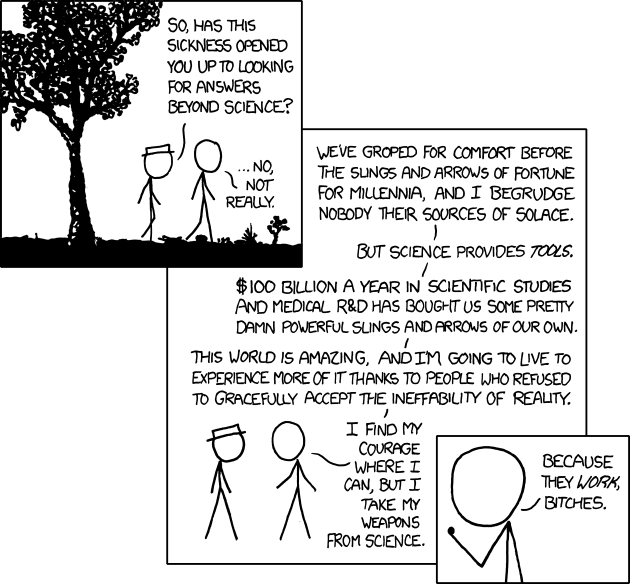
I love that comic. And I'm sorry to be that guy, but science is also based upon written and oral transmission of past testimony. Scientific studies are based upon the research that has already been done, which is why we comb through journals for relevant articles.Scars Unseen said:Science isn't based on faith any more than religion is. Faith is simply belief without understanding. You can have faith in science, and you can have faith in religion, but science is based on observation and experimentation while religion is based on written and oral transmission of past testimony.
Laymen have faith(or do not) that scientists are conducting experiments properly and thoroughly before reporting their findings. Theists have faith that the testimony they take their wisdom from is based on true events and has been been transmitted accurately and without secular tampering. So no, science is not based on faith, but people put their faith in science everyday.