Science thread!

Recommended Videos

Heronblade

New member
Apr 12, 2011
1,202
0
0
Mayhaps said:
Electron self-interference, tell me about it.
That's a nasty one to explain.

Ok, lets give this a shot. The most common example of electron self interference is the dual slit experiment using an electron (or photon) emitter, a screen with two slits in it, and a detector on the far side of the screen.

When the emitter emits, you can normally expect an electron that passes through either of the slits to take a particular path to the detector, with the laws of physics governing its overall motion and all that jazz. The puzzling thing is, electrons consistently fail to follow the same path. Many of them land on the emitter in locations that would require them to deflect after passing through the slits, in spite of there being nothing, at least in theory, to deflect them. Even more curiously, this simply does not occur when there is only one aperture for them to pass through.

The answer is not all that difficult if you remember that both photons and electrons do not entirely conform to physical properties. When either of them approach the slits, instead of simply passing through, they form a wave front that passes through BOTH of the slits simultaneously. There are then two separate amplitudes that pass through the screen, a bit like having two singers singing the same song together, only they are out of sync with each other. When the wave front tries to recombine, that difference causes the deflection.

 

Jonluw

New member
May 23, 2010
7,243
0
0
Mayhaps said:
Electron self-interference, tell me about it.
Okay.
First you need to know about the phenomenon of interference in relation to waves:
If two waves meet, they will cancel eachother out where the tops meet the bottoms, and they will amplify eachother where the tops meet the tops and the bottoms meet the bottoms.
If you send a wave towards a slit in a wall, the wave will spread out behind the wall.


Now let's say you send a wave towards two slits that are placed next to eachother in a wall.

What happens is that you get one wave spreading out from each slit, like on the right in that picture.

When those two waves meet, they will interfere with eachother. The tops will amplify the tops they meet and cancel out the bottoms they meet.

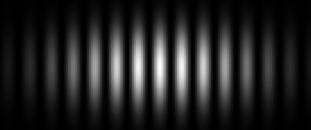
Behind the wall we have placed a sensor. It records how intense the waves are. This is represented by the striped area on the right of the image.
The darker grey an area on that stripe is, the more intense the wave is.

Now let's say we try to fire a random stream of particles, for example marbles through two slits like we did with the waves.
The sensor behind the wall notes that the highest intensities of marbles occur right behind each slit.
In other words, particles don't act like waves. Particles will only produce two gray strips on the sensor, where waves will create a striped pattern (an interference pattern)

Let's try that experiment again, but this time we'll use much smaller particles.
Let's use electrons.
So we fire a random stream of electrons towards a wall with two slits. They're particles with mass and everything, just like marbles, so they should create two stripes on the sensor behind the wall.

Wait a bloody second.
That's an interference pattern!
Maybe we'll try firing just one electron at a time through the slits in case they're bumping off eachother to create that pattern...

What the hell?
It still creates an interference pattern?
What's this supposed to mean?

We already know that the position of electrons are determined by a wavefunction though. What if we try to compare it to the interference pattern?


It appears that the electrons experience an interference that's determined by their wavefunction.
But that would have to mean that the electron passes through both slits at the same time or something...
How is that possible?

Okay, how about this: We'll place a sensor by the slits. That way we can observe which slit the electrons pass through when we fire them through there one at a time.
We'll just keep an eye on them and see what actually happens.

...
Son of a *****...

So it appears that electrons act as waves only when we're not observing them. When we do observe them, they behave like classical particles and skip the whole interference pattern thing.
 

McMullen

New member
Mar 9, 2010
1,334
0
0
Anyone willing to offer a primer on one or more of the following?

1) How biological neural networks form and function

2) Their similarities and differences to computer logic

3) What this means for AI research

Got any earth science questions?
 

Sougo

New member
Mar 20, 2010
634
0
0
I heard some time ago that they'd found the gene/protein responsible for aging. Does this mean that it is possible to advance human lifetimes by knocking off this gene?

Its weird that although the initial news was reported on a lot of science news, but no word on it since.

I was and am skeptical that prolonging human lifetimes can be so 'simple,' and truth be told none of those articles actually mentioned prolonging lifespans. But what else would you do with the gene that is responsible for cell aging?
 

Souplex

Souplex Killsplosion Awesomegasm
Jul 29, 2008
10,308
0
0
The Night Angel said:
Can someone explain how black holes can have infinite gravity?? :p
They don't have infinite gravity, they just have gravity strong enough that nothing we know of can escape it so it might as well be infinite.
Basically all mass has gravity.
A black hole is an object so massive that its own gravity crushes it into a single point.
Since no light can escape from it, it can't actually be seen and therefore is a black void to the outside observer.