Science thread!

Recommended Videos

Jonluw

New member
May 23, 2010
7,243
0
0
Hiya escapists.


[sub]Ahhh, science. We all love science, don't we?
Shut up in the back there, yes you do.[/sub]​

This is the thread where you may post any questions you may have about science and hopefully have it explained to you in layman's terms.
Wonder what electron self-interference is? Ask.
Curious how black holes come to be? Hell, I don't know. Ask anyways.
You might get an answer. And answers rock.


I don't have a very deep knowledge of physics or anything. This thread relies on the people in the community who actually study this or something making a collaborative effort to answer the questions of the people in the community who are curious about science.
i.e. The thread is open for anyone to ask anything, and it's open for anyone to answer any question. It would end up pretty pathetic if I should try to answer all the questions myself.

Bonus picture:

[sub]A scanning tunnel microscope picture of a ring of iron atoms. The spike in the middle there is an iron atom that's begging to form because the probability distributions of the other atoms accumulate in the center.[/sub]​
 

Esotera

New member
May 5, 2011
3,396
0
0
Biochemist undergrad...if anyone has questions then quote me & I'll try my best to answer them.

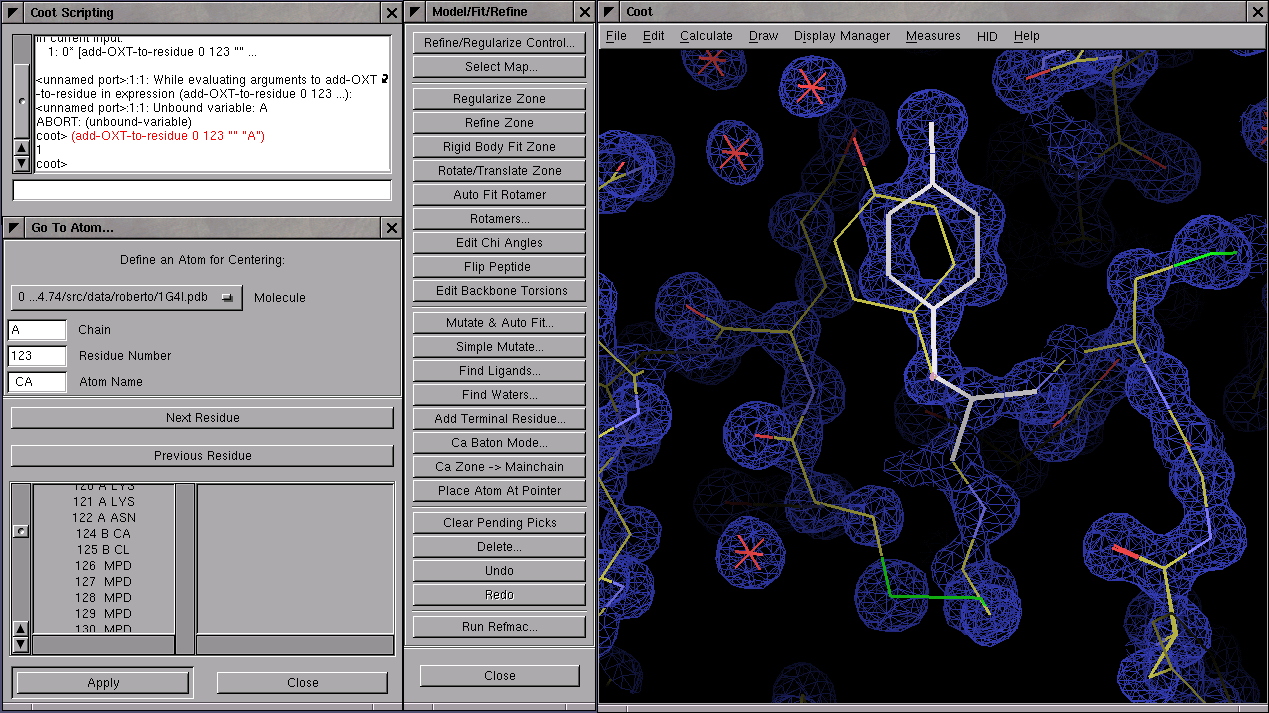
As for beautiful pictures, here's a predicted map of a protein from X-Ray Crystallography.


Every little bump on that screen reveals the position of one atom, which was determined by firing X-Rays at a protein crystal, which are absorbed by electrons & then sent out again in different directions, leading to a scatter pattern. Using some clever maths & graphics processing that the game industry has been driving, we can make maps like this.

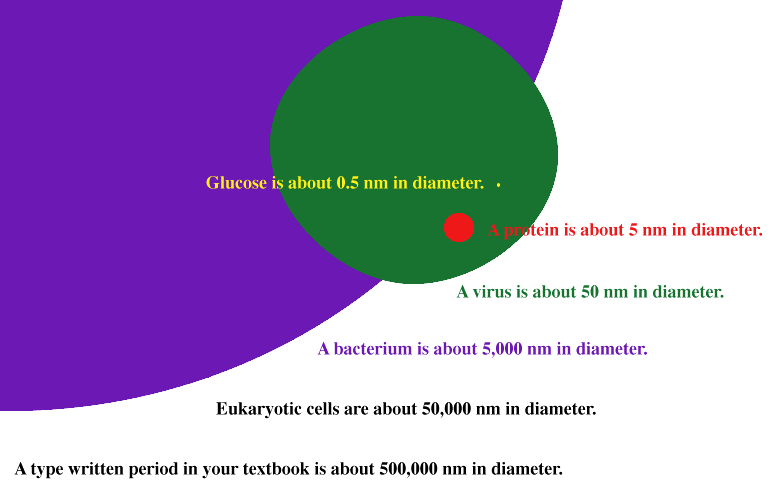
To put into perspective how incredibly small this thing is, and how amazing it is that we can see it, here's another image to demonstrate scale:


Science is awesome.
 

DoPo

"You're not cleared for that."
Jan 30, 2012
8,663
0
0
The Night Angel said:
Can someone explain how black holes can have infinite gravity?? :p
Sure - they had a gravity of 8 but then Stephen Hawiking rotated all of them 90 degrees to the side.
 

ClockworkPenguin

Senior Member
Mar 29, 2012
587
0
21
The Night Angel said:
Can someone explain how black holes can have infinite gravity?? :p
Classically gravity follows 1/r^2 law so as you approach it gets exponentially higher.
As you can see, there is a singularity at r=0

For most things this isn't a problem because you hit them (i.e electrostatic forces cancel out gravitational ones) before you get anywhere close to the centre of gravity.

black holes are super dense, such that before you actually hit the black hole you reach a point where gravity is so strong that even if you move at c, you cannot escape. I don't do astrophysics, just regular physics, so for a more detailed answer you'll have to ask someone else.

I have read that black holes do some pretty messed up things to space time, but i can't say i understood it, and i've not covered that sort of stuff in my degree yet.
 

The Night Angel

New member
Dec 30, 2011
2,416
0
0
DoPo said:
The Night Angel said:
Can someone explain how black holes can have infinite gravity?? :p
Sure - they had a gravity of 8 but then Stephen Hawiking rotated all of them 90 degrees to the side.
Thank you good sir, you have given me the best laugh of the day (so far, it's early yet :p ), I award you with one internet:


OT: I am actually genuinely curious about that though, any info on the subject would be appreciated. In simple English though, I haven't a head for science to be honest.
 

The Night Angel

New member
Dec 30, 2011
2,416
0
0
ClockworkPenguin said:
The Night Angel said:
Can someone explain how black holes can have infinite gravity?? :p
Classically gravity follows 1/r^2 law so as you approach it gets exponentially higher.
As you can see, there is a singularity at r=0

For most things this isn't a problem because you hit them (i.e electrostatic forces cancel out gravitational ones) before you get anywhere close to the centre of gravity.

black holes are super dense, such that before you actually hit the black hole you reach a point where gravity is so strong that even if you move at c, you cannot escape. I don't do astrophysics, just regular physics, so for a more detailed answer you'll have to ask someone else.

I have read that black holes do some pretty messed up things to space time, but i can't say i understood it, and i've not covered that sort of stuff in my degree yet.
Ah, I see my answer was ninja'd in. Thanks, that certainly helps. I have a friend doing Physics, and he had trouble trying to explain it too.
 

SckizoBoy

Ineptly Chaotic
Legacy
Jan 6, 2011
8,678
200
68
A Hermit's Cave
I'm only here to wait for a couple others to start spewing their stuff... they know who they are!

As for me... chem & chem-bio grad... so not big on phys, sorry, [user]Jonluw[/user]. However, for some reason, I also love pure maths.

Anyway, anyone for an Ireland-Claisen rearrangement?!
 

Jonluw

New member
May 23, 2010
7,243
0
0
overpuce said:
Another Science Question: When you have 2 particles that are entangled (quantum entanglement). Is the change of information in particle a instantly reflected in particle b? Or is there a delay, like speed of light delay?
There is no speed of light delay.
It's as if the entangled particles are one particle.
 

Bvenged

New member
Sep 4, 2009
1,202
0
0
Quote me with a question about space physics / magic and I will answer it as best I can (which should be pretty good). I'm always reading up on the subject.

- but nothing with maths, preferably :D

Here's a question for the OP:
Do you think in the relative future, we could operate on eyes to allow us to see further along the electro-magnetic spectrum, in a non-computing, biological way?
 

bobmus

Full Frontal Nerdity
May 25, 2010
2,285
0
41
To the biochemist students - did either of you take a neuroscience module? Was it good/bad, hard/easy etc?
Picking modules for next year you see...
(Pharmacology and Molecular Genetics student, reporting in)
 

Jonluw

New member
May 23, 2010
7,243
0
0
Bvenged said:
Here's a question for the OP:
Do you think in the relative future, we could operate on eyes to allow us to see further along the electro-magnetic spectrum, in a non-computing, biological way?
That's tricky.
We know certain animals can see other wavelengths, so photosensitive receptors that are triggered by UV-light do exist in nature.
The question is whether we can attach such receptors to the optical nerve on humans.
That might be tricky.

But even if we did manage to hook up some UV receptors to our optical nerve, there's the question of how our brains would process it. The brain might not have the capability to interpret the data in a way that makes sense.
Although I guess one could wire the receptors in such a way that the signals they send to the optical nerve are similar to those of our regular receptors, making other wavelengths appear as just regular light.

With those two issues coupled, I find it rather unlikely that we'll be able to manage it in the near future.
overpuce said:
Makes sense why a quantum network would be ideal. No delay in data transmission.
There's apparently a problem with transferring data via quantum entangement though. I can't remember it exactly, but it was something about the polarization of photons emitted from a reliable source being random, so you couldn't use it to transfer data.

Quantum entanglement has been used for a practical application though. I think it was a bank in Switzerland that wanted to determine and communicate the key to a code they would use for exchanging information. They didn't use it because it let the information travel quickly, but because the signal could not be seen by anyone but the intended receivers. If someone had tried to intercept it, it would be noticeable by the polarization of the photons.
Q: How does the theory of a toroidal universe make sense?
I haven't read up on that hypothesis, so I have no idea. From what I hear, it's likely that the universe is flat.
 

Jonluw

New member
May 23, 2010
7,243
0
0
overpuce said:
Jonluw said:
overpuce said:
Makes sense why a quantum network would be ideal. No delay in data transmission.
There's apparently a problem with transferring data via quantum entangement though. I can't remember it exactly, but it was something about the polarization of photons emitted from a reliable source being random, so you couldn't use it to transfer data.

Quantum entanglement has been used for a practical application though. I think it was a bank in Switzerland that wanted to determine and communicate the key to a code they would use for exchanging information. They didn't use it because it let the information travel quickly, but because the signal could not be seen by anyone but the intended receivers. If someone had tried to intercept it, it would be noticeable by the polarization of the photons.
But they have created a miniature quantum network at the Max Plank institute.
Hm, never heard of that. Interesting, but the link doesn't work.
BTW, in any network you would ideally want only the sender and receiver communicating with no one listening in.
Of course. That's why photon polarization/entanglement is so practical.
 

Bvenged

New member
Sep 4, 2009
1,202
0
0
I just bookmarked this thread for its awsome science-iness.
You also answered my question pretty much how I would have answered my own question, myself :D

Here's question no. 2 - another fairly hypothetical Q:

WE all know that gravity-time are interlocked... actually, one IS the other like matter IS energy, so.

Maybe black holes evaporate because they're so dense, when they disappear it's actually them reaching the end of the universe time-wise, and because without time, there is nothing (and they are infinitely dense) they disappear from existence?

What do you think? Also, do you think we could utilise time-gravity to travel faster than the speed of light (since E=mC^2, m=density, density/time)?

Or just travel faster than light by some other means, and if so, how?
 

Jonluw

New member
May 23, 2010
7,243
0
0
Bvenged said:
I just bookmarked this thread for its awsome science-iness.
You also answered my question pretty much how I would have answered my own question, myself :D

Here's question no. 2 - another fairly hypothetical Q:

WE all know that gravity-time are interlocked... actually, one IS the other like matter IS energy, so.

Maybe black holes evaporate because they're so dense, when they disappear it's actually them reaching the end of the universe time-wise, and because without time, there is nothing (and they are infinitely dense) they disappear from existence?

What do you think? Also, do you think we could utilise time-gravity to travel faster than the speed of light (since E=mC^2, m=density, density/time)?

Or just travel faster than light by some other means, and if so, how?
Considering that the equations derived from the theory of relativity provide very accurate answers, and that they also say that objects with mass require either infinite energy or infinite time in order to reach the speed of light...
E = mc[sup]2[/sup] / sqrt(1 - (v/c)[sup]2[/sup])
For an object with mass to reach the speed of light, the equations would have to be wrong, and that would mean we'd have to find a different theory that produced all the same results that relativity does, but also accounts for the possibility of faster-than-light travel. I don't think it's likely, but it's always possible.

m does not equal density though, unless we're talking about different things. m = density * volume.

The reason black holes evaporate is basically pair production, from what I understand.
When a particle-antiparticle pair appears along the event horizon of a black hole, one of the particles is drawn into the black hole. This particle has negative energy, so when it reaches the singularity, it reduces the hole's energy which is synonymous with mass.
The other particle flies away.
This creates the effect that particles radiate from the event horizon of a black hole, while the black hole loses mass equal to the mass of the radiation.
It's called Hawking radiation.
 

Dryk

New member
Dec 4, 2011
980
0
0
Bvenged said:
Maybe black holes evaporate because they're so dense, when they disappear it's actually them reaching the end of the universe time-wise, and because without time, there is nothing (and they are infinitely dense) they disappear from existence?
The version they taught us in physics: If a virtual particle/anti-particle pair comes into existence too close to the event horizon, instead of one of annihilating each other straight away one of them passes the horizon and because they can't annihilate the other particle is radiated away.

That's still a really simplified version though

EDIT: Curses ninjaed
 

Jonluw

New member
May 23, 2010
7,243
0
0
TheBobmus said:
To the biochemist students - did either of you take a neuroscience module? Was it good/bad, hard/easy etc?
Picking modules for next year you see...
(Pharmacology and Molecular Genetics student, reporting in)
I think you're going to have to quote them to get their attention.
 

Esotera

New member
May 5, 2011
3,396
0
0
TheBobmus said:
To the biochemist students - did either of you take a neuroscience module? Was it good/bad, hard/easy etc?
Picking modules for next year you see...
(Pharmacology and Molecular Genetics student, reporting in)
I'm currently doing Cellular Neurobiology as a second year module, which is probably the nearest we get to neuroscience. It's basically just what we've studied before in biochemistry applied to something vaguely interesting.

If something interests you and it doesn't cut off many later options, then I'd advise you to take that module, simply because you'll enjoy it more than doing something you hate.
 

Heronblade

New member
Apr 12, 2011
1,202
0
0
Bvenged said:
Quote me with a question about space physics / magic and I will answer it as best I can (which should be pretty good). I'm always reading up on the subject.

- but nothing with maths, preferably :D

Here's a question for the OP:
Do you think in the relative future, we could operate on eyes to allow us to see further along the electro-magnetic spectrum, in a non-computing, biological way?
Possible, but unlikely. It is biologically possible to see further along the spectrum. Dogs can see partly into the infrared section for instance.

The issue is not just a matter of bringing in new photoreceptors and getting the body to accept them, but that our brains are not wired to receive and process the different kind of information. The best way to do this in an organic fashion would actually be genetic modification rather than surgery, and since GM cannot safely be applied to developed organisms, your best bet is to focus on mechanical implants, since they can modify their output to match the information your brain is capable of receiving.