
Presents:
[HEADING=1]The Vengeance Trilogy[/HEADING]

Vengeance. Violence. Salvation.
Reminiscing over my last review, I said that in Asia, they make horror films of much higher quality than most of those done in the west. I?d like to expand upon that statement and say that Asian cinema doesn?t just do horror better, it practically does everything better.
Why yes I would like to elaborate on that statement. See, there is no short amount of creative genius in countries like Japan, China or South Korea. For example, look at how Anime has grown compared to its Western Animation counterpart. While it is true that most shonen series still follow a very conformist way of how their story is built up, when a medium of storytelling has films like Akira, Paprika or Howl?s Moving Castle, saying that Anime is on the same level of creativeness as Western Animation is like saying that I am about as tall as Furburt (Hint: It?s not true)
As for live action cinema, there is no short amount of movies there either. Don?t at least some of you find it sad that while our action blockbusters can consider themselves lucky to even have an allegory they can hamfist down our throats in between mindless explosions, Asian action films not only have good stories to couple their action, a lot of the time the action is nothing short of art.
A scene from Chinese martial arts film Hero
Of course, one does not always know where to look when trying to explore new grounds. So here I am, ready to recommend even more films. This time, we?re going to take a look at a South Korean trilogy of films, directed by the very same man who directed Cut in Three? Extremes, Park Chan-Wook.
In 2002, Park Chan-Wook, the man then famous for making the highest grossing South Korean film of all time in 2000, returned to the movie making business after a short siesta. The public eagerly anticipated his next film, hoping for something similar to his last film. What they got was completely different.
Instead of a conventional drama film, Park made Sympathy for Mr. Vengeance, a film that would later be followed by two others, Old Boy and Lady Vengeance, to create The Vengeance Trilogy, a series of incredibly tense and suspenseful thriller-dramas all centered around the theme of revenge. These films are what I am reviewing today.
[HEADING=1]Sympathy for Mr. Vengeance[/HEADING]

[HEADING=2]Vengeance[/HEADING]
[HEADING=2]Vengeance[/HEADING]
You may think life is hard, but whatever you are going through, the chances that your life situation is worse than that of our protagonist Ryu are slim. Born both deaf and dumb, the only person he?s ever had in his life is his sister. When he couldn?t get enough money to get into art school, his sister jumped off college so she could support him by working in a factory. When his sister then falls deathly ill from kidney disease, Ryu jumps of art school to work in a factory so he can pay for the medical bills. His blood-type doesn?t match with his sister so he can?t donate his own kidney, and because of economical issues, the factory he is working on must lay him off.
Now all he has is 10 million Won from the severance he was given, and a sister who is dying fast. In a desperate attempt to help her, he gets in contact with underground organ dealers in hopes of them finding an organ for him. They trick him, stealing one of his kidneys and all of his money. Merely days later he is informed by the hospital that a kidney has been found for his sister, and he is to pay them 10 million Won for the surgery. Now more desperate than ever, he and his terrorist girlfriend try a final attempt at saving his sister: Kidnapping the daughter of the CEO who owns the company that fired Ryu. This is when the shit really starts to hit the fan, as Ryu and his girlfriend are pulled into a situation more dangerous than they could possibly have hoped for.
[img height=280 width= 800]http://twitchfilm.net/mastheads/uploads/sympathyformrvengeance01_2.jpg[/img]
Ryu and his sister
Ryu and his sister
This is only the very first act of the film, and already has so much happened to Ryu. This helps us grow closer to him, because while he is often expressionless and rarely interacts with people, short but poignant scenes like when he is practicing baseball by himself in the rain to ventilate his emotions become so much more powerful when we know exactly how much weight he has on his shoulders. In the very first scene of the film, where Ryu has a letter he wrote recorded on audio-tape by a friend so that he can play it for his sister, we see him smile, and when it?s long past midnight in the incredibly noisy apartment building they live in, we learn that while he can?t hear all the screaming and shouting, the fact that it?s keeping his sister awake stops him from sleeping. We grow to love him because we admire his dedication to save his sisters life, and the hardships he goes through impact the audience.
The movie itself is very slow paced, often letting scenes drift along in silence, and there is rarely any music at all. In some scenes this helps to keep the atmosphere calm and peaceful, while in others it creates a furiously strong tension. It is as if the movie takes after Ryu, deafening the audience by not having the orchestral score we so often are used to in movies like this, stripping us of our senses so that we can?t anticipate what?s coming next, having out-drawn scenes of walking or simply sitting around to confuse and scare us of what might happen soon.
Sympathy for Mr. Vengeance should be experienced if only because of its unique and fresh take on how a thriller-drama is built. I cannot guarantee that you will like it, but you owe it to yourself to at least give it a chance.
[HEADING=1]Old Boy[/HEADING]

[HEADING=2]Violence[/HEADING]
[HEADING=2]Violence[/HEADING]
"If you stand aimlessly at a phone booth on a rainy day, and meet a man whose face is covered by a violet umbrella, I'd suggest that you get close to the TV."
Those are the words of Oh Dae-su, and he of everyone should know what he's talking about. After having been arrested by police on his daughter's birthday for being publicly drunk and causing trouble, he is bailed out by his friend. However, as his friend is calling from a phone booth to Oh Dae-su's home to explain that he's been found, Oh Dae-su disappears.
He wakes up in a shabby hotel room. There's a bathroom, a bed, and a TV. There are no windows, and the door is heavily fortified with only a small opening for which to give him food. When music starts playing, a knock-out gas fills the room. As Oh Dae-su is unconscious, his captors cleans his room, provide him with new clothes, and give him a haircut.
This goes on for 15 years.
Oh Dae-su starts writing a book, a diary filled with all evil things he's done to anyone in the past. He gives himself tatoo's, one line for every year he's been captured. He hardens his knuckles by constantly hitting the wall, and from time to time, he tries to commit suicide, only to be saved by the people still holding him captive. Then one day, he is released.

Oh Dae-su encounters a real person for the first time in 15 years
Such is the premise of Old Boy. From this point on, we follow Oh Dae-su as he goes on a journey to find out who did this to him and why. Along the way he encounters Mido, a young sushi chef who takes him in after he passes out in her restaurant, and together they try to solve this mysterious puzzle.
Old Boy is very different from Sympathy for Mr. Vengeance. Where Sympathy was slow-paced and without music, Old Boy is more conventional, having both music and normal pacing. Old Boy is also driven by a strong narrative from Oh Dae-su himself, but it's a different kind of narrative. Instead of the narrative being simple exposition of what is going on, it's a way for the audience to understand how Oh Dae-su thinks. Oh Dae-su is a changed man from who he was at the beginning of the film. He's stiffer, colder, less human than before. Oh Dae-su has become a monster, a monster seeking nothing but revenge, and his new personality is mirrored in his narrative. His way of thinking can almost be compared to that of Dr. Manhattan from Watchmen; it's devoid of any kind of human emotion, analyzing situations without actually feeling anything. It's like his mind is detached from any humanity.
Even though Old Boy has more conventional ways of directing than Sympathy, it's still a very different experience from what one usually sees in films, in no small part thanks to the presence of Oh Dae-su. However, it isn't just because of his detached narrative or his violent actions. In the same way that adding music would remove much of the impact in Sympathy for Mr. Vengeance, taking it away in Old Boy would do the same. The music is to Old Boy what silence is to Sympathy. It adds atmosphere to scenes where there isn't much talking or exposition, making them feel more beautiful and haunting.
Old Boy is probably the most accessible movie of the Vengeance trilogy, and it's also the most famous, something made obvious by the fact that almost every cover for Sympathy or Lady Vengeance feature the words "From the same director that made Old Boy". Out of all the films in the trilogy, this is the one I would recommend the most, not because I find it to be the best, but because I find it to be an experience many people would appreciate. If you haven't watched Old Boy already, this is the time to go and do so. You will not regret it.
[HEADING=1]Lady Vengeance[/HEADING]

[HEADING=2]Salvation[/HEADING]
[HEADING=2]Salvation[/HEADING]
Lee Geum-ja has spent 13 years in prison for a crime she didn't commit. Convicted for the murder of a seven year old boy, she's spent her entire prison time plotting to get her revenge on the man who set her up. Now that she is out, it is time to pull the strings she's made over the years and set her devious plan in motion.
If asked to summarize Lady Vengeance in one sentence, I would say "it's like if Kill Bill was less action filled, less humorous, and 10 times more powerful". While it is no doubt that the premise here is much more simpler than that of Sympathy or Old Boy, what's important here is not what the story is, but how it is told.
Lady Vengeance can probably be described as the "artsiest" film in the vengeance trilogy. There are strange dream sequences and a lot of symbolism, such as when Geum-ja dreams that the real murderer is a dog with a human face. This could be something that alienates some people from enjoying the film, but I believe that most of you will find it entertaining.
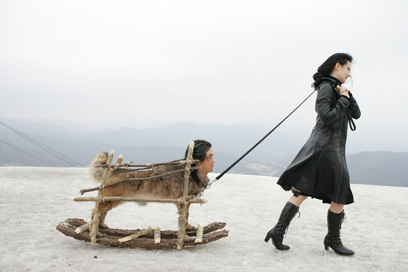
Geum-ja dreaming of her revenge
Not much can be said about Lady Vengeance, because where the movie truly shines is at the end, and I wouldn't want to spoil anything. That's not saying that the movie is bad in the beginning, it's very good all the way through, but the thing that sets Lady Vengeance aside from other films, the thing that makes it worthy of standing next to Sympathy and Old Boy, is the climax. Trust me when I say that you will have to look far and wide to find a more powerful ending than what is provided here.
So that is it; The Vengeance Trilogy, quite possibly the greatest series of film that has ever existed, and I would recommend you watch them all. In what order you watch them is of no real importance, as they are not connected in any way other than theme, and watching only one instead of all three is just as acceptable. The importance is that you give them a chance, because chances are that one of these films, if not all of them, will make their way up to your very own list of best movies ever.