

Your favorite Characters....*catch*
- Thread starter BOOM headshot65
- Start date
Recommended Videos









I must thoroughly disagree.Trilligan said:I'm . . . honestly not sure we watched the same video. Because I came a way from it with a completely different take.Vigormortis said:What I got instead was a long string of exaggerations, misdirections, and pointless bitching. (I really laughed at the "remain unbiased and object" bit at the start, which was followed by nothing but vitriolic disgust and insults" He seemed, throughout, to be reaching desperately for things to criticize. I'm not sure I found even a single valid point in the lot. And I actually tried to find one. (Loved the bit when he essentially said: Alyx Vance is an affable, likeable, believable, human character. And that makes her a bad character." lolwut. XD )
To be specific - around 5:24-30, where he says: "My problem with calling Alyx a great female character in games is not her character itself but her role in facilitating Gordon Freeman as a masturbatory aid for the player."
Because it isn't that Alyx is a 'bad' character, or even a 'flat' character - it is that she is exists purely in relation to Gordon. Which is true of every character in that universe, which orbits around Gordon Freeman's miraculously perfect Van Dyke (twenty years in limbo, not a single chin-hair out of place). But Alyx's role - and sort of her whole persona - is kinda that of a 'combat girlfriend' - she exists only as a female counterpart to Gordon, and ultimately becomes a cliffhanger-bait MacGuffin by the end of Episode 2, dropping the entirety of her character's presence in order to fill out the prototypical 'Damsel In Distress' for the never-to-be-released Half-Life 3.
Yes yes, just made an argument about a game that doesn't exist outside of Valvespace - but 'captured by aliens' doesn't leave much to the imagination. I feel justified in the conclusion given the current evidence. Moving on.
But the devolution from sidekick to mission goal isn't really the problem - we expect that in most action-oriented narratives. The problem is that Alyx Vance has no story arc. Her role is tightly regulated to companion throughout Half-Life 2. She is fully fleshed out, yes, and a fine example of how a real woman might act or behave (leaving aside that the stressess of the post-apocalypse seem to leave her psychologically unscathed - which is a valid argument but one that extends to every named character you meet with the exception of Breen and Father Grigori and possibly Mossman). But she has no character development. She doesn't really undergo any transformative action, she doesn't have a Hero's Journey of her own, she's just tagging along for the ride with Gordon. Gordon's presence - and her sidekick status - lessen her role in the narrative, which is why it's hardly surprising that she turns into another princess to be rescued.
To present an example of a similar dynamic worked in a different way: Chrono and Lucca from Chrono Trigger.
The trial-and-prison sequence early in the game gives you the Damsel-in-distress worked in reverse, with Crono awaiting his death sentence, and the choice to either face it quietly or bust out of jail. No matter which you choose, Lucca rides to the rescue, literally guns blazing, and the two of you proceed to kick ass so hard you tear a hole in spacetime. (I'm paraphrasing, of course). As the game moves on, you see Lucca's reactions to the events around you, and you learn more about her history - why she loves - and possibly hates - machines so much, why she's estranged from (and reconciles with) her father, what happened to her mother and what it meant to her. You see how she reacts to these things and how they change her.
But Alyx doesn't change, really - she isn't given an opportunity to change. She's just kinda there. She kicks ass while she's there, and I'm not taking anything away from that. She's a perfectly normal, believable (if somehow detached) individual, with individual mannerisms and motivations to the extent that her role lets her have them. I can't take away from that, either. But her role restricts her severely, and it prevents her from having much character growth at all, and that is the real problem. And it's something I likely never would have noticed if I hadn't watched the video.
EDIT: Incidentally, Gordon doesn't really have a story arc, either - he's really just following events around. This is an easy pitfall for a character like Gordon, who exists as a player-surrogate (which, if you remember from the video, is the essence of the Mary Sue). It's a criticism of this kind of character in general - but, other games handle this problem by giving us a measure of progression that we can attribute to the character to give some context to all the scenery we're passing; in Chrono Trigger, it was the stories and personalities of Crono's companions, in Super Metroid it was the steady increase of available skills and firepower, and so on. Also, note that in Super Metroid the story was reinforced at the climactic Mother Brain battle by stripping Samus of all her weaponry, leaving her utterly defenseless, which made the baby metroid's sacrifice all the more poignant and the resulting hyper-beam vengeance so viscerally satisfying. A much different feeling from giving Gordon a sniper crossbow and a slapdash dune-buggy ride every few levels.
Supplanting the normal character progression one sees in a narrative with another form of progression readily tangible to the player, a character that exists purely as audience-surrogate can be seen as an active participant in the story, rather than a figure moving through it. And here, Alyx represents a bit of wasted potential - the static nature of her character progression indicates wasted plot potential on Valve's part.
Edit 2: I have a feeling that nobody's ever gonna read my game-design essay.
Alyx does grow, as a character, throughout the series. If you look at the character; her actions, mannerisms, motivations, reactions; at the beginning of Half-Life 2 and compare them to what she is like by the end of Episode 2, you'll see quite a few striking differences.
For example, when you first meet her, she is very amiable yet brash and hap-hazard with her actions. Likewise, when she first meets Gordon, she acts both flirtatious and reserved. Like how someone often acts when they first meet their child-hood idol or crush. That was one point in the video, as he brought up as if it were a sign of bad character design, that made no sense.
Anyway, over the course of the game, that amiable almost child-like demeanor is stripped away. Due to the events she plays witness to, both with and without Gordon, and due to the "shocking revelations" that come to light, like Mossman's betrayal.
These changes aren't instantaneous, but by the end of Episode 2 we see a much darker, angrier, near-hopeless woman who's lost virtually everything she had; as little as it was.
You can see the same sorts of changes in Eli's character, as well as Mossman and Breen.
The one character I would argue that doesn't really change over the course of the series is Kleiner. He does become enthralled at the discovery of the Borealis, showing an almost removed sense of enthusiasm, but he still remains the classic "absent-minded professor".
............
Regardless of ones views on Alyx's character, I have to submit this: I honestly believe that, had Valve written her character in any other way (especially in an open-ended form like the man in the video seems to wish for(I'm guessing he's an avid fan of Skyrim and it's ilk, but that's a discussion for another day)), it would have made for both a far worse narrative flow and would have created a large disconnect between the player and the story experience. And, breaking immersion would be the death of a game like Half-Life as the series relies heavily on it.
I will admit that that "Campster" fellow did articulate his points quite well, for the most part. Still, I had a tough time regarding much of what he said in that video with any level of credulity when some of his biggest complaints and criticisms were that Half-Life is "overrated" because it's a linear narrative with a lot of variety and a "show, don't tell" design philosophy.
It almost seemed like he was saying, "It's not like an open-ended RPG, therefore it's overrated."
For example, when you first meet her, she is very amiable yet brash and hap-hazard with her actions. Likewise, when she first meets Gordon, she acts both flirtatious and reserved. Like how someone often acts when they first meet their child-hood idol or crush. That was one point in the video, as he brought up as if it were a sign of bad character design, that made no sense.
Anyway, over the course of the game, that amiable almost child-like demeanor is stripped away. Due to the events she plays witness to, both with and without Gordon, and due to the "shocking revelations" that come to light, like Mossman's betrayal.
These changes aren't instantaneous, but by the end of Episode 2 we see a much darker, angrier, near-hopeless woman who's lost virtually everything she had; as little as it was.
You can see the same sorts of changes in Eli's character, as well as Mossman and Breen.
The one character I would argue that doesn't really change over the course of the series is Kleiner. He does become enthralled at the discovery of the Borealis, showing an almost removed sense of enthusiasm, but he still remains the classic "absent-minded professor".
............
Regardless of ones views on Alyx's character, I have to submit this: I honestly believe that, had Valve written her character in any other way (especially in an open-ended form like the man in the video seems to wish for(I'm guessing he's an avid fan of Skyrim and it's ilk, but that's a discussion for another day)), it would have made for both a far worse narrative flow and would have created a large disconnect between the player and the story experience. And, breaking immersion would be the death of a game like Half-Life as the series relies heavily on it.
I will admit that that "Campster" fellow did articulate his points quite well, for the most part. Still, I had a tough time regarding much of what he said in that video with any level of credulity when some of his biggest complaints and criticisms were that Half-Life is "overrated" because it's a linear narrative with a lot of variety and a "show, don't tell" design philosophy.
It almost seemed like he was saying, "It's not like an open-ended RPG, therefore it's overrated."


funny >.> your added twist changes nothing about my list
Tera Brandford
Aya Brea
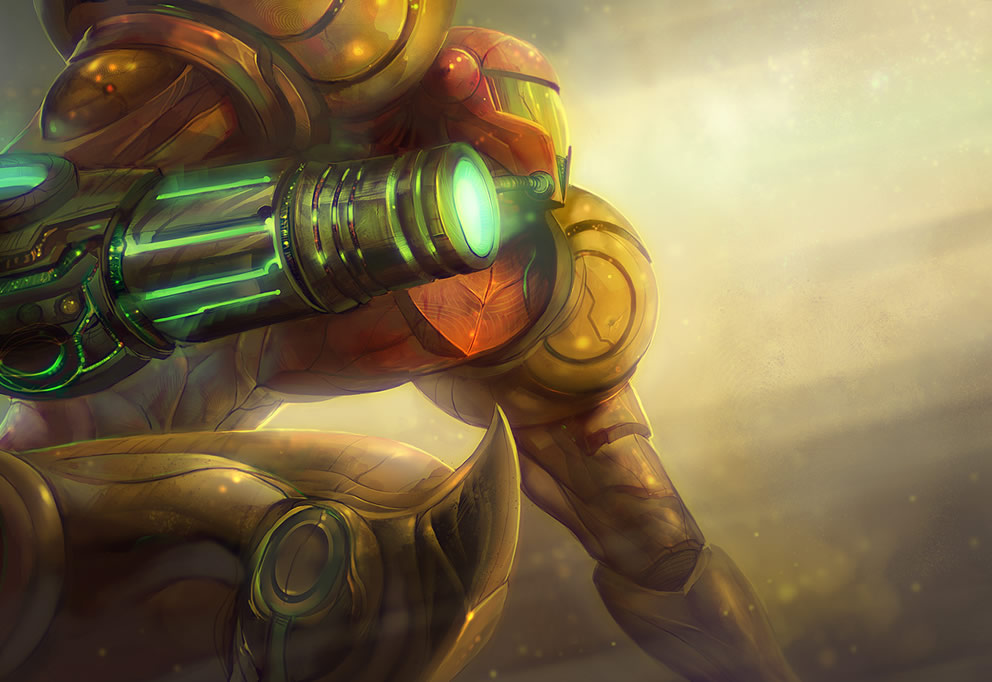
Samus Aran
Lilly Satou
Princess Luna
Lenneth Valkyrie
Yoko Linter
Rias Gremony
and the list goes on ....
Tera Brandford
Aya Brea
Samus Aran
Lilly Satou
Princess Luna
Lenneth Valkyrie
Yoko Linter
Rias Gremony
and the list goes on ....


Alyx Vance- "Half Life 2"
Ein/Erin- "Requiem for a Phantom"
Nariko- "Heavenly Sword"
Ada Wong- "Resident Evil 4" (and 6)
Holo- "Spice & Wolf"
Hinata- "Naruto"
Rebecca Chambers "Resident Evil 0/Chronicles"
The Boss- "Metal Gear Solid 3: Snake Eater"
Lin Beifong- "Legend of Korra"
Korra- "Legend of Korra"
Revi- "Black Lagoon"
Tifa Lockheart- "Final Fantasy 7"
Fran- "Final Fantasy 12"
Tali- "Mass Effect"
Liara- "Mass Effect"
Tonks- "Harry Potter"
Arya- "Game of Thrones"
Brienne- "Game of Thrones"
Raven- "Teen Titans"
Monza Murcatto- "Best Served Cold"
Shylo Vitari- "First Law Trilogy/ Best Served Cold"
Karrin Murphy- "Dresden Files"
Riza Hawkeye- "Fullmetal Alchemist: Brotherhood"
Lan Fan- "Fullmetal Alchemist: Brotherhood" ...and you know what? She might be the toughest one on this list...don't believe me? Watch the damn anime.
Ein/Erin- "Requiem for a Phantom"
Nariko- "Heavenly Sword"
Ada Wong- "Resident Evil 4" (and 6)
Holo- "Spice & Wolf"
Hinata- "Naruto"
Rebecca Chambers "Resident Evil 0/Chronicles"
The Boss- "Metal Gear Solid 3: Snake Eater"
Lin Beifong- "Legend of Korra"
Korra- "Legend of Korra"
Revi- "Black Lagoon"
Tifa Lockheart- "Final Fantasy 7"
Fran- "Final Fantasy 12"
Tali- "Mass Effect"
Liara- "Mass Effect"
Tonks- "Harry Potter"
Arya- "Game of Thrones"
Brienne- "Game of Thrones"
Raven- "Teen Titans"
Monza Murcatto- "Best Served Cold"
Shylo Vitari- "First Law Trilogy/ Best Served Cold"
Karrin Murphy- "Dresden Files"
Riza Hawkeye- "Fullmetal Alchemist: Brotherhood"
Lan Fan- "Fullmetal Alchemist: Brotherhood" ...and you know what? She might be the toughest one on this list...don't believe me? Watch the damn anime.


That lovely bipolar hatchet-swinging girl. OMOCHIKAERI, *****.

I love her mix of intelligence and compassion - devilishly smart, yet not an emotionless robot. She would be very interesting to talk to.

A kleptomaniac and a skilled navigator, I love her intelligent and shrewd personality. I like Nico Robin too.
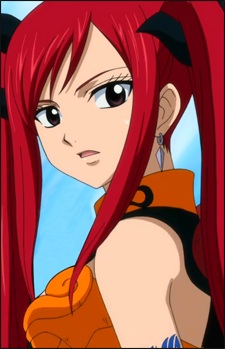
A brilliant battlemage, her requip ability is entrancing. She is truly Titania, Queen of the fairies.

Hmm, a lot of redheads there, but I like all hair colours.
Damn you, you beat me to it.Dango said:
*Fixxed
Ok, here is my absolute favorite character.

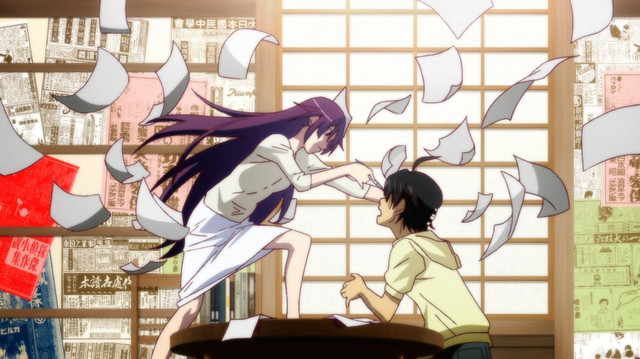

In no particular order...
1. Tohsaka Rin - Fate/Stay Night (Visual Novel)
2. Liara Tsoni - Mass Effect 2-3 (no real personality in 1)
3. Death - Sandman/DC Universe
4. The Angelus - The Darkness
5. Tron Bonne - Megaman Legends
I used to rank Samus in my top five favorite female characters, but then that abortion of a game Other M was released, so I had to knock her down a peg. No, you can't just pretend it doesn't exist. Otherwise Yuna would be up there too.
1. Tohsaka Rin - Fate/Stay Night (Visual Novel)
2. Liara Tsoni - Mass Effect 2-3 (no real personality in 1)
3. Death - Sandman/DC Universe
4. The Angelus - The Darkness
5. Tron Bonne - Megaman Legends
I used to rank Samus in my top five favorite female characters, but then that abortion of a game Other M was released, so I had to knock her down a peg. No, you can't just pretend it doesn't exist. Otherwise Yuna would be up there too.
It's either believe Other M isn't canon (I accept it exists, just not in the plot), or believe that the Prime series is non-canon, seeing as those two games contradict each other when it comes to Samus's reaction to Ridley. One of those is one of the best storylines of the series, the other is easily the worst.Sheo_Dagana said:In no particular order...
1. Tohsaka Rin - Fate/Stay Night (Visual Novel)
2. Liara Tsoni - Mass Effect 2-3 (no real personality in 1)
3. Death - Sandman/DC Universe
4. The Angelus - The Darkness
5. Tron Bonne - Megaman Legends
I used to rank Samus in my top five favorite female characters, but then that abortion of a game Other M was released, so I had to knock her down a peg. No, you can't just pretend it doesn't exist. Otherwise Yuna would be up there too.
I'll take Prime as canon, thank you very much.

In an order of your choosing! Vote for your favorite! Or not! There's no legally binding obligation!



Don't get me wrong, as a Metroid fan, I understand your position. Samus's reaction to Ridley, unfortunately, just isn't enough solid evidence for me to take Other M as non-canon. As shoe-horned into the canon as it is, it is still part of the Metroid continuity, and we fans are left to grumble about it like jaded Star Wars fans until Nintendo cares enough about the series to give us something to restore Samus's good name.thebobmaster said:It's either believe Other M isn't canon (I accept it exists, just not in the plot), or believe that the Prime series is non-canon, seeing as those two games contradict each other when it comes to Samus's reaction to Ridley. One of those is one of the best storylines of the series, the other is easily the worst.Sheo_Dagana said:In no particular order...
1. Tohsaka Rin - Fate/Stay Night (Visual Novel)
2. Liara Tsoni - Mass Effect 2-3 (no real personality in 1)
3. Death - Sandman/DC Universe
4. The Angelus - The Darkness
5. Tron Bonne - Megaman Legends
I used to rank Samus in my top five favorite female characters, but then that abortion of a game Other M was released, so I had to knock her down a peg. No, you can't just pretend it doesn't exist. Otherwise Yuna would be up there too.
I'll take Prime as canon, thank you very much.



My two favourite male characters are as follows:
Detective Robert Goren from Law and Order: Criminal intent

Brigadier Alastair Gordon Lethbridge-Stewart from Doctor Who (the classic series)

I like them both because they are intelligent and excellent characters played by two excellent actors. May be this video adequately sums up why I like the Brigadier:
'nuff said.
Detective Robert Goren from Law and Order: Criminal intent
Brigadier Alastair Gordon Lethbridge-Stewart from Doctor Who (the classic series)
I like them both because they are intelligent and excellent characters played by two excellent actors. May be this video adequately sums up why I like the Brigadier:
'nuff said.

5 of Favorite Male Characters (in no particular order)
1- Lloyd Irving (Tales of Symphonia)
2- Prince Zuko (Avatar: The Last Airbender)
3- The Doctor (Doctor Who)
4- Profesor Mordin Solus (Mass Effect trilogy)
5- Malcolm Reynolds (Firefly)
1- Lloyd Irving (Tales of Symphonia)
2- Prince Zuko (Avatar: The Last Airbender)
3- The Doctor (Doctor Who)
4- Profesor Mordin Solus (Mass Effect trilogy)
5- Malcolm Reynolds (Firefly)