All About Alignment

Recommended Videos

Mufujumon

New member
Nov 2, 2009
25
0
0
Ernil Menegil said:
Another fact that must be pointed out; while Paladins are one of the classes that face the most dillemmas about how they should act in given situations, there is actually a very simple answer given; When in doubt, go for the Good option rather than the Lawful option.
This is a misconception I'd like to address here and now. People tend to think that a Paladin is more closely bound by Good than by Law. This is not the case. A Paladin must act in a way which is both Good and Lawful, or he/she is considered to have breached his/her moral code, losing all Paladin abilities (going off of 3.5ED here, don't know if its changed any). This means that in any situation where Good is opposed to Law, a Paladin is forced to breach his/her alignment one way or the other. It's kind of a cruel thing for a DM to do to a PC, but not impossible.
 

Mufujumon

New member
Nov 2, 2009
25
0
0
Also, to contribute to the request initially posted, here are some characters and their proposed alignments (all pulled from Batman):

The Joker: Chaotic Evil
Two-Face: Lawful Evil
Robin: Chaotic Good
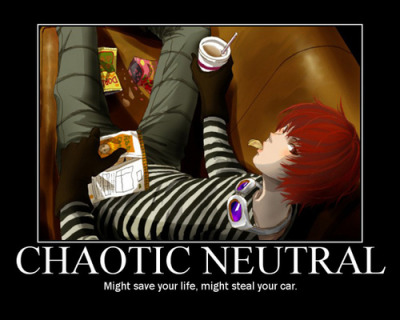
Catwoman: Chaotic Neutral
Poison Ivy: Neutral Evil
 

Altorin

Jack of No Trades
May 16, 2008
6,976
0
0
Falseprophet said:
On his YouTube channel, John Wick addressed this recently, and suggested a possible solution:

Interestingly enough, a lot of his "fixing your alignment" sounds like the alignment system in Exalted.

In Exalted (as I went over in my first response), you have 4 alignments: Compassion (Your character's willingness to help others), Conviction (Your character's willingness to act against hardship), Temperance (Your character's willingness to give up the things that they like), and Valor (Your character's willingness to die in a blaze of glory)

Those scores rate between 1 (weak willed) to 5 (ridiculously high willed)

If you act against any of your alignments in a meaningful way (usually in regards to your character's intimacies, or "things the character really cares about"), you roll your alignment in d10s. If you roll a success, you must either take action against whatever is causing the roll, or spend a point of Willpower and gain a point of "Limit".

If you are forced to spend enough Willpower that you accumulate 10 "Limits", you "Limit Break", and are forced to perform some egregious act that's attached to your highest alignment. If the alignment is Compassion, you'll often self-flaggelate yourself, or "take the whip" from weaker people, or brutally murder to protect the innocent (all without your player input). Valor, you'll often go into a berserker rage that can only be calmed when there is NOONE around - you'll just keep fighting everyone you see until they're either dead or everyone is gone.

ALSO, you can spend a point of Willpower when performing an action that exemplifies an alignment (such as charging headfirst into battle exemplifying Valor). If you do, you get to add your score in that alignment to your dicepool.

The only major difference (other then perhaps the "limit break" quality of Exalted's, is the fluid nature of his take on alignment. In Exalted you spend experience points to raise your alignments.
 

Zechnophobe

New member
Feb 4, 2010
1,077
0
0
Mufujumon said:
Also, to contribute to the request initially posted, here are some characters and their proposed alignments (all pulled from Batman):

The Joker: Chaotic Evil
Two-Face: Lawful Evil
Robin: Chaotic Good
Catwoman: Chaotic Neutral
Poison Ivy: Neutral Evil
Two face is a great example of Lawful Evil! He has a few important rules that he follows. Is there anything more lawful than NOT BEING ABLE TO KILL AN ENEMY just because the coin shows the good side? You might think 'but flipping a coin is chaotic!' but really, it is simply a cog in his system, nothing more.
 

Scow2

New member
Aug 3, 2009
801
0
0
kouriichi said:
Exacty! He cares about the outcome of every situation differently! Hence, Questionably Chaotic.

And i would set him to Neutral, but it feels to much like a lable. They see good and evil, while my character doesnt care for such things. He doesnt belive in law or chaos. Hence, he really isnt even Neutral.

Hes Questionably Chaotic. He does what he does when he does it. Good, evil, law, chaos, none of those effect he judgement. He could save the city. He could doom it. He could say, "I could care less what happens to you, i just like the adventure". Ofcourse, he could drink himself deep into the bottle and hit on the nearest living thing insted, costing dozens of people theyer lives. But hes not doing it because he wants to save people, or because he cares if people die or not. But because he does what he wants.
Actually, that's still neutral (Borderline Evil). You don't need to think of alignment to emulate it. Even animals have an alignment(Neutral), though they are incapable of comprehending moral choice.

Mufujumon said:
Ernil Menegil said:
Another fact that must be pointed out; while Paladins are one of the classes that face the most dillemmas about how they should act in given situations, there is actually a very simple answer given; When in doubt, go for the Good option rather than the Lawful option.
This is a misconception I'd like to address here and now. People tend to think that a Paladin is more closely bound by Good than by Law. This is not the case. A Paladin must act in a way which is both Good and Lawful, or he/she is considered to have breached his/her moral code, losing all Paladin abilities (going off of 3.5ED here, don't know if its changed any). This means that in any situation where Good is opposed to Law, a Paladin is forced to breach his/her alignment one way or the other. It's kind of a cruel thing for a DM to do to a PC, but not impossible.
Actually, the Paladin is closer aligned to Good than Law. His code automatically breaks him for commiting an Evil act, but not a Chaotic one. A Lawful character can still commit Chaotic acts, but they just are predisposed toward doing so. And, as outlined in this very article, the very act of Not Commiting an Evil Act Under ANY Circumstance (Restriction On Action = Deontological) automatically fullfills the "Must Act Lawful" requirement of the code. In other words, a Paladin must hold himself to the cause of Good with the steadfastness that makes him Lawful.

The Lawful Alignment is somewhat a misnomer because it has nothing to do with obeying the Law of The Land. As outlined in the article Lawful=Deontological, not Obediant To Authority. A Paladin is under no obligation to follow an unjust Law, nor is he forbidden from breaking a law that would hinder him from doing truly greater good.

If the DM doesn't quite get the point, time to justly break out the inner Rules lawyer and remind him of this: There is no greater Lawful Act than upholding a code bestowed upon you by the Highest of Powers (Either a Greater Diety or the Cause of Good itself) with Steadfast Conviction even in the face of the transient shadows of authority occassionally acquired and bandied about by Mortals, upholding and defending a Code and Cause that has existed before Creation, and must and will hold throughout the aeons, as even the Acts and Lives of the greatest dieties rise and fall in power. So, between obeying a Law, Order, or Superior of questionable integrity(Which it is, if it conflicts with Good), and Upholding the Right, go for Option #2.

The more conviction a player tells the GM this, the more you prove yourself actually capable of playing a Paladin. And, he is being Lawful, as he is "Sticking to His Guns" in the face of the chaotic and fickle whims of the source of the world itself. The greatest battle between Law and Chaos isn't in any of the outer planes in D&D, it's at a small table, between Player's citation of Law, and the fey-like rulings of the GM.
 

Altorin

Jack of No Trades
May 16, 2008
6,976
0
0
Scow2 said:
kouriichi said:
Exacty! He cares about the outcome of every situation differently! Hence, Questionably Chaotic.

And i would set him to Neutral, but it feels to much like a lable. They see good and evil, while my character doesnt care for such things. He doesnt belive in law or chaos. Hence, he really isnt even Neutral.

Hes Questionably Chaotic. He does what he does when he does it. Good, evil, law, chaos, none of those effect he judgement. He could save the city. He could doom it. He could say, "I could care less what happens to you, i just like the adventure". Ofcourse, he could drink himself deep into the bottle and hit on the nearest living thing insted, costing dozens of people theyer lives. But hes not doing it because he wants to save people, or because he cares if people die or not. But because he does what he wants.
Actually, that's still neutral (Borderline Evil). You don't need to think of alignment to emulate it. Even animals have an alignment(Neutral), though they are incapable of comprehending moral choice.

Mufujumon said:
Ernil Menegil said:
Another fact that must be pointed out; while Paladins are one of the classes that face the most dillemmas about how they should act in given situations, there is actually a very simple answer given; When in doubt, go for the Good option rather than the Lawful option.
This is a misconception I'd like to address here and now. People tend to think that a Paladin is more closely bound by Good than by Law. This is not the case. A Paladin must act in a way which is both Good and Lawful, or he/she is considered to have breached his/her moral code, losing all Paladin abilities (going off of 3.5ED here, don't know if its changed any). This means that in any situation where Good is opposed to Law, a Paladin is forced to breach his/her alignment one way or the other. It's kind of a cruel thing for a DM to do to a PC, but not impossible.
Actually, the Paladin is closer aligned to Good than Law. His code automatically breaks him for commiting an Evil act, but not a Chaotic one. A Lawful character can still commit Chaotic acts, but they just are predisposed toward doing so. And, as outlined in this very article, the very act of Not Commiting an Evil Act Under ANY Circumstance (Restriction On Action = Deontological) automatically fullfills the "Must Act Lawful" requirement of the code. In other words, a Paladin must hold himself to the cause of Good with the steadfastness that makes him Lawful.

The Lawful Alignment is somewhat a misnomer because it has nothing to do with obeying the Law of The Land. As outlined in the article Lawful=Deontological, not Obediant To Authority. A Paladin is under no obligation to follow an unjust Law, nor is he forbidden from breaking a law that would hinder him from doing truly greater good.

If the DM doesn't quite get the point, time to justly break out the inner Rules lawyer and remind him of this: There is no greater Lawful Act than upholding a code bestowed upon you by the Highest of Powers (Either a Greater Diety or the Cause of Good itself) with Steadfast Conviction even in the face of the transient shadows of authority occassionally acquired and bandied about by Mortals, upholding and defending a Code and Cause that has existed before Creation, and must and will hold throughout the aeons, as even the Acts and Lives of the greatest dieties rise and fall in power. So, between obeying a Law, Order, or Superior of questionable integrity(Which it is, if it conflicts with Good), and Upholding the Right, go for Option #2.

The more conviction a player tells the GM this, the more you prove yourself actually capable of playing a Paladin. And, he is being Lawful, as he is "Sticking to His Guns" in the face of the chaotic and fickle whims of the source of the world itself. The greatest battle between Law and Chaos isn't in any of the outer planes in D&D, it's at a small table, between Player's citation of Law, and the fey-like rulings of the GM.
Following your code doesn't give you carte blanche against all chaotic acts though. Enough chaotic acts, and your alignment risks shifting to neutral good, at which point no amount of atonement will help you until you rectify that, and that can be entirely Chaotic Good actions that cause that change.
 

Scow2

New member
Aug 3, 2009
801
0
0
Altorin said:
Following your code doesn't give you carte blanche against all chaotic acts though. Enough chaotic acts, and your alignment risks shifting to neutral good, at which point no amount of atonement will help you until you rectify that, and that can be entirely Chaotic Good actions that cause that change.
Correct. However, the protection the code offers against itself (Committing the Chaotic act is the Most Lawful thing you can do) should be more than enough to have it get through most "To be Lawful or To Be Good" decisions through consistently going "Good".

When given the choice between having to Act against Your Alignment (Choose a Chaotic Good act) versus Acting Against your Alignment, Breaking your Code Through Commiting an Evil Act, and Acting Against your Alignment by Breaking your Code Through Commiting and Evil Act (By committing the Lawful MildlyEvil act required instead), the choice between which course of action is demanded by the code becomes VERY clear. A true Paladin can generally understand what the best course of action is.
 

JMeganSnow

New member
Aug 27, 2008
1,591
0
0
You misquoted Galt's Oath from Atlas Shrugged, by the way. It's "I swear by my life and my love of it that I will never live for the sake of another man, nor ask another man to live for mine." not "man". But you did get it correct that from the perspective of conventional morality, Objectivists are double-neutral.

A much better article than the blurb would seem to indicate.
 

theklng

New member
May 1, 2008
1,229
0
0
Xzi said:


That's pretty much me in a nutshell.

I'd rather not take the time to define the alignments of historical characters, fiction or real, sorry. But I'm sure Hitler would be an easy diagnoses for most people.
i think hitler would be closer to you than you'd think...

i am apparently somewhere between chaotic neutral and evil.
 

Jenx

New member
Dec 5, 2007
160
0
0
Man as much as I love the Planescape campaign setting, my opinion has always been the same - the alignment system should be dragged to the back of the shed and shot in the head. It brings almost nothing of value to a game aside from wasting hours on arguments about what's Lawful Good and what isn't.
 

Towels

New member
Feb 21, 2010
245
0
0
Zechnophobe said:
Mufujumon said:
Also, to contribute to the request initially posted, here are some characters and their proposed alignments (all pulled from Batman):

The Joker: Chaotic Evil
Two-Face: Lawful Evil
Robin: Chaotic Good
Catwoman: Chaotic Neutral
Poison Ivy: Neutral Evil
Two face is a great example of Lawful Evil! He has a few important rules that he follows. Is there anything more lawful than NOT BEING ABLE TO KILL AN ENEMY just because the coin shows the good side? You might think 'but flipping a coin is chaotic!' but really, it is simply a cog in his system, nothing more.
That's a good distinction between "Choatic" and "Random." One could also argue that flipping a coin is Nuetral instead of Choatic because statistically "random" means equal probability of all possible results. (Statisticians generally agree that flipping a coin has Random results.) However, that's missing the point entirely: Morality describes Why, not How. I think many people confuse "Choatic" as being random/irrational/unpredictable behavior, and not reasoned "Consequentialist" behavior.

Two-Face is definately not a consequentialist, and his coin is a deontological tool.
However, I'm still not clear if he could be considered Evil or Neutral. Sure, some of his actions seem self-serving on the surface like robbing banks, but from watching The Dark Knight or the 90s Cartoons, his targets were other criminals who need to pay for their actions.

Is his revenge totally self-serving (Evil) or mutually benificial (Nuetral)?
 

Kiju

New member
Apr 20, 2009
832
0
0
Huh, very informative...even if I'd mostly thought about things like that myself. Still, it's kinda neat to see them in a more educated form. I'd never done the actual research for it, but a lot of my views were explained here. After all, how can one say someone is evil if his people think that he's doing something for the greater good?

In my opinion, one of the few people like that would be Napoleon. He wanted power, but he wanted it for his people, his country. He thought that France needed to grow powerful and strong, so that she could have more land. In a way, I think that he had good intentions...but only for his people. His moral circle encompassed his country and it's populace, but no one else. Some might say he was evil for being power-hungry and ruthless in battle...but I think he only did it out of necessity. Adolph Hitler is another example of that, if you exclude his mass genocide...
 

Callate

New member
Dec 5, 2008
5,114
0
0
This interpretation of the system is workable- and thoughtful- but I find it both a bit over-complicated and both broad and narrow in some ways that I think would frustrate me.

A lawful good character isn't necessarily inclined to abide by long-standing laws that provide for the enslavement or sacrifice of sentient creatures. And I can imagine a chaotic good barbarian who, while seeming completely without respect for authority or discipline, still has a deep respect for the traditions of his native people.

More to the point, some of the most interesting character interactions come from characters who, while similarly aligned, come into conflict through their interpretations of those alignments, or those of allegedly stress-causing conflicts of alignment who find common ground.

I once envisioned a situation in which a member of a party sprains his ankle as they race along the floor of a pit towards the hanging rope from which they can make their escape. The party is pursued by a monster against whom they have less than a 1-in-2 chance of prevailing. The Neutral character yells, "Look, he's done for! We need to get out of here while he's buying us time!" The Lawful Good character concurs: "The good of the party has to come first. I'm sorry he fell, but what good will come of all of us dying?" The Chaotic Good character replies: "Screw that, we're not leaving him!"- and cuts the rope.

I tend to view the Lawful-to-Chaotic axis as more Collective vs. Individual. The Lawful character doesn't necessarily respect local laws (in many versions of AD&D, there were Lawful rogues, thieves, and assassins), but they believe there are probably good reasons that laws, rules, and traditions are in place, that the collective wisdom usually overrules that of the individual, and while they might choose, say, to put the rules of the Guild above the laws those stodgy merchants lobby for, they still might believe there were reasons those rules were put into place. It makes sense in this context for Paladins to be Lawful Good because following the ancient traditions of their order gives them a sense of peace and assurance that the rightness of their action is guided and backed up by long-held wisdom. But even where those traditions didn't provide guidance, the Lawful character would be wondering about what others would make of his actions, if others of his caste or community would do the same in his stead.

Conversely, the Chaotic character is more likely to think of collective wisdom as most likely to come to decisions that are "good enough" at best, and if he comes up with what seems like a good idea despite going against the way things have been done for years, he's probably not going to spend a lot of time wondering why once the idea has cleared his own personal standard. The chaotic is more likely to feel that individual people have worth, but crowds of people quickly become mobs. Just because it worked yesterday doesn't mean it should be done that way tomorrow; what "works" ought to be subject to constant revision.

If the characters aren't leaders, the Lawful one will crave competent leadership; the Chaotic one is going to want proof of that leader's competence every step of the way, if not outright test it.

Neutral characters in the Law-to-Chaos spectrum I largely think of as the "go-along-get-along" types. If the local community is relgious, why of course they're a member- they just never seem to show up for services. They're glad the guard is there when he's protecting their shop, but resentful when he shows up to collect overdue taxes. Yes, it's great that the neighborhood committee expects certain standards to- Oh, I see. I'll get the lawnmower out.

"Good" and "Evil" I tend to think of on a much simpler scale: for what reasons will I harm or kill?

Good: I will fight the lizardmen because their aggression threatens the innocent people of our village!

Neutral: I will fight the lizardmen because they might have good loot I can hock!

Evil: I will fight the lizardmen because I like how the little ones "pop" when you set them on fire!

Now to some extent, it has to be recognized that this also comes down to the particulars of the individual and their culture, nature, and imagination. One "good" person could be a pacifist, another a soldier. One could be a hunter providing for his people, another could be a vegan who would consider harming an animal evil. And, yes, one "good" person could find torture reasonable in an extreme situation, another believe it could never be morally justifiable, and a third deplore it because the information it might reveal is unreliable and it cuts off other options.

A lot of campaigns I've been in define good and evil largely on a personal level. A few things, like dragons or celestial/infernal creatures might be inherently good or evil. But other things could be relative- a cleric of a religion could get a positive reading when casting "detect evil" on a cleric of an opposing religion, even though both religions could be considered "good"- a god of agriculture and harvest butting up against a god of sylvan wilderness, for example.
 

tetron

New member
Dec 9, 2009
584
0
0
The main thing I think people need to remember about alignment is that

1:Alignment is open to interpretation. You could be lawful in the sense that you do what is generally socially acceptable to do. Or you could be lawful in that you are devoted to an ideal, belief, code, or practice. For instance I could have a monk who drinks, constantly gets into barfights, steals, and is a general ornery douchebag. Yet he could still be lawful because of his devotion to his martial arts studies.(This is why you're unable to take levels in monk once you've leveled another class unless it says otherwise in the other classes description)

2:Alignments can change. A character can all too easily go from being lawful good to chaotic evil because of events that change around him or even the underhanded trickery of evil people.

3:There can be an actual and a perceived alignment. This refers to an evil deed for good ends, such as torture to save a town. Your character is doing something with good intent so whether it's evil or not it's still a good action, but others will perceive it as an evil action. So someone could be lawful good and because of the things they do people could consider them lawful evil.

4: Being in service to a deity can change how alignment works. Once upon a time I played a divine seeker, basically a rogue who works for a deity. My character was lawful good but a good number of people saw me as chaotic evil. I bore no symbols of my deity, went to none of his temples, and only once did my character ever pray to the deity. I lied, cheated, stole, sabotaged, tricked, and murdered in the service of my lawful good deity. I once entered a cult, and had to do all the rituals that came with it.
I sacrificed one of the fellow patrons of my deity just so I could enter the upper ranks of this cult, and then kill every last one of them from the top down. Was it evil of me to kill a fellow patron of my deity ? No, why ? Because I didn't actually murder them, they died in service to our deity. The person I killed could have wielded a sword and tried killing all of the cult members, and they would have failed. Thousands of good pious lives could have been lost to this cult, but instead only one was. In taking down that cult I performed actions to easily make me chaotic evil, but through it all I was lawful good.

5:Neutral can come in different flavors. While some people may think neutral is "meh" neutral, such as is talked about in this article. Neutral can mean much more than that. An alignment few people are familiar with is true neutral(aggressive). Wherein the character acts not for himself but for the good of everyone, and in doing so opposes both good and evil. Characters like these usually see good and evil as two sides of the same coin, and reason that all conflict is borne of these two sides being unable to coexist. The solution ? The end of both good and evil. In other words a neutral character who believes that neutral is the way to go. There can also be passive neutral characters, ones who don't recognize good or evil, such as healers who treat both sides. There can be characters who are neutral because they perform as many good deeds as they do evil, such as someone who kills people for a living but uses the money to improve the wellbeing of everyone he encounters.
 

znix

New member
Apr 9, 2009
176
0
0
Falseprophet said:
On his YouTube channel, John Wick addressed this recently, and suggested a possible solution:
Hey thanks, that was a good video. I like his system, though it would probably be better in a computer game, rather than a pen and paper gaming session. For me, I'll keep using the alignment system as a yard stick where the majority of actions will follow that certain direction. It's not really hard, since you have an idea about the type of character you're playing.
Also, characters can evolve... something that Wick addressed in a way. Just because you start good doesn't mean you have to be a slave to it. Eventually your character may turn bitter and evil. Or the other way around. An evil character may, through some way or other, adopt a change of heart and embark on a more righteous path.

Some of the most memorable characters have experienced this. Darth Vader comes to mind :) He went the full way from good, to evil to good again.

As a yard stick, a rough guide, the alignment works in a gaming session. A reminder, perhaps. But not heavy weight which can never ever be changed or deviated from. I'm repeating myself now =) At least that's how it'll be if someone ever attends a gaming session where I'm DM.

In fact.. Rules in general are guides, imo. They're the scaffolding upon which you build a story, but every interesting house has little quirks or oddities that make them appealing. The same goes for a story and role playing.
People who are slaves to rules are the same who tend to be boring and uninspiring. At least in my experience :)
 

irani_che

New member
Jan 28, 2010
630
0
0
Nietzche was not chaotic evil, he was chaotic neutral. he argued that human beings were motivated not by an external dietys list of laws or goodness but for love.
Ann Rynd was a better example of chaotic evil. She said humans should act as they please, motivated by their greed and egos, allowing the best to reach the top and the not-so-good to sink.
 

Whelp

New member
Feb 16, 2009
63
0
0
You haven't ever read Nietzsche, have you... (I'm referring to the original article).

EDIT: Has anybody here read Nietzsche??

He was CRITICIZING that behaviour goddamnit!

Also, the guy absolutely *hated* anti-semites for fuck's sakes, he even broke all contact with his own family because of it. How can you call him chaotic evil?

It was a really good article otherwise, but please do some more research next time.
 

Explorator Vimes

New member
Jun 7, 2010
57
0
0
I.E.D. said:
Archon said:
I.E.D. said:
Nice article, but it oversimplifies moral philosophy and it's somewhat redundant to more deterministically inclined dungeon masters. Meaning, I as a dungeon master, decide what action is good and evil, lawful and chaotic and there will be no argument about it. By assigning and subtracting good and evil points as seen in NWN2. That is, if I even allow the alignment system to be employed. You cannot put thousands of years of moral philosophy into a system of nine categories devised for a game.
Sure you can. In fact, I just did! :)

You're doing the same, too, you're just doing it intuitively rather than explicitly.
I was about to write a lengthy response to your reply, starting a deconstructionist ordeal of the entire article, but then I realized that in doing so I would just undermine my own arguments of deterministic nature of DnD gameplay (and deterministic nature of the planes and multiverse :D) , so I'll keep this as short as possible.

By which account does the alignment system used in DnD makes the necessary agreement of experience with the player's moral concepts and other objects? The main reason behind all the alignment system arguments is the fact that there is no answer to this question. Not even Kant could answer that, should someone cast a resurrect spell on him. And when you lack an answer to a question that's because no logical system is complete.

I, as a DM, can punish a paladin player for allowing a petty, sadistic bandit to live, because the paladin knew that the same bandit murdered an entire family that provided him with a shelter for the night. I can also punish him for murdering the helpless bandit in the first place. I can even introduce a new story line involving that same bandit who escaped the hand of law, and punish the poor Lawful Retard later. That example returns us to determinism, or in the case of a DM in a bad mood it gets even worse; such actions are fatalistic, and no moral philosophy can save the poor player from the wrath of Kelemvor and eternal servitude in his gray city.

We are all products of the millions upon millions of years of evolution and the concepts of good and evil are becoming more redundant as the computational power increases.

I always tell my players my opinion of the alignment system and it's up to them to choose if the system shall be used or not. But one thing is for certain, if it's used, a lot of lulz always ensue.
So, wait. Let me get this straight, you completely admit to being an alignment Troll in a game you are personally DMing? So really you're not giving them a choice, you're saying no alignment or I will make your character's lives hell. How is that at all helpful or conducive to a game that doesn't end with someone giving you a bloody nose for being the annoying DM with a God Complex?
 

Archon

New member
Nov 12, 2002
916
0
0
Whelp said:
You haven't ever read Nietzsche, have you... (I'm referring to the original article).

EDIT: Has anybody here read Nietzsche??

He was CRITICIZING that behaviour goddamnit!

Also, the guy absolutely *hated* anti-semites for fuck's sakes, he even broke all contact with his own family because of it. How can you call him chaotic evil?

It was a really good article otherwise, but please do some more research next time.
Well, I read Thus Spoke Zarathustra in high school, took a course in Nietzsche in undergrad, another course at the grad level, and have since read most of his works. All of which has taught me that if there's one thing everyone can agree on when it comes to Nietzsche is that no one can agree about anything.

As far as Anti-Semites and Nietzsche, what does breaking off relationships because of Anti-Semitism have to do with alignment in D&D? If an Orc breaks off relations because of Anti-Goblinism, that doesn't make him Good. All I'm saying is that Nietzsche's normative ethics are Evil *from the point of view of D&D*. That's a different thing than saying they are evil in some sense of discussion outside of D&D. Lots of things are "Good" in D&D that probably we don't think are good in real life, or "Evil" in D&D that we wouldn't call evil in real life.

irani_che, Ayn Rand said no such thing. In fact, Rand believed in what might be called duties to one's self that prohibited behavior based on a whim. Her philosophy is rather heavily based on Aristotelian virtue ethics.
 

Scow2

New member
Aug 3, 2009
801
0
0
Jenx said:
Man as much as I love the Planescape campaign setting, my opinion has always been the same - the alignment system should be dragged to the back of the shed and shot in the head. It brings almost nothing of value to a game aside from wasting hours on arguments about what's Lawful Good and what isn't.
Just because you don't understand it doesn't mean it is broken... The axis are sliding scales, but Good and Evil are often clearly defined, and no amount of justification would make Genocide against a sapiant, material-planed creature a Good act.

tetron said:
The main thing I think people need to remember about alignment is that
...
3:There can be an actual and a perceived alignment. This refers to an evil deed for good ends, such as torture to save a town. Your character is doing something with good intent so whether it's evil or not it's still a good action, but others will perceive it as an evil action. So someone could be lawful good and because of the things they do people could consider them lawful evil.
Actually, torture is an Evil act, but it might be "Percieved" as good. As outlined in the Book of Exalted Deeds, to give into the temptation of commiting an "Evil" act has repercussions throughout the cosmos as the Power of Evil gains an advantage from the corruption of a Good character. (Good and Evil are discernable forces in their own right).

4: Being in service to a deity can change how alignment works. Once upon a time I played a divine seeker, basically a rogue who works for a deity. My character was lawful good but a good number of people saw me as chaotic evil. I bore no symbols of my deity, went to none of his temples, and only once did my character ever pray to the deity. I lied, cheated, stole, sabotaged, tricked, and murdered in the service of my lawful good deity. I once entered a cult, and had to do all the rituals that came with it.
I sacrificed one of the fellow patrons of my deity just so I could enter the upper ranks of this cult, and then kill every last one of them from the top down. Was it evil of me to kill a fellow patron of my deity ? No, why ? Because I didn't actually murder them, they died in service to our deity. The person I killed could have wielded a sword and tried killing all of the cult members, and they would have failed. Thousands of good pious lives could have been lost to this cult, but instead only one was. In taking down that cult I performed actions to easily make me chaotic evil, but through it all I was lawful good.
Umm... this is wrong on so many levels. Sorry, your character is straight-up Chaotic Evil (His Circle of Morality extends to his God alone and no Mortals, and he follows the chaotic creed of "The Ends Justify the Means"

"I didn't Murder him! He died in service to my diety" ... And several thousand Jews died in service to improving the Human Race. [Sorry to invoke Godwin's law, but in a debate of Good Vs. Evil, he makes a VERY effective baseline to define evil]. And a high-enough leveled character (Or competant player) could hack his way through that sort of cult and destroy it or shut it down without performing a single evil deed, unlike what your character did. Also, murder and malicious deception are evil acts no matter who you are (It says so multiple times!). It's why an Avenger in 4e is allowed to be Unaligned even if they serve an LG Diety.

5:Neutral can come in different flavors. While some people may think neutral is "meh" neutral, such as is talked about in this article. Neutral can mean much more than that. An alignment few people are familiar with is true neutral(aggressive). Wherein the character acts not for himself but for the good of everyone, and in doing so opposes both good and evil. Characters like these usually see good and evil as two sides of the same coin, and reason that all conflict is borne of these two sides being unable to coexist. The solution ? The end of both good and evil. In other words a neutral character who believes that neutral is the way to go. There can also be passive neutral characters, ones who don't recognize good or evil, such as healers who treat both sides. There can be characters who are neutral because they perform as many good deeds as they do evil, such as someone who kills people for a living but uses the money to improve the wellbeing of everyone he encounters.
Actually, someone who acts for "The Good of Everyone" is Good. What you describe is someone who doesn't understand anything... Good doesn't destroy, it protects. Note in D&D the planes where true peace and harmony exist (Hello Elysium!). By DEFINITION Nothing Good can be Evil, and Nothing Evil can be Good. The reason Good opposes Evil is because Evil seeks to spread misery and destroy life. Those who don't believe in the justice and Virtue of Good, and seek to actively oppose it (even if they nominally oppose Evil as well) are Evil themselves. It's why in Star Wars, those that use their hatred of the Dark Side and see the Light Side as weak fall to it themselves. Evil is NOT monolithic. Nor is good, though it's more united than evil.

Good is something people have to strive to become. Evil is easy to default. Fortunately for the forces of Good, Evil is also pretty much abhorrent to everyone to some degree (Even Gnolls have some standards, as Evil as they are), so most will strive for at least a modicum of good, at least in their initial area.

Anyone who puts an intangible cause above the physical, tangible lives of everyone else is Not Good. Paladins are somewhat exempt with their pursuit of Good above all else (even if some lives must suffer in the process) due to a more complex understanding of the nature of Good and how evil taints all.

I.E.D. said:
I, as a DM, can punish a paladin player for allowing a petty, sadistic bandit to live, because the paladin knew that the same bandit murdered an entire family that provided him with a shelter for the night. I can also punish him for murdering the helpless bandit in the first place. I can even introduce a new story line involving that same bandit who escaped the hand of law, and punish the poor Lawful Retard later. That example returns us to determinism, or in the case of a DM in a bad mood it gets even worse; such actions are fatalistic, and no moral philosophy can save the poor player from the wrath of Kelemvor and eternal servitude in his gray city.
Actually, he can do either and still keep to his code (though his code prefers sparing the bandit). Vengeance and Punishment are Lawful acts, not Good. Mercy (Sparing the Bandit) is a Good act, and by being good, in Lawful through acting in accordance of the code. On the other hand, killing the Bandit to prevent him from harming others is also a Good act, and Lawful for execution of Justice and Vengeance. Yet, because killing a helpless person is an Evil act, he has to be careful on how to proceed, since Committing and Evil act is against his Code, and therefore Not Lawful. If the bandit requests mercy or asylum from the Paladin, he must give it.

The BEST course of action for a Paladin is to take the bandit as a prisoner and hand him over to local authorities to be tried and punished by law if the Bandit does not seek redemption. If the bandit does end up executed for his crimes, the Paladin is not at fault because he acted honorably, and the verdict and sentence were carried out through Just means, with the bandit's threat to the well-being of other people being properly assessed and handled. If the Bandit pleads for redemption, the Paladin should offer him the chance (His DETECT EVIL ability keeps the bandit from "Faking" being redeemed), and if the Bandit attempts to betray him during the period of redemption, the Paladin can lawfully and morally kill him in self-defense.

However, in most cases, time doesn't permit it, and the Paladin can safely choose either to kill him because he's a threat to society (as long as the bandit isn't already helpless or promised asylum by the Paladin) OR spare him out of mercy in accordance with his code, and give the bandit a lawful trial with his code and other party members being the Jury, himself being the Judge (The code determines his guilt, his discretion gives the sentence), and powers or other resources (party members, items) being the Executioner. It's tough work, but I find that, as a general rule, a well-played Paladin can be assumed to be wise enough that, except in extreme cases, his deliberate actions (meaning he's delibrated and considered them carefully) are justfied within the code. Generally, I treat the Paladin Code presented in the book as the tl;dr version, with the actual sworn code being much more in-depth and robust, with the circumstances, exceptions, and appropriate actions being spelled out clearly enough to be expanded to cover almost any situation. Since I find Paladins awesome, if the character takes time to delibrate on his actions and his code, I tell them if a considered course of action is in line with it or not (or if it's in line, but there is a better option).

A quote I like is from Terry Pratchett:
Terry Pratchett said:
"...And that's what your holy men discuss, is it?" [asked Granny Weatherwax.]
"Not usually. There is a very interesting debate raging at the moment on the nature of sin. for example." [answered Mightily Oats.]
"And what do they think? Against it, are they?"
"It's not as simple as that. It's not a black and white issue. There are so many shades of gray."
"Nope."
"Pardon?"
"There's no grays, only white that's got grubby. I'm surprised you don't know that. And sin, young man, is when you treat people like things. Including yourself. That's what sin is."
"It's a lot more complicated than that--"
"No. It ain't. When people say things are a lot more complicated than that, they means they're getting worried that they won't like the truth. People as things, that's where it starts."
"Oh, I'm sure there are worse crimes--"
"But they starts with thinking about people as things..."
--from Carpe Jugulum, by Terry Pratchett.
Hope that helps :)

There's another quote (I can't remember the source) where it explains that while there are shades of grey in Alignment issues, it doesn't really concern a Paladin-type. Their job is to hunt down and destroy those who are so dark you can't see lightness "no matter how hard you squint", which there apparently is plenty of.