Jimquisition: The 100% Objective Review

Recommended Videos

Mangue Surfer

New member
May 29, 2010
364
0
0
I don't think is a question of objectivity vs subjectivity is more like professional vs amateur. For example, sometimes reviewers make comments about the difficulty of a game but the game in focus has difficulty selection. What he wants to say? The difficulty selection don't work or he had expectations about one particular difficult and was too lazy to try the others?
 

Antari

Music Slave
Nov 4, 2009
2,246
0
0
Jimothy Sterling said:
The 100% Objective Review

This video is good. Unless you think it's bad. Then it's bad.

Watch Video
Keep them honest Jim. You are the truth. And the truth hurts those who lie. May the merchants of mediocrity cower in your presence. Thank god for Jim Fucking Sterling!
 

Netrigan

New member
Sep 29, 2010
1,924
0
0
chikusho said:
I find it highly amusing that GG people wants to work against censorship (of slander and libel being removed from forums), and also want to force gaming journalists into self censorship (of things GG people don't agree with).
Stripped of all the extraneous BS, this thread here seems to get to the heart of the whole GG movement better than anything else. It centers around a bunch of people who are really angry that people have opinions they don't agree with... and that's wrong and they're not going to take it anymore.

Now, there is something wrong with video game reviews. Two things to my eyes. One is grade inflation where far too many games get perfect or near perfect scores, when it's clear to absolutely everyone that very few games should be getting such high scores. A 7/10 should not be considered a mixed opinion on metacritic, yet that is where we are right now.

Second is the absence of negative scores for most major games. There's plenty of people who don't like GTA V as witnessed by user scores across the Internet, yet only one critic gave it a mixed review. Plenty of people don't like Call of Duty, Halo, Assassins Creed, and other major franchises; but when is the last time you saw someone just slam one of those franchises with a really harsh review. It's almost unheard of for a movie to get universal praise, but games get it all the time. I'm not saying the guy who gave Deus Ex its one harsh review was right, but hand a game to enough people I expect someone to have that kind of reaction to almost any game. I thought I'd love Unreal, I hated it. I thought I'd enjoy Max Payne 3, I hated it. Where are these random negative reactions?

And witnessing the reaction of fans when someone gives a beloved franchise a 7/10, it might explain why negative reviews of major franchises happen so infrequently. Unless everyone is on-board to low-ball a game (Destiny), then the pitchforks and torches will come out for the guy who dared have a contrary opinion.
 

Netrigan

New member
Sep 29, 2010
1,924
0
0
MrFalconfly said:
Zachary Amaranth said:
MrFalconfly said:
However, if someone says that I'll have fewer troubles by adding a line of text then fine, I'll write that little disclaimer (and the just Ctrl+C, Ctrl+V from then on).
I don't even believe it'll lead to fewer troubles. People are upset because they're not being told what they want to hear.
But at least they can't shout at you for being a bad reviewer, when you have fully disclosed your methodology.
I've dabbled in the review game. There really isn't a methodology.

You watch/play/read something, you have a reaction, then you try to articulate why you had that reaction.

One week, you might complain that you hate something which is all explosions and no characters... then a few weeks later, someone does something really cool that is all explosions and no characters. You give a Michael Bay movie a four star review, then give a great film a three-and-a-half star review the next week. Not because the Bay movie is better, but because you have different expectations for the different kinds of films. You discover you have certain triggers. There's stuff you react very positively to and other things you react very negatively to. You discover that little things can taint your entire experience. You discover your mood plays into it, with certain things being more enjoyable if you're in that mood, but being a bit boring when you're not. Because you're on a schedule set by someone else, that you're not in the mood for a shooter this week doesn't mean jack because you've been assigned a shooter this week. Sometimes you're flat-out wrong. Sometimes the material is meh, so you amuse yourself by going on about extraneous stuff, because your job is as much entertaining the audience as it is informing the audience... this is why critics love bad reviews, because they're the most fun to write and the most entertaining to read.

The problem with video game reviews is they're stuck between fan reviews and professional reviews. A Roger Ebert likely would have made a mockery of something like Watch Dogs because it's so uninspired and unoriginal... but we have fan reviews, so everyone tries to focus on the positive because they don't want to stir the angry fanboys who will vilify them if they stray from the pack. A reviewer liking something should mean something. It's why I pay attention to Jim and Yahtzee, because they're a bit more vicious than the average critic. Them liking a game means something. Most video games reviewers, it means nothing. Yesterday I watched a 9.1 review of Call of Duty: Advanced Warfare from IGN and it meant nothing; they demonstrated no particular excitement about the game. It's just another inflated review score from an industry dedicated to over-praising everything.
 

Something Amyss

Aswyng and Amyss
Dec 3, 2008
24,756
0
0
MrFalconfly said:
But at least they can't shout at you for being a bad reviewer, when you have fully disclosed your methodology.
Yes they can. I don't even think it'd stop people from shouting at you for posting your opinion, let alone for being a bad reviewer. Not only that, you haven't disclosed your methodology, only that the result is based upon opinion. Netrigan pointed out the dubious nature of review methodology in the first place, but my methodology could involve wearing the game around on my head for all you know. Not that that would be anything useful, but none of this is.

And the most amazing part is that other industries are able to do this without infantilising people. Maybe you think it's petty, but I'd like to not be talked to like I'm five when I'm trying to decide if/when/how to buy things.

Netrigan said:
Stripped of all the extraneous BS, this thread here seems to get to the heart of the whole GG movement better than anything else. It centers around a bunch of people who are really angry that people have opinions they don't agree with... and that's wrong and they're not going to take it anymore.
Which is why GG seems more interested in going after Jim Sterling or the Guardian than after the Shadows of Mordor debacle. But that's totally not journalism or...ponies.

And witnessing the reaction of fans when someone gives a beloved franchise a 7/10, it might explain why negative reviews of major franchises happen so infrequently. Unless everyone is on-board to low-ball a game (Destiny), then the pitchforks and torches will come out for the guy who dared have a contrary opinion.
And this is the problem. A 7/10 isn't even the problem anymore, though. There have been rage campaigns because a Halo title only got a 92/100. Only! And that's not even to get into things like the Carolyn Petit petition, which was probably more oriented towards the mention of sexism than the score itself.

Because we want an honest media--as long as it says exactly what we want to hear and scores things exactly as we want.

It does baffle me that scores that would be acceptable in any other medium are treated as though they're a personal vendetta against the fans or developer.

And on a related note, look at the guy who had a meltdown because Jim was mean about his game. I get that the game is his creation and whatnot, but he took criticism of bad game design and decided to rail against Jim. I can't help but think this is at least partially driven by a culture where we're expected to pretend games are awesome, lest we upset someone.
 

chikusho

New member
Jun 14, 2011
873
0
0
Netrigan said:
Now, there is something wrong with video game reviews. Two things to my eyes. One is grade inflation where far too many games get perfect or near perfect scores, when it's clear to absolutely everyone that very few games should be getting such high scores. A 7/10 should not be considered a mixed opinion on metacritic, yet that is where we are right now.
I disagree. The reason so many games get so high scores is that they are the biggest and most often highest quality products available in the marketplace. The reason you see a 7 as a mixed review instead of a 4 or 5 is that most major outlets only review games that have already achieved a certain level of quality and public interest. And I have no problem with that at all.

Second is the absence of negative scores for most major games. There's plenty of people who don't like GTA V as witnessed by user scores across the Internet, yet only one critic gave it a mixed review. Plenty of people don't like Call of Duty, Halo, Assassins Creed, and other major franchises; but when is the last time you saw someone just slam one of those franchises with a really harsh review.
Well, yeah, this is hardly a surprise either. GTA 5 sold almost 34 million copies. That's plenty of people who's personal tastes will deny them the pleasure of enjoying the game even though it's still an extremely well made product. The same goes for the other franchises.

And witnessing the reaction of fans when someone gives a beloved franchise a 7/10, it might explain why negative reviews of major franchises happen so infrequently. Unless everyone is on-board to low-ball a game (Destiny), then the pitchforks and torches will come out for the guy who dared have a contrary opinion.
Also, pitchforks come out for the guy who dared have a similar opinion to other outlets. That doesn't really mean anything.
 

JustMakingAComment

New member
Jun 25, 2014
29
0
0
MS267 said:
This is a viewpoint I completely disagree with.
If you tell someone they are "completely" in the wrong, then you are telling them that you have not understood their position and you have no sympathy for them, no appreciation of their thought process and no interest in establishing a shared view of the subject, a common language for expressing mutually held ideas and a fundamental sense of the necessity to achieve those things. In short, you are telling them that they, and their ideas, are disposable to you and you would be perfectly content to see them, and their ideas, vanish from the discourse and the world in general.

Context is everything. Context separates "the news" from "editorials" from "humor" from "art". All of these can say the same things, but they are all based in human attempts to express what is being said using different modes. Game reviews fall all across these modes, and the modes can have blurry lines, especially when they address topics that exist primarily in other modes. Video games are, in and of themselves, in general, humor and art. The games put forth ideas or stories or settings that have emotional resonance and invite the player to connect with them, much like a novel, painting, piece of music, dance, play or so forth.

On the other hand, game journalism is generally expected to align itself with news and editorials -- to, in effect, make a sincere and thoughtful attempt to avoid distorting the subject to make its points. When people ask for something like "objectivity" or "impartiality", they are trying to say they want the presenter to be aware of their own biases and to avoid them with roughly the same level of ethical rigor that is considered appropriate for the news.

However, this is an inherently flawed and impossible goal, because games are not, in general, a topic suitable to reporting in a news mode. Many aspects of games are suitable, such as "release dates" and "price" and "frame rate", but these are trivial and below the level of what qualifies as "news" -- it would be like expecting an evening news broadcast to read the local bus schedule.

News and games do overlap significantly in the case of game tournaments. The event itself is appropriate for news, and the reporting can cover, as relevant to the event, the concepts of the game, its strategy, character options, play styles, historical evolution of technique and a variety of topics that work to convey to the audience the significance of what is happening. (This is not new. World chess competitions used to be considered major news.)

But looking for game reviews to cover games themselves as if they were "news" is basically asking for "art" to be treated as a subject of "news". The news can tell you where a painting is exhibited or when a ballet will be performed. The news can tell you if there is a long line to see a play or if the prior works of a writer sold well. The news can convey a lot of material, including reporting on ways in which a work of art has caused controversy. But the news cannot tell you what you will think about it. The news can't tell you what "feminists" or "athletes" or "republicans" or "gamers" or "terrorists" will think about a work of art or a game. Not as groups or individuals, because the modality of news precludes that kind of speculation and projection. Moreover, in the realm of honest news it is recognized that groups like those do not have monolithic viewpoints. The news can report that, "a spokesman for the ... said ...", but that is considered distinct from expressing that every member of that group would have also said the same thing.

Game journalism as game reviews are, functionally, editorials. That's virtually all they can be, without slipping into "humor" or "art" themselves. While the news makes (when done properly) an extreme effort to avoid presenting "distorted" content by excluding the presentation of inherently distorted content, editorials are considered free to enter that realm. That is, an editorial can say, "This is good" and "I liked this" and "This is crap" and "I hated this". And that is what people want from game reviews -- just like what they want from movie reviews, fashion reviews and numerous other forms of commentary on what people think about a piece of art.

So, what are the social rules? In a "news" context, editorials must be labeled as such. This is often considered to have occurred when the word "editorial" is placed near the content. But also when anything that is considered equivalent and historically valid is used to delineate the content as well, such as "movie review" or "morning news" or "cable news after a certain hour of the day". The very detail that a "game review" is called a "game review" should convey that it is an editorial, an opinion, and not "news".

But it's not that simple. Because "game reviewers" are now artists and humorists who are often tasked with presenting factual news as well. Jim is an excellent example of this. His presentation is in the form of a persona -- a "character" who one is led to imagine is at least somewhat distinct from himself. He will often perform in ways that use distortion for humor, such as with this video. Jim is attempting not just to convey a review of a game, but also to make an artistic expression about who Jim is (both as a character and as the person creating and presenting that character). Jim is also attempting to be funny. And, perhaps most awkwardly, Jim is often conveying actual game industry news. This fails as "news" and "editorial", may work as "humor" (which is a matter of taste), and certainly succeeds in being performance art. The same can be said of many other "reviewers" who perform their reviews in an artistic format.

What makes the "news" news is the sincere attempt to exclude performance, humor and opinion. An editorial allows opinions, but requires them to be sincerely held and to avoid distortions purely intended to humorous effect or for other performance value. Humor and art (as modes) permit any distortions and make no promises to the audience about the content.

I don't completely disagree with anyone in this "argument". Because all I see are people trying to be understood and looking to the general community for validation, but refusing to understand each other. People are expressing themselves with emotionally-charged language, confused short-hand and misappropriated argot. Sincerity is met with scorn, and there is always one knight on the line who draws his sword to kill a snake, sending whole armies into unwanted battle.

 

MrFalconfly

New member
Sep 5, 2011
913
0
0
Zachary Amaranth said:
MrFalconfly said:
But at least they can't shout at you for being a bad reviewer, when you have fully disclosed your methodology.
Yes they can. I don't even think it'd stop people from shouting at you for posting your opinion, let alone for being a bad reviewer. Not only that, you haven't disclosed your methodology, only that the result is based upon opinion. Netrigan pointed out the dubious nature of review methodology in the first place, but my methodology could involve wearing the game around on my head for all you know. Not that that would be anything useful, but none of this is.

And the most amazing part is that other industries are able to do this without infantilising people. Maybe you think it's petty, but I'd like to not be talked to like I'm five when I'm trying to decide if/when/how to buy things.
Well, I've got nothing.

I want to find an answer.

An answer that preferably wont involve shouting at an entire demographic (because that never works, and you'll piss off quite a lot of "innocent bystanders" if you do it. Also, apropos of #Gamergate", I thought their issue was with the collusion in games media, not "objective reviews". Or maybe the word "objective" was used to keep the reviewer distance from the company producing the product. Like Chris Harris not having Ferrari looking over his should while he reviews their new car)
 

Netrigan

New member
Sep 29, 2010
1,924
0
0
chikusho said:
Netrigan said:
Now, there is something wrong with video game reviews. Two things to my eyes. One is grade inflation where far too many games get perfect or near perfect scores, when it's clear to absolutely everyone that very few games should be getting such high scores. A 7/10 should not be considered a mixed opinion on metacritic, yet that is where we are right now.
I disagree. The reason so many games get so high scores is that they are the biggest and most often highest quality products available in the marketplace. The reason you see a 7 as a mixed review instead of a 4 or 5 is that most major outlets only review games that have already achieved a certain level of quality and public interest. And I have no problem with that at all.
I was a little late to the GTA IV party, so by the time I had shown up the general consensus was "it looks amazing, but it's not a particularly good GTA game"... but endless stream of 10/10 reviews for it. So much so that fans were expressing doubts about the objectivity of game reviewers way back when.

I read the reviews, so I go back to the Quake 1 days of finding game reviews kind of tough to take. If you read a lot of game reviews, they're describing games they really weren't *that* impressed by, but they give it a ridiculously high score at the end if it's a major franchise. There's long been this sense of "please, don't hurt me" in game reviews as they know there's these highly volatile fan bases out there just itching to go after you if you dare suggest their favorite franchise is anything less than brilliant. If the fans decide a game didn't live up to expectations, then every critic suddenly retcons their opinion to one of disappointment, so all the glowing reviews of Quake 2 became "after the disappointment that was Quake 2, Quake 3 is a return to form".

Maybe reviewers were momentarily dazzled by the games they give perfect scores to, but you're still left with an industry with a distinct and long-standing habit of over-praising games that quickly lose their luster.
 

Roofstone

New member
May 13, 2010
1,641
0
0
This is actually really interesting. I now know pretty much everything about final fantasy 13, and absolutely nothing!

My head hurts.
 

themilo504

New member
May 9, 2010
731
0
0
Ickorus said:
themilo504 said:
I don?t understand either why people want a 100 percent objective review, if all they want is info on the game just read a Wikipedia article, just admit that you dislike that the reviewer gave a game you liked a low score and stop making excuses.
Problem is, nobody is saying they want a 100% objective review, there's a massive difference between reviewing a game based on the game and using a game review as your own personal platform for whatever cause you've decided to champion for that week.

I'm personally fine if people want to talk about their problems with a game, but when you're attaching a score to it and pretending you're reviewing the game I'll call bullshit.
Could you please give me a example of a reviewer using a review as a platform to talk about a cause he?s fighting for, I?m sure they exist but I would like to actually see one.
 

Thanatos2k

New member
Aug 12, 2013
820
0
0
andri88 said:
"I hated this movie. Hated hated hated hated hated this movie. Hated it. Hated every simpering stupid vacant audience-insulting moment of it. Hated the sensibility that thought anyone would like it. Hated the implied insult to the audience by its belief that anyone would be entertained by it."
-So you wanna go back in time and tell Roger Ebert how to do his job?
Oh, you want to talk about Roger Ebert? Fine, let's talk about Roger Ebert.

http://www.rogerebert.com/rogers-journal/rogers-little-rule-book

Ebert actually cared about his ethics. Now read that list and let me know how many things on there these "professional reviewers" violate each and every day?

Shjade said:
Thanatos2k said:
"Some people like it, some people don't" is not objective criticism. Saying WHY people like it or don't is objective criticism.
Actually, unless you have concrete, irrefutable evidence proving what you claim about why people like or don't like something, saying why people like or don't like it is giving your opinion about why people may or may not like it, which is not objective criticism. It's subjective. You are not stating facts; you are giving your opinion. You are commenting on something that may or may not be true, not stating something that you know is true.

Thank you for demonstrating you don't understand what you're talking about.
Yes, it would involved actually talking to people, and doing research. Tough for many of these glorified bloggers, I know. But if you're going to claim to be professional you should probably bring more knowledge to the table than a random user review on Steam.
 

hydrolythe

New member
Oct 22, 2013
45
0
0
Thanatos2k said:
Sorry Jim, but no. I know what you're going for, but it doesn't work because this wasn't an objective review, it was a review mocking the reader. "Some people like it, some people don't" is not objective criticism. Saying WHY people like it or don't is objective criticism. Saying "You can save the game sometimes" is not an objective explanation, because I have no idea how the save system is structured, and you can tell me how it works, objectively.

I'll repeat what I said before:

A bad review is a personal opinion. A professional review attempts to be objective criticism.

What almost every single professional game reviewer out there fails to realize is their purpose.

A professional review is not supposed to tell me whether the reviewer liked the game. A professional review is supposed to tell me whether *I* will like the game. You do this by objectively analyzing the technical merits of the game, comparing and contrasting the game with others like it, and then perhaps going into what does or does not work about the story/characters/etc from a structural level. NOT injecting your own personal ideology, because your ideology is probably not my ideology and thus serves no purpose in informing me properly about the reviewed game. If you want to mention what elements of the game may be of interest or disinterest to me then so be it (ex: feminists may not like the themes in this game = ok. This game has sexist themes = not ok) but keep your politics in your pocket.

Game reviewers almost never understand this, and most go with a "This is what I liked and didn't like" review which is of limited use to anyone. That's why people in large consider game reviews to be a joke.

No one says you can't have an opinion, no one says reviews should be 100% objective, but that opinion should be built on video game knowledge. When you talk about whether something works or not in a video game whether the combat system is fun or not, or balanced or not, it should be based on your experience in video games, not some personal vendetta or political nonsense that has nothing to do with games and nothing to do with whether or not the game is good. Because that's what we're getting out of reviews these days. People who don't even like genres or know something in the game is going to "trigger" them are being given games to review specifically so their review will generate controversy clicks or they can push an agenda.

This is of NO VALUE to us, the consumers. You're a consumer advocate, right? Then you should want what's best for the consumer too.
I like the comment, but I disagree with the "personal ideology" part. One of the review styles of my all-time favorite video game reviewer (Dr. Sparkle) is to explain out his personal ideology on the game and then explaining why he exactly holds that personal ideology in very elaborate detail.

That being said though, I found a reviewer and (ex-EGM member) which fits your criteria of a professional reviewer. Here is a link: https://www.youtube.com/watch?v=_v5EHqO153E&list=PL9D5F481536776B3A&index=1 . I hope you will like him.
 

Netrigan

New member
Sep 29, 2010
1,924
0
0
Thanatos2k said:
andri88 said:
"I hated this movie. Hated hated hated hated hated this movie. Hated it. Hated every simpering stupid vacant audience-insulting moment of it. Hated the sensibility that thought anyone would like it. Hated the implied insult to the audience by its belief that anyone would be entertained by it."
-So you wanna go back in time and tell Roger Ebert how to do his job?
Oh, you want to talk about Roger Ebert? Fine, let's talk about Roger Ebert.

http://www.rogerebert.com/rogers-journal/rogers-little-rule-book

Ebert actually cared about his ethics. Now read that list and let me know how many things on there these "professional reviewers" violate each and every day?
Notice how few of the rules have anything to do with the actual contents of the review beyond a few guidelines.

First rule: tell the reader if you liked/hated it, not if they will like/hate it.
Second rule: give them a sense of the experience, as it allows them to take away useful information if your opinion is different from theirs.
.
Then some general rules about hyperbole, as too many critics will over-praise; and not being afraid of being negative.

Then a lot of stuff about how to safeguard your integrity, both to the public and to the subjects of your reviews... including some exceptions to allow for poverty.

And I'm seeing quite a few people here who are really upset that critics are following Rule #1, which is rather the crux of the argument about "objective" reviews. A bunch of people don't want critics to insert their own personal opinions into the review, because said review is supposed to tell the reader if they'll like the game or not. And a lot of us are calling Bullshit on that, because giving their honest opinion is what a critic should do... they can't be afraid to be negative if that's their honest opinion. They can't be afraid to express why they have a negative reaction, because that hides crucial information from the reader.

Far too many people just want those negative opinions to go away, never to be discussed; because they don't share those negative opinions. Then complain bitterly when game reviews don't express negative opinions, because they have those negative opinions.

Game reviewers are not your *****. They shouldn't be anyone's *****. They should be brave enough to write the reviews they believe are appropriate, not constantly be looking over their should at the fans and publishers who want to punish them for being honest.
 

hydrolythe

New member
Oct 22, 2013
45
0
0
Stilkon said:
Found this episode to be particularly funny. Thank God for Jim. I also find the term "objective review" to be oxymoronic, given that the whole point of a review is to provide an opinion.

As many people have already been pointing out, a review may bring the author's biases into their thought process, subtly changing the content of their writing. But the experience of playing the game can differ between people as well, reflecting on whether or not they like the game.

Example: Suppose in a game that there's a scripted sequence in an early level teaching the player how to fight a certain enemy. The player needs to be facing the right way in order to see this, otherwise they may have difficulty fighting these grunts later on. Now suppose that two reviewers are playing the game, but only one of them is facing the right way in order to see the sequence. These two reviewers are going to have very different experiences playing the game: one is going to understand how to fight the enemies immediately, while the other is going to experience much more frustration trying to figure it out. You can sure as hell bet that's going to be mentioned in their reviews.

Even if we managed to divorce reviews from outside contexts, we can't account for how a person experiences a game with 100% certainty. Hence, the idea of a totally objective account of a game is impossible.
While I would love to agree with your opinion I find your example to be flawed.

In your example you noted that they are having different experiences fighting an enemy, but one thing their opinion is not going to diverge upon is the behavior and strength of that particular enemy. As long as you only write that you have a fact, thus showing that your example does not illustrate your point well enough.
 

Metalix Knightmare

New member
Sep 27, 2007
831
0
0
andri88 said:
Thanatos2k said:
Sorry Jim, but no. I know what you're going for, but it doesn't work because this wasn't an objective review, it was a review mocking the reader. "Some people like it, some people don't" is not objective criticism. Saying WHY people like it or don't is objective criticism. Saying "You can save the game sometimes" is not an objective explanation, because I have no idea how the save system is structured, and you can tell me how it works, objectively.

I'll repeat what I said before:

A bad review is a personal opinion. A professional review attempts to be objective criticism.

What almost every single professional game reviewer out there fails to realize is their purpose.

A professional review is not supposed to tell me whether the reviewer liked the game. A professional review is supposed to tell me whether *I* will like the game. You do this by objectively analyzing the technical merits of the game, comparing and contrasting the game with others like it, and then perhaps going into what does or does not work about the story/characters/etc from a structural level. NOT injecting your own personal ideology, because your ideology is probably not my ideology and thus serves no purpose in informing me properly about the reviewed game. If you want to mention what elements of the game may be of interest or disinterest to me then so be it (ex: feminists may not like the themes in this game = ok. This game has sexist themes = not ok) but keep your politics in your pocket.

Game reviewers almost never understand this, and most go with a "This is what I liked and didn't like" review which is of limited use to anyone. That's why people in large consider game reviews to be a joke.

No one says you can't have an opinion, no one says reviews should be 100% objective, but that opinion should be built on video game knowledge. When you talk about whether something works or not in a video game whether the combat system is fun or not, or balanced or not, it should be based on your experience in video games, not some personal vendetta or political nonsense that has nothing to do with games and nothing to do with whether or not the game is good. Because that's what we're getting out of reviews these days. People who don't even like genres or know something in the game is going to "trigger" them are being given games to review specifically so their review will generate controversy clicks or they can push an agenda.

This is of NO VALUE to us, the consumers. You're a consumer advocate, right? Then you should want what's best for the consumer too.
"I hated this movie. Hated hated hated hated hated this movie. Hated it. Hated every simpering stupid vacant audience-insulting moment of it. Hated the sensibility that thought anyone would like it. Hated the implied insult to the audience by its belief that anyone would be entertained by it."
-So you wanna go back in time and tell Roger Ebert how to do his job?
Actually, considering the movie in question, I'd say that's a pretty objective review of it.
 

Hyrist

New member
Apr 5, 2005
37
0
0
The title was enough to avoid me giving the video a 'click'.

This level of satire is beneath you at this point Jim, and I do feel, along with others, that you've been dragged down into the narrative banter that really subtracts from anything resembling journalistic or intelligent in the discourse.

I believe in variety; in gaming, in Journalism, so long as that variety is fair. Right now in both gender issues and journalistic representation/integrity, we don't have that, and we should.

I remember your previous videos saying you were doing what you could to stay out of the mire of all of this, and now it seems you're in the thick of it. Worse, you're no longer appealing for sensibility here but joining at the Journalistic inside joke of being able to snipe at a portion of its reader/viewership without the said consumer base having a clear voice representing them.

Yes, our culture is heavily diversified: But it's the role of the Journalist to give clear voices to the chaotic mire that is any diversified community - and the more I observe the events going on, the more I've seen Journalists lose touch of that. "Us vs Them" is prevalent on both sides of the debate table and I don't agree with the tone either are taking.

One group really does not have a clear voice to carry that tone any longer - that being the mired gaming base. The Journalists, however? Each of you have something the collective consumer does not: A pedestal upon which to speak and be listened to, where many eyes are naturally drawn. There's a bit of responsibility in that position, I think. And it seems to me the biggest argument against Gaming Journalists right now is that the many of the consume feels like that responsibility is being ignored.
 

Netrigan

New member
Sep 29, 2010
1,924
0
0
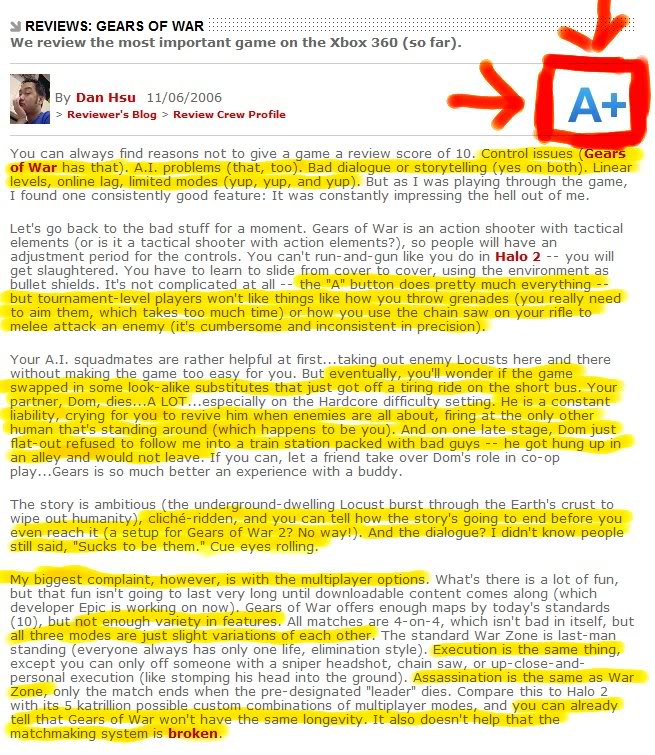
I was looking up Greg Tito's infamous Dragon Age II review (which I personally don't have a problem with because he really seemed to love it) and stumbled across this gem of a review, which is the sort of thing I personally hate about far too many video game reviews.


I don't care if you love or hate Gears of War, but if you give an A+ review to it, I expect to see a ton of love on display in the written review. If you give an F, I expect to see a ton of hate. It drives me nuts when the written review is describing a C game and clearly giving the game a much higher score.

This is why I take a bit of issue with Greg Tito's GTA V review. It's not that he didn't like it, it's so clear from the written review that he didn't enjoy the game that his 7/10 displays a certain lack of courage. But considering how insane some folks went over a 7, I almost can't blame him.
 

Atmos Duality

New member
Mar 3, 2010
8,470
0
0
erttheking said:
Let's be perfectly honest. People can dress it up however they want "Be objective" "Don't be biased" "Focus on what the consumer wants" It's all window dressing.
I wasn't aware I was being dishonest here.

Really people are saying "People keep talking about the portrayal of non-white male heterosexual characters and I don't care about that and I want them to shut up." Most of them will never admit it though.
I agree that definitely occurs, though I don't entirely blame them either given the amount of Genetic Fallacy being slung everywhere.

"Games misrepresent me, therefore: Gamers are misogynist! Gamers are insular bigots! Gamers are over!"
I'd get sick of that shit too...hell, I AM sick of that shit already.

There are plenty of people out there who really do want better "Ethics" in journalism, but plenty of people just talk about "ethics" to say "don't talk about this thing I'm not invested in and dislike."
The subject of ethics in gaming journalism* appears to have morphed into some sort of metaphysical boomerang; throw it out there, and it flies right back at you.

I don't think it's unfair to request better disclosure of potential ethical issues; like conflicts of interest in reviews.
Perspective and objectivity aren't absolute requirements in criticism, but neither can they be discounted either.

Then again, it appears what I (or anyone else) thinks is fair or unfair does not matter at all if it doesn't serve some social-political narrative. Small wonder nothing changes, let alone for the better.

(*or gaming press, more accurately; virtually none of them have journalism degrees or anything more than the barest understanding of what journalism actually is)