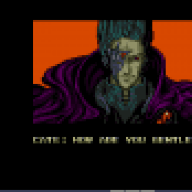
That was sort of my point. You don't fill in the gaps with black and white movies, you simply accept it as a part of the style. The same goes with games, well at least while you are playing it. I didn't play through Pokemon actively imagining images of being a fully-rendered character in a fully-rendered environment. I accepted the style for what it was. It was stylized, just as cartoons are. I did get quite engrossed, but it wasn't because the limited graphics caused me to see more vivid images or insert my own. It was because I got engrossed in the gameplay and levels. I have loved the graphical improvements with every new installation, the broadened range of styles gives the world even more depth and even more to get lost in. I did to a bit of "role-playing" I guess, but I wasn't really able to do this well until they made a female model available. And even then I didn't really mind the preset look. Immersion relies less on graphics and more on gameplay. It does require a balance, though. The gameplay must be solid and engrossing and the graphics should at the very least not distract from this.Blood Brain Barrier said:How? How could that possibly fit within the gaps of Citizen Kane? I challenge you to try this.Lilani said:Let's say we applied this logic to color and movies. You could argue films were more colorful in the black-and-white days because you could fill in the gaps with your imagination. You could say Citizen Kane was a wild and crazy adventure in technicolor Wonderland where everybody's complection looked like Oompa Loompas and they dressed like the Lollypop Guild.Blood Brain Barrier said:Games went from very low resolution to very high. In low resolution games the dots are bigger which means there is more information you can fill that space with. This meant that you could imagine that the stick figure in Ultima that you are a mighty warrior with streaming hair and shiny, rock-hard abs or the colorful blob in Dragon Quest is a brave Samurai Warrior. In new games, the resolution from sitting distance is high enough to look realistic - that is, it appears the same as looking at an object in the real world. This means that you yourself can only BE one character - the one you are looking at. There is no space for you to fill with your own information. So the more realistic the character we are portraying is, the less it is you. Older games are fueled by your own imagination, and so they are better, in the same way that old tech cartoons are better than new tech ones such as 3D.
That isn't what I was saying at all. I was simply saying we can't know for sure what the ideal level of graphical sophistication would have been for the games of old. What if the original Legend of Zelda game were made today? I'm pretty sure, at the very least, it would look a bit more sophisticated. Same goes with Super Mario Brothers. I don't think those characters looked so simple because Shigeru Miyamoto really had a thing for pixels, or so that they were simple enough for people to use their own imaginations to fill in the blanks. They looked like that because that's all they could do with the graphics of the time. You can even tell he tried his hardest to define who his characters were, but those few stacks of pixels were as far as he could get at the point of delivery.Good point, but not quite there. So all art is aimed at accurately portrayal? What about modern abstract art? We don't know how humans long ago saw other humans. It's possible they found the stick figure the most suitable form.
If the old limited graphics of yesteryear better enable your imagination, I'm afraid it wasn't intentional, at least most of the time. They were just doing the best they could with the tools they had. I'm sure they would have loved to deliver colorful and well-defined characters with sophisticated aesthetics, but they couldn't.