Your favorite philosopher

Recommended Videos

Yarkaz

New member
Aug 22, 2009
182
0
0
Flatfrog said:
Deathmageddon said:
Flatfrog said:
Daniel Dennett.

He gets science and therefore wins.
Intolerant people like him and Richard Dawkins are the reason some 35-40% (it's somewhere around that number, but don't quote me on it) Americans don't believe in evolution.
OK, not wanting to derail the thread but:

What is intolerant about Dennett? Have you read anything he has written? Or Dawkins either, for that matter? They write clearly and simply about their subject in the face of a constant barrage of hatred, bile and actual threats. And just to make it clear, this isn't because of *their* attitude, it's purely because they have the temerity to profess a public belief in evolution - if you don't believe me then look at the abuse David Attenborough, the most softly-spoken, kindly man receives from the same people.

Blaming atheists for other people's ignorance is ridiculous. The reason huge numbers of Americans don't believe in evolution is a dedicated and hugely funded misinformation campaign perpetrated by variously ignorant, misguided or plain malign individuals on a massive scale. And frankly, thank Thor that some people have the courage to stand in the face of it.
I don't think it's just because they're proud of their beliefs, we Christians tend to like Bill Nye and De'Grasse Tyson enough (though Nye has been pretty irritating lately). It's the fact that folk like Dawkins thinks religion is some awful blight on the human mind that drives us away from them. I (and many others like me) actually really don't mind when atheists defend their own views calmly and rationally, it's when they focus less on supporting their own stance and more on degrading everyone else that we get annoyed. People like that only serve to fan flames and piss everyone off, and before anyone mentions it I know that people of all philosophical outlooks, viewpoints, and faiths do this. Dawkins just caught a lot of flak because of... Well, you gut that part right, a smear campaign. But don't think they didn't pick him for a reason, he was a really easy target.

EDIT: Obligatory escapist personal belief disclaimer: Theistic evolutionist, though I grew up a creationist so I understand and sympathize with them far better than most.

 

Grumpy Ginger

New member
Jul 9, 2012
85
0
0
I have to say I really like Epicurus , enjoy the simple things in life and don't worry about death or gods. Unfortunately I think computers and video games come under the whole unnatural and unnecessary tag (he said anything in that category causes unhappiness)so I wouldn't make a very good epicurean.
 

Silvanus

Elite Member
Legacy
Jan 15, 2013
13,960
7,240
118
Country
United Kingdom
Deathmageddon said:
If they *merely* tried to educate people about evolution, that would be one thing, and there would be a lot more theistic evolutionists around. They attempt to use evolution as proof against the existence of God, which, as you can imagine, turns people away.

This is a fundamental misunderstanding of his point. It's not that evolution is "proof against the existence of God", and Dawkins has never claimed such.

The point is that the hypothesis of God is made less and less necessary with every verifiable scientific explanation, evolution being one such. There's a big distinction there. It's a rational standpoint.


Yarkaz said:
it's when they focus less on supporting their own stance and more on degrading everyone else that we get annoyed.
Dawkins does not focus more on "degrading" others than supporting his own stance. The man has written eleven books, and only one of them was about atheism/ religion. The others were various scientific books on biology, evolution and genetics, unrelated to the issue of the religious.

People misrepresent Dawkins and his focus constantly. It gets on my wick. He's far more constructive than he is destructive, but people are always eager to forget the broadness of his scope of work.
 

mbarker

New member
Nov 12, 2008
146
0
0
Lionsfan said:
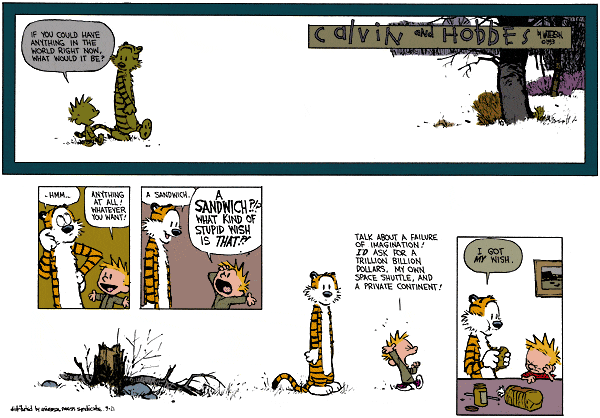
Definitely Hobbes.

I mean, sometimes you just gotta keep things simple, and you'll be happier

Ah... you beat me to the punch...

What better words to listen to other than that of a 6 year old and his sardonic stuffed tiger? I couldn't think of any other characters worthy of such names.
 

axlryder

victim of VR
Jul 29, 2011
1,862
0
0
Silvanus said:
Deathmageddon said:
If they *merely* tried to educate people about evolution, that would be one thing, and there would be a lot more theistic evolutionists around. They attempt to use evolution as proof against the existence of God, which, as you can imagine, turns people away.

This is a fundamental misunderstanding of his point. It's not that evolution is "proof against the existence of God", and Dawkins has never claimed such.

The point is that the hypothesis of God is made less and less necessary with every verifiable scientific explanation, evolution being one such. There's a big distinction there. It's a rational standpoint.


Yarkaz said:
it's when they focus less on supporting their own stance and more on degrading everyone else that we get annoyed.
Dawkins does not focus more on "degrading" others than supporting his own stance. The man has written eleven books, and only one of them was about atheism/ religion. The others were various scientific books on biology, evolution and genetics, unrelated to the issue of the religious.

People misrepresent Dawkins and his focus constantly. It gets on my wick. He's far more constructive than he is destructive, but people are always eager to forget the broadness of his scope of work.
I can at least sympathize with people's negative conception of certain prominent atheists, less so because of the men themselves and more so because of the rabid, atheistic fanaticism surrounding them and their views. If you try and google Tyson or Russel, for instance, then you'll be mercilessly bombarded by arrogant atheists treating these men like some kind of mascot, often times to the point of misrepresentation. The body of their work is instantly buried beneath their claims against religion, when often times such stances are merely a byproduct or a small part of their main body of work. Tyson, if I recall, has tried to distance himself from the atheist community because of his frustration with this phenomenon.
 

axlryder

victim of VR
Jul 29, 2011
1,862
0
0
Flatfrog said:
axlryder said:
Googling Dennett, all I'm seeing is a bunch of videos on atheism. Could you elucidate what other "philosophical" contributions he's made outside of his criticisms of religion? More specifically, what is it that he's said/done which resonates with you personally outside of religious denouncement/criticism?
Well, he's best known for two books, Darwin's Dangerous Idea and Consciousness Explained, which are both excellent. In terms of pure philosophy, my favourite work of his is Freedom Evolves, which is an in-depth look at the question of free will and determinism and whether the two can be reconciled (which he believes they can, and argues it very convincingly)

Many of my friends at university were philosophy students and they were all irritating. You could never have a proper conversation with them because they would pick you up on the smallest logical error. What I like about Dennett is that he never seems to be playing that game. He's great at puncturing preconceived notions of philosophers (particularly the idea of 'philosophical zombies' - things that act just like people but have no conscious experience) but mostly he just makes interesting points clearly, concisely and often wittily.

His most important contribution to philosophy in my opinion is the concept of the various 'stances' you can take towards other things in the universe - as a way of avoiding the question of what something actually is; rather similar to Aristotle's classification of causes. So when faced with an object, you can face it with the physical stance: you can just treat it as a set of atoms obeying physical laws. You can always do this, but it doesn't have much explanatory power. You can also take the design stance - that's when you imagine that the object is 'for' something, and try to explain its properties in that way. Finally, you can take the intentional stance, which is to imagine that the object 'wants' something - it has beliefs and desires. If taking the intentional stance has some predictive power, he argues, then it is useful, whether or not it is actually true.

That's it in a nutshell, anyway. I hugely recommend him. I first encountered his work through the book he co-authored with Douglas Hofstadter, my all-time scientific hero, and I've never read anything by him I didn't like. Even Breaking The Spell, his book on religion, is interesting and an original take on the subject - he dares to ask the question of whether religion might be a good or bad thing independent of its truth.
Thanks, good explanation. I'll probably pick up a book of his at some point down the road.
 

Hap2

New member
May 26, 2010
280
0
0
Hard to choose, I just finished my undergraduate degree in philosophy.

I can think of six that have been most influential on my thought (in no particular order): Wittgenstein, Nietzsche, William James, Foucault, Shunryu Suzuki, and Nagarjuna. For various reasons of course, though writing them would take more time than I have right now to spare.

I've yet to find any particular philosopher I really dislike (I don't count Ayn Rand as one). I hold a soft spot for Diogenes of Sinope, I admit. You have to somewhat admire a man, on some perverse level, who gathers a crowd while speaking on virtue only to suddenly stop and literally take a dump right there and then in front of everyone, scaring them all off. I'm also fond of the works of Heidegger, if not the man, with his outlook on nature and art, and I enjoy the works of Camus and some of the other existentialists (Sartre is okay, but some of his arguments are rough; De Beauvoir is much more articulate). And, of course, one cannot forget Socrates.
 

Flatfrog

New member
Dec 29, 2010
885
0
0
Deathmageddon said:
I'll admit, I'm more familiar with Dawkins than Dennett, but they are two of the "Four Horseman of New Atheism," New Atheism being, by definition, completely intolerant of religion (sentence 1 on the wikipedia page).
I think you're misusing the word 'intolerant' here. What Dawkins does (and Hitchens did and Dennett does to a sgnificantly lesser extent) is to *reject* religion, and to refuse to *respect* it. So they reject the notion that someone's faith is inherently immune from challenge or criticism - what's more, they insist that the scientific method is precisely the right tool to use to make those challenges.

You can contrast this with, for example, Stephen Jay Gould's approach, which was to divide science and religion into two 'non-overlapping magesteria'. In his view, science dealt with how the world is and with issues of factual truth, while religion dealt with matters of ethics and morality ("is" and "ought", if you like). Unfortunately, Gould's compromise solution doesn't satisfy either side, since many religious opponents believe that the Bible does deal with factual matters, such as the creation, while the New Atheists ('Brights' as they sometimes like to call themselves) challenge the idea that religion has anything to tell us about morality.

Deathmageddon said:
If they *merely* tried to educate people about evolution, that would be one thing, and there would be a lot more theistic evolutionists around. They attempt to use evolution as proof against the existence of God, which, as you can imagine, turns people away. Their work reinforces the lie that science inherently rejects metaphysical claims. In reality, such claims cannot be evaluated using the scientific method (not falsifiable).
I don't think that's really stating it fairly. Dawkins doesn't claim evolution is proof against the existence of God, just that it's proof against creationism, which is one of the principal arguments that people use in favour of the existence of God. He's explicitly said that he has no problem with the 'metaphysical' God - the 'principle of goodness', one might say; an ineffable something that makes life wonderful. It's when religious claims fly in the face of clear evidence that he rejects them - and he just refuses to toe the line that we have to be polite about it. And, like Hitchens, he opposes many of the clear evils of religion, such as sectarian violence and the Catholic church's opposition to condoms.

Dennett, meanwhile, tends to stay out of these things altogether. His approach to religion is far more hands-off.

Deathmageddon said:
I'm not blaming atheists in general. I would love to hear more about this "hugely funded misinformation campaign perpetrated by variously ignorant, misguided or plain malign individuals on a massive scale" you THINK exists, because last time I checked, public schools only teach evolution. And I wouldn't be thanking Thora - dude had to dress in drag just to retrieve his little club. :p
Well, public schools (in the US) still only teach evolution by the skin of their teeth in the face of huge opposition and several court battles. As for the misinformation campaign, well, I'm afraid you don't have to look terribly far. Start with the Discovery Institute ($4 million annual budget) and work your way out. Take a look at how Fox News treat Dawkins whenever he's featured, or how they endorse the teaching of creationism (http://mediamatters.org/video/2011/08/19/fox-news-hosts-endorse-teaching-creationism-alo/183811).

The sad thing is, the theory of evolution is so beautiful, far better than any ludicrous creation myth. It's a sad situation that anyone should be having these debates in the 21st century.
 

Faelix

New member
Mar 22, 2013
30
0
0
Witty Name Here said:
There are a few philosophers I generally like.

St. Thomas Aquinas is one of the bigger ones I support; I really agree with his opinion on the intention behind an action being as important as the action itself, his theory on what constitutes a "just war" is also pretty agreeable in my opinion.

Other then Thomas Aquinas, I can also respect Laozi (assuming he's real, of course). I think that Taoism is a very noble and interesting philosophy, unfortunately it's for a much better man then me. I believe I'm too ambitious to practice it in day to day life, still I can respect it.

Karl Marx is another good one. His insights into what causes economic crashes are astounding, and despite disagreeing with him on the whole "communism" thing, he does present a decent case.

Finally, Leo Tolstoy. I have an incredible amount of respect for the man. His ideas may have required a "community of saints" to live up to, but they were very noble. I'd love to read more of his books some time.
Flatfrog said:
Deathmageddon said:
Flatfrog said:
Daniel Dennett.

He gets science and therefore wins.
Intolerant people like him and Richard Dawkins are the reason some 35-40% (it's somewhere around that number, but don't quote me on it) Americans don't believe in evolution.
OK, not wanting to derail the thread but:

What is intolerant about Dennett? Have you read anything he has written? Or Dawkins either, for that matter? They write clearly and simply about their subject in the face of a constant barrage of hatred, bile and actual threats. And just to make it clear, this isn't because of *their* attitude, it's purely because they have the temerity to profess a public belief in evolution - if you don't believe me then look at the abuse David Attenborough, the most softly-spoken, kindly man receives from the same people.

Blaming atheists for other people's ignorance is ridiculous. The reason huge numbers of Americans don't believe in evolution is a dedicated and hugely funded misinformation campaign perpetrated by variously ignorant, misguided or plain malign individuals on a massive scale. And frankly, thank Thor that some people have the courage to stand in the face of it.
I'm a Christian and a European, so I don't follow too closely these things you mention about misinformation. I assume you are talking about America.

Regarding Dawkins, in his younger days he came out very enthusiastically about Darwinism and the survival of the fittest. He soon found himself used by rightwings with neonazi like ties, I think some Austrian groups. Not wanting to be misused like Nietsche, he made a documentary. Called Nice guys finish first (http://en.wikipedia.org/wiki/Nice_Guys_Finish_First).

It was about altruism, and how cooperation and the ability to trust one another ultimately rewards fruits that the selfish individual can't have.

So far so good.

The thing is, here on his old days, it has become clear to him that he is not going to go down in history as the guy who dismantled religion. This has in my eyes, turned him more and more hostile and aggressive as he surely had his academic sights set on that prize.

Last I heard from him, he was trying to gather the trolls of the internet, and wanted them to unite in attacks and verbal abuse against Christians and mock them. (a link here from the first google result I found http://finkorswim.com/2012/03/29/richard-dawkins-urges-others-to-ridicule-and-show-contempt-for-religion/)

Now, what was it about nice guys finishing first? Is Dawkins not a nice guy, and thus destined to lose by his own words? Or was he wrong right from the start and evil shall prevail in the form of his own doing?

My God says; He who has, shall be more given and he shall have in abundance. And he who thinks he has, from him shall be taken even that which he thinks he has.

Sounds to me like Dawkins became the latter in that teaching. He has lost what he thought he had.
 

Flatfrog

New member
Dec 29, 2010
885
0
0
Faelix said:
I'm a Christian and a European, so I don't follow too closely these things you mention about misinformation. I assume you are talking about America.

...

The thing is, here on his old days, it has become clear to him that he is not going to go down in history as the guy who dismantled religion. This has in my eyes, turned him more and more hostile and aggressive as he surely had his academic sights set on that prize.

Last I heard from him, he was trying to gather the trolls of the internet, and wanted them to unite in attacks and verbal abuse against Christians and mock them. (a link here from the first google result I found http://finkorswim.com/2012/03/29/richard-dawkins-urges-others-to-ridicule-and-show-contempt-for-religion/)

Now, what was it about nice guys finishing first? Is Dawkins not a nice guy, and thus destined to lose by his own words? Or was he wrong right from the start and evil shall prevail in the form of his own doing?
Well, I'm European too, but I do follow these things a fair bit, and I'm a long-time Dawkins fan (I certainly largely credit him with turning me from a disinterested agnostic into a fairly hard-core atheist).

I don't know if he ever wanted to be 'the guy who dismantled religion' but it's true that he's been a fervent atheist for as long as he's been famous - he gave a talk at my school once, many years ago, and stated baldly that Darwin's theory disproved God; he's eased off on that claim since then.

But although lots of people call him 'hostile and aggressive' and many other things ('strident' is a common one), he really isn't. He's actually quite softly-spoken and pleasant. He just doesn't respect faith. He thinks the whole notion is stupid and doesn't understand why he should be expected to tiptoe around it.

The example you gave is a case in point. I just looked the speech up and here is what he actually said:

So when I meet somebody who claims to be religious, my first impulse is: ?I don?t believe you. I don?t believe you until you tell me do you really believe ? for example, if they say they are Catholic ? do you really believe that when a priest blesses a wafer it turns into the body of Christ? Are you seriously telling me you believe that? Are you seriously saying that wine turns into blood?? Mock them! Ridicule them! In public!
Don?t fall for the convention that we?re all too polite to talk about religion. Religion is not off the table. Religion is not off limits.
And I think that's a perfectly valid point. He's not calling on people to be trolls. He's just saying 'let's stop being so generous to ridiculous ideas'. And I agree with him. I think very, very few people *really* believe the things they profess to believe. They call it faith, which is just another word for a mental disconnect: believing something that you know to be irrational. I don't need to believe in my table. I can see the damn thing in front of me. I don't need to believe in evolution - the world is full of ample proofs of its existence. So if you profess to believe in something as idiotic as wine turning into blood, then yes, you deserve to be ridiculed for it. And if you *really* believe in it, then isn't that insanity?

Edit: I just went back and read the whole speech. It really is a corker and I recommend it.
http://ladydifadden.wordpress.com/2012/03/28/transcript-of-richard-dawkins-speech-from-reason-rally-2012/
 

Jacques Joseph

New member
Nov 15, 2012
70
0
0
Well... Dawkins always seemed pretty agressive to me but then again, I never got really deeply involved with that question (I live in Europe in a country that is very atheistic in general so it always seemed a bit distant to me).

Flatfrog said:
And I think that's a perfectly valid point. He's not calling on people to be trolls. He's just saying 'let's stop being so generous to ridiculous ideas'. And I agree with him. I think very, very few people *really* believe the things they profess to believe. They call it faith, which is just another word for a mental disconnect: believing something that you know to be irrational. I don't need to believe in my table. I can see the damn thing in front of me. I don't need to believe in evolution - the world is full of ample proofs of its existence. So if you profess to believe in something as idiotic as wine turning into blood, then yes, you deserve to be ridiculed for it. And if you *really* believe in it, then isn't that insanity?

Edit: I just went back and read the whole speech. It really is a corker and I recommend it.
http://ladydifadden.wordpress.com/2012/03/28/transcript-of-richard-dawkins-speech-from-reason-rally-2012/
I´m not sure if the point is really that valid. What is being criticized is not really the core of christian belief. And I know transubstantiation is the official doctrine but you have to see it in its real context - transubstantiation in opposition to the Eucharist as, e.g. a simple commemoration. The transformation is still understood on a symbolic level (which does not mean it has only "symbolic" value in the sense we usually give to the word - I´m talking about symbols perceived as means that allow us to reach the transcendental). Also, the strict insistence on transubstantiation was without doubt part of a "political" struggle during the time of Reformation.
Neither is the real point literal belief in the creation of the world in seven days (allegoric interpretation, anyone?), for that matter. The real point should be belief in the existence of God - I mean, I know that is not the only thing a Christian believes in but again, see the context of the discussion, the opposing view is atheism, i.e. belief in the non-existence of God. That should be what is adressed, some wafer turning into the body of Christ or not has no relation to it whatsoever.
That´s a problem I have with a lot of those "new atheists" in general, they tend to criticize the most narrow-minded a fundamentalist form of religion. That in itself is perfectly OK and I´m the first to agree with them, but then they shouldn´t pretend to be criticizing religion as a whole or the existence of God (or a god?) because these are different matters.

Furthermore, belief is not only mental disconnect but a central part of how we perceive the world. Whatever your world-view, there are always unquestioned presumptions, or in other words, beliefs (I´d recommend reading Quine, which would probably be my favourite philosopher, to answer the OP :) ). Most of those unquestioned beliefs seem so absolutely obvious that it would be impossible to question them but that doesn´t necessarily make them true or "certain" (see Wittgenstein´s On Certainty, another favourite of mine). I´m not falling into total relativism here (neither are those authors but the argument to demonstrate that would be too long to expose here), just trying to say that it´s not so easy to go from faith to insanity (which, by the way, is also a non-trivial notion, formed mostly by the world-view of society and very easily abusable to oppress and silence the voices you do not like - see Foucault, although I´m not that familiar with him).
 

Nieroshai

New member
Aug 20, 2009
2,940
0
0
Mycroft Holmes said:
Jesus Christ.

And hopefully to prevent this from turning into a religious discussion: I am an agnostic. I make no claims that he is or isn't divine. I make no claims that he is or isn't a real person historically rather than just an amalgamation of ideas and stories attributed to a name. For all intents and purposes, barring discovery of time travel, he is a real person historically speaking, and probably the most important Philosopher that has yet lived on this island we call Earth.

One could easily spend hours dissecting the philosophies and ideas attributed to him as well as his profound effect on religion and society. But he's my favorite philosopher for a much more limited reason than that. The birthing of an idea ignored for a long time before it was re-popularized by Count Leo Tolstoy in his Kingdom of God Essays. An idea that I sincerely hope continues to grow in popularity, as it has been, and changes the way we treat our fellow human beings.

Every single non-violent movement every pacifist has stemmed from Jesus' sermon on the mount speech. The idea that the only way to break the cycle of violence is to replace it with one of love. That we should turn the other cheek, to not back down but to not respond in kind to those who would hurt us. The US civil rights movement, the Indian independence movement, the mothers of the Plaza de Mayo, the velvet revolution, the Rosenstrasse protest in the heart of Nazi Berlin; are all heritage from that simple idea.
I am, of course, not trying to pick a fight. I just want to be sure you really fully respect Jesus as an agnostic.

Jesus is often claimed by nonbelievers (and those not sure, like yourself) to have been a profoundly good and wise man even if he was not divine. But some points must be made.
1. He claimed to be the son of God.
2. He claimed to be capable of miraculous deeds, and made no effort to convince others his deeds were normal.
3. He told others that if they believed strongly enough, they could do what he did.

With this being said, the conclusion rises: if he wasn't divine, was he truly a good man? He lied, he indentured many into servitude through the claim that he was a demigod. He openly defied the law, on the mere justification that his way was better. If he was sane, and not divine, how could he possible be a good man?

But what if he really believed what he said, and was not divine? Then he must have been insane. His literal belief that he was the son of God led him to insurrection, wild claims, and causing chaos both in Rome and Judea.

The point I'm trying to make is that Jesus is only worth looking up to if he was divine. Otherwise, he was either a superb con man who got caught in the end or a lunatic. Or else, he was just a character in a book, in which case he was never a man to begin with. Of course, I love philosophical discussion and if you feel otherwise, I'd love to chat.
 

Nieroshai

New member
Aug 20, 2009
2,940
0
0
I love the philosophy of Socrates, most of all because it makes a great tool through which to view the world, not just a series of profound teachings. Many philosophers give answers, but Socrates taught men how to find their own answers.
 

Flatfrog

New member
Dec 29, 2010
885
0
0
Jacques Joseph said:
I´m not sure if the point is really that valid. What is being criticized is not really the core of christian belief. And I know transubstantiation is the official doctrine but you have to see it in its real context - transubstantiation in opposition to the Eucharist as, e.g. a simple commemoration.
I think this is a really important point, but isn't it exactly the point he's making? He's asking the question:

When you say you're a Christian, what do you *really* mean? Because that is a very broad spectrum. Do you just mean 'I'm a good person who believes in the principles of tolerance and simple living espoused by Jesus of Nazareth'? If so, then I'm a Christian too. Or do you mean 'I believe in the existence of a personal deity who answers prayers and will reward me in the afterlife'? Because there I disagree with you but I'm not going to get into an argument about it (and I suspect neither particularly would Dawkins). Or do you mean 'I believe in a supreme being who created the world in seven days and who placed dinosaur fossils in the earth to test my faith'? Because then I'm prepared to argue quite strenuously with you and claim that your belief system isn't just wrong but logically flawed.

But that's not the discussion we have in the real world. In the real world, people say 'I'm a person of faith' and that is supposed to be the end of all argument. And *That* is what I disagree with, and what Dawkins is trying to combat.

My son's desperately waiting to use the computer now so I'd better go - but I'll return to talk Wittgenstein with you later, with the greatest of pleasure!
 

Nieroshai

New member
Aug 20, 2009
2,940
0
0
Jacques Joseph said:
Well... Dawkins always seemed pretty agressive to me but then again, I never got really deeply involved with that question (I live in Europe in a country that is very atheistic in general so it always seemed a bit distant to me).

Flatfrog said:
And I think that's a perfectly valid point. He's not calling on people to be trolls. He's just saying 'let's stop being so generous to ridiculous ideas'. And I agree with him. I think very, very few people *really* believe the things they profess to believe. They call it faith, which is just another word for a mental disconnect: believing something that you know to be irrational. I don't need to believe in my table. I can see the damn thing in front of me. I don't need to believe in evolution - the world is full of ample proofs of its existence. So if you profess to believe in something as idiotic as wine turning into blood, then yes, you deserve to be ridiculed for it. And if you *really* believe in it, then isn't that insanity?

Edit: I just went back and read the whole speech. It really is a corker and I recommend it.
http://ladydifadden.wordpress.com/2012/03/28/transcript-of-richard-dawkins-speech-from-reason-rally-2012/
I´m not sure if the point is really that valid. What is being criticized is not really the core of christian belief. And I know transubstantiation is the official doctrine but you have to see it in its real context - transubstantiation in opposition to the Eucharist as, e.g. a simple commemoration. The transformation is still understood on a symbolic level (which does not mean it has only "symbolic" value in the sense we usually give to the word - I´m talking about symbols perceived as means that allow us to reach the transcendental). Also, the strict insistence on transubstantiation was without doubt part of a "political" struggle during the time of Reformation.
Neither is the real point literal belief in the creation of the world in seven days (allegoric interpretation, anyone?), for that matter. The real point should be belief in the existence of God - I mean, I know that is not the only thing a Christian believes in but again, see the context of the discussion, the opposing view is atheism, i.e. belief in the non-existence of God. That should be what is adressed, some wafer turning into the body of Christ or not has no relation to it whatsoever.
That´s a problem I have with a lot of those "new atheists" in general, they tend to criticize the most narrow-minded a fundamentalist form of religion. That in itself is perfectly OK and I´m the first to agree with them, but then they shouldn´t pretend to be criticizing religion as a whole or the existence of God (or a god?) because these are different matters.

Furthermore, belief is not only mental disconnect but a central part of how we perceive the world. Whatever your world-view, there are always unquestioned presumptions, or in other words, beliefs (I´d recommend reading Quine, which would probably be my favourite philosopher, to answer the OP :) ). Most of those unquestioned beliefs seem so absolutely obvious that it would be impossible to question them but that doesn´t necessarily make them true or "certain" (see Wittgenstein´s On Certainty, another favourite of mine). I´m not falling into total relativism here (neither are those authors but the argument to demonstrate that would be too long to expose here), just trying to say that it´s not so easy to go from faith to insanity (which, by the way, is also a non-trivial notion, formed mostly by the world-view of society and very easily abusable to oppress and silence the voices you do not like - see Foucault, although I´m not that familiar with him).
I love your analysis. It's refreshing to see an acknowledgement that nothing can be absolutely certain, at least not from our limited human perception. I used to be an atheist; hell, I was an arrogant one at that. But the more I dived into science, the more I realized that while we can learn, codify, measure, and write run-on sentences, acting like we can ever know or even be certain of it all is pure arrogance. To quote a game that makes few other valid points (and yes that one book they took it from), "Nothing is true, everything is permitted." Or as I think of it, nothing is absolute and everything is possible. Damn, quantum physics hurts my brain. I won't go into what I believe now, but it's the only belief system I could Socratically justify.
 

Jacques Joseph

New member
Nov 15, 2012
70
0
0
Flatfrog said:
When you say you're a Christian, what do you *really* mean? Because that is a very broad spectrum. Do you just mean 'I'm a good person who believes in the principles of tolerance and simple living espoused by Jesus of Nazareth'? If so, then I'm a Christian too. Or do you mean 'I believe in the existence of a personal deity who answers prayers and will reward me in the afterlife'? Because there I disagree with you but I'm not going to get into an argument about it (and I suspect neither particularly would Dawkins). Or do you mean 'I believe in a supreme being who created the world in seven days and who placed dinosaur fossils in the earth to test my faith'? Because then I'm prepared to argue quite strenuously with you and claim that your belief system isn't just wrong but logically flawed.
I´d be prepared to argue with the last one, too, even though I´m not that sure it has to be logically flawed but that would be nitpicking. There´s obviously empirical evidence, common sense, Ockham´s razor and what not to argue against such an opinion so I think we´re in agreement here.


Flatfrog said:
But that's not the discussion we have in the real world. In the real world, people say 'I'm a person of faith' and that is supposed to be the end of all argument. And *That* is what I disagree with, and what Dawkins is trying to combat.
As I´ve said, given my background, living in a mostly atheist country that does not care that much about political correctness, I´ve never been in this discussion, which is why I didn´t see that aspect of the argument. That of course puts the whole thing in a different light, though I´d still argue that it would be good to make a clearer distinction. First, such an argument isn´t that much about the non/existence of God but about religion, and second, only about a very specific form of religion which a lot of reasonable religious people would be ready to argue against as well. I don´t mean to be quarelling over words but the way in which the problem is presented can, I think, lead to misunderstandings. For example, in the speech transcript you posted a link to, Dawkins comes across as saying that all religion (in general) only serves to perpetrate lies and obscurantism, using narrow-minded Christian fundamentalism as a strawman to prove his point.

Anyway, I´ll be looking forward to exchanging some views on Wittgenstein!
 

Mycroft Holmes

New member
Sep 26, 2011
850
0
0
Nieroshai said:
I am, of course, not trying to pick a fight. I just want to be sure you really fully respect Jesus as an agnostic.
You should try to pick ones more often, I love arguments. An idea that can't stand up to being argued about is one not worth having.

Nieroshai said:
Jesus is often claimed by nonbelievers (and those not sure, like yourself) to have been a profoundly good and wise man even if he was not divine. But some points must be made.
1. He claimed to be the son of God.
2. He claimed to be capable of miraculous deeds, and made no effort to convince others his deeds were normal.
3. He told others that if they believed strongly enough, they could do what he did.

With this being said, the conclusion rises: if he wasn't divine, was he truly a good man? He lied, he indentured many into servitude through the claim that he was a demigod. He openly defied the law, on the mere justification that his way was better. If he was sane, and not divine, how could he possible be a good man?

But what if he really believed what he said, and was not divine? Then he must have been insane. His literal belief that he was the son of God led him to insurrection, wild claims, and causing chaos both in Rome and Judea.

The point I'm trying to make is that Jesus is only worth looking up to if he was divine. Otherwise, he was either a superb con man who got caught in the end or a lunatic. Or else, he was just a character in a book, in which case he was never a man to begin with. Of course, I love philosophical discussion and if you feel otherwise, I'd love to chat.
To put it short, it is my opinion that Jesus was just a guy(or several people reordered into a single person) who had a lot of ideas that he told a lot of people. He developed some following, and after his death people made books about what he said, but they were religious texts so like all such stories, they were spruced up to make them more mystical and to make their ideas have more 'pull' as it were.

A large portion of the Jesus story bears a striking resemblance to other 'myths' as pointed out by The Zeitgeist as well as other far more reputable sources. Sons of gods wasn't exactly a new thing, Perseus, Hercules. Virgin births isn't a new thing(also fun fact: the term virgin has changed in the current venacular, it used to simply mean 'not married' and had nothing to do with sex at all.) Osiris was resurrected after 3 days, he walked on water, he was the lamb of god, he cured the sick, three kings/wise-men came to his birth. The story of Jesus reads like it was assembled in the exact same way as stories of other holy men.

The background story is far from unique and far from new, but the idea's were shockingly new and radical even by todays standards. So as I said before it would seem to me someone came up with those ideas, spread them around, gained something of a cult following, and then was rewritten to be divine after his death. Because we always are more willing to listen to the far out there stories more than the mundane. So I would contend that Jesus likely never said any of the points you made and ipso ergo was not a liar.

Spreading radical idea's about peace, tolerance and good will towards all men is more than enough to get a person killed by the powers that be. Look at reggae stars, they tell that message every day, and Bob Marley gets shot at with a sniper while on stage.
 

MeisterKleister

Regular Member
Mar 9, 2012
98
0
11
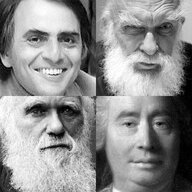
Daniel Dennett (3rd picture in my avatar); he explains consciousness and the purpose of life using science.

As for debates, I love listening to Matt Dillahunty (former president of the Atheist Community of Austin).
He is the best debater I have seen; an eloquent and fierce advocate of skepticism and critical thinking; and one of the best defenders of reason today, in my humble opinion.
http://www.youtube.com/results?search_query=Matt+Dillahunty&page=&utm_source=opensearch