I didn't say you were a troll I said your post felt like either a troll, or someone who hadn't looked into it to me because the " irreducible complexity" * think that's the name of what your talking about* argument has been done to death There's like 30 videos in that series pretty sure they get pretty in depth about things, also look up PZ meyers or read Origins of species.Mimsofthedawg said:ok, so I watched the video, and the basic problem that I have with it is that it's a narrow minded view of how the biology of a developing animal works. To put it simply, you can't just have a single layer of cells that suddenly develops into an eye simply because it gets more "concave" or lens grow over it or whatever. each part of those things are created from entirely different segments of a developing fetus. The human eye, for example, is composed of several different materials, ranging from muscles to nerves to dense connective tissue. There are also distinct differences in eye structure from a "primitive group of light sensitive cells" as compared to a complex eye. For example, how is it that a nervous system developed with all its intricacies that it would be able to connect to the brain to process the information? And don't get me started on hormones, which in a developing animal turn "on" or "off" a variety of different genes. Oh and there's the different layers of cells in a fetus. and and and... There's just too much for something to spontaneously be created like that. it's not like we're talking about "the dampening of the light sensitive patch, creating an area better suited for movement". We're talking about thousands of different processes that have to change simultaneously in order to achieve a simple result. I just don't see how it could logically happen.Ben Hussong said:Heck, Darwin explained it way back when he wrote origin of speciesMimsofthedawg said:ok, will do, I'll get back to you in a moment.Ben Hussong said:Okay there are SO many explanations for this i almost didn't bother posting this since you broadcaster either " troll" or " didn't bother to see if my argument was valid" Seriously google "The evolution of the human eye" or watch the video series " why people laugh at creationists" as i recall it explains this sort of thing pretty well.Mimsofthedawg said:I just don't buy it... look at the complexities of a human heart and explain to me how natural selection and random genetic mutations created such a perfect organ. Chiefly, explain to me how come "evolution" chose such a complex mechanism when a whole host of other systems could work. Every loop, crevis, nook, cranny, detail (both large and small) has a unique purpose in the heart. Not to mention over a single individuals life the heart "evolves". The heart of a fetus is RADICALLY different from the heart of an adult... How does that spring up from natural selection? I sincerely makes about as much sense to me as my creamy mashed potatoes spontaneously covering themselves with butter, gravy, pepper, and salt... and then giving me the steak and broccoli too.randomsix said:If the first paragraph above were true, then there would be no evolution. To my knowledge it is not.omega 616 said:If animals eat the weakest or an abnormal baby did these evolutions occur? Surely the mother would have seen the mutation and eaten it.
If I made a new animal, which had no defence or offense, then plonked it down in the animals version of hells kitchen (Aus) how would it evolve and adapt to the enviroment? If it gets eaten then it can't send a message to it's kids saying "evolve a way to stop being eaten. It sucks!", so how does it over many generations evolve the ability or a way to stop it'self being food?
That isn't how evolution works. You take an existing animal and nature keeps killing off the members of its species that are the worst at surviving. The result is that ones with traits which are better suited to the environment live and give those traits to their children.
I'm not sure where you got this idea of evolution, but it isn't good. If my explanation isn't good enough, I suggest you find some entry level text and read that.
It's not necessarily that I believe in anything else, I just don't understand how this could happen.
I guess life's a miracle... but aren't miracles from God? hmmm...............
And I'm not a troll and I'm not an idiot. I'm actually a bio-engineer major. In order to make these accusations on the evolution of something as "simple" as an eye, you have to make a lot of assumptions... and I'm sorry if I'm skeptical that I don't think the other 999 things have to also be changed for the change in the 1000th thing to work properly.

Evolution
- Thread starter omega 616
- Start date
Recommended Videos

I believe the fundamental misunderstanding you have is apparent in the first sentence above. It's not like the heart just happened like throwing a 6 twenty times in a row would happen. It's not about just random in the sense that all mutations are equal. If a mutation is bad, it dies off.Mimsofthedawg said:I just don't buy it... look at the complexities of a human heart and explain to me how natural selection and random genetic mutations created such a perfect organ. Chiefly, explain to me how come "evolution" chose such a complex mechanism when a whole host of other systems could work. Every loop, crevis, nook, cranny, detail (both large and small) has a unique purpose in the heart. Not to mention over a single individuals life the heart "evolves". The heart of a fetus is RADICALLY different from the heart of an adult... How does that spring up from natural selection? I sincerely makes about as much sense to me as my creamy mashed potatoes spontaneously covering themselves with butter, gravy, pepper, and salt... and then giving me the steak and broccoli too.randomsix said:If the first paragraph above were true, then there would be no evolution. To my knowledge it is not.omega 616 said:If animals eat the weakest or an abnormal baby did these evolutions occur? Surely the mother would have seen the mutation and eaten it.
If I made a new animal, which had no defence or offense, then plonked it down in the animals version of hells kitchen (Aus) how would it evolve and adapt to the enviroment? If it gets eaten then it can't send a message to it's kids saying "evolve a way to stop being eaten. It sucks!", so how does it over many generations evolve the ability or a way to stop it'self being food?
That isn't how evolution works. You take an existing animal and nature keeps killing off the members of its species that are the worst at surviving. The result is that ones with traits which are better suited to the environment live and give those traits to their children.
I'm not sure where you got this idea of evolution, but it isn't good. If my explanation isn't good enough, I suggest you find some entry level text and read that.
It's not necessarily that I believe in anything else, I just don't understand how this could happen.
I guess life's a miracle... but aren't miracles from God? hmmm...............
And a the heart as a perfect organ? Really? People's hearts break down and people have heart attacks every day. Hell my heart grew with a goddamn hole in it. If that's perfection to you I don't want to know what you would accept as adequate.
You also have to remember the kind of timescales we are talking about here. Think on the order of hundreds of millions of years. Given the proliferation of early (precambrian and cambrian) life, it's not all that far fetched to say that everything happened randomly. After all, sit a monkey down at a typewriter and its only a matter of time until it finishes Hamlet.
And about your argument; it's an argument from ignorance, which is universally recognized as invalid by philosophers. It boils down to: I, personally, don't understand how this could happen on its own, so therefor someone must be responsible.
And even the eye: Start with a patch of light sensitive cells, then add a clear protective coating, next is increased object recognition, then gradual increases in concavity as a lensing effect enhances precision, then a way to move it around with respect to the "head,"... soon enough you get a fully functioning eye through very small alterations. It's not like this is impossible. Even if all of these mutations are random it's possible because every baby born for millions and millions of years has the possibility of advancing the chain.

I say the same thing about you. removing the anti part of course.Aurora Firestorm said:Whoever recommended Dawkins to you, don't listen. Don't support Dawkins. He's an anti-religious fanatic who needs a sanity check.
but I guess we'll have to take your word for it...Mimsofthedawg said:a LONGGGG ass time ago, I once heard a top, atheist scientist refute almost everything that Dawkins said. Twas interesting.
[hr/]
wellll said sir!BioHazardMan said:It's not that you don't have a voice, but people like you take teaching both sides to an extreme. If we have to teach both Evolution AND Creationism, then we will also have to teach "Did the Holocaust actually happen?" or "World War 2, the non-existent hoax of the 20th century"Nieroshai said:Then why is it that when for the sake of knowledge I ask questions like the one right below your last post, I often get yelled at for questioning the most stable scientific law ever discovered? The fact remains that anyone who questions evolution for any reason is given no chance to speak outside friends' circles and religious groups because we never even GET to the part where we counter the theory or propose amendmments. Like how the UN climate research department brags about every single member believing in global warming, when in fact they silently can everyone who disbelieves. I'm just saying, it would be fine if opponents got the chance to speak, but thaat will never happen unless in the name of the scientific method the theory be allowed to be questioned without a witch hunt.BioHazardMan said:Well there we goUszi said:There are actually more historians who deny the holocaust then their are biologists who deny evolution. Fun fact.BioHazardMan said:There is so much evidence for evolution that denying it is like denying the holocaust, most people just automatically deny it in the face of huge evidence because it would bring their faith to shambles.
http://en.wikipedia.org/wiki/Level_of_support_for_evolution
You do have a voice, but it's irrational, so stop trying to put your "theories" into a scientific classroom.
Though I have to agree with you to a certain point, it's important to remain skeptical, which I think you should re-examine yourself.

I think you might have to study a bit harder, chum. Evolution is not a spontaneous process and no one said it was. Life has existed for 3.5 Ga and the very gradual, very slow change of life is evidently seen in the fossil record. Every single organ and type of tissue in your body can be traced back and their gradual sophistication needed to support larger and more complex organisms can easily be studied.Mimsofthedawg said:And I'm not a troll and I'm not an idiot. I'm actually a bio-engineer major. In order to make these accusations on the evolution of something as "simple" as an eye, you have to make a lot of assumptions... and I'm sorry if I'm skeptical that I don't think the other 999 things have to also be changed for the change in the 1000th thing to work properly.
Go back and read the Biology 101 textbook you would have had to buy (if you really are a bio-engineer major) and read the part on evolution again. Actually, read the whole thing again.

it simply becomes better. the better survivor gets more females or males, and thus more children are born with the new traits that make it better, so others are born with the trait, which in turn get more females or males than those without the trait, and on and on and on. who do you think is better at getting food, a rattlesnake sized snake with no venom or one with venom? which one do you think would fend of other males most? thats the one that makes the most babies. i dont get cow though. seriously darwin, what the fuck happened there? to slow to run, to wimpy to fight unless its a bull, but mostly females, and very large. its like if the 1000 pound man was an animal

Well, most of these specific examples are probably wildly inaccurate. Honestly, I think that Giraffes may have not even evolved from horses, I don't remember. Cursory google search says it was probably an antelope or gazelle. I'm just trying to go to an extreme, to demonstrate how even minor differences can accumulate into huge changes over the immense amount of time that evolution works in.Jonluw said:You know, I think we're underestimating the individual differences in a species here.
It's not like the length of the horses' necks vary only by 1 mm between individuals. That would be silly. Take a look at humans: Some are nearly 4 feet tall, some are 6 feet.
I agree with you, yes. I just felt the need to point out that there are significant differences between individuals with animals as well, because I was afraid it might all seem a little too far fetched if 1 mm was to have a significant impact.
I mean, it might, but maybe not.
In truth, evolution would factor in neck size, countless genes for neck size, the different ways a body changes to accommodate a neck size, other advantages to neck size, disadvantages to neck size, complex behavioral interaction in a herd of future giraffes based on neck size, how increasing neck size influenced specific tree varieties, in what order, over what time frame...understanding exactly how it worked is like going through every possible game of chess in the universe. You have to look at broad strategies, and make an educated guess, and keep supporting that guess until it is pretty much guaranteed to be accurate. The 1 MM difference in neck size could be the accumulation of variables akin to a chess game where a pawn is moved 1 space on its first move instead of 2 at one point in the game, leading to a completely different outcome.
I'm sure a book or biology teacher would be more qualified to answer your questions than the average forum poster. Unless, that is to say, your goal was to start a flame war between creationists and evolutionists.

The thing is, it isn't exactly about specifically choosing the horsie with the long neck, it's about the horsie with the long neck surviving comfortably while the others are struggling more. The horsie that can survive with no problem will find a mate while the ones that aren't fairing so well will die of starvation. Then over the course of thousands of years the long-necked horsies continue to survive, reproduce and eventually it builds up to being a giraffe. The shorter-necked horsies fight to survive and over the course of thousands of years die off.omega 616 said:Thats the bit I am not getting. You have these horsies trying to much on the bottom leaves, they all have necks roughly the same size (your not going to be having one horse with no neck and one 20 foot long), are the females walking round thinking "oooh his neck is 1 mm longer than all the others, I shall mate with him!" and the males are thinking "yeah, shes into me but her neck is short as hell! Now her over there has a really long neck but shes not a looker!".
Say all animals are like that, there are no great or very weak, there just all kind of samey. How does the female spider, with venom so weak a flea wouldn't even get dizzy from it choose a mate with slightly stronger venom, how does she know? Same for the male? How do they know "If only I had more powerful venom I could eat that lizard".
Why did the jumping spider decide to make wasps it's main meal? How did it get the ability to jump so far? Why didn't it stick to building a web? How did it learn how to get hold of the wasp but avoid it's sting?
A better example would be wolves and rabbits in an arctic climate. Taking wolves and rabbits with dark fur in a mostly white environment would cause the wolves to stick out like a sore thumb and the rabbits as well. Now, out of some random mutation, some wolves are born with white fur. They blend in better with the environment and they see the rabbits from a distance and sneak up on them. The rabbits get hunted by the white wolves. Because these white wolves are successful at eating, they live and find mates. The darker wolves aren't successful at hunting and starve. Over thousands of years the dark wolves are on the brink of extinction in that particular geographic location.
The rabbits also start giving birth rabbits with white fur, and because they have this natural camouflage, they are better at not being seen by their hunters. And like the white wolves, they survive and are able to reproduce and create more white rabbits. The dark rabbits are easily hunted to extinction just like their dark wolf counterparts die of starvation.
Like I said before, it's not because the female wolves find the white wolves sexy or decide that the white fur is beneficial, it's because they continue to live and are given the opportunity to reproduce and pass on these traits.
As far as humans go, our intelligence to create homes to stay out of the harsh wilderness, grow crops, create farms to raise animals for the slaughter and build tools like cars and weapons allows us to reach our evolutionary peak because even the slowest and dumbest of us can survive by buying food from stores, driving cars to get around and everything else. You see a great deal of deviating in humans, people with different skin tones, hair colors, heights, and different genetic codes, yet we all survive with equal opportunity because our intelligence as a whole has allowed most of us to survive regardless.

Sorry to say, but you really messed out that first quote. I have NEVER said anything BUT that a theory is as good as fact in science. In fact the post you quoted was dedicated to the fact that theory is something that can't be proven wrong and hypothesis is something that have yet to be tested. Good luck next time.Uszi said:Theory is truth in science.Glademaster said:I said it was only a theory and not a truth like some people think which it is. In fact Relativity is just a theory and not a complete one at that. The great thing about Science is there is always something else to add always one more step to take. Being happy with one theory is stupid.
You're quibbling semantics, not science.
Are germs truth?
Are atoms truth?
Evolution is one of the best supported theories around. It draws great support from physics, geology, biology and chemistry.
Oh, I wasn't claiming to know how giraffes evolved. I was just making an example about how a species might develop a long neck.flamingjimmy said:Actually that's not how Giraffe's long necks evolved. You can easily see this simply by observing Giraffes, and noting that most of their food isn't really that high, they don't have to use their full length necks to eat.Jonluw said:The key here is time and large populations. Lots of time.
Imagine if there is a race of horse-like creatures living in fields. They do not eat grass, instead they eat the leaves off trees. Now say there are other creatures living with these creatures in their fields, eating from the same trees. Neither of the two species of creatures are tall enough to reach the leaves at the top, so they all have to compete for the leaves at the bottom of the trees.
Now, just like all humans are different, all (advanced) animals are different as well. This means that - just like with humans - some of the creatures that are born will have a longer neck than the others. Reaching leaves that haven't yet been eaten by other creatures will be marginally easier for the taller animals. This means that specimens with a longer neck will have a slightly higher rate of survival, and will therefore have a higher chance of procreating successfully.
Over the course of thousands upon thousands of years, the species as a whole will obviously end up with longer necks, since a long neck is an inheritable trait.
And then you have giraffes.
Also, think about it, what about baby giraffes? They do alright don't they? Otherwise there'd be no giraffes.
No, giraffes necks evolved for fighting to impress the ladies.
The giraffe comment was just a little quip on the end.
Very much, yes. I just didn't want to make the OP think that the necks of different horses don't vary with more than 1 mm.Xanadu84 said:Well, most of these specific examples are probably wildly inaccurate. Honestly, I think that Giraffes may have not even evolved from horses, I don't remember. Cursory google search says it was probably an antelope or gazelle. I'm just trying to go to an extreme, to demonstrate how even minor differences can accumulate into huge changes over the immense amount of time that evolution works in.Jonluw said:You know, I think we're underestimating the individual differences in a species here.
It's not like the length of the horses' necks vary only by 1 mm between individuals. That would be silly. Take a look at humans: Some are nearly 4 feet tall, some are 6 feet.
I agree with you, yes. I just felt the need to point out that there are significant differences between individuals with animals as well, because I was afraid it might all seem a little too far fetched if 1 mm was to have a significant impact.
I mean, it might, but maybe not.
In truth, evolution would factor in neck size, countless genes for neck size, the different ways a body changes to accommodate a neck size, other advantages to neck size, disadvantages to neck size, complex behavioral interaction in a herd of future giraffes based on neck size, how increasing neck size influenced specific tree varieties, in what order, over what time frame...understanding exactly how it worked is like going through every possible game of chess in the universe. You have to look at broad strategies, and make an educated guess, and keep supporting that guess until it is pretty much guaranteed to be accurate. The 1 MM difference in neck size could be the accumulation of variables akin to a chess game where a pawn is moved 1 space on its first move instead of 2 at one point in the game, leading to a completely different outcome.

There's not enough proof to support the theory of evolution so I try to avoid conversations that assume it's a fact. To many holes too. Its worse than a George Lucas film.
Glademaster said:The thing is Evolution is only a theory(wouldn't be called a theory otherwise) and not fully complete and of badly put across in modern society. Although the general idea of it does exist we can't really say we can from apes. I am sure we have a similar ancestor going back millions of years but then again if you go back far enough we all came from space dust.
><
People misuse the word 'Theory' to much. A Theory within science is considered the truth, because it is based on facts and data gathered from nature.
That you refer a "theory" is in fact a 'Hypothesis'. A hypothesis something that you think might or might not be real, but you have no proof yet. A Scientist will work to try and disprove his Hypothesis, and if he can not then the hypothesis might one day become a Theory.
Also when people say "In theory this should work" or "Theoretically Speaking we can..." they are not guessing or hoping, they are saying that the FACTS are indeed saying it should work. And even if something fail even if the theory was right, doesn't mean the theory is wrong... what about calculation errors?
So yeah people need to understand the bloody meaning of Theory, and stop using it as a synonym for Hypothesis.
EDIT:
I also want to add something about the concept of being 'Skeptical';
To be skeptical is good, it means you want to challenge the truth, this is what should drive a scientist to hammer his hypothesis to the ground to disprove it.
But skeptical doesn't mean that you have the right to say "Hey I think this sounds to odd to be true, so why is it true" And then when someone try and explain it to you you say "I am just being skeptical". Yes you are, but that doesn't make the truth less correct. If you are skeptical then go out and test your hypothesis.
Glademaster said:The thing is Evolution is only a theory(wouldn't be called a theory otherwise)
Edit: *ninja'd*TheDist said:Theory in science is the most solid you can get
The phrase "evolution is only a theory" is a fundamentally smug one. No matter how humble you try to sound when you say it, you're still saying, "You hoped I wouldn't notice that you haven't confirmed evolution, but I'm too clever for you." At the same time, given the semantics of the situation, it's also a fantastic way to make yourself look ignorant.
Actually, if you look at the hearts of animals of different levels of complexity, you'll see something interesting: The hearts gradually move from very simple balls of muscle around a vein to the more complex hearts we mammals have today:Mimsofthedawg said:I just don't buy it... look at the complexities of a human heart and explain to me how natural selection and random genetic mutations created such a perfect organ. Chiefly, explain to me how come "evolution" chose such a complex mechanism when a whole host of other systems could work. Every loop, crevis, nook, cranny, detail (both large and small) has a unique purpose in the heart. Not to mention over a single individuals life the heart "evolves". The heart of a fetus is RADICALLY different from the heart of an adult... How does that spring up from natural selection? I sincerely makes about as much sense to me as my creamy mashed potatoes spontaneously covering themselves with butter, gravy, pepper, and salt... and then giving me the steak and broccoli too.randomsix said:If the first paragraph above were true, then there would be no evolution. To my knowledge it is not.omega 616 said:If animals eat the weakest or an abnormal baby did these evolutions occur? Surely the mother would have seen the mutation and eaten it.
If I made a new animal, which had no defence or offense, then plonked it down in the animals version of hells kitchen (Aus) how would it evolve and adapt to the enviroment? If it gets eaten then it can't send a message to it's kids saying "evolve a way to stop being eaten. It sucks!", so how does it over many generations evolve the ability or a way to stop it'self being food?
That isn't how evolution works. You take an existing animal and nature keeps killing off the members of its species that are the worst at surviving. The result is that ones with traits which are better suited to the environment live and give those traits to their children.
I'm not sure where you got this idea of evolution, but it isn't good. If my explanation isn't good enough, I suggest you find some entry level text and read that.
It's not necessarily that I believe in anything else, I just don't understand how this could happen.
I guess life's a miracle... but aren't miracles from God? hmmm...............
In insects you have an open system with (several/a) heart(s) that has only one "chamber".
The blood moves into the heart, which contracts and squeezes it out into the arteries, which in turn empty the blood into the body of the insect.
Then look at the common earthworm: It has a closed system, so the arteries do not empty the blood into its body. Its hearts are similar to those of insects. They consist of merely one chamber which blood enters. The chamber then contracts in otder to push the blood through its arteries.
Then look at fish; the next step in complexity: The fish's heart is divided into two chambers. The blood moves into one chamber, and is then let into the other which squeezes the blood trough the system.
Then you have amphibians: Their hearts are divided into three chambers. Blood enters the right pre-chamber, then it moves into the large third chamber, which squeezes the blood out towards the lungs, where it picks up oxygen. Then the blood enters the left pre-chamber, then again passes into the large third chamber, and is squeezed out into the body.
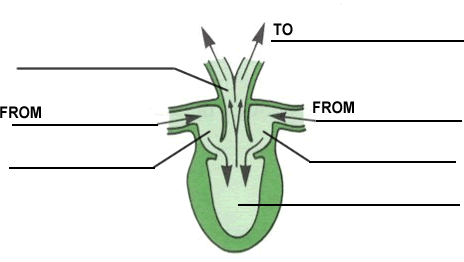
Wouldn't it be nice if the third chamber was separated into two chambers just like it is with us mammals, so that it could be more effective?
Yes, and that's the interesting part. Let's look at the animals that are slightly more advanced than amphibians: Reptiles
The hearts of reptiles work in the exact same way as those of amphibians, except for one little detail: There is an incomplete wall separating the two halves of the third chamber.

The most advanced animals are birds and mammals. These have hearts with four chambers (the workings of which I presume you understand already) that allow them to make the best use of the oxygen in their blood.
Take a look at this: http://en.wikipedia.org/wiki/Circulatory_system#Nonhuman
Looking at it like this, it becomes very obvious that our hearts have probably evolved from a simpler form to reach the form they have in this day.
As for why evolution chose that system when there could be better, more effective alternatives. This would be because evolution, is not a conscious thinking being. It doesn't choose what is best, it merely chooses in favour of what works.
Indeed, the fact that we aren't perfect suggests that we weren't made by a creator, but rather by a process in which the ones who are the best adapted survive and reproduce.
have you ever actually looked into the subject or say talked to a biologist? Or done anything to support such an ignorant provably false statement?jawakiller said:There's not enough proof to support the theory of evolution so I try to avoid conversations that assume it's a fact. To many holes too. Its worse than a George Lucas film.
Could you back those claims up with some Literature?jawakiller said:There's not enough proof to support the theory of evolution so I try to avoid conversations that assume it's a fact. To many holes too. Its worse than a George Lucas film.
OR!
Show me literature with an alternate Theory that is supported by factual studies, and not just religious Zealotry?
You can't just say "There isn't enough proof, therefore it isn't real" without presenting a counter argument as to why there isn't enough proof.
Also, there isn't enough proof to support the Theory of gravity? So should be avoid talking about that as a fact?Aurgelmir said:Could you back those claims up with some Literature?jawakiller said:There's not enough proof to support the theory of evolution so I try to avoid conversations that assume it's a fact. To many holes too. Its worse than a George Lucas film.
OR!
Show me literature with an alternate Theory that is supported by factual studies, and not just religious Zealotry?
You can't just say "There isn't enough proof, therefore it isn't real" without presenting a counter argument as to why there isn't enough proof.

Yopaz said:The weakest dies is the worst kind of view on evolution there is. Insects don't have the strength you find in most vertebrates, yet they are the rulers of the world in diversity and biomass. Counting all the ants there are more ants (in weight) than the weight of all vertebrates combined. The logic is also flawed since evolution makes the "weak" ones able to survive in various ways. It got to do with the conditions around the organism. Plants gain secondary metabolites to either make poison or look like plants that are poisonous, are they strong? No, not at all. Are they fit to survive in the selected habitat? Yes!caz105 said:It doesn't the species just dies, it's called survival of the fittest for a reason, the weakest die while the animals more suited to the environment live on and produce offspring therefore passing on its genes.
I have oversimplified it a bit but if you want more details use Google.
Dude I thought it was implied that by weak I didn't mean physically weak, but the least suited to the habitat they reside in.