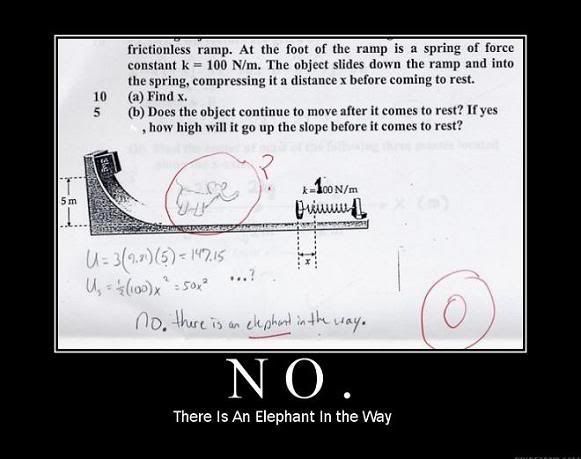
that is the best thing i have ever read, and I've read WatchmenMikeTheElf said:My favourites are actually the math/science pick-up lines:
If I were an enzyme, I'd be DNA Helicase so I could unzip your genes.

that is the best thing i have ever read, and I've read WatchmenMikeTheElf said:My favourites are actually the math/science pick-up lines:
If I were an enzyme, I'd be DNA Helicase so I could unzip your genes.

It's just an extra step to confuse you. 1/(1-.5)=2 and 2=1+.5+.25+.125+.0625 etc.MikeTheElf said:wait a sec, how does 1/(1-1/2) = 1 + 1/2 + 1/4 + 1/8...? Do I not know something or does 1/(1-1/2) not solve as 1/(1-1/2) = 1/(1/2) = 2? Or did you mean 1/((1-1)/2)? which would end in division of 0crimson5pheonix said:A pure and an applied mathematician are asked to calculate 2 * 2.
The applied mathematician's solution: We have
2 * 2 = 2 *1/(1-1/2).
The second factor on the right hand side has a geometric series expansion
1/(1-1/2) = 1 + 1/2 +1/4 + 1/8 + ....
Cutting off the series after the second term yields the approximate solution
2 * 2 = 2 *(1 +1/2) = 3.
As far as jokes go:
Photons have mass? I didn't even know they were Catholic (I think this was said earlier)
My favourites are actually the math/science pick-up lines:
If I were an enzyme, I'd be DNA Helicase so I could unzip your genes.
But wait, how can it equal 2 if the number you're adding just keeps halving? It'd only equal 2 due to rounding?crimson5pheonix said:It's just an extra step to confuse you. 1/(1-.5)=2 and 2=1+.5+.25+.125+.0625 etc.MikeTheElf said:wait a sec, how does 1/(1-1/2) = 1 + 1/2 + 1/4 + 1/8...? Do I not know something or does 1/(1-1/2) not solve as 1/(1-1/2) = 1/(1/2) = 2? Or did you mean 1/((1-1)/2)? which would end in division of 0crimson5pheonix said:A pure and an applied mathematician are asked to calculate 2 * 2.
The applied mathematician's solution: We have
2 * 2 = 2 *1/(1-1/2).
The second factor on the right hand side has a geometric series expansion
1/(1-1/2) = 1 + 1/2 +1/4 + 1/8 + ....
Cutting off the series after the second term yields the approximate solution
2 * 2 = 2 *(1 +1/2) = 3.
As far as jokes go:
Photons have mass? I didn't even know they were Catholic (I think this was said earlier)
My favourites are actually the math/science pick-up lines:
If I were an enzyme, I'd be DNA Helicase so I could unzip your genes.
MikeTheElf said:But wait, how can it equal 2 if the number you're adding just keeps halving? It'd only equal 2 due to rounding?crimson5pheonix said:It's just an extra step to confuse you. 1/(1-.5)=2 and 2=1+.5+.25+.125+.0625 etc.MikeTheElf said:wait a sec, how does 1/(1-1/2) = 1 + 1/2 + 1/4 + 1/8...? Do I not know something or does 1/(1-1/2) not solve as 1/(1-1/2) = 1/(1/2) = 2? Or did you mean 1/((1-1)/2)? which would end in division of 0crimson5pheonix said:A pure and an applied mathematician are asked to calculate 2 * 2.
The applied mathematician's solution: We have
2 * 2 = 2 *1/(1-1/2).
The second factor on the right hand side has a geometric series expansion
1/(1-1/2) = 1 + 1/2 +1/4 + 1/8 + ....
Cutting off the series after the second term yields the approximate solution
2 * 2 = 2 *(1 +1/2) = 3.
As far as jokes go:
Photons have mass? I didn't even know they were Catholic (I think this was said earlier)
My favourites are actually the math/science pick-up lines:
If I were an enzyme, I'd be DNA Helicase so I could unzip your genes.
eh, I guess lolcrimson5pheonix said:MikeTheElf said:But wait, how can it equal 2 if the number you're adding just keeps halving? It'd only equal 2 due to rounding?crimson5pheonix said:It's just an extra step to confuse you. 1/(1-.5)=2 and 2=1+.5+.25+.125+.0625 etc.MikeTheElf said:wait a sec, how does 1/(1-1/2) = 1 + 1/2 + 1/4 + 1/8...? Do I not know something or does 1/(1-1/2) not solve as 1/(1-1/2) = 1/(1/2) = 2? Or did you mean 1/((1-1)/2)? which would end in division of 0crimson5pheonix said:A pure and an applied mathematician are asked to calculate 2 * 2.
The applied mathematician's solution: We have
2 * 2 = 2 *1/(1-1/2).
The second factor on the right hand side has a geometric series expansion
1/(1-1/2) = 1 + 1/2 +1/4 + 1/8 + ....
Cutting off the series after the second term yields the approximate solution
2 * 2 = 2 *(1 +1/2) = 3.
As far as jokes go:
Photons have mass? I didn't even know they were Catholic (I think this was said earlier)
My favourites are actually the math/science pick-up lines:
If I were an enzyme, I'd be DNA Helicase so I could unzip your genes.
Yes.... Do you see the joke now?
Okay then. Lousy non-mathematicians and their not understanding simple jokes.MikeTheElf said:eh, I guess lolcrimson5pheonix said:MikeTheElf said:But wait, how can it equal 2 if the number you're adding just keeps halving? It'd only equal 2 due to rounding?crimson5pheonix said:It's just an extra step to confuse you. 1/(1-.5)=2 and 2=1+.5+.25+.125+.0625 etc.MikeTheElf said:wait a sec, how does 1/(1-1/2) = 1 + 1/2 + 1/4 + 1/8...? Do I not know something or does 1/(1-1/2) not solve as 1/(1-1/2) = 1/(1/2) = 2? Or did you mean 1/((1-1)/2)? which would end in division of 0crimson5pheonix said:A pure and an applied mathematician are asked to calculate 2 * 2.
The applied mathematician's solution: We have
2 * 2 = 2 *1/(1-1/2).
The second factor on the right hand side has a geometric series expansion
1/(1-1/2) = 1 + 1/2 +1/4 + 1/8 + ....
Cutting off the series after the second term yields the approximate solution
2 * 2 = 2 *(1 +1/2) = 3.
As far as jokes go:
Photons have mass? I didn't even know they were Catholic (I think this was said earlier)
My favourites are actually the math/science pick-up lines:
If I were an enzyme, I'd be DNA Helicase so I could unzip your genes.
Yes.... Do you see the joke now?

It actually does both.crimson5pheonix said:It cuts off the oxygen supply... Physicists, I swear.olicon said:By the way, why does water put out fire? Does it evaporate at relatively low temp so it sucks out all the energy or what?

Now excuse me, my humor array needs recharging.Ranooth said:Two atoms walk into a bar and one says "I think I've lost an electron". The other says "Are you sure?", "I'm Positive"

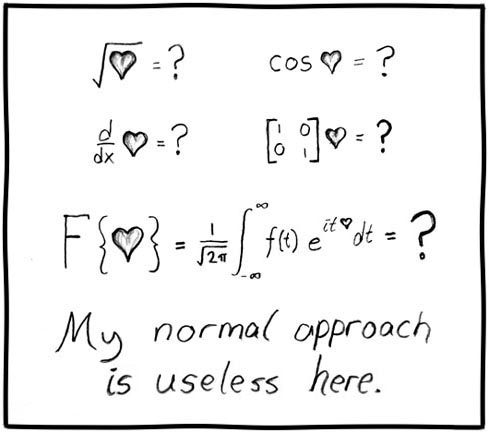
YES! WIN!Jobz said:My favorite math joke doesn't work as text, time to scour Google Images for a picture of it...
After a tedious 10 second search, I found it:


Actually, a good engineer using proper safety practices would see it as 16.666666... percent larger than it needs to be.Hunde Des Krieg said:Optimists see the glass as being half full
Pessimests see the glass as half empty
Engineers see the glass as being two times larger than it needs to be.
Tsk, tsk, tsk. Engineers... The science equivalent of Drummers.Saskwach said:Actually, a good engineer using proper safety practices would see it as 16.666666... percent larger than it needs to be.Hunde Des Krieg said:Optimists see the glass as being half full
Pessimests see the glass as half empty
Engineers see the glass as being two times larger than it needs to be.
You see, the standard safety factor for any procedure is 0.6. What this means in simple terms is that every object is made so that the worst conditions it is expected to withstand - maximum force, for instance - is only 60% of what it can hold before failure. 0.5 divided by 0.6 = 0.833333...; If you reduced the glass by 16.66666...% you'd have a glass 83.33333....% as tall as the original glass, which contains an amount of water - that we assume is the maximum it is expected to hold - that goes up to 6/10ths of its total height.
What?

Labyrinth said:Indeed.Jobz said:My favorite math joke doesn't work as text, time to scour Google Images for a picture of it...
After a tedious 10 second search, I found it:
*Snip*
YES! WIN!




more like "lousy mathematicians who don't round and their not understanding of rounding jokes"crimson5pheonix said:Okay then. Lousy non-mathematicians and their not understanding simple jokes.MikeTheElf said:eh, I guess lolcrimson5pheonix said:MikeTheElf said:But wait, how can it equal 2 if the number you're adding just keeps halving? It'd only equal 2 due to rounding?crimson5pheonix said:It's just an extra step to confuse you. 1/(1-.5)=2 and 2=1+.5+.25+.125+.0625 etc.MikeTheElf said:wait a sec, how does 1/(1-1/2) = 1 + 1/2 + 1/4 + 1/8...? Do I not know something or does 1/(1-1/2) not solve as 1/(1-1/2) = 1/(1/2) = 2? Or did you mean 1/((1-1)/2)? which would end in division of 0crimson5pheonix said:A pure and an applied mathematician are asked to calculate 2 * 2.
The applied mathematician's solution: We have
2 * 2 = 2 *1/(1-1/2).
The second factor on the right hand side has a geometric series expansion
1/(1-1/2) = 1 + 1/2 +1/4 + 1/8 + ....
Cutting off the series after the second term yields the approximate solution
2 * 2 = 2 *(1 +1/2) = 3.
As far as jokes go:
Photons have mass? I didn't even know they were Catholic (I think this was said earlier)
My favourites are actually the math/science pick-up lines:
If I were an enzyme, I'd be DNA Helicase so I could unzip your genes.
Yes.... Do you see the joke now?